• KGS/USD = 0.01144 0%
  • KZT/USD = 0.00216 0%
  • TJS/USD = 0.10663 0%
  • UZS/USD = 0.00008 0%
  • TMT/USD = 0.28530 0%
  • KGS/USD = 0.01144 0%
  • KZT/USD = 0.00216 0%
  • TJS/USD = 0.10663 0%
  • UZS/USD = 0.00008 0%
  • TMT/USD = 0.28530 0%
  • KGS/USD = 0.01144 0%
  • KZT/USD = 0.00216 0%
  • TJS/USD = 0.10663 0%
  • UZS/USD = 0.00008 0%
  • TMT/USD = 0.28530 0%
  • KGS/USD = 0.01144 0%
  • KZT/USD = 0.00216 0%
  • TJS/USD = 0.10663 0%
  • UZS/USD = 0.00008 0%
  • TMT/USD = 0.28530 0%
  • KGS/USD = 0.01144 0%
  • KZT/USD = 0.00216 0%
  • TJS/USD = 0.10663 0%
  • UZS/USD = 0.00008 0%
  • TMT/USD = 0.28530 0%
  • KGS/USD = 0.01144 0%
  • KZT/USD = 0.00216 0%
  • TJS/USD = 0.10663 0%
  • UZS/USD = 0.00008 0%
  • TMT/USD = 0.28530 0%
  • KGS/USD = 0.01144 0%
  • KZT/USD = 0.00216 0%
  • TJS/USD = 0.10663 0%
  • UZS/USD = 0.00008 0%
  • TMT/USD = 0.28530 0%
  • KGS/USD = 0.01144 0%
  • KZT/USD = 0.00216 0%
  • TJS/USD = 0.10663 0%
  • UZS/USD = 0.00008 0%
  • TMT/USD = 0.28530 0%

Viewing results 1 - 6 of 8

Kazakhstan and Azerbaijan Are Reinforcing the Middle Corridor’s South Caucasus Link

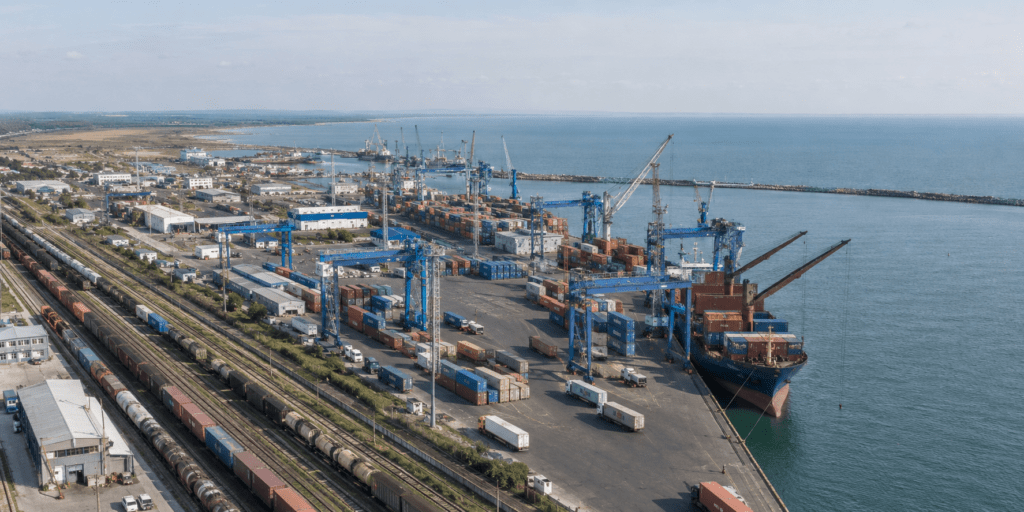
On April 7 Kazakhstan’s Foreign Minister Yermek Kosherbayev visited Tbilisi to hold talks with Georgian Foreign Minister Maka Bochorishvili and sign a 2026–2027 foreign-ministry cooperation program. He called Georgia “a key link” in the Europe–Asia transport architecture and said the common task was to raise corridor capacity, improve service predictability, and ensure tariff transparency. The materialization of the bilateral cooperation is already evident from last June’s opening of the Poti multimodal terminal by a joint Kazakhstani-Georgian company. The real meaning of Kosherbayev's discussions in Tbilisi lies in their context. On April 2 in Baku, Prime Minister Olzhas Bektenov said Kazakhstan plans an intergovernmental agreement with Azerbaijan this year to strengthen the status of the Middle Corridor (also known as the Trans-Caspian International Transport Corridor, TITR), and he proposed moving quickly on the Digital Monitoring Center under the Organization of Turkic States (OTS). On April 6 in Tbilisi, Azerbaijani President Ilham Aliyev called the Azerbaijan–Georgia segment the corridor’s “main transport artery.” Then on April 8 in Baku, Aliyev received Kosherbayev together with Kazakhstan’s transport minister. The official readout ranged from the Middle Corridor to joint investment, green-energy, and fiber-optic projects. Kosherbayev’s April 7 stop in Tbilisi thus belongs to a short Kazakhstan-led diplomatic run across the corridor’s western nodes. Kazakhstan and Azerbaijan Tighten the Corridor Kazakhstan’s early-April engagement in the South Caucasus rests on its eastward-looking framework with China. Two China–Kazakhstan documents were already in evidence in October 2023: a Memorandum of Understanding (MoU) on deepening the development of the China-Europe Railway Trans-Caspian route, and an intergovernmental agreement on developing that route. China’s National Development and Reform Commission (NDRC) subsequently clarified that the agreement focused on stronger transit organization, fewer administrative barriers, and improved logistics and transport operations. In July 2024, Kazakhstan’s President Kassym-Jomart Tokayev and his Chinese counterpart Xi Jinping jointly attended the opening of the Trans-Caspian direct fast transport service; NDRC then recorded a work mechanism with Kazakhstan’s transport ministry to carry that cooperation forward. On January 1, the first Trans-Caspian train of 2026 departed Xi’an for Baku carrying 45 containers of photovoltaic equipment. Chinese reports assert that the route had accumulated 466 runs by the end of November 2025, moved onto a weekly six-outbound and three-inbound timetable, and cut travel times from the roughly 20-day average recorded in 2025 to a standard 15 days, with the fastest runs taking 11 days. On April 3, it was also reported that there were 85 Xi’an Trans-Caspian trains in the first quarter of 2026, up 150% year-on-year, while the Kazakhstan–Xi’an terminal in Almaty handled more than 6,000 containers in that quarter alone, a 60% increase from a year earlier. A separate quasi-official Chinese trade-services portal reported that Trans-Caspian trains had reached daily service and that 371 such trains had run in January–October 2025, up 33%. China’s NDRC also said in late 2025 that Aktau and Baku should be strengthened as hub nodes in this corridor system. Azerbaijan is the indispensable partner without which the route’s western logic does not function. Bektenov’s...

Georgia May Replace Russian Oil with Imports from Turkmenistan and Kazakhstan

Georgia’s only oil refinery, owned by Black Sea Petroleum (BSP), plans to completely stop importing Russian oil and instead switch to crude supplies from Turkmenistan and, potentially, Kazakhstan. This was announced by the company’s CEO, David Potskhveria. According to Potskhveria, the shift would not only diversify supply sources but also open access to European markets. “We will completely replace Russian oil with Turkmen oil, and then with Kazakhstani oil. This will give us the opportunity to export products to the EU,” he said. The rationale is straightforward: imports of Russian petroleum products into the European Union are currently prohibited. Maintaining previous supply arrangements would effectively block access to European markets. However, switching suppliers presents logistical challenges. As Potskhveria noted, processing of Turkmen crude can begin only after transit issues through Azerbaijan are resolved. For now, logistics remain the main bottleneck. While the refinery is technically ready, implementation depends on securing reliable transport routes. The proposed move away from Russian oil follows earlier developments. In late February, the EU considered including the Kulevi port on a preliminary sanctions list due to its import and processing of Russian crude. The trigger was a shipment delivered in October 2025 by Russneft, involving approximately 105,000 tons of oil to the port of Kulevi. The shipment prompted criticism from the Georgian opposition, which accused the authorities of undermining the sanctions regime and appealed to European institutions. The Kulevi refinery is a relatively new entrant to the regional oil market. It began operations in December last year and has already outlined expansion plans. Its current processing capacity is around 1.2 million tons per year, with plans to increase this to 4.5 million tons. At present, the facility produces fuel oil, diesel, and other petroleum products. Future plans include expanding output to Euro-5 standard gasoline, jet fuel, and Eurodiesel. BSP’s international partners reportedly include Trafigura and Saudi Aramco.

New round of talks in Georgia

TBILISI (TCA) — On December 20, 2019 Georgian authorities made a new proposal to the opposition on the electoral reform, in order to stabilize the situation. But opposition has rejected this proposal as too rigid. "Georgia is going to fall into an international isolation if the government would not agree to the principle of fair elections," declared the statement by the so called United Opposition. The authorities have proposed the system that would have 100 members of the parliament elected on the proportional system and 50 members on the majoritarian system. So the system would be changed — with two thirds elected by proportionate system, while maintaining the mixed system with one third majoritarians. According to this proposal these constitutional changes would be made not just for the year of 2020, but for good. And this proposal is absolutely unacceptable for the opposition at this point. The initiative by the ruling coalition was voiced by Chairman of the Parliament, Archil Talakvadze. Continue reading

Georgia’s precarious state

TBILISI (TCA) — According to former EU and US Ambassadors to Georgia Denis Corboy, William Courtney, and Kenneth Yalowitz "Georgia’s status as a post-Soviet democratic leader is under challenge. A flawed presidential election, use of force against protesters, and political manipulations by the secretive billionaire who heads the ruling Georgian Dream Party have strained public confidence and brought mounting public protests. Domestic calm may hinge on improving political dialogue and conducting free and fair parliamentary elections in fall, 2020. Continue reading