• KGS/USD = 0.01144 0%
  • KZT/USD = 0.00200 0%
  • TJS/USD = 0.10475 -0.19%
  • UZS/USD = 0.00008 0%
  • TMT/USD = 0.28490 0%
  • KGS/USD = 0.01144 0%
  • KZT/USD = 0.00200 0%
  • TJS/USD = 0.10475 -0.19%
  • UZS/USD = 0.00008 0%
  • TMT/USD = 0.28490 0%
  • KGS/USD = 0.01144 0%
  • KZT/USD = 0.00200 0%
  • TJS/USD = 0.10475 -0.19%
  • UZS/USD = 0.00008 0%
  • TMT/USD = 0.28490 0%
  • KGS/USD = 0.01144 0%
  • KZT/USD = 0.00200 0%
  • TJS/USD = 0.10475 -0.19%
  • UZS/USD = 0.00008 0%
  • TMT/USD = 0.28490 0%
  • KGS/USD = 0.01144 0%
  • KZT/USD = 0.00200 0%
  • TJS/USD = 0.10475 -0.19%
  • UZS/USD = 0.00008 0%
  • TMT/USD = 0.28490 0%
  • KGS/USD = 0.01144 0%
  • KZT/USD = 0.00200 0%
  • TJS/USD = 0.10475 -0.19%
  • UZS/USD = 0.00008 0%
  • TMT/USD = 0.28490 0%
  • KGS/USD = 0.01144 0%
  • KZT/USD = 0.00200 0%
  • TJS/USD = 0.10475 -0.19%
  • UZS/USD = 0.00008 0%
  • TMT/USD = 0.28490 0%
  • KGS/USD = 0.01144 0%
  • KZT/USD = 0.00200 0%
  • TJS/USD = 0.10475 -0.19%
  • UZS/USD = 0.00008 0%
  • TMT/USD = 0.28490 0%

Viewing results 1 - 6 of 72

German Firm to Build New Cargo and Passenger Airport in Kazakhstan

Kazakhstan’s Prime Minister, Olzhas Bektenov, has met with Dr. Christine Grötzbach, board member and co-founder of the German aviation company Skyhansa, to finalize the construction timeline for a new cargo and passenger airport in the Zhetysu region. The first phase of the project is expected to be completed by 2027. The facility will be built within the Khorgos - Eastern Gate special economic zone (SEZ), located on Kazakhstan’s border with China. The project envisions the creation of a multifunctional aviation hub designed to meet ICAO international standards and will be developed in phases, according to a government announcement. The initiative is being carried out under a framework agreement between Kazakhstan’s Ministry of Transport and the Kazakh-German consortium Skyhansa. On the German side, the project is led by the Hansa Consortium, an aviation infrastructure specialist, while the Kazakh side is represented by Skymax Technologies, a regional logistics and infrastructure operator active in Central Asia and the Caucasus. The total investment in the airport project is projected at $500 million. Dr. Grötzbach emphasized that the vision extends far beyond a standard airport facility. “We are creating not just an airport, but a comprehensive infrastructure: cargo and passenger terminals, a fuel and refueling complex, an aviation technical center, a business center, and hotels,” she stated. “Its strategic location near China, combined with access to rail and road transport, positions it as a key logistics node on the New Silk Road.” Bektenov echoed this sentiment, stating that the project will significantly enhance Kazakhstan’s transport and logistics capabilities. “The implementation of this project will give a powerful impetus to the development of transport infrastructure and reinforce Kazakhstan’s role as a bridge between China, Central Asia, and Europe,” he said. This announcement follows a similar initiative by Kazakhstan’s Ministry of Transport, which recently signed an investment agreement with Terminals Astana Airport Limited, a subsidiary of a UAE-based holding company. That project involves a $1.1 billion investment in the development of the Astana Aerotropolis, as reported by The Times of Central Asia.
Uzbekistan and Germany Partner on Green Industrialization with €3 Million Grant

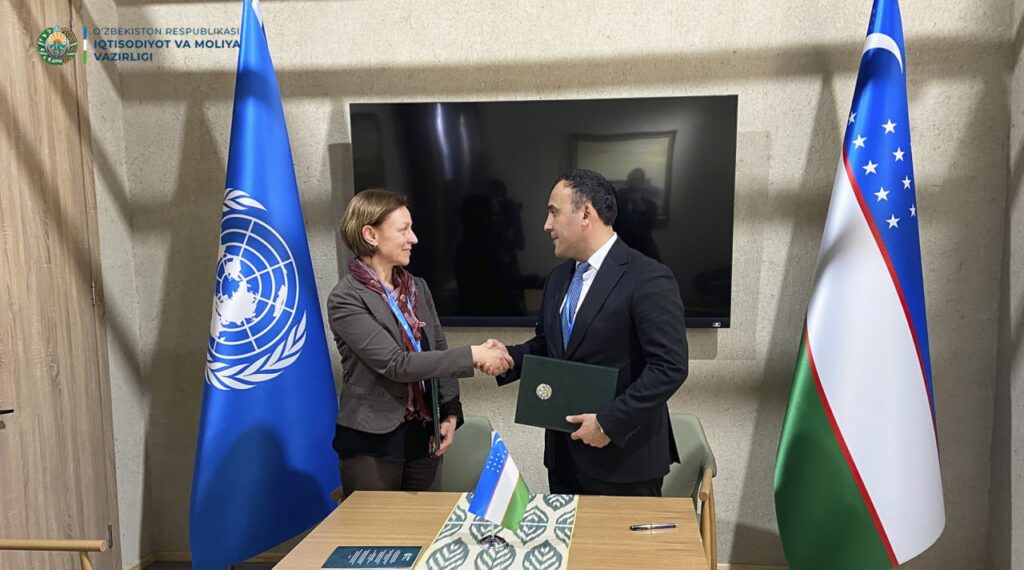
On November 13, at the 29th UN Climate Change Conference (COP29) in Azerbaijan's capital Baku, Uzbekistan's Ministry of Economy and Finance signed a memorandum with the German International Cooperation Society (GIZ) to secure additional funding for a project aimed at supporting the private sector in green industrialization. As part of the initiative, Germany has allocated €9 million to help Uzbekistan’s private sector transition to a green economy. The project is designed to assist the Uzbek government in implementing economic reforms and fostering sustainable economic development, focusing on enhancing the capacity of both the public and private sectors to adopt green industrialization practices. The initiative will also provide technical expertise in measuring and certifying greenhouse gas emissions, supporting Uzbekistan’s participation in international carbon trading mechanisms, and aligning with the European Union’s Cross-Border Adjustment Mechanism (CBAM). Additionally, it aims to promote resource-saving and sustainable production by encouraging the private sector to adopt green technologies, including circular economy practices and green industrial park models. To further bolster the project, a €3 million grant was approved during the conference. This funding will complement the ongoing initiative, titled “Support to the Private Sector and Advice on Economic Policy in Uzbekistan.”

Germany Deports Tajik Political Activist Dilmurod Ergashev

Germany has decided to deport Dilmurod Ergashev, a political activist and member of the Movement for Reforms and Development of Tajikistan, who had applied for asylum in Germany. This is despite requests from international human rights organizations such as Human Rights Watch and the Helsinki Committee not to deport Ergashev because of the risk of him being tortured in Tajikistan. Friends of the activist said Ergashev was told to report to the deportation center and prepare to leave. The activist, who has lived in Germany for the past 13 years, was detained in the town of Kleve on October 28 and taken to the administrative court, where his deportation was ordered. According to associates, the court should have considered that another administrative court was still considering Ergashev's application for political asylum. Sharofiddin Gadoev, leader of the Movement for Reforms and Development, confirmed that the deportation process has already begun. Ergashev is likely to be sent back to Tajikistan on November 6. “The decision to deport Ergashev strengthens the authoritarian system in Tajikistan and increases fear among political activists,” Gadoev said. He said there may be an agreement between Germany and Tajikistan to deport activists forcibly. Ergashev's lawyer has filed an appeal with the Supreme Court but is unavailable for comment. Dozens of Tajik citizens have moved to Europe in recent years, many of whom disagree with their country's policies. Germany has previously deported activists such as Abdullo Shamsiddin and Bilol Kurbonaliev, who were sentenced to long prison terms upon their return home. Also extradited from Austria to Tajikistan in 2020 was Hizbullo Shovalizoda, a member of the banned Islamic Renaissance Party of Tajikistan. He has been sentenced to 20 years in prison.

Germany Closes Money Laundering Case Against Uzbek-Russian Billionaire Usmanov

The Frankfurt Prosecutor’s Office has completed its money laundering investigation against Uzbek-Russian businessman Alisher Usmanov. The case was settled on October 11, 2024, when Usmanov agreed to pay 1.5 million euros to non-profit organizations and 2.5 million euros to the German treasury. When these payments are completed, the case will be completely closed. Prosecutors say the alleged actions in question occurred long ago and did not cause financial damage in Germany. This decision was made under section 153a of the German Criminal Procedure Code, which allows cases to be dropped if the crime is minor and prosecution isn’t in the public interest. Usmanov’s lawyers praised the result, calling it a step towards restoring his reputation. They noted that the investigation found no evidence to support money laundering charges. Usmanov has now decided not to file a counter lawsuit against prosecutors or demand damages. In 2022, a Frankfurt court deemed the searches of properties linked to Usmanov in Germany illegal, and all seized items were ordered to be returned. However, in 2023, the German Constitutional Court declined Usmanov’s complaint over the searches, stating that he had not exhausted all legal options before filing the complaint. Previously, The Times of Central Asia reported that the news from the Hamburg court about Usmanov as broadcast by the German TV channel ARD was found to be unreliable. ARD accused Usmanov of creating a system of bribing International Fencing Federation (FIE) judges. According to the report, the court found the information published by the ARD channel unreliable and banned its distribution as “inappropriate news based on suspicion.” If the court order is violated, the party found to be in violation can be fined up to 250,000 euros per episode or face imprisonment.

Rahmon Invites German Chancellor to Cooperate on Rogun HPP

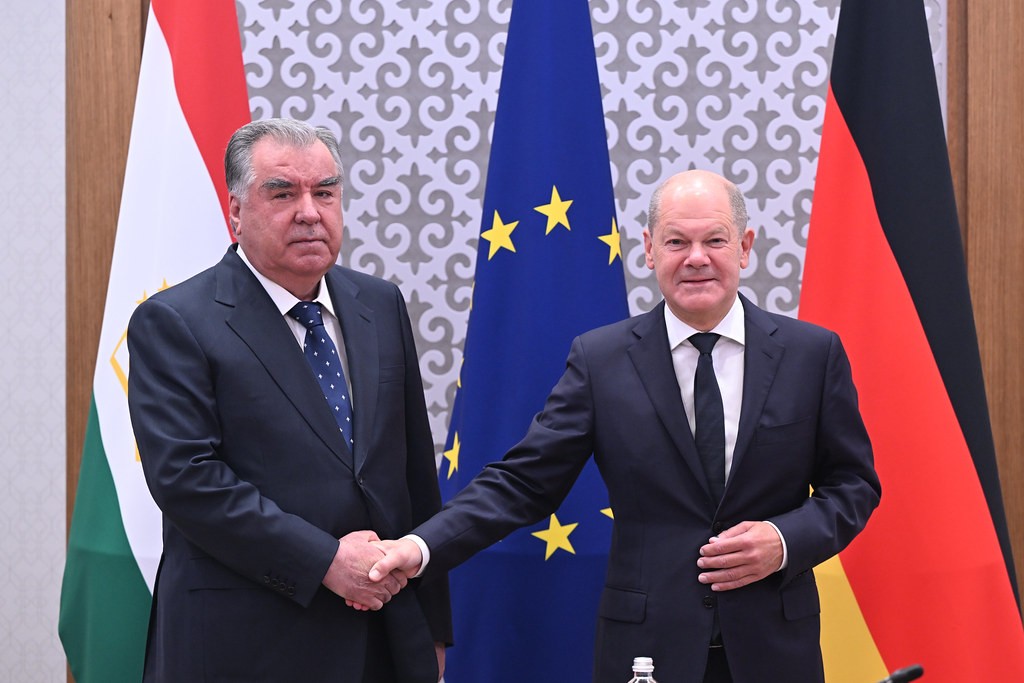
During the summit of Central Asian countries and Germany on September 17 in Astana, Tajik President Emomali Rahmon spoke with German Chancellor Olaf Scholz on expanding Tajikistan’s cooperation with Germany and furthering Germany's business interests in the country. The president noted the significant contribution made by the German Society for International Cooperation and the German Development Bank to Tajikistan's implementation of its national strategies. With regard to future projects, the parties discussed developing effective cooperation in economy and trade, industry, hydropower, solar and wind energy, transport, and agriculture. The two leasers also exchanged views on mining and processing minerals and scarce earth metals, the expansion of bilateral cooperation in industry and agriculture, and the prospects of exporting products from Tajikistan to Germany. Talks also covered global problems related to drinking water, melting glaciers, climate change, and food security. Olaf Scholz confirmed Germany's interest in cooperating with Tajikistan in energy fields, including hydropower and other green energy sources, mining, environmental protection, and security, and emphasized,   “we encourage cooperation with Tajikistan to global German companies." According to the president's press service, Emomali Rahmon recalled Germany’s contribution to the construction of the Tajikistan and Sebzor power plants in Badakhshan and the modernization of the Nurek hydroelectric power plant. Looking ahead, the president expressed confidence that such cooperation could continue on the Rogun power plant. The estimated  cost of completing the construction of the Rogun HPP is $6.4 billion, and when fully operational, about 70% of the electricity produced will be exported to other Central Asian countries. The meeting closed with Rahmon inviting Scholz to come to Tajikistan on an official visit.

Kazakhstan Hosts Summit of Central Asian Countries and Germany

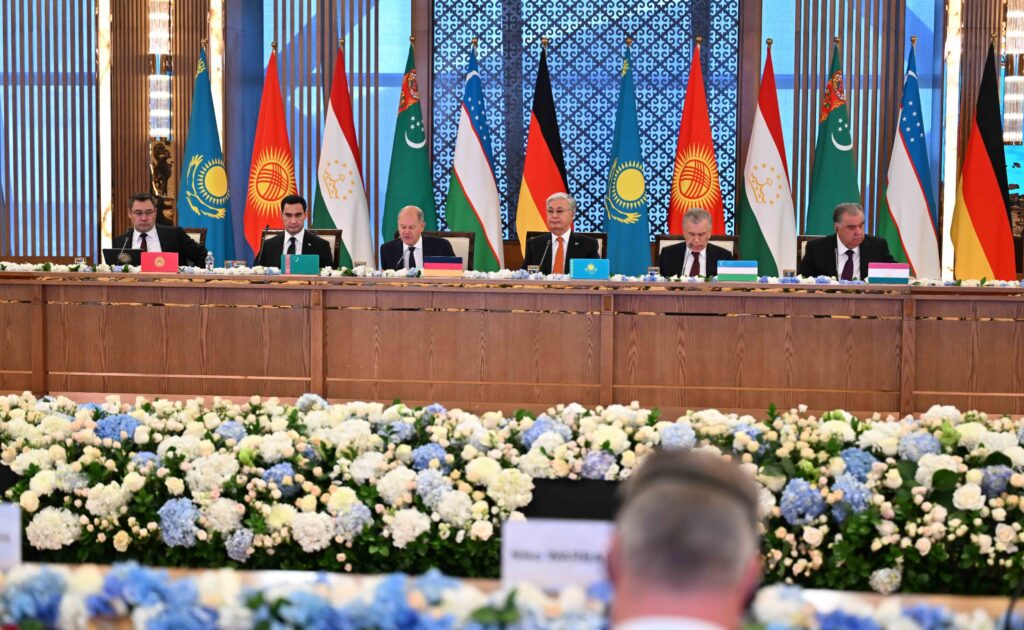
Opening the summit in Astana, Kazakh President Kassym-Jomart Tokayev expressed gratitude to Federal Chancellor Olaf Scholz and Central Asian leaders for their participation and support of regional cooperation. Noting the strengthened relationship following the high-level dialog launched in Berlin last September, he stated, “I believe this is evidence of interest and aspiration from the Central Asian states and Germany for comprehensive development of strategic partnerships. Our meeting is called to summarize joint work and outline new ways to deepen cooperation. Today, we will discuss important trade, investment, energy, ecology, transportation and logistics, education, and science issues. I am confident that our constructive discussions will lead to concrete solutions that will benefit all our countries.” According to the President of Kazakhstan, Germany's socio-economic, scientific, and technological progress is an example for many countries. The positive impact of German technologies and investments in various spheres of the economy cannot be overestimated. Hence, full-scale partnership with Germany, one of the world's most developed countries and the largest economy in the European Union, is a priority for Kazakhstan and other Central Asian states. The most promising areas of cooperation between Central Asian states and Germany include increasing trade turnover, cooperation in the energy sector, development of industrial cooperation, transportation and logistics interconnection, and development of scientific and educational ties. With reference to the above, Tokayev stated: “Wide investment prospects are opened by the development of the Middle Corridor, including the modernization and digitalization of the Caspian Sea ports and construction of cargo terminals. Further integration of Central Asian and European transportation and logistics systems remains urgent. Kazakhstan welcomes the decision of European partners to allocate 10 billion euros under the Global Gateway program for the development of the Middle Corridor. We count on Germany's assistance connecting this route with the Trans-European Transport Network (TEN-T) and the Global Gateway strategy." Citing the need for sustained focus on strengthening and ensuring international security and stability,  Tokayev then emphasized: “Our countries closely cooperate in a multilateral format, including within the framework of the United Nations. We intend to continue to strongly support the efforts of this non-alternative universal Organization in the fight against terrorism, extremism, illegal migration, climate change, peacekeeping, and disarmament. Kazakhstan is ready to participate in the UN reform process. We believe that several developed countries, including Germany, certainly deserve a place as permanent members of the UN Security Council. I want to take this opportunity to wish the Kyrgyz Republic success in promoting its candidacy for the post of a non-permanent member of the UN Security Council for 2027-2028. I am confident that Kyrgyzstan will be able to significantly contribute to strengthening stability and security in Central Asia and beyond." Following speeches by Federal Chancellor of Germany Olaf Scholz, President of Kyrgyzstan Sadyr Japarov, President of Tajikistan Emomali Rahmon, President of Turkmenistan Serdar Berdimuhamedov and President of Uzbekistan Shavkat Mirziyoyev, a Joint Declaration was adopted by the Heads of the Central Asian states and the Federal Chancellor of Germany.