• KGS/USD = 0.01144 0%
  • KZT/USD = 0.00201 0%
  • TJS/USD = 0.10475 0%
  • UZS/USD = 0.00008 0%
  • TMT/USD = 0.28571 0%
  • KGS/USD = 0.01144 0%
  • KZT/USD = 0.00201 0%
  • TJS/USD = 0.10475 0%
  • UZS/USD = 0.00008 0%
  • TMT/USD = 0.28571 0%
  • KGS/USD = 0.01144 0%
  • KZT/USD = 0.00201 0%
  • TJS/USD = 0.10475 0%
  • UZS/USD = 0.00008 0%
  • TMT/USD = 0.28571 0%
  • KGS/USD = 0.01144 0%
  • KZT/USD = 0.00201 0%
  • TJS/USD = 0.10475 0%
  • UZS/USD = 0.00008 0%
  • TMT/USD = 0.28571 0%
  • KGS/USD = 0.01144 0%
  • KZT/USD = 0.00201 0%
  • TJS/USD = 0.10475 0%
  • UZS/USD = 0.00008 0%
  • TMT/USD = 0.28571 0%
  • KGS/USD = 0.01144 0%
  • KZT/USD = 0.00201 0%
  • TJS/USD = 0.10475 0%
  • UZS/USD = 0.00008 0%
  • TMT/USD = 0.28571 0%
  • KGS/USD = 0.01144 0%
  • KZT/USD = 0.00201 0%
  • TJS/USD = 0.10475 0%
  • UZS/USD = 0.00008 0%
  • TMT/USD = 0.28571 0%
  • KGS/USD = 0.01144 0%
  • KZT/USD = 0.00201 0%
  • TJS/USD = 0.10475 0%
  • UZS/USD = 0.00008 0%
  • TMT/USD = 0.28571 0%

Viewing results 1 - 6 of 6

“Be a Man”: Bishkek Vice Mayor Detained in Public Showdown

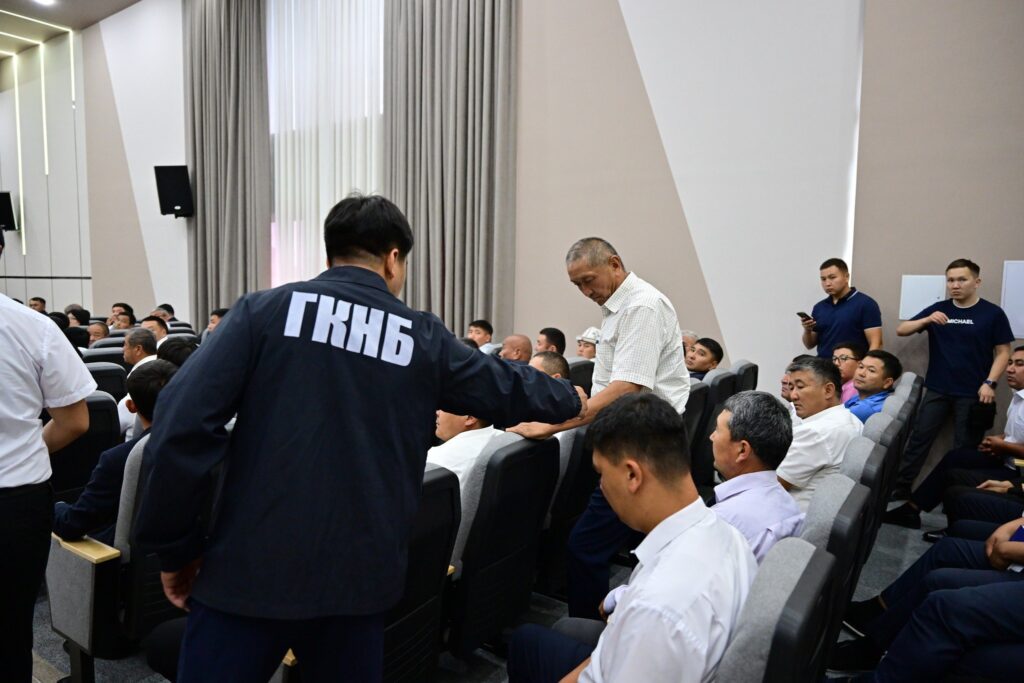
The Vice Mayor of Bishkek, Zhamalbek Yrsaliev, has been detained during a public meeting in the Tunguch neighborhood, presided over by Kamchybek Tashiyev, the controversial Chairman of Kyrgyzstan’s State Committee for National Security (GKNB). Residents at the July 16 meeting accused Yrsaliev of illegally occupying a 1,500 m² municipal land plot where unauthorized commercial kiosks and children's attractions had been operating for six years without any lease payments. According to Economist.kg, this misuse cost the city budget over 2.9 million Kyrgyz som ($33,160), and stalled the planned development of a public square and playground. During the meeting, Tashiyev confronted Yrsaliev directly. In a moment caught on video, he told the vice mayor to take responsibility for his actions and “Be a man,” ordering the security services to detain him immediately. Officers escorted Yrsaliev from the event to the GKNB headquarters. According to Sputnik Kyrgyzstan, Yrsaliev admitted responsibility and apologized, but Tashiyev continued to reprimand him, telling Yrsaliev, “You will not deceive the people.” The investigation is ongoing. The charges against Yrsaliev include abuse of office and corruption. Alongside him, officials from the Lenin and Oktyabr district administrations were also detained during the same operation, according to preliminary reports. Appointed as vice mayor in May 2024, Yrsaliev previously served as vice-mayor of Bishkek for housing and communal services, and akim of the Pervomaisky district. The arrest marks another chapter in Kyrgyzstan’s sweeping anti-corruption campaign under President Sadyr Japarov. In January 2023, former Deputy Prime Minister Zhenish Razakov was detained on suspicion of a $1 million fraud and abuse of office, and in December 2024, the authorities arrested the head of the state tax service and his deputy. While Yrsaliev’s detention has been officially framed as part of an anti-corruption effort, it unfolds within a broader political climate in Kyrgyzstan marked by increasing executive consolidation and the expanded role of the GKNB in domestic affairs. Independent watchdogs, including Freedom House, have noted a rise in politically motivated prosecutions and diminished judicial independence in recent years, raising concerns that cases such as this may serve not only legal but also political purposes. Further updates are expected as the investigation continues.
Kyrgyz Anti-Corruption Crackdown: Officials Arrested During Live Meeting in Osh

Several officials were arrested during a high-level government meeting in the southern Kyrgyz city of Osh, as part of an ongoing anti-corruption campaign led by the State Committee for National Security (GKNB). Kamchybek Tashiev, chairman of the GKNB, ordered the arrests during a gathering with the heads of state agencies. Six civil servants were detained on the spot after Tashiev accused them of embezzling state funds and providing false information. Among those taken into custody were the head of the Tax Service in the Uzgen district and the deputy head of the Tax Service in the Kara-Suu district. “Take him out, he’s lying!” Tashiev said, pointing to the deputy head of the Kara-Suu Tax Inspectorate. He also stated that the head of the service had already been transferred to the GKNB’s central office in Bishkek for interrogation. The detentions extended beyond the tax authorities. According to local media reports, two employees from the Cadastral Service in the Nookat district, a representative of the judiciary, and a passport office staff member in Uzgen were also arrested. All face allegations of corruption and misappropriation of public funds. These events in Osh follow a series of high-profile detentions in northern Kyrgyzstan. Over the past month, at least three mayors and several senior officials have been arrested in the Chui and Issyk-Kul regions. They are accused of abuse of office, illicit enrichment, and orchestrating corruption networks. During the meeting, Tashiev reiterated the GKNB’s commitment to combating corruption at all levels of government. He referenced the arrest of former State Tax Service head Altynbek Abduvapov in late 2024 as a prominent example. Investigators claim Abduvapov accumulated approximately $55 million in assets through illegal means. “He never had a business of his own. Employees say they gave him bribes ranging from $50,000 to $100,000 every month. We are confiscating everything. Altynbek Abduvapov will now be a poor man,” Tashiev declared. Political analysts suggest the crackdown indicates both an intensification of anti-corruption efforts and a recalibration of power dynamics between Kyrgyzstan’s northern and southern regions. While critics have accused the authorities of selective justice, GKNB officials maintain that the arrests are supported by solid evidence and reveal systemic governance failures.

Kyrgyz Transport Minister Wears Camouflage Following Rebuke by State Security Chief

Kyrgyzstan’s Minister of Transport and Communications, Absattyr Syrgabaev, was seen wearing camouflage during a recent site inspection, days after facing public criticism from Kamchybek Tashiev, head of the State Committee for National Security (GKNB) and deputy chairman of the Cabinet. The incident took place during a working visit to the Jalal-Abad region. Tashiev’s reprimand was sparked by the poor condition of a local maternity hospital. He criticized hospital staff for neglecting basic maintenance, including watering trees and keeping the grounds tidy. “Is it really impossible to water them? Why do I have to come here and talk about this?” Tashiev said during the visit. Turning his attention to Syrgabaev, Tashiev accused the minister of ignoring broader infrastructure responsibilities beyond road construction. He urged Syrgabaev to change his appearance to reflect a more hands-on approach. “Until November, don’t wear a suit. Wear camouflage like me and work until nightfall. In winter, you can go back to suits. Otherwise, you’ll keep showing up in Naryn and Ton in business attire. You have to work! Do you hear me?” Tashiev said at a government meeting in Jalal-Abad. Demands for Constant Work Tashiev also directed harsh criticism at regional governors (akims) and other civil servants, insisting they work “around the clock without days off.” He emphasized that every official must act as a “strong manager.” “Stop working one day and resting two!” he demanded. Shortly after these remarks, Syrgabaev appeared in camouflage during a road reconstruction inspection in the Suusamyr Valley, aligning with Tashiev’s directive. The appearance drew attention from local media outlets. Context of Political Pressure This is not the first time Syrgabaev has come under scrutiny. In May 2025, Tashiev gave him a one-month deadline to complete the Balykchy to Cholpon-Ata highway. While the road was completed on time, unfinished sidewalks led to a “final warning” for the minister. A year earlier, he had been criticized for delays in constructing a bridge over the Ala-Archa River in Bishkek. The backdrop of heightened scrutiny comes amid ongoing corruption investigations. In recent months, authorities have arrested the mayors of Tokmok and Kara-Balta, the deputy mayor of Bishkek, and several contractors. In this climate, Tashiev’s public remarks are increasingly viewed as informal mandates, reflecting his growing influence within Kyrgyzstan’s state apparatus.

Kyrgyz Authorities Step Up Pressure on Kloop: Searches, Arrests, and International Outcry

In late May, Kyrgyz security forces conducted coordinated raids on the homes of eight current and former employees of the independent media outlet Kloop. Operatives from the State Committee for National Security (GKNB) simultaneously entered apartments in Bishkek and Osh. Video journalist Alexander Alexandrov and former cameraman Joomart Duulatov were detained and remain in custody on charges of “public calls for mass unrest” under Article 278 of the Criminal Code. The other six individuals were released after hours of interrogation but were compelled to sign non-disclosure agreements. According to Kloop’s editorial staff, five minutes before the raids began, the outlet received an anonymous email with the subject line: “You have crossed the line.” The incident drew swift condemnation from human rights groups. The Committee to Protect Journalists (CPJ) demanded an immediate end to what it described as persecution, while other international organizations called for the charges to be dropped. From Student Project to Investigative Powerhouse Founded in 2007 by journalists Bektur Iskender and Rinat Tukhvatushin, Kloop began as a training platform for aspiring reporters. The outlet gained prominence during its around-the-clock reporting on the 2010 uprising. It later evolved into a leading investigative publication, exposing high-profile cases such as the 2017 “Samaragate” voter data scandal and the 2019 financial network linked to customs official Raiymbek Matraimov. Despite legal threats, including lawsuits from the Matraimov family that were later withdrawn, Kloop’s reporting bolstered its credibility and amplified its visibility, making it increasingly unwelcome in official circles. Escalating Crackdown Tensions escalated in August 2023 when the Bishkek Prosecutor’s Office filed a lawsuit to dissolve the Kloop Media Foundation, accusing it of “negative coverage of government activities.” The Oktyabrsky District Court approved the request in February 2024, and the Supreme Court upheld the decision that July in a closed session. The ruling remained classified for a month. The Ministry of Culture subsequently ordered Kloop’s website to be blocked within Kyrgyzstan, despite assurances that the foundation’s removal from the official register would not impede freedom of expression. In response, the editorial team relocated servers abroad and registered a new legal entity. Nevertheless, the authorities resumed the pressure in January 2024 with searches targeting other independent outlets, including Temirov Live and 24.kg. By May, the security forces were back at Kloop. The investigation now alleges that Kloop continued to operate illegally post-liquidation, publishing materials purportedly aimed at “inciting public discontent.” This echoes the case against Temirov Live, where several journalists were imprisoned, including director Makhabat Tazhibek Kyzy, who is serving a six-year sentence. Human rights advocates argue the charges are part of a broader strategy to criminalize dissent. International Reactions The arrests have provoked international condemnation. Amnesty International, Human Rights Watch, Civil Rights Defenders, and Reporters Without Borders were among more than a dozen NGOs that issued a joint statement decrying a “new wave of repression” threatening the future of independent journalism in Kyrgyzstan. The statement urged the immediate release of detained journalists and called on international partners, particularly the European Union, to adopt a...

Kyrgyz Security Forces Warn Officials of Prosecution Over Inefficiency

The State Committee for National Security (GKNB) of Kyrgyzstan has issued a stern warning to municipal officials in Bishkek, threatening criminal prosecution for negligence and ineffective performance of official duties. The warning came during a meeting initiated by the GKNB and held at Bishkek City Hall. All heads of the capital’s territorial divisions were present. Officials were instructed to take a more responsible approach to their work, particularly regarding urban development, social services, and the responsible use of public funds. “All heads of local authorities are advised to draw their own conclusions so that their future activities will only benefit society and not cause harm,” stated Kamchybek Tashiev, head of the GKNB. Tashiev also criticized the procurement of cheap, low-quality goods through public tenders, emphasizing that quality and efficiency, not just cost, should guide spending decisions. The crackdown follows the high-profile arrest of Tokmok Mayor Maksat Nusuvaliyev, a move seen by analysts as a stark signal from the central government to regional administrations. Nusuvaliyev was detained during a similar meeting with Tashiev in Tokmok, in full view of his subordinates. He faces charges of corruption and misappropriation of funds intended for the construction of a sports school and a cultural park. His arrest followed complaints from local residents and concerns from central authorities over delays and inefficiencies in the projects. The government had previously allocated approximately $12 million for Tokmok’s urban improvement. However, President Sadyr Japarov later stated that the funds had yielded no tangible results. Along with Nusuvaliyev, two other officials and the head of the construction company overseeing the projects were also detained. A court has ordered that all four be held in pretrial detention for two months. Footage of the mayor’s detention was widely circulated online, further fueling public attention. In response to the scandal, Tashiev demanded immediate accountability from other local officials. They were given three days to either recommit to fulfilling their duties or resign voluntarily. In a striking directive aimed at reconnecting officials with local issues, Tashiev also ordered administrators in the Chui region to travel on foot through their districts to observe municipal problems firsthand.

Kyrgyz Special Forces Showcase Combat Drone Capabilities in Anti-Terror Exercise

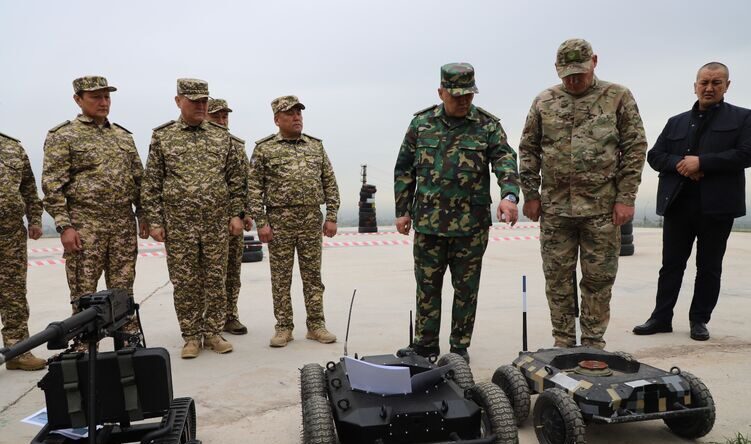
Kyrgyzstan’s elite State Committee for National Security (GKNB) special forces unit, Alpha, demonstrated advanced combat capabilities during the Asman Kozomolu 2025 anti-terrorist exercises, held to enhance operational readiness in modern warfare scenarios. According to the GKNB, the drills featured the use of cutting-edge weaponry, including unmanned aerial vehicles (UAVs), first-person view (FPV) drones, and robotic ground systems​. The exercises aimed to sharpen the operational skills of personnel in deploying modern combat technologies under conditions simulating real combat. “In conditions close to combat, critical capabilities of modern combat robotics and UAVs were demonstrated, along with the process of manufacturing FPV drones,” the committee stated. A key component of the drill involved storming a simulated administrative building using a ground-based combat robot, followed by a coordinated assault by special forces. The unit also rehearsed neutralizing enemy vehicles using kamikaze ground drones and attack drones equipped with shaped-charge munitions. Additionally, operators practiced deploying FPV drones with varying payload-release mechanisms. GKNB Chairman Kamchybek Tashiev attended the exercise and participated in sniper shooting drills. Addressing the forces, he emphasized the government’s commitment to equipping military and security units with state-of-the-art logistics and weaponry to counter emerging threats. Kyrgyzstan initiated its drone program in late 2021, acquiring Turkish-made Bayraktar drones during heightened tensions along the Tajik border. Since then, the country has expanded its drone arsenal to include Russian Orlan-10 UAVs. In 2022, Kyrgyzstan inaugurated its first drone base, and by 2024, it had unveiled its first domestically produced drone at an industrial exhibition attended by President Sadyr Japarov.