• KZT/USD = 0.00214
  • TJS/USD = 0.10810
  • UZS/USD = 0.00008
  • TMT/USD = 0.29760
  • KZT/USD = 0.00214
  • TJS/USD = 0.10810
  • UZS/USD = 0.00008
  • TMT/USD = 0.29760
  • KZT/USD = 0.00214
  • TJS/USD = 0.10810
  • UZS/USD = 0.00008
  • TMT/USD = 0.29760
  • KZT/USD = 0.00214
  • TJS/USD = 0.10810
  • UZS/USD = 0.00008
  • TMT/USD = 0.29760
  • KZT/USD = 0.00214
  • TJS/USD = 0.10810
  • UZS/USD = 0.00008
  • TMT/USD = 0.29760
  • KZT/USD = 0.00214
  • TJS/USD = 0.10810
  • UZS/USD = 0.00008
  • TMT/USD = 0.29760
  • KZT/USD = 0.00214
  • TJS/USD = 0.10810
  • UZS/USD = 0.00008
  • TMT/USD = 0.29760
  • KZT/USD = 0.00214
  • TJS/USD = 0.10810
  • UZS/USD = 0.00008
  • TMT/USD = 0.29760
11 August 2026

Viewing results 1 - 6 of 43

Cardiff University to Open New Campus in Kazakhstan

Cardiff University in Wales has announced plans to open a new campus in Astana, Kazakhstan’s capital, later this year. The move represents a major step in the university’s global expansion and underscores its commitment to providing world-class education in Central Asia. According to Kazakhstan’s Ministry of Science and Higher Education, Cardiff University Kazakhstan will begin offering programs in STEM (Science, Technology, Engineering, and Mathematics) and Business in 2025, with undergraduate programs to follow in 2026​. The Astana campus is being developed in partnership with the not-for-profit Public Foundation “Qualified Centre of Education” (QCEF). To ensure broad access, the Kazakh government has pledged to provide up to 500 fully funded scholarships over the first three years of the campus's operation. The initiative aims to make high-quality education accessible to talented students across Kazakhstan. Once fully operational, the campus is expected to accommodate more than 2,500 students annually, contributing to the development of a skilled workforce and supporting economic growth in the region. Cardiff University’s President and Vice-Chancellor, Professor Wendy Larner, said: “We are excited about the opportunities that the Cardiff University Kazakhstan campus will create. It is clear from our extensive discussions with the Kazakh government, investors, and other stakeholders that this initiative will be truly reciprocal and mutually beneficial.”

Trump 2.0: Security Implications for Central Asia – Diplomats and Analysts Weigh the Risks for Regional Stability

Narxoz University’s Eurasian Institute for Economic and Legal Research and the School of Economics and Management convened distinguished diplomats, military analysts, and academics from the Conference on Interaction and Confidence Building Measures in Asia (CICA), The National Institute for Defense Studies (Japan),  George Mason University (US), and Maqsut Narikbayev University (Kazakhstan) to analyze the geopolitical and security implications of a second Donald Trump presidency in Central Asia. Professor Ikboljon Qoraboyev, Director of the Center for Global and Regional Governance at Maqsut Narikbayev University, argued that Trump’s pragmatism will drive him to exploit every available opportunity to advance the financial and political interests of himself, his loyal corporate allies, and the United States. This approach, characterized by a “nothing-personal-just-business” mindset, makes his actions inherently unpredictable, keeping both allies and rivals on edge. Trump thrives on calculated ambiguity, using surprise as a strategic tool to gain the upper hand in negotiations and exert maximum pressure on his counterparts. [caption id="attachment_28674" align="aligncenter" width="936"] Image: Daniyar Kosnazarov[/caption] Professor Erzhan Issabayev, Deputy Director of the Eurasian Institute for Economic and Legal Research at Narxoz University, agreed that this unpredictability could shape a second Trump presidency, particularly in terms of global power dynamics. In Central Asia, where political stability and a carefully maintained multi-vector foreign policy are crucial, Trump’s erratic decision-making presents a significant challenge for regional leaders. Professor Issabayev suggested that if Trump escalates efforts to counter China globally or if negotiations to end the war in Ukraine falter, Central Asia could become an unintended yet significant geopolitical battleground. Building on this perspective, Olzhas Zhorayev, a World Bank Group Consultant and Doctoral Researcher at the Schar School of Policy and Government at George Mason University, examined the potential consequences of deepening U.S.-Russia and U.S.-China confrontations. According to Zhorayev, heightened tensions could push Central Asia further into Moscow’s and Beijing’s political and economic orbit, restricting the region’s strategic flexibility. However, Zhorayev also presented another possibility; if Russia and Ukraine reach a peace agreement, the Kremlin may redirect its focus and resources toward Central Asia, increasing its influence and reshaping the regional balance of power. Expanding on this idea, Marek Jochec, Associate Professor of Finance at Narxoz University, explored the varying perceptions of major global powers in Central Asia. Jochec noted that attitudes toward China and Russia are shaped by a combination of historical experiences, economic ties, and political considerations. While Chinese investment is often viewed as a driver of infrastructure and economic growth, concerns over dependency and influence persist. Russian engagement, deeply rooted in historical and cultural connections, continues to play a significant role, though perceptions vary across different countries. These contrasting views add layers of complexity to the region’s geopolitical positioning, making strategic decision-making increasingly delicate. Ultimately, the expert discussion at Narxoz University highlighted that Trump’s leadership — whether defined by unpredictability, pragmatism, or strategic maneuvering — will have a significant impact on Central Asia. As the region faces shifting geopolitical pressures, governments will need to adapt quickly, reassessing their alliances and economic strategies to...

Shaping the Future of Science in Kazakhstan

At Kazakhstan's Nazarbayev University (NU), work is geared toward understanding the intricacies of modern science. TCA spoke to Dr. Aidos Baumuratov, the science director of the NU Collective Use Office, who discussed the importance of scientific collaboration, supported by world-class laboratories, and how Kazakhstan is aiming to nurture the next generation of scientists. TCA: Can you tell me about the work that NU laboratories do? Baumuratov: The laboratories have collected unique, expensive equipment from all over the university. The staff that interprets the results has been selected. In simple words, we help scientists to create science. Unfortunately, Kazakhstan cannot afford the purchase of expensive devices in large quantities, so the model is justified from an economic point of view. The model of a shared office is taken from American and European universities. Today, I manage 23 laboratories with 80 main items of equipment and about 400 additional ones. We are creating a world-class scientific infrastructure, and the laboratories are equipped accordingly. NU scientists win grants, among other things, and consequently, they implement their developments in practice. They come to our laboratories for the missing equipment and perform most of their experiments here. TCA: How much of NU's research is focused on practical applications? Baumuratov: Science is designed to solve global problems. It cannot be considered only from the point of view of immediate return. I can say that in the top global universities, where there are thousands of scientists, only a few startups occur after many years of research, which are eventually taken into development by industrial giants or IT corporations. TCA: What should be done to make the young generation in Kazakhstan more eager to enter science? Baumuratov: I can only express my personal opinion. Attitudes should be learned from childhood. Today, science is undeservedly in the shadows. After the collapse of the USSR, we went through difficult years; we had to fix the economy, and of course, this had an impact on who stayed. If I am not mistaken, 70-80% of scientists left after the collapse. Of those who remained, about the same number went into business, anywhere but science. It takes time to restore the potential, and it should start with schools. When I began working at the university, I proposed an initiative to organize schoolchildren's visits to our laboratories. The initiative was successfully implemented and is still in use today. Children from the 5th and 6th grades visit us; they see aesthetically pleasing, insanely complex equipment at the international level, the finest instruments, and they can talk to those who work here. This is very useful, as it clearly shows schoolchildren what path they can choose. They see and realize that science brings benefits to society and the country. Even the signature of a scientist under an article in a journal, where the university and Kazakhstan are mentioned, already works for the image of the country as a whole. In addition, scientists' general intelligence creates an appropriate environment around children. Ethical norms, the priority of education,...

inDrive Poised to Open University in Kazakhstan and Environmental Project in Almaty

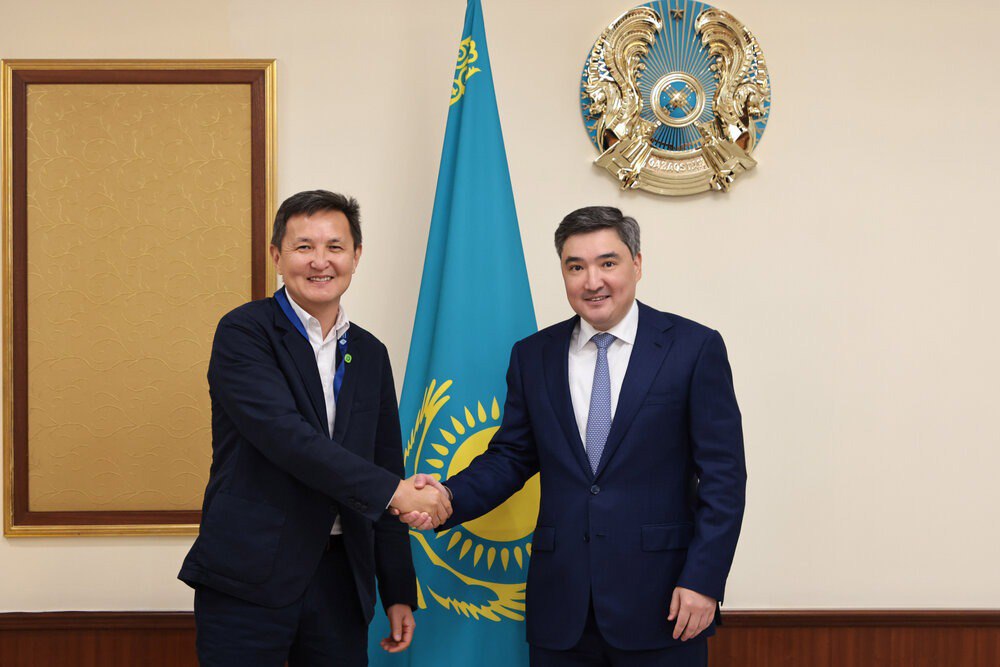
At a meeting on September 5 between Kazakhstan's Prime Minister Olzhas Bektenov and Arsen Tomsky, Founder and CEO of inDrive, a California-based global transport and urban services platform, a proposal was mooted to open an "inVision U University" in Kazakhstan, providing training for 400 qualified specialists in IT, education, science, and art. The Prime Minister also pledged support for the company's plans to implement several environmental initiatives to improve air quality in megacities; the first of which will be implemented in Almaty. Last year, in collaboration with Astana Hub and regional IT hubs, inDrive launched "Beginit", a free international social leadership program across six regions in Kazakhstan to enable 10th-grade students to implement social projects from concept to realization. Founded in 2013 in Yakutia, Russia, and incorporated in the U.S. in 2018, inDrive is now available in 749 cities in 46 countries. In 2021, its market value was estimated at $1.2 billion. In 2022, the company pulled out of Russia, and relocated to Almaty, Kazakhstan. In 2022 and again in 2023, inDrive was the second most downloaded ride-hailing app worldwide based on Google Play and App Store data. In addition to rides, inDrive offers a growing list of urban services, including intercity and freight transportation, handyman calls and courier delivery. In December 2023, Kazakh media reported that Arsen Tomsky had obtained Kazakhstani citizenship.

Turkmenistan Supports Japanese Language Exam

The official website of the Embassy of Japan in Turkmenistan reports that Ashgabat will host the second Japanese-Language Proficiency Test (JLPT) on December 1, 2024, with applications accepted from 26-30 August. JLPT, the most comprehensive exam in the Japanese language in both Japan and abroad to assess the skills of foreign citizens, comprises five levels - from N1-N5- and the cost of participation varies according to grade. In 2022, the Dovletmamed Azadi Turkmen National Institute of World Languages signed a contract with the Government of Japan to implement the “Japanese Language Teaching Equipment Project Grant.” The project includes re-equipping three university classrooms to provide language laboratories, facilities for simultaneous translation, and rooms designated for Japanese language teachers.

Stay or Go? Uzbek Students Ponder Studies at Home, Abroad

Like many Uzbek students, Nigina Poziljonova left Uzbekistan to study at a university abroad. She doesn’t regret her decision. “Unlike the teachers I personally saw in Uzbekistan, professors are happy when students say, ‘I don’t understand, please explain again,’” said Poziljonova, who is studying for a bachelor’s degree in business economics with data science at the University of Cassino in Italy. “If necessary, they are willing to spend two hours after class for that student. If I fail one exam, I can take it 5 times a year for 3 years for free,” said the Uzbek student, who nevertheless describes her Italian experience as “more challenging than I anticipated.” --- The perceived shortcomings of higher education have long been a preoccupation in Uzbekistan, which has a large population of young people and is the most populous country – with about 35 million citizens – in Central Asia. Authorities are trying to fix the problem. Last month, Minister of Higher Education Kongratbay Sharipov said 20 underperforming universities will be closed because only 5-10% of their graduates are employed. Uzbekistan has more than 200 universities - 114 are state-run, 65 are private and 30 are foreign university branches, according to 2023 data. Uzbekistan had the fifth largest number of “tertiary” students (students who have completed secondary school) studying abroad – 109,945 – among countries around the world that were surveyed, according to UNESCO data in 2021. Around that time, more than 570,000 students were studying in higher education institutions in Uzbekistan. As in many countries, a lot of Uzbek students believe a quality education lies abroad and their increasing command of English and openness to the world can bring that goal within reach. Additionally, Uzbekistan’s El-Yurt Umidi foundation, a state agency launched in 2018, covers tuition fees and living expenses of talented people who want to study abroad. The foundation signs a contract with scholarship holders that requires them to return to Uzbekistan and work for three years. Many students study at universities in neighboring countries such as Kazakhstan, Kyrgyzstan, and Tajikistan, and then, after one or two years, transfer to universities in Uzbekistan. According to Kyrgyz data, some 38,857 Uzbek students studied in higher education institutions in Kyrgyzstan in 2022 and the figure reached 40,282 in 2023. Uzbek President Shavkat Mirziyoyev chaired a meeting in May at which officials discussed the 306 majors available at the bachelor’s level in Uzbekistan, and the 625 specialties at the master’s level. They acknowledged that some don’t meet international standards and labor market requirements and explored ways to revise them. Opening new courses in areas of high demand was also discussed. Another problem in Uzbek universities is an excessive focus on specializations. At one journalism university, specialists taught multiple sub-topics, including TV, international news, public relations, the internet, as well as military, travel, art, economic and sports journalism. Progress has been made. More people have access to higher education. Starting this year, state grants are given for one year, and in the remaining years of...