• KGS/USD = 0.01144 0%
  • KZT/USD = 0.00203 0%
  • TJS/USD = 0.10685 -0.19%
  • UZS/USD = 0.00008 0%
  • TMT/USD = 0.28530 0%
  • KGS/USD = 0.01144 0%
  • KZT/USD = 0.00203 0%
  • TJS/USD = 0.10685 -0.19%
  • UZS/USD = 0.00008 0%
  • TMT/USD = 0.28530 0%
  • KGS/USD = 0.01144 0%
  • KZT/USD = 0.00203 0%
  • TJS/USD = 0.10685 -0.19%
  • UZS/USD = 0.00008 0%
  • TMT/USD = 0.28530 0%
  • KGS/USD = 0.01144 0%
  • KZT/USD = 0.00203 0%
  • TJS/USD = 0.10685 -0.19%
  • UZS/USD = 0.00008 0%
  • TMT/USD = 0.28530 0%
  • KGS/USD = 0.01144 0%
  • KZT/USD = 0.00203 0%
  • TJS/USD = 0.10685 -0.19%
  • UZS/USD = 0.00008 0%
  • TMT/USD = 0.28530 0%
  • KGS/USD = 0.01144 0%
  • KZT/USD = 0.00203 0%
  • TJS/USD = 0.10685 -0.19%
  • UZS/USD = 0.00008 0%
  • TMT/USD = 0.28530 0%
  • KGS/USD = 0.01144 0%
  • KZT/USD = 0.00203 0%
  • TJS/USD = 0.10685 -0.19%
  • UZS/USD = 0.00008 0%
  • TMT/USD = 0.28530 0%
  • KGS/USD = 0.01144 0%
  • KZT/USD = 0.00203 0%
  • TJS/USD = 0.10685 -0.19%
  • UZS/USD = 0.00008 0%
  • TMT/USD = 0.28530 0%
09 February 2026

Viewing results 1 - 6 of 11

The Contested Legacy of Kazakhstan’s Independence Day: From Sovereignty to Unrest and Reinvention

On December 16, 2025, Kazakhstan marks the 34th anniversary of its independence. The story of this national holiday mirrors the nation’s own complex path toward sovereignty and statehood. A Difficult Legacy On December 16, 1991, Kazakhstan adopted the Law “On State Independence of the Republic of Kazakhstan,” officially becoming the last Soviet republic to leave the USSR. The date came at the tail end of the so-called “parade of sovereignties,” when other republics had already declared independence. This delay led to a popular saying: “Kazakhstan turned off the lights in the USSR.” In the early years of independence, the holiday was celebrated widely, often with several days off. Yet the date also evokes painful memories. Just five years earlier, in December 1986, the capital city of Alma-Ata (now Almaty) witnessed what are now known as Jeltoqsan köterılısı - the December Events. On December 16, 1986, the Communist Party of Kazakhstan abruptly dismissed First Secretary Dinmukhamed Konaev and replaced him with Gennady Kolbin, a party official from the Russian city of Ulyanovsk with no ties to the republic. This Moscow-imposed decision sparked protests by students and young people that turned violent. While the full causes and consequences remain partially unexplored, the uprising is widely seen as an early expression of resistance to Soviet central control and the imposition of non-Kazakh leadership. The protests were brutally suppressed. For several days, unrest continued in the city, with some incidents fueled by ethnic tensions. In the years since, the December Events have become symbolic of both state repression and the early stirrings of Kazakh nationalism. Because of the proximity of dates, many citizens continue to conflate the date of independence with the December Events. For years, the national holiday was therefore overshadowed by grief and division. Unrest in the Oil Region Independence Day was further marred in 2011 by violent unrest in the oil-rich Mangistau region after months of unresolved labor disputes. On December 16 of that year, striking workers from the OzenMunaiGas company in the town of Zhanaozen clashed with police after demanding higher wages. The protests escalated into riots, with government buildings, hotels, and vehicles set ablaze. ATMs were looted, and a state of emergency was declared. Official figures state that about 20 people were killed and over 100 were injured. The Zhanaozen tragedy underscored deep socioeconomic disparities, particularly in regions rich in resources but lacking infrastructure and basic services. From Old to New Kazakhstan Over time, Independence Day became closely associated with unrest and national trauma. Analysts suggest that full investigations into the December 1986 and 2011 events were hindered by the political legacy of Nursultan Nazarbayev, Kazakhstan’s first president. Nazarbayev held senior posts during the Soviet period and later presided over the country during the Zhanaozen crackdown. In June 2019, Kassym-Jomart Tokayev succeeded Nazarbayev as president and launched a platform of gradual political reform. However, his efforts were reportedly obstructed by entrenched elites aligned with the Nazarbayev era, often referred to as “Old Kazakhstan.” Public discontent boiled over again in January...

Kazakhstan’s Independence Day: Plenty to Cheer, More to Consider

As Kazakhstan prepares to celebrate its Independence Day on December 16th, The Times of Central Asia (TCA) sat down with its special correspondent, Javier M. Piedra, a banker, corporate executive, writer, and seasoned international development expert whose professional ties to Kazakhstan date back to 2000. Piedra lived in Kazakhstan for 16 years. Over that time, he headed KPMG’s M&A (2007 – 2012), set up a credit bureau - the only one in the region at the time - and was a senior advisor for a private equity fund. He also taught corporate finance at Narxoz University. Back in Washington, he later managed USAID’s multibillion-dollar Asia Bureau under Donald Trump. Drawing on decades of experience in financial consulting, international development, and regional policy, Piedra offers wide-ranging insights into the nation’s evolution since 1991. In this conversation, he reflects on the mindset of Kazakhstan’s leadership – especially in recent years – that has led to, despite challenges, to its achievements - from economic reforms and institutional development to social progress and an increasingly dynamic national outlook. He highlights milestones worth celebrating, offers guidance to the next generation, and provides nuanced commentary on religious freedom and the country’s ongoing development path. The views expressed in this interview are those of the speaker and do not necessarily reflect the editorial position of The Times of Central Asia. TCA: As Kazakhstan marks Independence Day on December 16, what core achievements of the country are most worth celebrating at this moment in its history? Piedra: On December 16th, I expect – and this is good news – President Tokayev to repeat what he said last year, i.e., “I am convinced that by maintaining our unity, tranquility and stability in society, we will overcome all challenges and reach new heights on the path of progress.” Put simply, Kazakhstan can stay unified and stable despite challenges if it commits to doing so. People need to hear this message because it is positive, and the record supports his optimism. It is worth celebrating the country’s positive attitude and confidence in the future. Kazakhstan’s greatest achievement since independence, despite forces pushing in the contrary direction, has been the ability of its multiethnic and multicultural society to flourish. Kazakhstan has preserved unity, strengthened friendships with neighbors, ensured economic freedoms, and inspired its youth with hope, despite trials, corruption, and human shortcomings. Kazakhstan’s dedication to unity is strengthened by its refusal to get pulled into unnecessary geopolitical ambitions or Great Power maneuverings that tend to rob countries of their sovereignty; this mindset is worth celebrating on Independence Day. TCA: You mention “confidence in the future.” What does that mean in the context of Independence Day? Piedra: The early days of Independence were rough, very rough, not only for Kazakhstan, but for the rest of the countries of Central Asia. Since independence in 1991, Kazakhstan has worked hard to build social and institutional structures that enable people to have greater “confidence in the future,” and there were many mistakes made, but Kazakhstan came...

97% of Uzbeks Express Pride in Independence, Survey Finds

Ahead of Uzbekistan’s 34th Independence Day, a national survey conducted by the “Ijtimoiy Fikr” Public Opinion Research Center revealed widespread pride and optimism among citizens. According to the findings, 97% of respondents said they feel proud of their country on Independence Day, while 87.6% described the occasion as joyful and festive. Another 84.7% associated the holiday with national unity, and 95.5% expressed pride in being citizens of Uzbekistan. The survey also reflected how deeply independence is viewed as both a historic milestone and a catalyst for personal growth. Some 79.1% of respondents reported that, in recent years, they have had more opportunities to realize their potential and achieve personal goals. Nearly all participants shared a positive outlook for the country’s future. When asked about their vision for Uzbekistan, 97.8% imagined it as strong and prosperous, 88.9% as peaceful and stable, 85.3% as spiritually rich and cultured, and 81.9% as modern and innovative. Researchers concluded that Independence Day has become not just a commemorative date but a potent symbol of national pride and collective confidence in the country’s direction. The findings echo Uzbekistan’s rising profile in international well-being indices. According to the World Happiness Report, published by the World Population Review and based on Gallup poll data, Uzbekistan ranked 47th globally in 2024, making it the happiest country in Central Asia. The ranking considers six categories: income, social support, life expectancy, freedom of choice, generosity, and perceptions of corruption. Kazakhstan followed at 49th, down from 44th the previous year.

Kyrgyzstan Independence Day Marked by Celebrations

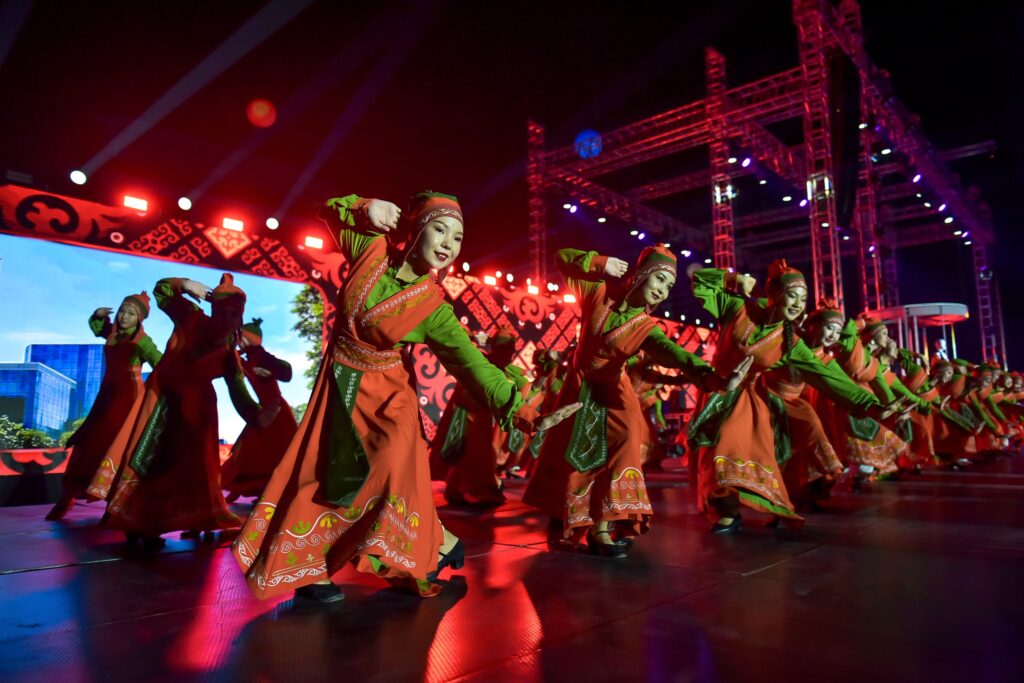
Kyrgyzstan marked the 34th anniversary of its independence on August 31 with large-scale celebrations across the country. For the first time, the central venue for the national festivities was the southern city of Jalal-Abad, the country’s third largest urban center.  The official program featured cultural, social, and sporting events, including a large-scale choreographic performance titled Future Kyrgyzstan, involving 600 dancers in the city’s main square. [caption id="attachment_35595" align="aligncenter" width="2560"] @president.kg[/caption] [caption id="attachment_35596" align="aligncenter" width="2560"] @president.kg[/caption] Celebrations Nationwide Events were held across all regions. In Bishkek, several thousand people gathered in Ala-Too Square for a garrison parade by the Internal Affairs Directorate. In the Issyk-Kul region, festivities included traditional equestrian competitions and other national games. Development and Investment During the festivities, President Sadyr Japarov inaugurated 100 new social facilities and more than 60 industrial facilities via online launch. He also encouraged domestic and foreign investors to take advantage of the country’s ready-made industrial zones: “We invite all business structures, from small to large enterprises. We have ready-made industrial zones, we can provide land, help with infrastructure and documentation,” he said. [caption id="attachment_35597" align="aligncenter" width="2560"] @president.kg[/caption] In Jalal-Abad, Japarov also opened a new art school and a 450-unit social housing complex. Concluding his address, Japarov offered a metaphor for the country's trajectory: “Kyrgyzstan is like a galloping horse,” he said. “Thirty-four years of independence is only the beginning of our long journey.”

Marking 34 Years of Independence: Uzbekistan’s Past, Present, and Future

Uzbekistan declared its independence from the Soviet Union on August 31, 1991, during the final, turbulent months of the USSR's collapse. On that day, an extraordinary session of the Uzbek SSR Supreme Council in Tashkent adopted a Declaration of Independence and passed the law “On the Foundations of State Independence.” The same session resolved that September 1 would henceforth be celebrated annually as Independence Day. The move came just days after the failed Moscow coup attempt (GKChP) against Soviet leader Mikhail Gorbachev, and in the wake of Ukraine and Belarus declaring their own independence. Uzbekistan’s then-leader Islam Karimov moved swiftly to follow suit. At the time, Karimov served both as the leader of Soviet Uzbekistan and First Secretary of the Communist Party of Uzbekistan. He presided over the landmark session on August 31 and proposed September 1 as the national holiday. Shortly afterward, his administration began establishing the institutions of statehood, including a Ministry of Defense and a National Security Service, both created in early September 1991. Later that year, on December 29, a national referendum overwhelmingly supported independence, and Karimov was elected the first president of the new republic. Karimov’s position in 1991 was not without contradictions. Earlier that year, during a USSR-wide referendum in March, he had campaigned for the preservation of the Soviet Union. At the time, he reportedly warned Uzbeks: “Our rivers will run with milk if we stay within the Soviet Union, but if we leave it, our rivers will fill with blood.” For many Uzbeks, the first Independence Day came as a surprise. The declaration was made hastily, and the celebrations of September 1, 1991, were unlike the orchestrated commemorations seen in later years. According to Kursiv, citizens awoke to an unfamiliar atmosphere, karnay horns echoed through the streets, cars were spontaneously decorated, and celebrations broke out informally. “Citizens didn’t even know they had woken up in a new independent state,” one account recalled. Emotions ranged from pride and elation to confusion and concern. The post-Soviet transition proved challenging: economic hardship and shortages left some wondering whether independence had been a mistake. “People in the villages were very unhappy, a bit scared, and already wondering if independence was a big mistake,” wrote Bruce Pannier in 2016. At the time, Pannier, now a contributor to The Times of Central Asia, was traveling through Uzbekistan in 1992. Others remained hopeful, viewing independence as a long-awaited moment of self-determination. For older generations raised under Soviet rule, the sense of historic transformation was profound. Today, 34 years later, Independence Day remains Uzbekistan’s most important national holiday, marked by public ceremonies and official remembrances. The events of 1991 continue to shape national identity and memory. Islam Karimov is remembered by some as the founding father of the republic; a legacy still debated in public discourse. For those who lived through the early 1990s, memories of watching a new flag rise and hearing a new anthem are inseparable from the hardship and promise of the era. Journalist Aziza Qurbonova reflected...

Marked by Tragedy: Why Kazakhstan’s Independence Day Is a Day of Reflection

On December 16, Kazakhstan marks Independence Day, commemorating the adoption of the Law on Independence and State Sovereignty of the Republic of Kazakhstan in 1991. Until 2022, the country observed this holiday over two days - December 16 and 17 - but recent legislative changes have reduced the celebration to a single day. The amendments to the Law on Holidays in the Republic of Kazakhstan, adopted in September 2022, redefined the country’s official holidays. Republic Day on October 25 regained its national holiday status, while December 1 - Day of the First President - was removed as a public holiday. Independence Day, while still classified as a state holiday, was given a more somber tone, with official emphasis placed on honoring the sacrifices that paved the way to sovereignty. [caption id="attachment_26631" align="aligncenter" width="1204"] @TCA, Askar KubaizhanovIndependence monument[/caption] From Republic Day to Independence Day The roots of Republic Day lie in Kazakhstan’s Declaration of State Sovereignty, adopted on October 25, 1990, as the Soviet Union was nearing its collapse. The declaration symbolized Kazakhstan’s first step toward independence. However, following the country’s full independence in 1991, December 16 became the primary national holiday. Republic Day lost its significance in 2009 but was reinstated as a national holiday in 2022. President Kassym-Jomart Tokayev, in his proposal to restore Republic Day, emphasized its role as the foundation of Kazakhstan’s independence journey. He suggested that Independence Day, while significant, should serve as a time for mourning and remembrance to honor those who contributed to the country’s sovereignty. [caption id="attachment_26632" align="aligncenter" width="1600"] @TCA, Askar Kubaizhanov[/caption] The Legacy of December 1986: Zheltoksan Protests December 16 carries weighty historical significance for Kazakhstan. On this day in 1986, protests erupted in Alma-Ata (now Almaty) after Moscow appointed Gennady Kolbin - a Soviet official with no prior ties to Kazakhstan - as head of the Kazakh SSR. Young Kazakh protesters demanded the application of the Korenization principle, which advocated for local leadership in Soviet republics. The protests, often viewed as a precursor to Kazakhstan’s independence movement, were violently suppressed by Soviet authorities. The operation reportedly codenamed “Blizzard,” was designed to provoke unrest and then crush it through bloodshed. Controversially, Nursultan Nazarbayev, who would later become Kazakhstan’s first president, was aligned with Soviet power at the time. In his memoir "Without Right and Left, "Nazarbayev claimed he led one of the protest columns during the demonstrations. For many Kazakh citizens, particularly those who participated in or were affected by the events, December 16-17 remain days of mourning. Almaty’s Peace Street was renamed Zheltoksan Street to honor the memory of the victims. December 2011: The Zhanaozen Tragedy The somber tone surrounding Independence Day was reinforced by the events of December 16, 2011, in Zhanaozen. For months prior, oil workers in the Mangystau region had been on strike, demanding better wages. The protests escalated when workers occupied the city’s central square. On Independence Day, clashes broke out between protesters and local officials during holiday celebrations. The situation turned violent when a group of...