• KGS/USD = 0.01144 0%
  • KZT/USD = 0.00207 0%
  • TJS/USD = 0.10440 -0.19%
  • UZS/USD = 0.00008 0%
  • TMT/USD = 0.28490 0%
  • KGS/USD = 0.01144 0%
  • KZT/USD = 0.00207 0%
  • TJS/USD = 0.10440 -0.19%
  • UZS/USD = 0.00008 0%
  • TMT/USD = 0.28490 0%
  • KGS/USD = 0.01144 0%
  • KZT/USD = 0.00207 0%
  • TJS/USD = 0.10440 -0.19%
  • UZS/USD = 0.00008 0%
  • TMT/USD = 0.28490 0%
  • KGS/USD = 0.01144 0%
  • KZT/USD = 0.00207 0%
  • TJS/USD = 0.10440 -0.19%
  • UZS/USD = 0.00008 0%
  • TMT/USD = 0.28490 0%
  • KGS/USD = 0.01144 0%
  • KZT/USD = 0.00207 0%
  • TJS/USD = 0.10440 -0.19%
  • UZS/USD = 0.00008 0%
  • TMT/USD = 0.28490 0%
  • KGS/USD = 0.01144 0%
  • KZT/USD = 0.00207 0%
  • TJS/USD = 0.10440 -0.19%
  • UZS/USD = 0.00008 0%
  • TMT/USD = 0.28490 0%
  • KGS/USD = 0.01144 0%
  • KZT/USD = 0.00207 0%
  • TJS/USD = 0.10440 -0.19%
  • UZS/USD = 0.00008 0%
  • TMT/USD = 0.28490 0%
  • KGS/USD = 0.01144 0%
  • KZT/USD = 0.00207 0%
  • TJS/USD = 0.10440 -0.19%
  • UZS/USD = 0.00008 0%
  • TMT/USD = 0.28490 0%

Viewing results 1 - 6 of 101

Tajikistan and Kuwait Sign Nine Cooperation Agreements

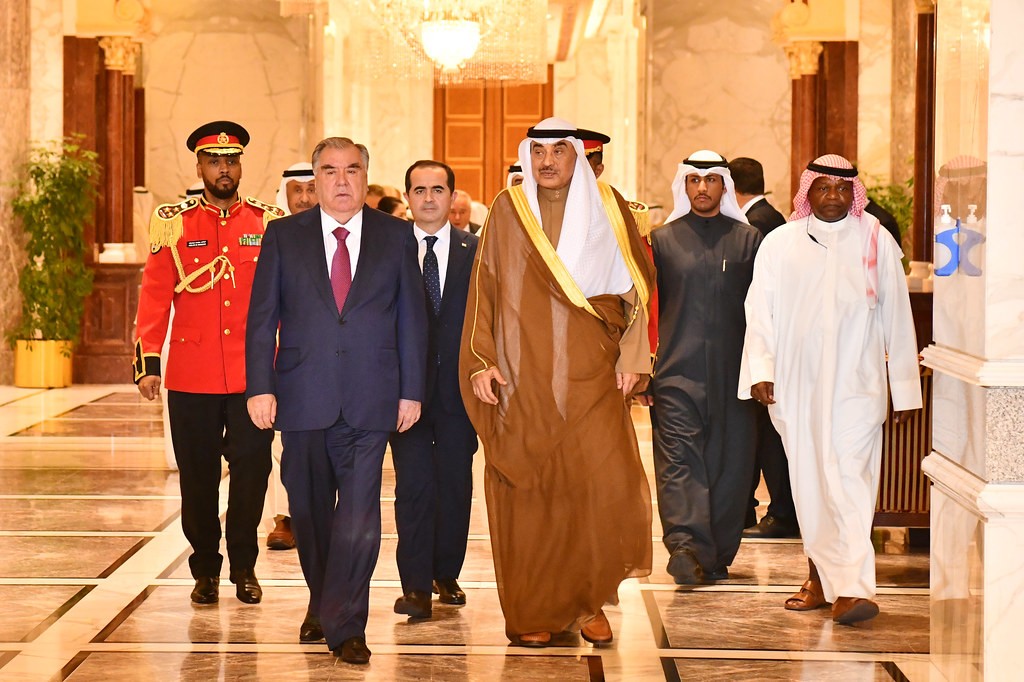
Tajik President Emomali Rahmon began his official visit to Kuwait on November 3. He met with the country’s leaders and finalized agreements to strengthen bilateral cooperation. Following discussions, Tajikistan and Kuwait signed nine key documents to enhance their collaboration, the President’s press service reports. In the presence of Rahmon and Crown Prince Sheikh Sabah al-Khalid Al-Hamad Al-Mubarak Al-Sabah, both sides signed: • A Memorandum of Cooperation between the Foreign Ministries of Tajikistan and Kuwait’s Diplomatic Academy; • A protocol to amend the double taxation agreement between the two countries; • A memorandum on labor regulation in the private sector; • Agreements on trade and industrial cooperation; • A cooperation agreement between Tajikistan’s National Information Agency “Khovar” and Kuwait’s State Information Agency “KUNA”; • Memorandums covering sports, standardization, and physical culture; • An executive tourism program for 2024-2026. Rahmon is quoted as saying: “We are ready to take practical steps to strengthen our relations further.” The discussions emphasized the importance of increasing the intergovernmental joint commission’s activities and establishing an Entrepreneur Council and a Joint Investment Fund between the two nations. Rahmon also thanked Sheikh Mishaal Al-Ahmad Al-Jabir Al-Sabah for the Kuwait Development Fund’s support of critical projects in Tajikistan, particularly in road construction, energy, and irrigation. Additionally, both leaders discussed expanding Kuwaiti investment into Tajikistan’s light, food, metallurgy, pharmaceutical, and agriculture industries. The Emir of Kuwait recognized Rahmon’s initiatives in empowering women and shared Kuwait’s similar efforts, highlighting recent appointments of women to senior government roles. The signed memorandum on private-sector labor regulation was celebrated as a step toward cooperation, further solidifying the growing partnership between Tajikistan and Kuwait.
Diplomatic Renaissance: How Tokayev’s Visit to Mongolia Went

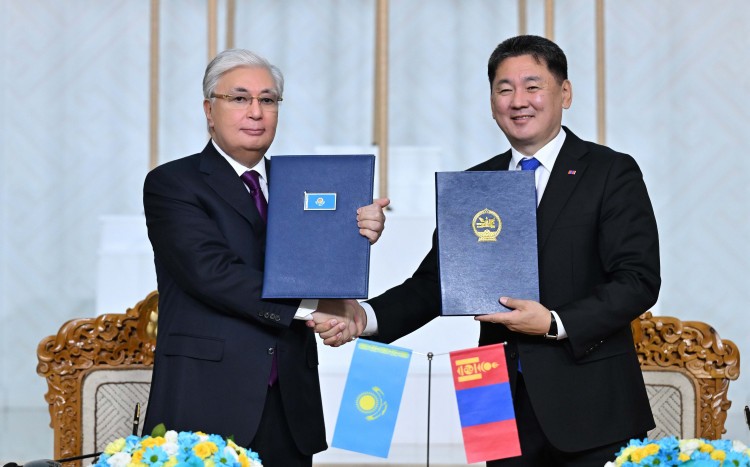
The recent state visit by Kassym-Jomart Tokayev to Mongolia, the first by a Kazakh president in 16 years, demonstrated an excellent approach to expanding Astana's strategic ties. After all, despite 32 years of diplomatic relations and a relatively extensive Kazakh diaspora in Mongolia, under the first president of Kazakhstan, Nursultan Nazarbayev, Astana's ties with Ulaanbaatar were essentially put on hold. This pause in relations likely arose due to Mongolia's political reputation in the region. Protests often erupt in the country, sometimes becoming particularly violent. In 2008, when the Kazakh authorities justified their failures in the economy with the outbreak of the global economic crisis, a state of emergency was imposed in Mongolia for four days in July. The reason was violent opposition protests against the results of the parliamentary elections. Protesters smashed the headquarters of the ruling party and set fire to several buildings in the center of Ulaanbaatar, killing five people and injuring 300. For Mongolia, with its population of 3.4 million, this was a significant shock, as it was for its neighbors in the Eurasian region, where three leaders fell between 2003 and 2005 -- Eduard Shevardnadze in Georgia, Leonid Kuchma in Ukraine, and Askar Akayev in Kyrgyzstan. All this was declared in the region as an “export of revolutions,” building around this notion, a conspiracy theory about the machinations of the U.S. State Department and George Soros. Tokayev's state visit to Mongolia 16 years after Nursultan Nazarbayev refers to the Kazakh leader's key idea about the renaissance of Central Asia. Mongolia is no stranger to the region in one way or another. The main thing for Kazakhstan is the strong Kazakh diaspora, which exceeds 117,000 people. This is the largest national minority in Mongolia and the second largest ethnic group after the titular one. A Kazakh newspaper is published in Mongolia, some Kazakh TV channels are shown on television, and there is an hour of radio news in Kazakh. In short, the basis for strengthening relations is powerful. Tokayev and the president of Mongolia, Ukhnaagiin Khurelsukh, who received him, spoke in both narrow and extended formats about reaching the level of strategic partnership. Tokayev and Khurelsukh, even before the one-on-one meeting, had revitalized diplomatic and trade ties between Kazakhstan and Mongolia. Data from the Statistics Committee of the Ministry of National Economy of Kazakhstan provides evidence. Since 2017, there has been a steady decline in trade turnover between the countries. In 2017, its level was $74.8 million; in 2018 - $67.4 million; in 2019 - $59.9 million. In 2020, it fell to $29.3 million. COVID restrictions can explain such a sharp drop. In 2021, the turnover reached almost $61 million, but at the end of 2023, the trade volume jumped to $150 million. Therefore, when Tokayev said at a joint press briefing that he and the Mongolian president had agreed to turn over $500 million in the “foreseeable future,” this did not seem overly optimistic. The Kazakh delegation did not come empty-handed; during Tokayev's visit, the parties...

Authorities Rail Against Use of Kazakhstan in Circumventing International Sanctions Against Russia

Kazakhstan's Deputy Foreign Minister Roman Vassilenko emphasized in an interview with the Polish publication PAP that the country seeks to prevent its territory from being used to circumvent international sanctions imposed against Russia. According to Vassilenko, although Kazakhstan has not officially imposed sanctions nor joined the anti-Russian measures, the republic's authorities consider it essential to prevent risks associated with possible secondary sanctions against its companies. This is especially important in regard to its close economic ties with Western countries. At the same time and in acknowledgement of its position concerning both its Western partners and Russia, Kazakhstan has emphasized the need for  balance and an avoidance of circumvention of restrictive measures. Vassilenko also noted that Kazakhstan is actively cooperating with the European Union on the sanctions regime, and as part of  these consultations, reported that he had been in dialog with David O'Sullivan, the EU special envoy for sanctions. Vassilenko denied speculation about growing tensions between Kazakhstan and Russia, and pointing out that the countries maintain close ties, explained: “There are different issues because we are neighbors and have diverse relations. We are working with Russia to solve these issues before they become problems. This is our approach not only to the Russian Federation but to any other country." After the start of the Russian military operation in Ukraine, Kazakhstan took a neutral stance and did not support Western sanctions against Moscow. Nevertheless, the Kazakh authorities have repeatedly stated that they will not allow the country's territory to be used to circumvent these restrictions. President Kasym-Jomart Tokayev, in his speeches, adheres to the principle of compliance with the international sanctions regime and aims to conduct a constructive dialog with the EU and the U.S. to  avoid possible secondary sanctions that could affect Kazakh companies.  

Kazakhstan’s Strategic Stand: Navigating BRICS Amidst Geopolitical Tensions

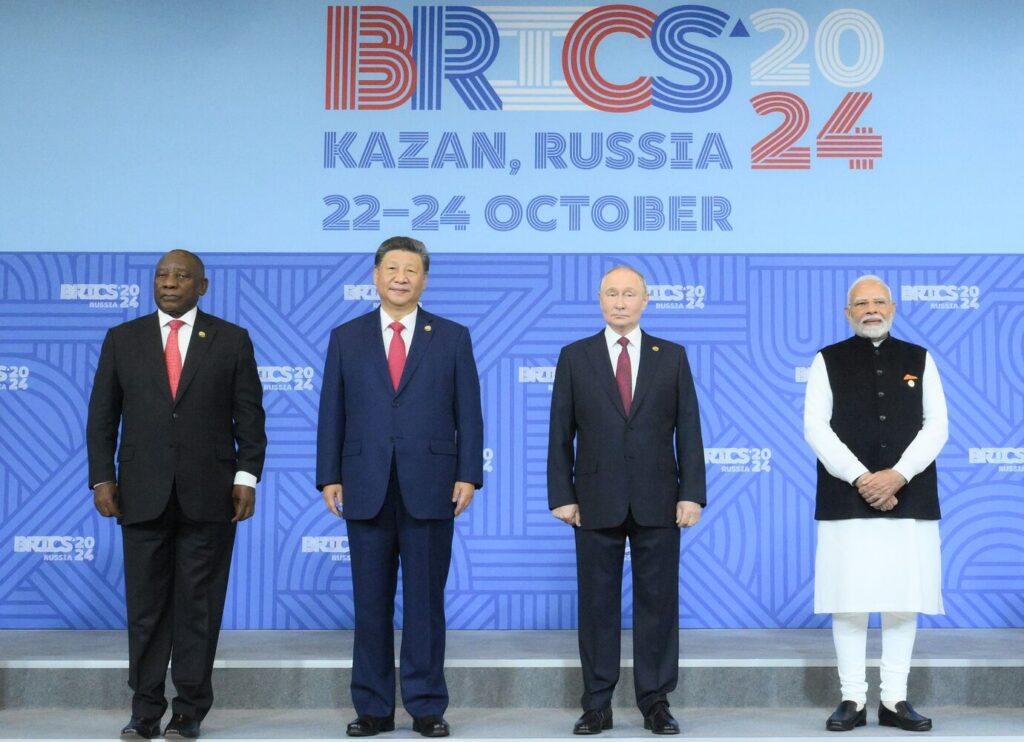
In recent days, BRICS - an intergovernmental organization comprising Brazil, Russia, India, China, South Africa, Iran, Egypt, Ethiopia, and the UAE - has become one of the most critical topics on the Eurasian region's information agenda. Russian propaganda has presented the BRICS summit, which is taking place in Kazan, as a global event. However, the press secretary of Kazakhstan's president, Kassym-Jomart Tokayev, has stated that the republic has no plans to apply for BRICS membership in the foreseeable future, which has caused an adverse reaction in the Russian media, and led to a seemingly retaliatory Russian ban on Kazakhstan's agro-products. The Kazakhstani side, represented by the expert community, has tried to explain that its reasoning is based not only on Astana's national interest, but also on its obligations to its partners in Central Asia. Perhaps the most convincing argument is that the C5+1 mechanism is effective as a format for the region's interactions with the outside world. Therefore, it is not worth breaking this mechanism. No Central Asian country besides Kazakhstan has been invited to join BRICS, but Astana cannot afford to damage the established alliance by creating the conditions for distrust from its neighbors; Central Asia has already gone through a period of distrust. At the same time, rejecting the idea of joining BRICS, where India, Russia, Brazil and China are the founding members, does not unduly affect Kazakhstan's interactions with these powers. Kazakhstan works with China and Russia within the framework of the SCO (Shanghai Cooperation Organisation) and EAEU (Eurasian Economic Union), and has signed multiple partnership and alliance agreements with Beijing and Moscow. In other words, the information hysteria that Kazakhstan will exit Russia's sphere tomorrow and join the "Global West" (a term used in the Russian media) has no basis in reality. At the same time, however, it is evident that most Central Asian countries are trying to distance themselves from Russia as much as possible, maintaining cooperation only along certain economic lines. Even banks in Kyrgyzstan, a republic maximally dependent on Moscow on several essential issues, have stopped working with Russian banks. The Kazakhstan Stock Exchange, meanwhile, recently announced the end of cooperation with the sanctioned Moscow Stock Exchange. Moreover, Rosselkhoznadzor's ban on imports of a wide range of agro-industrial products from Kazakhstan, if not a response to the refusal to join the BRICS, clearly hints that behind the scenes, economic relations between Astana and Moscow are not all that smooth. Another argument against joining BRICS was voiced not just within Kazakhstan, but also by Russian experts. Despite the organization's purportedly representative nature, which includes countries with a combined population of 3.5 billion people (45% of the Earth's population), the association has no structure. Russian analysts opposed to the Kremlin believe that BRICS is a club where one can come, sabre-rattle at the West, conclude bilateral agreements, and forget about everything until the next summit. No coordinating center monitors the implementation of any agreements reached. BRICS was conceived as an intercontinental organization, uniting similar economies in volume and GDP. Thus, it initially included Brazil, representing...

Navigating Afghan-Pakistani Conflict: Central Asia’s Mediating Role in Regional Stability

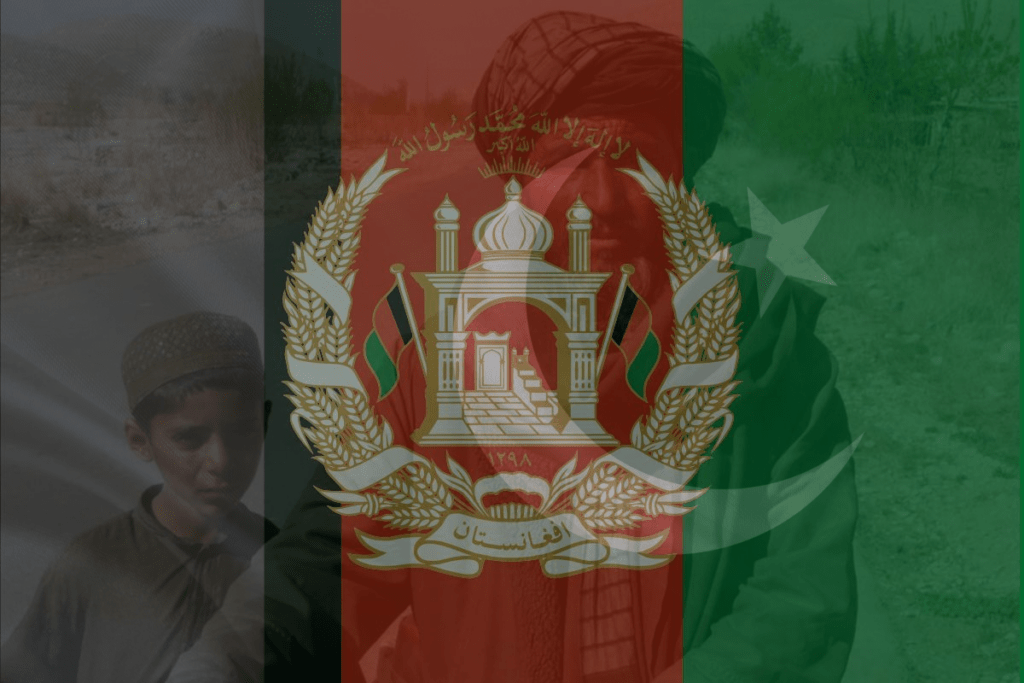
Recently, there has been a significant increase in tensions between Afghanistan and Pakistan, with both sides regularly exchanging accusations. In addition to this, border conflicts have become more frequent, with border crossings periodically closed. According to Modern Diplomacy, both countries are in a state of quite severe political conflict, and distrust and hostility from the Afghan population towards Pakistan is growing even though the "victory of the Taliban and the reincarnation of the Islamic Emirate... should have been a victory for Pakistan and strengthened its position in the region.” The confrontation between the two neighbors in South Asia is a source of concern for other countries in the region, especially for the Central Asian republics, which are increasingly acquiring the status of independent players in their dealings with Afghanistan. Due to their proximity, these republics to varying degrees link their development with a stable Afghanistan designed to become a bridge to South Asia. Negative dynamics in Afghan-Pakistani relations are a cause of much wringing of hands. Pakistan was among the first states to recognize the independence of the former Soviet Central Asian republics and has dynamic ties with them. Pakistan's trade turnover with the region is roughly $500 million annually, most of which comes from imports to Pakistan. The nations are linked by the Quadrilateral Traffic in Transit Agreement (QTTA), the Turkmenistan-Afghanistan-Pakistan-India (TAPI) gas pipeline project, the CASA-1000 energy project, and the Uzbekistan–Afghanistan–Pakistan Railway Project. The majority of these projects use Afghanistan as a bridge between Central Asia and Pakistan. In this regard, the countries of Central Asia are interested in a political situation which excludes confrontational approaches; none of them are interested in further destabilization in Afghanistan. In the Central Asian republics, there is a well-established understanding of Pakistan's exceptional and particularly important role in Afghanistan’s stability. Pakistan has a defining influence on security in Afghanistan and has historically been the most integrated in Afghan issues at the level of political and multi-ethnic conflicts. Pakistan is linked to its neighbor by historical and socio-cultural ties. In reality, however, a different story is emerging. At both a global and regional level, active measures out of Islamabad set to discredit the de facto Taliban-led government of Afghanistan have been observed. Islamabad has undertaken a robust information campaign, which has put forward an entrenched narrative about Afghanistan being one of the world’s major sources of terrorism. In this information war, Islamabad, being a fully-fledged member of the international community, has clear advantages and has used all available tools, including access to global platforms. Islamabad also has access to specialized committees and departments of the UN, which regularly prepare reports on the situation in Afghanistan. Unsurprisingly, it has used these to include ideas favorable its' position on the world stage. Acting as a source of information, Islamabad has presented its point of view, which the international community has largely accepted as objective information. However, it does not provide specific data, such as the size of terrorist groups or the location of their training camps....

Central Asia Finesses Pressure over Russia, Sanctions

Kyrgyzstan says it will cooperate with regional heavyweight Russia despite appeals from some Western countries not to do so. The comment by President Sadyr Japarov of Kyrgyzstan reflects a broader effort by Central Asian countries to balance longstanding economic and security ties with Moscow alongside relationships with Europe and the United States, which have imposed multiple sanctions packages on Russia since its full-scale invasion of Ukraine in February 2022. “Certainly, there are Western countries that ask us not to cooperate with Russia,” Japarov said in an interview with the state-run Kabar news agency that was published on Wednesday. “However, I always openly and sincerely respond to them: ´We cannot refuse to cooperate with Russia. Our trade turnover with Russia exceeds $4 billion. We buy oil, gas, wheat and other foodstuffs from Russia. Geographically, we are in a landlocked area. Our road and rail routes to the world pass through Russia. Russia hosts about a million of our migrants. How can we not cooperate with Russia?”´ Japarov noted that trade between some European Union countries and Russia runs into billions of dollars a year despite sanctions, saying: “When you need it, you cooperate with Russia, but we are not allowed to. This is an unfair demand.” The EU says it has imposed “massive and unprecedented” sanctions on Russia, including travel bans on individuals, asset freezes on individuals and entities and economic measures that target Russia’s financial, trade, energy, transport, technology and defense areas. However, exemptions and loopholes mean that some trade continues, for example allowing EU member states that are especially dependent on Russian crude oil to continue receiving it by pipeline. Czechia has spent more than 7 billion euros on Russian oil and gas, over five times what it has provided in aid to Ukraine, according to a report released this week by the Center for the Study of Democracy, a European public policy institute. Additionally, many analysts have pointed to a surge in European exports to Central Asia and the Caucasus since 2022 as a probable indication that EU and British companies are using the regions as a conduit to send goods to Russia, including at least a portion that are subject to sanctions. The difficulty of tracking products made it hard to confirm any sanctions-dodging, though an analysis of trade data by the European Bank for Reconstruction and Development last year concluded that changes in regional trade patterns “may be used to circumvent economic sanctions but on a limited scale.” At the same time, there have been more reports of banks in Central Asian countries refusing to accept cross-border payments from Russian companies as the United States moved to impose secondary sanctions for doing business with Russian entities. Banks in China, Türkiye and the United Arab Emirates, all big trade partners with Russia, have taken similar action. Kyrgyzstan is not the only Central Asian country that has expressed frustration about Western sanctions. Last year, Kazakh President Kassym-Jomart Tokayev said his country would comply with sanctions against Russia while still...