• KGS/USD = 0.01144 0%
  • KZT/USD = 0.00216 0%
  • TJS/USD = 0.10680 0.19%
  • UZS/USD = 0.00008 0%
  • TMT/USD = 0.28530 0%
  • KGS/USD = 0.01144 0%
  • KZT/USD = 0.00216 0%
  • TJS/USD = 0.10680 0.19%
  • UZS/USD = 0.00008 0%
  • TMT/USD = 0.28530 0%
  • KGS/USD = 0.01144 0%
  • KZT/USD = 0.00216 0%
  • TJS/USD = 0.10680 0.19%
  • UZS/USD = 0.00008 0%
  • TMT/USD = 0.28530 0%
  • KGS/USD = 0.01144 0%
  • KZT/USD = 0.00216 0%
  • TJS/USD = 0.10680 0.19%
  • UZS/USD = 0.00008 0%
  • TMT/USD = 0.28530 0%
  • KGS/USD = 0.01144 0%
  • KZT/USD = 0.00216 0%
  • TJS/USD = 0.10680 0.19%
  • UZS/USD = 0.00008 0%
  • TMT/USD = 0.28530 0%
  • KGS/USD = 0.01144 0%
  • KZT/USD = 0.00216 0%
  • TJS/USD = 0.10680 0.19%
  • UZS/USD = 0.00008 0%
  • TMT/USD = 0.28530 0%
  • KGS/USD = 0.01144 0%
  • KZT/USD = 0.00216 0%
  • TJS/USD = 0.10680 0.19%
  • UZS/USD = 0.00008 0%
  • TMT/USD = 0.28530 0%
  • KGS/USD = 0.01144 0%
  • KZT/USD = 0.00216 0%
  • TJS/USD = 0.10680 0.19%
  • UZS/USD = 0.00008 0%
  • TMT/USD = 0.28530 0%

Viewing results 1 - 6 of 20

Opinion: Kazakhstan’s Human Capital Problem – How State Scholarships Are Building a Talent Pipeline for the West

Kazakhstan spends millions of dollars every year sending its brightest students to the world's best universities through two flagship programs: the Nazarbayev Intellectual Schools (NIS) and Bolashak. For NIS, the state invests millions with no public record of what becomes of its graduates once they enter foreign educational institutions. For Bolashak, the return figures look reassuring on paper, but only until one asks what happens the moment the obligation expires. For Kazakhstan’s economy, heavily reliant on oil and gas exports, human capital is what can bring the country to its goal of economic diversification through the ideas and skills that no natural resource can replicate. Students from Kazakhstan studying abroad, with access to the world’s best professors and cutting-edge technologies, are exactly the human capital the country cannot afford to lose. However, they are also the ones the government has been paying to send away without a sustainable retention strategy in place. Nazarbayev Intellectual Schools Founded in 2008, the Nazarbayev Intellectual Schools network offers an internationally recognized 12-year curriculum, directly compatible with many foreign university admissions systems. It also provides some of its students with grants covering the full cost of attendance. The state funds NIS generously: in 2023 alone, more than $37 million was invested into the network. The results are extraordinary: from 2010 to 2024, 654 students received offers from the top 100 universities in the world, with 32 of them from the Ivy League. However, which country these graduates end up in is a different question, and the available statistics offer no public answer to. One former NIS student, who received a full scholarship to study abroad, says, "I'm extremely grateful for all the resources that the NIS provided me with. However, after my graduation from the university, I will be moving to San Francisco to work as an AI engineer. It would take me at least seven years to make the same salary I'll be earning here in a year." Another says, "It is not only about the higher wages in the U.S. It’s about the opportunities and autonomy one gets. The research lab I've joined since graduation has far more funding and resources for the work I'm actually passionate about." Bolashak Program Unlike NIS, the Bolashak program, established in 1993 and widely regarded as one of the most generous scholarship programs in the world, does require its recipients to return. Graduates must work in Kazakhstan for up to four years or face financial penalties. On paper, this looks like a solution to the human capital problem. In practice, it is only a delay. While the state at least partially recovers its investment, it is developed markets that eventually inherit the talent. "After completing my requirement back home, I was able to get an American company to sponsor my visa," says one Bolashak recipient. "I moved to the U.S. shortly after." "I was offered a transfer to the European branch of my company," says another, one year after fulfilling their obligation. The Solution to the Brain...

How Young Professionals from Central Asia Are Building Global Careers

Beyond opportunity, a new generation of Central Asians is learning how to compete, adapt, and fit into global work environments. “I felt like I would understand what real work is much faster by living in the U.S.,” Ruzana Ileuova says. Many people view building a career abroad as an opportunity. However, for Central Asian professionals, it also entails constantly adapting to new identities and expectations. While logging in to work every day from a location that feels both familiar and unfamiliar, Ruzana learns to trust her abilities and adapt to unspoken expectations. She says that pressure increases when working remotely, as it requires a high level of self-discipline. “I always feel like I have to do more to prove myself,” she says. Despite strong language skills and academic preparation, she describes an ongoing sense of self-doubt, particularly in high-performance environments. “Even the language barrier still gives me imposter syndrome,” she adds. “And I’m the youngest on my team.” Her narrative highlights a crucial aspect of this generation: success overseas requires constant negotiation of confidence, identity, and location, in addition to opportunity. Reinventing the Path For others, the path to an international career begins not with a plan, but with chance. Originally from Bishkek, Kyrgyzstan, Aman Arykbaev did not imagine a global career. His journey began when he was unexpectedly selected for the green card lottery. “I used to think the green card was not a real thing until I saw that I was selected,” he says. His early years were characterized by uncertainty, as he arrived in the United States with little money and no guidance. “I worked almost two years installing heating, ventilation, and air conditioning. At that time, my English was very weak,” Arykbaev recalls. After attending a six-month IT boot camp, he was able to enter a new field and land his first tech job in a matter of weeks. “I had several interview stages, and by the end of the week, I got an offer.” Arykbaev, who is currently a senior quality engineer, exemplifies a characteristic of this generation: the ability to change course. Careers are now rebuilt, sometimes from the ground up, rather than fixed. Breaking Into Global Systems The route was more regimented, but no less difficult, for Aldiyar Bekturganov, an Amazon software engineer. He followed a well-known path of internships, networking, and applications after relocating to the U.S. for college. However, the process was anything but easy. “I failed my first interview completely,” he says. That setback accelerated his learning curve. Even after landing a job, entering the workforce was not without its challenges. The shift from university to professional life, he explains, was immediate. “You suddenly realize the work actually matters,” he says. “If something is delayed, people are waiting on you.” Unlike academic settings, where mistakes are part of the process, professional environments demand results that affect teams and timelines. While Bekturganov represents a more traditional corporate trajectory, Dameli Bozzhanova offers a contrasting perspective shaped by entrepreneurship and flexibility. Working in...

Opinion: Central Asia Through Western Eyes – Misconceptions Among Young People

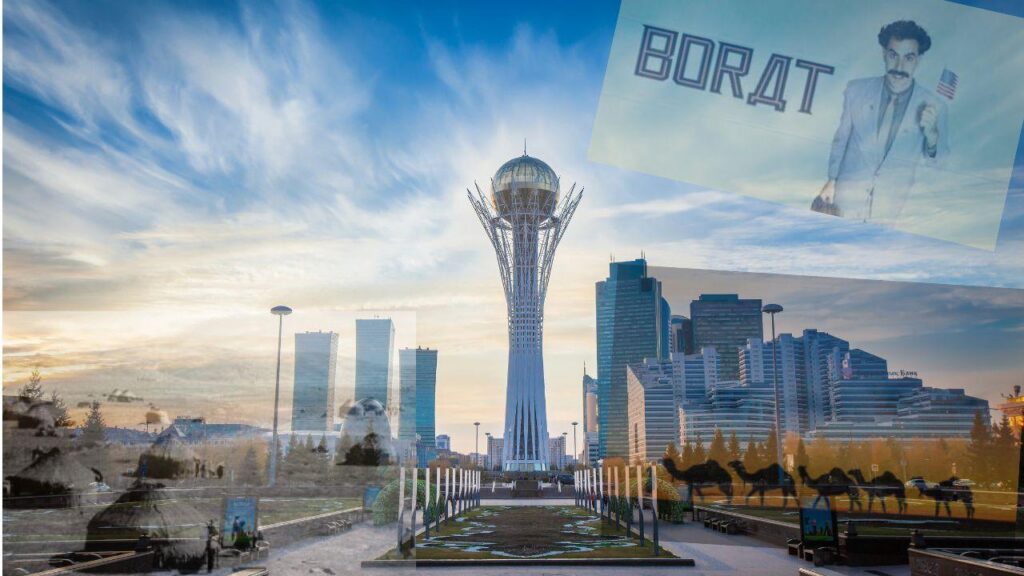
Do you know where Kazakhstan is? Although the question is straightforward, it often causes hesitation on a university campus in Washington, D.C. Some students gesture uncertainly toward Eastern Europe. Others guess the Middle East. Some admit they have never heard of it, often with a nervous laugh. Central Asia remains one of the least understood parts of the world for many young people in the West. It is often defined more by pop culture, history, and imagination than by its diverse reality. “I honestly thought Kazakhstan was somewhere near Afghanistan,” said Michael, a student from Georgetown University. “I didn’t realize it was its own region.” Such knowledge gaps are not unusual. Central Asia is rarely mentioned in Western education systems or media coverage, despite its size, strategic significance, and rich cultural heritage. As a result, assumptions often take the place of understanding and tend to follow similar patterns, which over time may shape Western attitudes toward the region. A Region Reduced to Stereotypes When Western students are asked what comes to mind when they think about Central Asia, their responses often follow a familiar pattern: deserts, nomads, the Soviet Union, and sometimes confusion with other regions. Emily, a student from American University, remarked, “I picture a lot of sand and heat, and perhaps those who ride horses?” Although this image is partial, it is not entirely inaccurate, as the region’s customs and natural surroundings do contribute to its character. However, contemporary cities, academic institutions, businesses, and the region’s cultural diversity are largely absent from these perceptions. Perceptions have also been shaped by pop culture. For some, Kazakhstan is associated less with geography or history than with Borat, the fictional journalist from a Hollywood comedy. Despite being widely recognized as satire, the persona has nevertheless made a lasting impression on viewers unfamiliar with the region. As Sacha Baron Cohen explained, Kazakhstan was chosen precisely because it was largely unknown to Western audiences. According to his explanation, he selected the country because “no one had heard anything about it,” making it a blank canvas onto which Western attitudes about backwardness could be projected. None of the scenes depicting Borat’s “home village” were filmed in Kazakhstan; they were shot in rural Romania. The language Borat speaks is not Kazakh, and the customs he describes bear no relation to everyday life in Kazakhstan. Daniel, a student from George Mason University, asked, half-jokingly, “Is that where Borat is from?” These examples illustrate how humor and media can fill gaps in knowledge. When Kazakhstan first appeared in popular Western media, it was often portrayed through harsh stereotypes, introducing global audiences to a country still defining its image. Between Curiosity and Ignorance However, alongside these misconceptions, there is also genuine interest. “I had no idea it was so multicultural,” said Emma, a student from American University. “We never really learned about it.” This response points to a broader issue: Central Asia is often misunderstood not only because of misinformation, but because of its limited visibility in the...

Why More Students in Kazakhstan Choose to Study Abroad

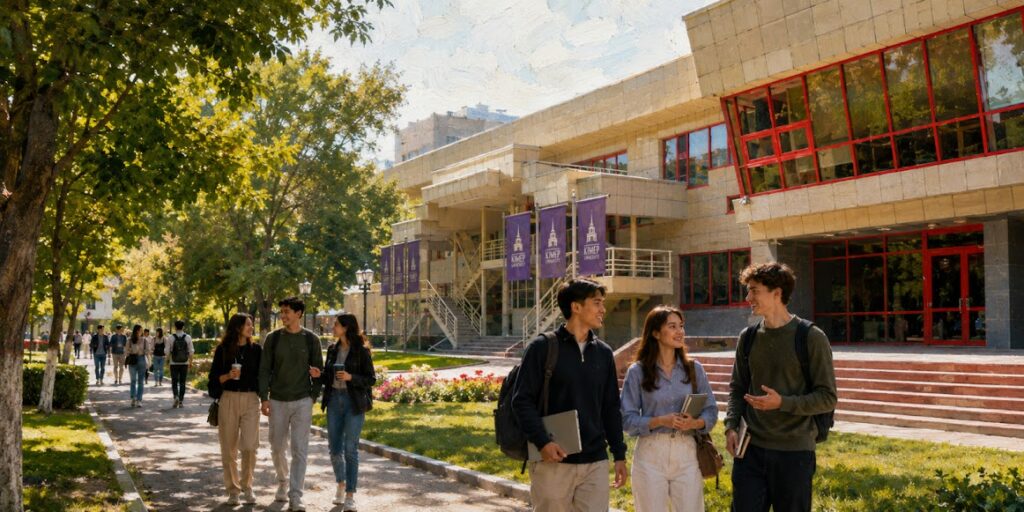
An increasing number of students in Kazakhstan are considering education abroad. For some, it offers access to high-quality academic programs; for others, it provides opportunities to gain international experience, learn new languages, and improve career prospects. Interest in foreign universities is growing among school graduates and their parents, who increasingly view overseas education as an investment in their children’s future. According to the Bureau of National Statistics, 678,100 students were enrolled in higher education institutions in Kazakhstan at the start of the 2025-2026 academic year. At the same time, data from the International Trade Administration indicate that more than 90,000 Kazakhstani citizens are currently studying abroad.  Sanzhar Uvashev, an employee of InterPress Abroad, a company that assists applicants seeking admission to foreign universities, spoke about the factors influencing students’ choices and the opportunities offered by international education. TCA: Tell us about your work. What does your organization do? Uvashev: Our company helps students apply to universities abroad. We support applicants in selecting academic programs, preparing documents, and navigating the entire admissions process. One of our distinguishing features is that we are not limited to a specific list of partner institutions or countries. We can assist students in applying to a wide range of universities, depending on their individual preferences. TCA: Which countries are currently the most popular destinations? Uvashev: We work with a broad range of destinations, particularly the United Kingdom, the United States, and Canada, as well as countries across Europe and Asia. Recently, students have shown greater interest in exploring multiple options rather than focusing on a single country. Some prioritize studying in an English-speaking environment, others seek more affordable tuition, while some focus on scholarship opportunities and employment prospects after graduation. TCA: What opportunities exist today for students from Central Asia to study abroad? Uvashev: Opportunities are expanding. Many universities are paying closer attention to applicants from Central Asia, as international students contribute to a more diverse academic environment. As a result, institutions are offering scholarships, tuition discounts, and preparatory programs. Awareness of the region is growing, and with it the range of options available to students. TCA: Why do students continue to choose the U.S. and other destinations? Uvashev: The U.S. remains one of the most popular destinations because of its strong universities and perceived career opportunities. At the same time, countries such as Italy, Austria, and China are also attracting interest. Italy and Austria appeal to students because public universities there can offer relatively affordable, and in some cases almost free, education. China has gained popularity due to the quality of its universities, their rising positions in global rankings, and the availability of scholarships for international students. TCA: Are there programs that allow students to study free of charge? Uvashev: Yes. Students often inquire about scholarship schemes that significantly reduce tuition fees or cover them entirely. Examples include the Bolashak international scholarship program, Stipendium Hungaricum, and Erasmus Mundus. These initiatives provide talented applicants with real opportunities to obtain an education abroad, provided they are well...

Tokayev Proposes Employing Top Foreign Graduates in Kazakhstan

President Kassym-Jomart Tokayev has proposed launching a program to employ the most talented foreign graduates of Kazakh universities, allowing them to begin their professional careers within the country. He announced the initiative during the Strategic Partners Forum, Kazakhstan - Territory of Academic Education. According to Tokayev, over 31,000 foreign students are currently studying at Kazakh universities, a national record. The government aims to increase this figure to 100,000 by 2029 through visa liberalization and improved learning conditions. The employment program will enable top-performing international graduates to stay in Kazakhstan, contributing to the national economy. Simultaneously, the country plans to expand the number of foreign university branches in Kazakhstan, with a particular focus on technical disciplines. “The opening of branches of foreign universities is fully in line with our goal of developing engineering and IT education,” Tokayev said. Kazakhstan currently hosts three Lu Ban workshops, which serve as centers for applied engineering training. Special emphasis is being placed on preparing skilled personnel for the nuclear energy sector. “Our task is to ensure a direct link between education and science and the real sector of the economy. There are already successful examples: the partnership between Kozybayev University and the University of Arizona has led to the development of a technology to convert sulfur into innovative polymers. This is a vital project for our country, which has significant sulfur reserves. It will spur growth in the chemical industry and contribute to solving environmental challenges,” Tokayev noted. Since 2019, Kazakhstan has tripled its investment in education and science. Five Kazakh universities have been included in the Times Higher Education global rankings, and higher education institutions now enjoy greater autonomy. Tokayev emphasized that investment in education is an investment in Kazakhstan’s future. He said the country sees the demographic potential of Central Asia and neighboring regions as an opportunity to grow its higher education sector and attract international students. “Kazakhstan has set itself the ambitious goal of becoming part of the global knowledge market. To this end, we have partnered with 40 leading universities worldwide and opened 33 foreign university branches. Many of these institutions offer courses in English, Russian, and Chinese. Multilingualism is the key to openness and competitiveness for both universities and nations,” he said. To help foreign students better understand local culture, all foreign university branches are required to offer mandatory courses in the Kazakh language and the history of Kazakhstan. Tokayev also named digital state development and the integration of artificial intelligence (AI) technologies among the country's top priorities. He noted that by 2030, AI is projected to contribute over $15 trillion to global GDP, and Kazakhstan intends to play an active role in this transformation. “Since the beginning of the year, we have launched the AI-Sana program, completed by more than 540,000 students. Courses on artificial intelligence have become mandatory in all schools and universities. An AI university is currently in development,” Tokayev said. He cited agreements reached with OpenAI during his September visit to the United States, under which...

From Astana to the World: Kazakhstan Expands Academic Frontier

Kazakhstan is rapidly establishing itself as a regional center for higher education, attracting students from around the world. The number of branches of foreign universities operating in the country is steadily increasing, complemented by a growing domestic academic base, especially in fields such as artificial intelligence. Today, Kazakhstan is viewed as a viable regional alternative to Russia, which has long been considered a destination for affordable, high-quality education. Expanding Options for Students In June, the Ministry of Science and Higher Education of the Republic of Kazakhstan unveiled a map of foreign university branches operating in the country. The government is positioning Kazakhstan as a leading academic hub in Central Asia by enhancing international cooperation and expanding opportunities for students. Partnerships have already been established with 39 foreign universities. Currently, 23 branches of institutions from the UK, Italy, China, Russia, the U.S., France, and South Korea operate in Kazakhstan. [caption id="attachment_36320" align="aligncenter" width="1201"] Map of foreign university partnerships; image: Ministry of Science and Higher Education of Kazakhstan.[/caption] Seven more branches are expected to open in the 2025-2026 academic year, namely Coventry University, the Moscow State Institute of International Relations (MGIMO) in Astana, Gazi University in Shymkent, Woosong University in Turkestan, Anhalt University in Almaty, Politecnico della Marche in Taldykorgan, and Dong Eui University in Kostanay. A standout example of this strategy arrived in early September: Notably, on September 3, Cardiff University opened its first campus outside the UK in Astana. It is also the first member of the prestigious Russell Group to begin operations in Kazakhstan. The Russell Group comprises 24 leading UK universities responsible for two-thirds of all research grants and contract funding in the UK, and 56% of doctoral degrees awarded. Cardiff University Kazakhstan is now accepting students for four-year bachelor’s programs in computer science, business management, civil engineering, and geology and mineral exploration. Kazakhstan has witnessed a surge in the establishment of foreign university branches since 2021. These include the Peking University of Languages and Culture at Astana International University, and the National Research Nuclear University MEPhI (Russia) at Al-Farabi Kazakh National University. Additional branches include the University of Lorraine (France) at the Kazakh National Pedagogical University named after Abai, and the University of Anhalt (Germany) at the Almaty University of Power Engineering and Telecommunications named after Gumarbek Daukeev. Other notable branches include the University of Hong Kong at Satpayev University in Almaty, Berlin Technical University in Aktau, De Montfort University (UK) in Almaty, and Queen’s University Belfast (Ireland) at Narxoz University, among others. These branches offer programs in mining, water resource management, and mineral exploration and extraction, along with biotechnology, electrical engineering, energy, mechatronics, logistics, chemical technology, robotics, and related disciplines. In 2023, Korkyt Ata University in Kyzylorda launched an Institute of Artificial Intelligence, in partnership with Seoul National University of Science and Technology. It currently offers programs in computer science, cybersecurity, software development, and information systems. An Ambitious Vision Observers note that Kazakhstan’s education drive is unfolding amid growing global competition for international students. Neighboring Uzbekistan...