Kazakhstan is rapidly establishing itself as a regional center for higher education, attracting students from around the world. The number of branches of foreign universities operating in the country is steadily increasing, complemented by a growing domestic academic base, especially in fields such as artificial intelligence. Today, Kazakhstan is viewed as a viable regional alternative to Russia, which has long been considered a destination for affordable, high-quality education.
Expanding Options for Students
In June, the Ministry of Science and Higher Education of the Republic of Kazakhstan unveiled a map of foreign university branches operating in the country. The government is positioning Kazakhstan as a leading academic hub in Central Asia by enhancing international cooperation and expanding opportunities for students.
Partnerships have already been established with 39 foreign universities. Currently, 23 branches of institutions from the UK, Italy, China, Russia, the U.S., France, and South Korea operate in Kazakhstan.
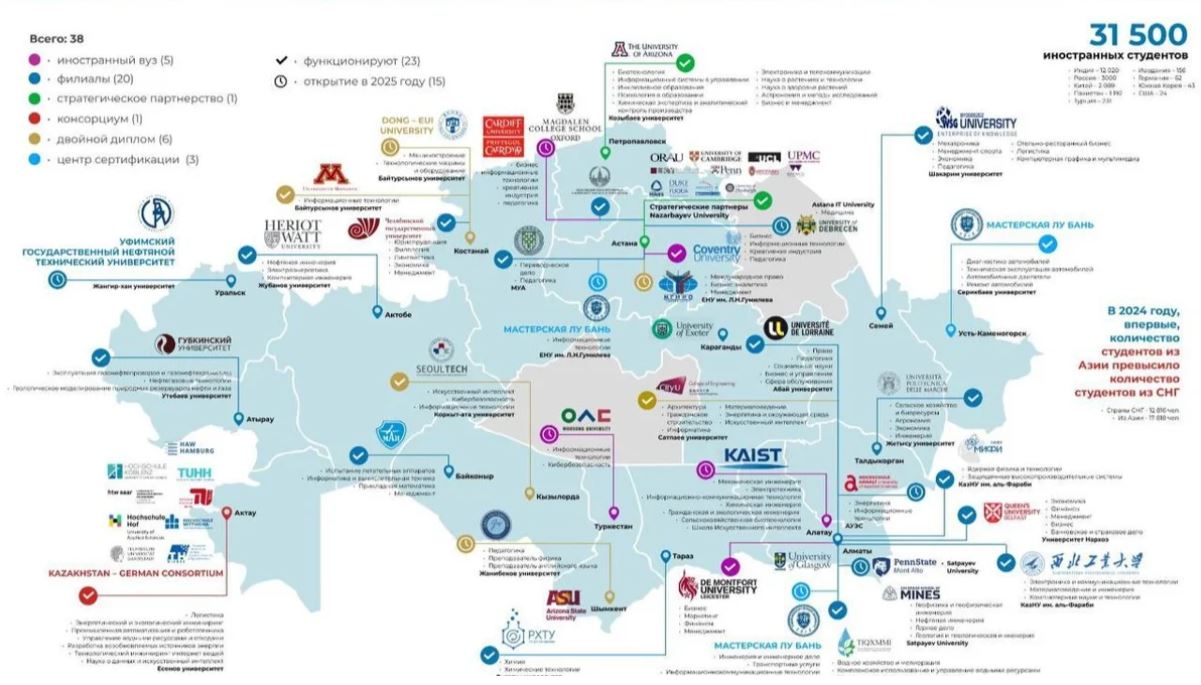
Map of foreign university partnerships; image: Ministry of Science and Higher Education of Kazakhstan.
Seven more branches are expected to open in the 2025-2026 academic year, namely Coventry University, the Moscow State Institute of International Relations (MGIMO) in Astana, Gazi University in Shymkent, Woosong University in Turkestan, Anhalt University in Almaty, Politecnico della Marche in Taldykorgan, and Dong Eui University in Kostanay.
A standout example of this strategy arrived in early September:
Notably, on September 3, Cardiff University opened its first campus outside the UK in Astana. It is also the first member of the prestigious Russell Group to begin operations in Kazakhstan. The Russell Group comprises 24 leading UK universities responsible for two-thirds of all research grants and contract funding in the UK, and 56% of doctoral degrees awarded. Cardiff University Kazakhstan is now accepting students for four-year bachelor’s programs in computer science, business management, civil engineering, and geology and mineral exploration.
Kazakhstan has witnessed a surge in the establishment of foreign university branches since 2021. These include the Peking University of Languages and Culture at Astana International University, and the National Research Nuclear University MEPhI (Russia) at Al-Farabi Kazakh National University. Additional branches include the University of Lorraine (France) at the Kazakh National Pedagogical University named after Abai, and the University of Anhalt (Germany) at the Almaty University of Power Engineering and Telecommunications named after Gumarbek Daukeev.
Other notable branches include the University of Hong Kong at Satpayev University in Almaty, Berlin Technical University in Aktau, De Montfort University (UK) in Almaty, and Queen’s University Belfast (Ireland) at Narxoz University, among others.
These branches offer programs in mining, water resource management, and mineral exploration and extraction, along with biotechnology, electrical engineering, energy, mechatronics, logistics, chemical technology, robotics, and related disciplines.
In 2023, Korkyt Ata University in Kyzylorda launched an Institute of Artificial Intelligence, in partnership with Seoul National University of Science and Technology. It currently offers programs in computer science, cybersecurity, software development, and information systems.
An Ambitious Vision
Observers note that Kazakhstan’s education drive is unfolding amid growing global competition for international students. Neighboring Uzbekistan has also launched partnerships with European institutions, while Turkey and the Gulf states are actively courting students from Asia and Africa. By moving early and offering relatively low tuition, Kazakhstan hopes to secure a durable niche in this crowded market.
Kazakhstan is aiming to become the top education destination in Central Asia. The government is working with globally recognized universities to align its education system with international standards. As previously reported by The Times of Central Asia, Minister of Science and Higher Education Sayasat Nurbek has stated that Kazakhstan aims to attract 150,000 foreign students by 2029, nearly five times the current number.
The country offers several advantages: a strategic location bridging Europe and Asia, political and economic stability, and lower tuition fees compared to Western countries and Russia. “Kazakhstan is not only a leader in education in Central Asia; we are becoming a new Eurasian center,” said Nurbek. “Our partnerships with global universities and the growth in world-class campuses show that students no longer need to leave the region to access international-quality education.”
To support this goal, the government is providing tuition grants, building new dormitories, and investing in research clusters. Thirty-five Kazakhstani universities have been included in the QS Asia University Rankings 2025. Al-Farabi Kazakh National University, L.N. Gumilyov Eurasian National University, and Satpayev University are ranked among the top 100, reflecting growing international recognition.
Officials emphasize that attracting students requires more than campuses and programs. Work is underway to improve dormitory conditions, expand visa services, and create cultural integration programs. Several universities now run orientation courses for foreign students, including Kazakh language basics and intercultural workshops, aimed at easing adjustment and retention.
Building an AI-Ready Future
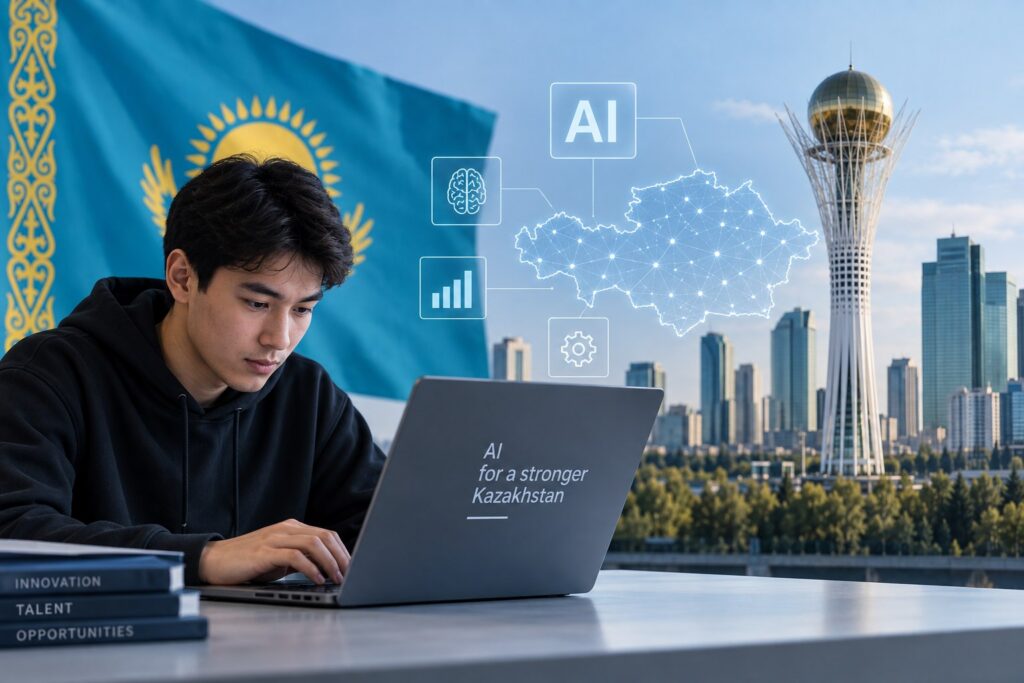
Kazakhstan has also made significant investments in AI infrastructure. In May 2025, the country acquired the most powerful supercomputer in Central Asia, with a processing capacity of approximately two exaflops. Based on NVIDIA’s H200 graphics chips, the system is available to government agencies, universities, and startups.
The country has also established partnerships with Huawei, Coursera, and Astana Hub, supporting a practical and applied approach to education. AI studies are being integrated across higher and secondary education curricula.
The government also sees higher education as a tool for economic diversification. By training specialists in AI, engineering, and energy, officials hope to reduce reliance on extractive industries and foster a knowledge-based economy. Analysts argue that international campuses can serve as incubators for research partnerships, tech startups, and innovation clusters that will spill over into broader economic growth.
A Competitive Alternative
For decades, Russia was the primary destination for students from the post-Soviet space. That dynamic is shifting, not only due to the war in Ukraine, but because Russia’s withdrawal from the Bologna Process has complicated degree recognition in Western countries.
Kazakhstan is well-positioned to fill the gap. It offers a Russian-speaking environment while increasingly improving English and other foreign language instruction in its universities.
As a result, Kazakhstan is attracting more students from countries such as China, India, Pakistan, across Asia and Africa, Eastern Europe, and even Russia and other post-Soviet states. This trend is supported by deliberate government policies, expanding global university partnerships, and growing international awareness of Kazakhstan’s academic strengths. Whether this momentum can be sustained will depend not only on Kazakhstan’s ability to attract prestigious partners, but also on how its institutions deliver. For now, as new campuses open and domestic programs grow, Kazakhstan’s higher education system is entering a decisive phase in its evolving regional role.