• KGS/USD = 0.01144 0%
  • KZT/USD = 0.00205 0%
  • TJS/USD = 0.10441 0.1%
  • UZS/USD = 0.00008 0%
  • TMT/USD = 0.28490 -0.28%
  • KGS/USD = 0.01144 0%
  • KZT/USD = 0.00205 0%
  • TJS/USD = 0.10441 0.1%
  • UZS/USD = 0.00008 0%
  • TMT/USD = 0.28490 -0.28%
  • KGS/USD = 0.01144 0%
  • KZT/USD = 0.00205 0%
  • TJS/USD = 0.10441 0.1%
  • UZS/USD = 0.00008 0%
  • TMT/USD = 0.28490 -0.28%
  • KGS/USD = 0.01144 0%
  • KZT/USD = 0.00205 0%
  • TJS/USD = 0.10441 0.1%
  • UZS/USD = 0.00008 0%
  • TMT/USD = 0.28490 -0.28%
  • KGS/USD = 0.01144 0%
  • KZT/USD = 0.00205 0%
  • TJS/USD = 0.10441 0.1%
  • UZS/USD = 0.00008 0%
  • TMT/USD = 0.28490 -0.28%
  • KGS/USD = 0.01144 0%
  • KZT/USD = 0.00205 0%
  • TJS/USD = 0.10441 0.1%
  • UZS/USD = 0.00008 0%
  • TMT/USD = 0.28490 -0.28%
  • KGS/USD = 0.01144 0%
  • KZT/USD = 0.00205 0%
  • TJS/USD = 0.10441 0.1%
  • UZS/USD = 0.00008 0%
  • TMT/USD = 0.28490 -0.28%
  • KGS/USD = 0.01144 0%
  • KZT/USD = 0.00205 0%
  • TJS/USD = 0.10441 0.1%
  • UZS/USD = 0.00008 0%
  • TMT/USD = 0.28490 -0.28%

Viewing results 1 - 6 of 15

Daines Retirement Leaves Uncertainty for Senate Central Asia Caucus

Senator Steve Daines has announced that he will not seek re-election in 2026, a decision that could have implications for congressional initiatives focused specifically on Central Asia. Daines has been among the most active advocates in Congress for strengthening U.S. engagement with the region, particularly on trade policy and economic cooperation with Kazakhstan, Kyrgyzstan, Tajikistan, Turkmenistan, and Uzbekistan. In 2024, Daines partnered with Democratic Senator Gary Peters to launch the U.S. Senate Central Asia Caucus, a bipartisan forum intended to raise the region’s profile in Washington and encourage cooperation on trade, investment, and security. The initiative reflected growing interest in Congress as Central Asia has gained strategic importance amid shifting global supply chains and efforts by governments in the region to diversify partnerships beyond Russia and China. One of the caucus’s key policy priorities has been the repeal of the Cold War-era Jackson–Vanik Amendment, which still applies to multiple former Soviet states. Its continued presence in U.S. law is widely viewed as an outdated barrier to deeper economic engagement. Momentum for its repeal has grown as policymakers seek to expand trade with Central Asia and modernize the legal framework governing U.S. economic relations with the region. Supporters argue that removing the amendment would encourage American investment in sectors such as energy, infrastructure, and critical minerals while aligning U.S. trade policy with Washington’s broader strategic outreach to Central Asia. Debate in Washington over normalizing trade relations has increasingly been framed as part of a wider push to strengthen economic ties with the region. With both Daines and Peters expected to leave the Senate by 2027, the caucus’s founding leadership will soon depart Capitol Hill, potentially narrowing the window for congressional action on the issue.

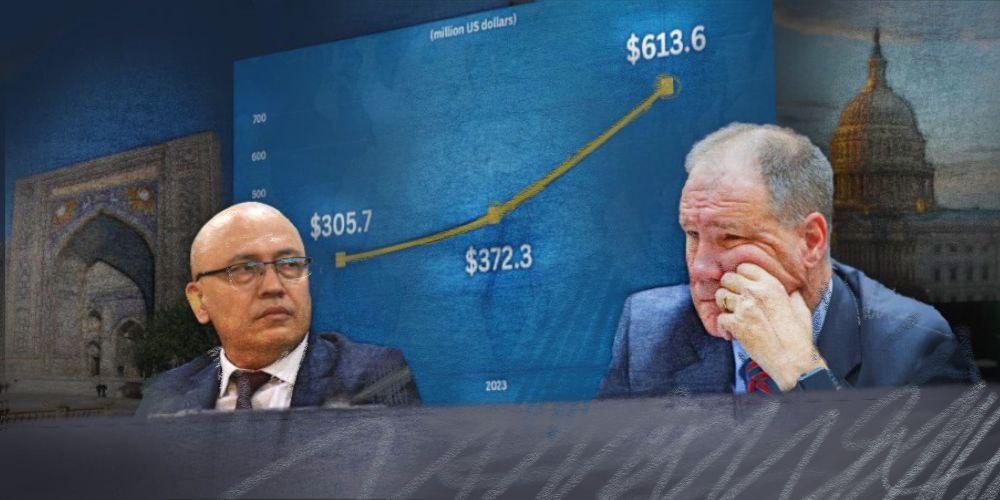
Modernization Without Dependence: Why Uzbekistan Is Deepening Ties with Washington

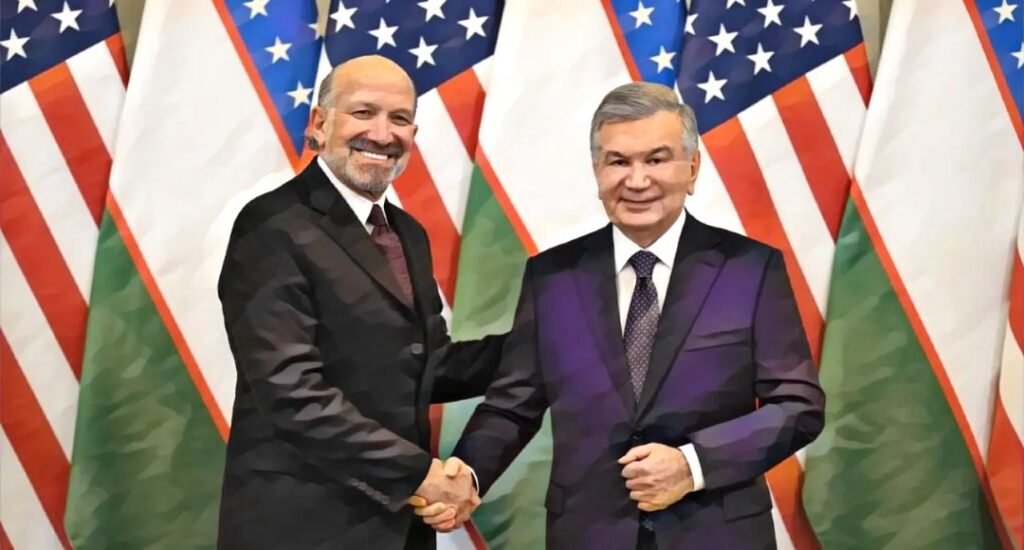
The recent rise in Uzbekistan-U.S. engagement is often framed as a sudden diplomatic turn, and much of the commentary has focused on what Washington hopes to gain from deeper involvement in Central Asia. Far less attention, however, has been given to what Tashkent is seeking from this relationship. From Uzbekistan’s perspective, this engagement is part of a broader national strategy to expand the country’s foreign policy options at a time when all of the major powers are competing for influence in Central Asia. In November 2025, President Shavkat Mirziyoyev joined the other C5 leaders in Washington for a White House summit focused on economic cooperation, critical minerals, energy, and trade. By February 2026, the relationship had moved beyond talks and into financing and project design, with new agreements involving the U.S. International Development Finance Corporation and EXIM, alongside a new critical minerals framework. From Uzbekistan’s side, the core objective is straightforward. Tashkent wants to modernize rapidly without risking becoming overdependent on any single external investor. That means using U.S. interest as leverage and in tandem with, not as a replacement for ties with Russia or China. Washington is courting the region because it wants access to minerals and supply chains that reduce reliance on China and limit exposure to sanctioned or geopolitically sensitive suppliers. Uzbekistan is well aware of this and is using that demand to strengthen its bargaining position for financing, technology, and industrial upgrading. In other words, Uzbekistan is positioning itself as a strategic production and transit partner. The direction of cooperation is revealing. The February 2026 U.S.-Uzbekistan critical minerals pact prioritizes the full-value chain from exploration and extraction to processing, and even proposes a joint investment holding company. This signals that Tashkent is aiming beyond raw-material exports. It wants to break from the post-Soviet pattern of shipping resources while others capture refining, technology, and margins. If it can secure processing capacity, infrastructure, and long-term financing, the deal becomes an instrument of industrial policy. The second objective is finance and implementation capacity. President Mirziyoyev also held separate bilateral meetings with the U.S. Secretary of Commerce, Howard Lutnick, and other senior U.S. trade officials. The meetings focused on an investment platform, business council coordination, and support for large industrial and infrastructure projects. EXIM also publicly described the new framework as a way to convert earlier commitments into financing solutions for energy, aviation, critical minerals, and advanced technologies. The third objective is trade normalization and market access. A bipartisan Senate effort has introduced legislation to repeal Jackson-Vanik restrictions for Central Asian states, and President Mirziyoyev raised U.S. support for Uzbekistan’s WTO accession and stronger cooperation under the U.S.–Central Asia Trade and Investment Framework Agreement (TIFA). These measures shape the legal and trade environment that ultimately determines investor confidence. Uzbekistan is trying to make the relationship durable by embedding it in institutions. The move also serves a domestic political economy logic. President Mirziyoyev’s government has spent years presenting itself as reformist, investment-friendly, and open for business. Deeper engagement with the United...

Jackson-Vanik Repeal Gains Momentum as U.S. Courts Central Asia

For many years, U.S. relations with Central Asia were primarily political in nature, while economic ties developed slowly. However, in the past year, engagement has intensified significantly, with recent agreements suggesting the U.S. is poised to strengthen its economic presence in the region. A recent statement by U.S. Secretary of State Marco Rubio reinforces this outlook. Calls to repeal the outdated Jackson-Vanik trade restrictions have been framed by U.S. officials as a way to facilitate trade with Central Asia and strengthen U.S. energy security. The Jackson-Vanik Amendment The Jackson-Vanik Amendment, enacted in 1974, restricts trade with countries that limit their citizens’ right to emigrate. At the time of its passage, Central Asia was still part of the Soviet Union.  The amendment prohibits granting most-favored-nation (MFN) status, government loans, and credit guarantees to countries that violate their citizens’ right to emigrate, and allows for discriminatory tariffs and fees on imports from non-market economies. The amendment was repealed for Ukraine in 2006, and for Russia and Moldova in 2012. However, it remains in effect for several countries, including Azerbaijan, Kazakhstan, Tajikistan, Turkmenistan, and Uzbekistan, which continue to receive only temporary normal trade relations. In May 2023, a bill proposing the establishment of permanent trade relations with Kazakhstan, which included repealing the Jackson-Vanik Amendment, was introduced in the U.S. Congress. A follow-up bill with similar provisions was submitted in February 2025. Then-nominee and now Secretary of State Marco Rubio previously noted that some policymakers viewed the amendment as a tool to extract concessions on human rights or to push Central Asian states toward the U.S. and away from Russia. However, he characterized such thinking as outdated, stating that, “In some cases, it is an absurd relic of the past.”  Rubio has consistently supported expanding U.S. ties with Central Asia. Expanding Cooperation In 2025, relations between the U.S. and Central Asia deepened significantly, particularly with Kazakhstan and Uzbekistan, which are seen by analysts as the primary beneficiaries of this cooperation. In late October 2025, U.S. Deputy Secretary of State Christopher Landau and U.S. Special Representative for South and Central Asia Sergio Gor visited Kazakhstan and Uzbekistan. One of the year’s major events was the Central Asia-U.S. (C5+1) summit held in Washington on November 6. Leaders of the five Central Asian states met with President Donald Trump and members of the U.S. business community. Uzbekistani President Shavkat Mirziyoyev also met with U.S. Senator Steve Daines, co-chair of the Senate Central Asia Caucus, with both sides focusing heavily on economic cooperation. At the summit, Uzbekistan finalized major commercial agreements with U.S. companies, including aircraft orders by Uzbekistan Airways and deals spanning aviation, energy, and industrial cooperation. Kazakhstan signed agreements worth $17 billion with U.S. companies in sectors including aviation, mineral resources, and digital technologies. This included a deal granting American company Cove Kaz Capital Group a 70% stake in a joint venture to develop one of Kazakhstan’s largest tungsten deposits, an agreement valued at $1.1 billion.  Further agreements were signed on critical minerals exploration. Kazakhstan and the...

Uzbekistan Day on Capitol Hill Highlights Deepening Ties With the U.S.

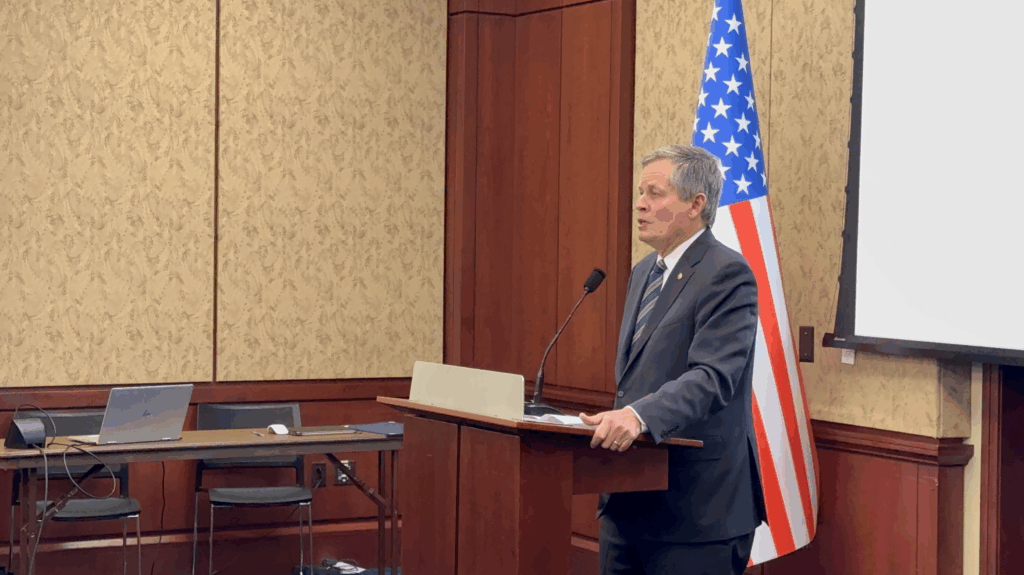
On July 23, the U.S. Capitol hosted “Uzbekistan Day,” a significant event co-organized by the Congressional Uzbekistan Caucus to reaffirm growing ties between Uzbekistan and the United States. More than a hundred participants — including lawmakers, diplomats, officials from the State Department and Pentagon, business leaders, and journalists — gathered to engage with the Uzbek delegation and explore new areas for bilateral cooperation. The forum focused on Uzbekistan’s ongoing political and socio-economic reforms and its foreign policy vision centered on regional stability and international cooperation. A central priority discussed was Uzbekistan’s accession to the World Trade Organization (WTO), with officials framing it as a vital step to ensuring long-term reform and global market integration. U.S. Lawmakers Praise Reforms At the event, Congressman Trent Kelly, Co-chairman of the Caucus on Uzbekistan, praised President Shavkat Mirziyoyev’s leadership, stating, “I want to express my gratitude to President Shavkat Mirziyoyev. He is a bold reformer, a reliable partner, and a sincere friend of the U.S. Under his leadership, Uzbekistan is confidently moving along the path of change. Human rights are being strengthened, democratic institutions expanded, and opportunities for international cooperation opened. These achievements inspire all of us.” On a more personal note, Kelly added, “I have had the opportunity to visit Uzbekistan four times, and each visit left a deep impression on me. I was moved by the kindness of the Uzbek people, the richness of their cultural heritage, and the hospitality of your country. Music, cuisine, and deep traditions — all of this makes Uzbekistan truly unique… We will soon remove the Jackson-Vanik Amendment from our agenda because Uzbekistan is doing everything right and carrying out reforms,” he concluded. Senator Steve Daines, Co-chairman of the Caucus on Central Asia, described himself as a “sincere friend of Uzbekistan.” Reflecting on his March 2024 trip to Tashkent, he said, “I felt at home and among friends. This meeting strengthened my desire to continue supporting the Central Asian countries.” [caption id="attachment_34350" align="aligncenter" width="2560"] Montana Senator Steve Daines, Co-chairman of the Caucus on Central Asia[/caption] Congresswoman Carol Miller, also part of the March delegation, spoke of her personal connection to Uzbekistan’s heritage. “Uzbekistan, with its ancient history, has long aroused my professional interest, since I am a historian by education. The opportunity to see the country’s unique historical and cultural heritage in person was an invaluable experience.” Miller emphasized that, “The conversation took place in a trusting and open atmosphere. The topics raised during the meeting were not only relevant but also extremely promising from the viewpoint of the future development of Uzbek-American relations.” [caption id="attachment_34351" align="aligncenter" width="1020"] West Virginia Congresswoman Carol Miller[/caption] Miller underscored her commitment to concrete legislative goals: “The removal of the Jackson-Vanik Amendment regarding our country and support for Uzbekistan’s accession to the WTO are priority tasks. I am currently working closely with members of Congress to accelerate these issues.” Economic Cooperation and Business Confidence The event also featured remarks from American business leaders highlighting Uzbekistan’s economic potential. Peter Flanagan, Senior Vice President...

Congressman Trent Kelly and Ambassador Furkat Sidikov Drive U.S.-Uzbekistan Trade and Investment Progress

On March 26, 2025, Ambassador Furkat Sidikov hosted a Congressional Breakfast featuring Congressman Trent Kelly (R, Mississippi), Co-Chair and founding member of the U.S.-Uzbekistan Caucus. The event focused on the theme of trade, investment, and U.S.-Uzbekistan relations. Business leaders and policy experts also joined to discuss the evolving economic landscape and the future of U.S.-Uzbekistan relations. Ambassador Sidikov highlighted the presence of over 300 American companies in Uzbekistan and expressed optimism about bilateral trade soon surpassing $1 billion annually. The Ambassador emphasized the strengthening of multifaceted partnership with the U.S. over economic and security partnerships, alongside ongoing reforms in democracy and human rights. Congressman Kelly praised the strong partnership between the United States and Uzbekistan, highlighting the country’s reforms and its openness to U.S. business and trade. He expressed deep admiration for the Uzbek people and their government, emphasizing the growing ties fostered through the State Partnership Program with Mississippi. Congressman Kelly voiced strong support for removing the Jackson-Vanik Amendment (a Cold War-era provision that restricts trade with certain countries), stating that the time was right for such action. He noted ongoing collaboration with congressional and senatorial colleagues to advance this effort. Referring to Uzbekistan Day on the Hill as a growing tradition, he encouraged stronger connections between the two nations, underscoring Uzbekistan's vibrant culture, abundant resources, and welcoming spirit. [caption id="attachment_30169" align="aligncenter" width="1280"] Ambassador Furkat Sidikov, Congressman Trent Kelly (R, Mississippi), and Congresswoman Carol Miller (R, West Virginia) display the Uzbekistan Normalized Trade Act, H.R. 2329[/caption] The Uzbekistan Caucus was established in 2018 to strengthen bilateral relations between the United States and Uzbekistan by encouraging dialogue on issues such as trade, security, governance, and cultural exchange. While bilateral caucuses are often seen as ceremonial with limited tangible outcomes, the Uzbekistan Caucus has proven to be an exception by driving meaningful progress in U.S.-Uzbekistan relations. This success reflects the contributions of both officials. Ambassador Sidikov has served as Uzbekistan's ambassador to the United States since 2023, playing a key role in strengthening bilateral ties. During his tenure, he facilitated the signing of the Customs Mutual Assistance Agreement (CMAA), streamlining trade and enhancing border security, and supported Uzbekistan’s reforms to align with World Trade Organization (WTO) standards, fostering a more open and competitive economic environment. These efforts have not only expanded market access, such as enabling U.S. meat and poultry exports to Uzbekistan, but also fostered deeper economic and strategic ties between the two nations. Congressman Kelly's 36 years of military service, including his role as a brigadier general, two Bronze Star Medals, and deployments to Iraq, have been instrumental in advancing collaboration with Uzbekistan through the State Partnership Program. His efforts have supported joint training, disaster preparedness, and modernization initiatives, providing valuable U.S. expertise and strengthening defense ties between the two nations. Uzbekistan ranks 58th in the Global Firepower Index, which ranks countries by military strength.

Jackson-Vanik: One Step Away from Repeal

The U.S. Senate has confirmed Marco Rubio as Secretary of State, raising hopes among Central Asian leaders - particularly in Kazakhstan - that his recent comments regarding the Jackson-Vanik amendment may soon translate into concrete action to repeal this outdated policy, which continues to hinder mutual trade. Passed in 1974 as part of the Trade Act under President Gerald Ford, the Jackson-Vanik amendment was designed to penalize countries with non-market economies that restricted emigration, particularly targeting the Soviet Union. The amendment specifically sought to pressure the USSR to allow its Jewish population to emigrate freely, while also protesting the suppression of Judaism and other religious practices. The amendment achieved a measure of success by 1989, when the Iron Curtain fell and Soviet Jews were permitted to emigrate in large numbers, primarily to Israel and the United States. However, the policy remained in place, even after the dissolution of the USSR, applying to the newly independent Central Asian republics despite their vastly different political and economic landscapes. On January 15, Rubio delivered a nearly five-hour confirmation speech during a Senate hearing for his nomination as Secretary of State under the Donald Trump administration. Among the topics discussed was the Jackson-Vanik amendment. Senator Steve Daines specifically asked Rubio for his position on the amendment, emphasizing that its repeal could normalize U.S. trade relations with Kazakhstan and Uzbekistan. Rubio described the amendment as “an absurd relic of the past,” asserting that it no longer serves any meaningful purpose in pressuring Central Asian countries on human rights. He warned that continued use of such measures could push nations like Kazakhstan and Uzbekistan closer to Russia’s sphere of influence. Rubio singled out Kazakhstan, noting that the country had “successfully met the conditions” to transition to a market economy, as evidenced by its accession to the World Trade Organization several years ago. He pledged to work with lawmakers to repeal the Jackson-Vanik amendment, signaling a shift in U.S. policy toward fostering deeper economic ties with the region. Why Central Asia Was Left Behind The continued application of the Jackson-Vanik amendment to Central Asia can be partially explained by the differing domestic policies of its key players - Kazakhstan and Uzbekistan. Under Nursultan Nazarbayev, Kazakhstan quickly abandoned Soviet-era restrictions on emigration and took steps to promote religious tolerance and interfaith harmony. By contrast, Uzbekistan under Islam Karimov maintained many of the Soviet Union’s repressive practices, including restrictions on religious minorities. This disparity in policies contributed to Washington’s perception of the region as monolithic and resistant to reform, discouraging efforts to lift the amendment. Recent Developments and Challenges In recent years, there have been efforts to lower trade barriers between the U.S. and Central Asia, particularly through initiatives like the B5+1 dialogue, which aims to attract greater Western investment to the region. However, the Jackson-Vanik amendment complicates these efforts, as countries must secure an annual waiver from the U.S. President to maintain normal trade relations. Kazakhstan has emerged as the frontrunner in advocating for the amendment’s repeal. An...