• KZT/USD = 0.00220
  • TJS/USD = 0.10820
  • UZS/USD = 0.00009
  • TMT/USD = 0.29850
  • KZT/USD = 0.00220
  • TJS/USD = 0.10820
  • UZS/USD = 0.00009
  • TMT/USD = 0.29850
  • KZT/USD = 0.00220
  • TJS/USD = 0.10820
  • UZS/USD = 0.00009
  • TMT/USD = 0.29850
  • KZT/USD = 0.00220
  • TJS/USD = 0.10820
  • UZS/USD = 0.00009
  • TMT/USD = 0.29850
  • KZT/USD = 0.00220
  • TJS/USD = 0.10820
  • UZS/USD = 0.00009
  • TMT/USD = 0.29850
  • KZT/USD = 0.00220
  • TJS/USD = 0.10820
  • UZS/USD = 0.00009
  • TMT/USD = 0.29850
  • KZT/USD = 0.00220
  • TJS/USD = 0.10820
  • UZS/USD = 0.00009
  • TMT/USD = 0.29850
  • KZT/USD = 0.00220
  • TJS/USD = 0.10820
  • UZS/USD = 0.00009
  • TMT/USD = 0.29850
08 September 2026

Viewing results 1 - 6 of 6

Kyrgyzstan Beats Kazakhstan 12-0 to Win World Nomad Games Kok Boru Gold

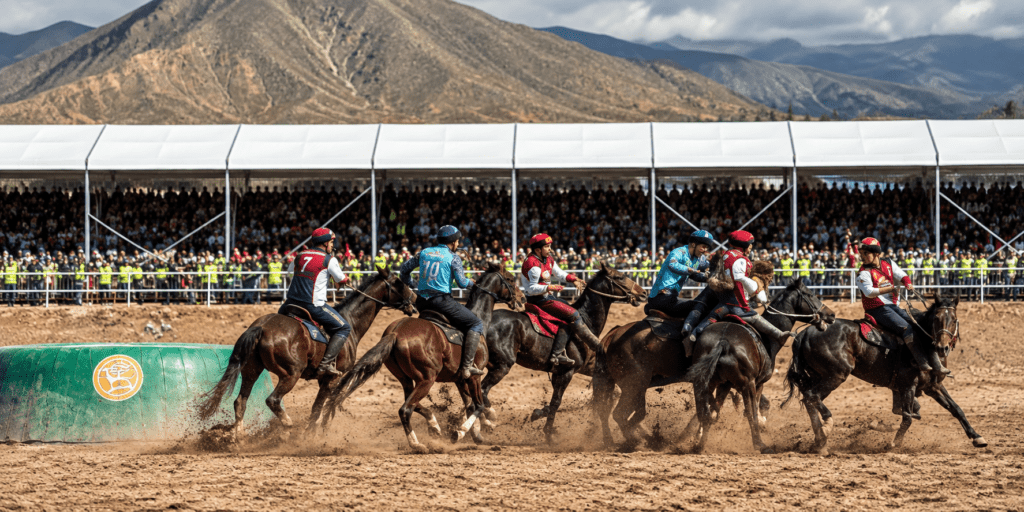
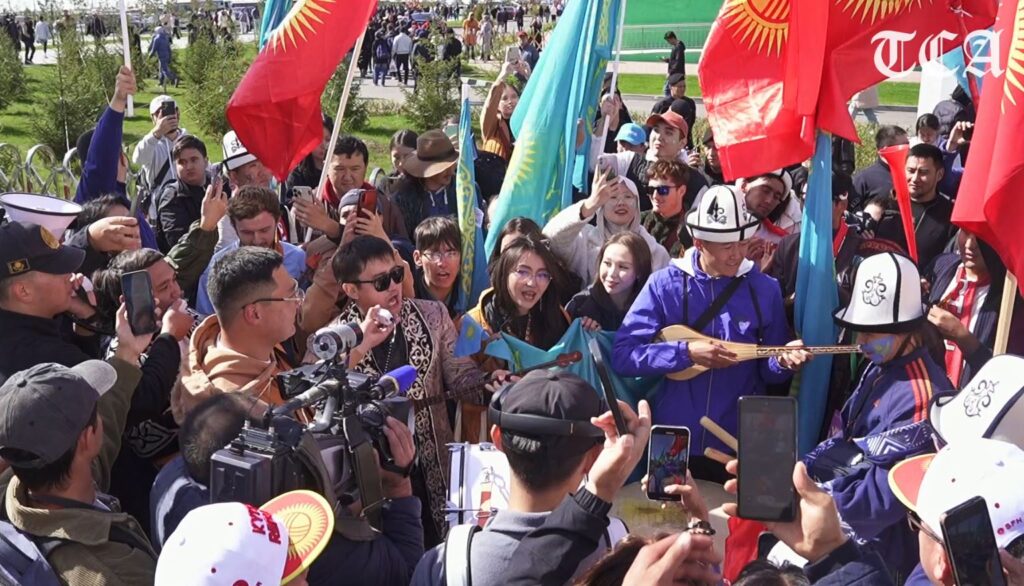
Kyrgyzstan has won the kok-boru title at the 6th World Nomad Games after overwhelming Kazakhstan 12-0 in Sunday’s final at the Kok-Boru Arena in Cholpon-Ata. The hosts dominated the match and shut Kazakhstan out entirely. In the third period, Baytegin Omorbekov, Ernazar Koshumbaev, and Mirbek Mukashev added to Kyrgyzstan’s total, before Anarbek uulu Seitbek scored again as the margin widened. [video width="478" height="850" mp4="https://timesca.com/wp-content/uploads/2026/09/A-gY_JlG.mp4"][/video] The victory gave Kyrgyzstan the gold medal, with Kazakhstan taking silver and Russia bronze. The medal ceremony was held later on Sunday in Cholpon-Ata. The sport combines horsemanship, strength, and close physical contact, and remains one of the biggest crowd draws at the Games. Kyrgyzstan also defeated Kazakhstan 7-2 in the kokpar final, completing a sweep of the two major mounted team events on the final day of competition. Before the final, several men reportedly tried to force their way through a police cordon into the stands and were detained. The incident did not disrupt the match.

Kyrgyzstan Beats United States 16-7 as Kok Boru Opens at World Nomad Games

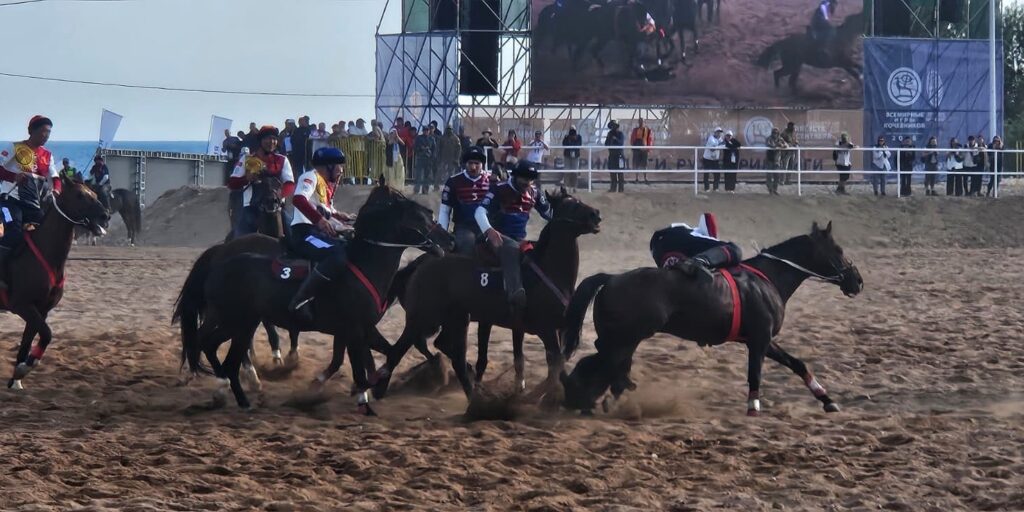
Two years after Kazakhstan beat Team USA in Astana, the Americans again faced a World Nomad Games host in kok boru. Kyrgyzstan won 16–7 at the Cholpon-Ata Kok Boru Arena on Wednesday, but the U.S. riders were a markedly different proposition from the side that failed to score in 2024. Kok boru, whose name means “gray wolf,” occupies a special place in Kyrgyz culture. UNESCO added it to the Representative List of the Intangible Cultural Heritage of Humanity in 2017, recognizing its place in the country’s cultural identity, while the arena commentator repeatedly described the sport as a point of national pride. Tradition traces the game to mounted hunters fighting for possession of a wolf killed while protecting livestock, an old practice later developed into a team contest. The modern game uses a prepared headless goat carcass, which a rider must carry across the field and get into the opposing tai kazan, the raised circular goal at either end. Kyrgyzstan restored the real carcass for these Games after Kazakhstan used a synthetic rubber serke in Astana, making the object’s weight and bulk unmistakable whenever a rider leaned almost to the sand to seize it. Under the current rules, four riders from each team compete on the field during three 15-minute periods. The carcass normally weighs 30–32 kilograms, and although riders may press one another with their bodies or use their horses to nudge for position, striking is prohibited. [video width="848" height="478" mp4="https://timesca.com/wp-content/uploads/2026/09/WhatsApp-Video-2026-09-02-at-21.55.39.mp4"][/video] Team USA started strongly, trading scores with Kyrgyzstan early and holding its own in the scrums for possession. Horses pressed flank to flank in what could look like an impossible embrace as riders bent low into the crush. When one came free with the goat held against the saddle, the tangle opened immediately into a gallop toward the tai kazan. Nurzhan Melisbek uulu opened the scoring for Kyrgyzstan after just 23 seconds, but Team USA answered and kept the opening exchanges close. By the middle of the first period, Kyrgyzstan had begun finding more openings and closed it 7–2. During the first break, Ennio Morricone’s theme from Sergio Leone’s A Fistful of Dollars played over the speakers in what appeared to be a nod to the American cowboys. The Americans returned to the field with renewed energy and scored almost immediately, with the board soon showing 8–3. Kyrgyzstan did not loosen its grip for long, but neither did the second period become the one-way procession seen in Astana. The hosts added five points to the Americans’ three, taking the cumulative score to 12–5. During the second period, U.S. No. 33 Zanen Pitts fell from his horse but quickly recovered. No. 2 Nick Willert was also back with Team USA, two years after explaining in a 2024 interview with The Times of Central Asia that the Americans combined techniques learned from Central Asian players with Western horsemanship. Finding suitable horses and having enough time to become familiar with them, he said, had always been a major difficulty for the team. Kyrgyzstan controlled...

Kok Boru and the Art of Being Noticed: The World Nomad Games as Kyrgyzstan’s Calling Card

A stampede throws up a great wall of dust as a scrum of white, sweating stallions tears past. A roar rises from the stands. With horsemen in hot pursuit, a rider bursts from the pack, swinging a 30-kilo plastic simulation of a goat carcass. As they charge toward the goal, the horses bare their teeth. This is the spectacle awaiting travelers from far and wide at this year’s World Nomad Games. For Kyrgyzstan, the Games are a source of pride. Born beside Lake Issyk-Kul, twelve years on, the sixth edition will see 100,000 visitors descend on a town of 13,000. The timing in 2026 makes the aspiration hard to ignore. The opening ceremony falls on Kyrgyzstan’s Independence Day, while leaders are also gathering in Bishkek for the Shanghai Cooperation Organization summit. Presidential spokesman Askat Alagozov has said 21 heads of state are expected. The Games will open before many of them in the new 51,000-seat Bishkek Arena. [caption id="attachment_54493" align="aligncenter" width="1774"] Image: International Secretariat of the World Nomad Games[/caption] Kyrgyzstan has spent more than a decade building toward this goal. The initiative was approved at the Turkic Council summit in Bishkek in 2012 before the first Games were staged in Cholpon Ata in 2014. Then, there were 583 athletes from 19 countries. Kyrgyzstan hosted again in 2016 and 2018, before the event moved to Turkey in 2022 and Kazakhstan in 2024. That decision could have diluted Kyrgyzstan’s ownership. Instead, each foreign edition strengthened the identity of the event Kyrgyzstan had started. In December 2025, founder Askhat Akibaev transferred the intellectual property rights to the Kyrgyz state. Cabinet Chairman Adylbek Kasymaliev called the Games “the flagship of our state’s cultural diplomacy.” Akibaev explained the achievement succinctly after the first three editions. “We proved to ourselves and the world that a small country can do something global,” he told RFE/RL. Kyrgyzstan cannot match major powers through stadium budgets or international sports leagues, but the Games have given it access to an audience money alone could not buy. The cultural case has also gained international recognition. In 2021, UNESCO selected “Nomad games, rediscovering heritage, celebrating diversity” for its Register of Good Safeguarding Practices. The program was praised for reviving traditional games and passing knowledge to younger generations, while bonding contestants across borders. [caption id="attachment_54490" align="aligncenter" width="1774"] Image: International Secretariat of the World Nomad Games[/caption] The numbers tell their own story. Astana brought together 2,500 athletes from 89 countries in 2024. This year, around 3,000 athletes are registered from 113 countries for 43 sports. Local organizers say the field now reaches far beyond states with a direct nomadic heritage, with newcomers expected from New Zealand and several African countries. Team GB offers one of the clearest examples. Britain competed in Astana in 2024, and is returning with a larger contingent. The team has expanded beyond tug-of-war and intellectual games into horseback archery and wrestling. The sole British competitor in the Alysh wrestling will be The Times of Central Asia contributor, Jonathan Campion. The British...

After Player’s Death, Kyrgyzstan Debates How to Make Kok Boru Safer

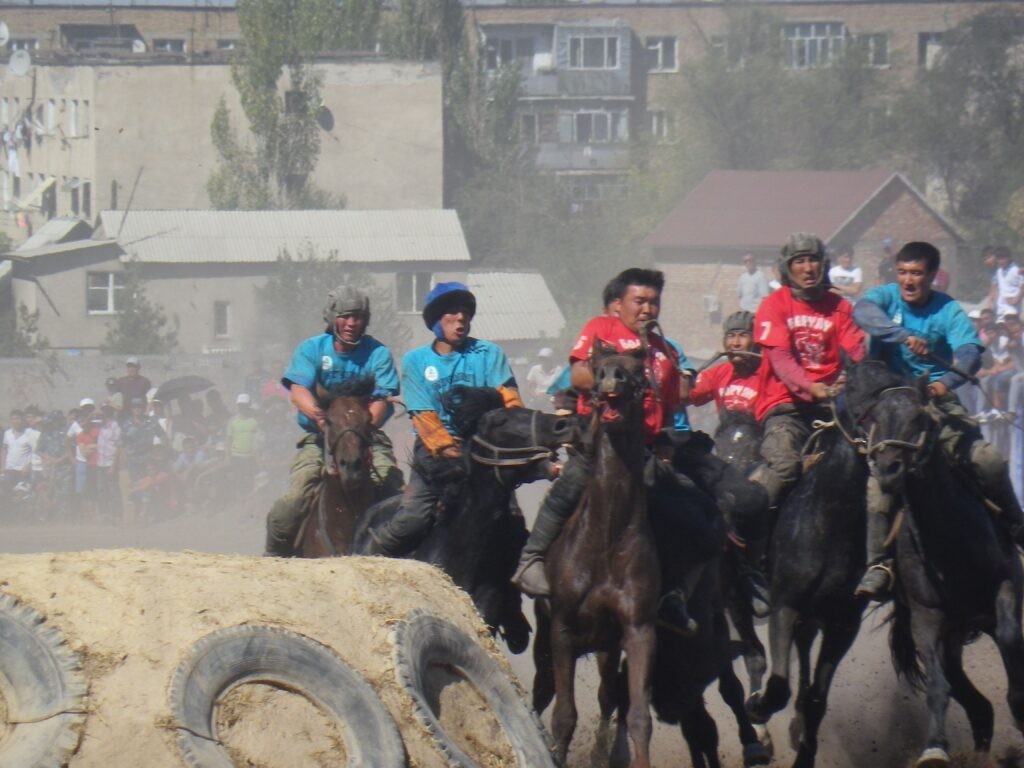
The death last month in Kyrgyzstan of a player of kok boru, a traditional game in which horse riders try to maneuver a headless goat carcass into an opposing team’s goal, has led to discussion in the parliament about whether a rough sport that is a source of regional pride should be made safer for man and horse alike. Mirlan Srazhdinov, a 45-year-old team captain, died during a game of kok boru at an equestrian stadium on the outskirts of Bishkek, Kyrgyzstan’s capital, on March 12. A video that circulated on various online platforms purportedly shows the accident in which Srazhdinov appears to bend down to the side of his horse – and then falls to the ground after another horse and rider crash into him next to a barrier on the side of the sandy playing area. The accident alarmed some lawmakers who view kok boru as an emblem of cultural identity in Kyrgyzstan and elsewhere in Central Asia, acknowledging that the sometimes chaotic scrums on the dusty field have caused harm to contestants but rejecting the idea of banning the game altogether. Kok boru, which is recognized by UNESCO, has a wider following in the region. Kazakhstan, for example, has a variant known as kokpar, and it is known as buzkashi in Afghanistan. The game featured in the World Nomad Games in Kazakhstan last year, using a mould as a modern replacement for the carcass. Srazhdinov had suffered a brain injury and multiple fractures, including one at the base of his skull, the 24.kg news agency reported, citing Bishkek’s Emergency Medicine Center. The player who collided with him was placed in pre-trial detention for two months, and the referee was placed under house arrest. Both have been charged in connection with the death of the team captain. At a parliamentary session, lawmaker Balbak Tulobaev said accidents can happen in any sport and that kok boru should continue to be played with some adjustments to reduce the chance of injury. “There are forces that want to ban the game of kok boru because of this. But we must not allow this," Tulobaev said last week, according to the Kloop news organization. Parliamentarian Ilimbek Kubanychbekov agreed, though he also said changes were necessary because players were getting hurt. Deputy Akkulu Berdiev had concerns about the perils of play near the taikazan, or goal where the goat carcass (or mould) is thrown. He said riders have suffered spinal and other injuries in this area, and horses haven’t been spared either. The taikazan is a raised circular structure with a hollowed out part in the middle. A manual of the rules of kok boru indicates that is very much a contact sport: “To increase interest in the game, forceful techniques are allowed, used by both horses and players, but not violating the rules of the game - player can accidentally hit others by a horse (not strike), players can push each other with their torsos and chests without touching each other’s hands....

A Bone of Contention: Kazakhstan and Kyrgyzstan at Loggerheads Following World Nomad Games Kokpar Final

Astana largely managed to turn the 5th World Nomad Games into an exemplary international sporting event free of politics and disagreements. Overall, the Games stood in stark contrast to the Olympics in Paris earlier this year, when the International Olympic Committee’s decision to allow a handful of athletes from Russia and Belarus to compete under a neutral flag led to calls from some counties for a boycott. However, the culmination of the Nomad Games saw an unpleasant incident at the final of the most popular event, which resulted in a fallout between Kazakhstan and Kyrgyzstan. [video width="1920" height="1080" mp4="https://timesca.com/wp-content/uploads/2024/09/nomad-game-2.mp4"][/video]   A blow with a kamcha On September 12, an incident occurred during the Kokpar final, in which the national teams of Kazakhstan and Kyrgyzstan met, when a player from the Kazakh team, which was underperforming, struck a Kyrgyz rider with a kamcha (whip). At this point, the game was stopped, and a squad of law enforcement officers immediately surrounded the culprit. After the offender was suspended from proceedings and given a time penalty, the game continued, and Kazakhstan, having leveled the score, won the match in overtime. The Kokpar final at the previous Nomad Games, hosted by Turkey, also ended with a marginal Kazakh victory in the derby between the long-standing rivals. However, unlike in 2022, this time the Kyrgyz national team did not accept defeat in silence. At the awards ceremony, the Kyrgyz team ripped off their silver medals, raised their country's flag, and defiantly left the arena. “We knew it would be unfair, but not to this extent. The referees were swearing at us, and the police were beating our players," the Kyrgyz captain said. "A KNB (national security) officer came up to me, showed me his ID card, took my picture, and started to intimidate me, saying I was sowing discord between nations. The pressure was strong. After the scuffle, when the score was 3-1 in our favor, we were asked to leave the game. They said the refereeing would be fair... We didn't think the Kazakhstani side would allow such disorganization and injustice. If Kazakhstanis have pride, they won't celebrate such a victory.” The press service of Kazakhstan's National Security Committee promptly denied the allegations, saying their officers were not involved in providing security for the Games. Tastanbek Yesentaev, the Chief Judge of the World Nomad Games in Astana, threatened the Kyrgyz team with a 2-3 year suspension from the competition for showing disrespect. This statement only served to further inflame proceedings. At a briefing on September 16, four days after the final, Ramis Kudaibergenov, an expert on the Kyrgyz Kok-Boru Federation, stated that the Kazakh national team committed 14 gross violations of rules in the final of the Kokpar, and given a level playing field, the Kyrgyz team would have won 5-1. “Everyone blames the referee, but the whole system is culpable. We prepared the players based on previous games, but there were so many infractions we didn't take into account. We were able to...

Video Highlights: World Nomad Games Day Five

On the fifth day of the World Nomad Games, themed as the “Gathering of the Great Steppe,” TCA soaked up the raucous atmosphere and took in the finals of the equestrian events, including the ever-popular kokpar and kok boru: [video width="1920" height="1080" mp4="https://timesca.com/wp-content/uploads/2024/09/nomad-game-1.mp4"][/video]