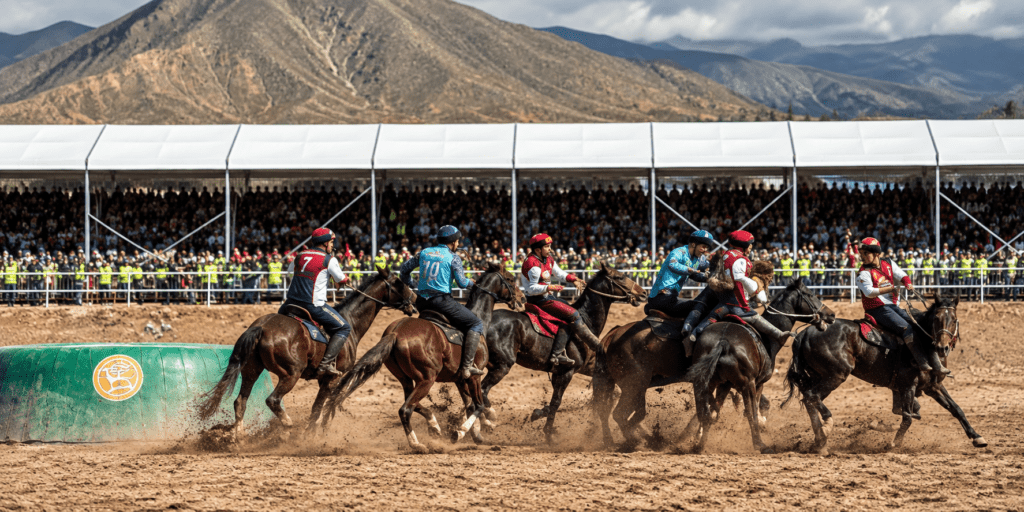
A stampede throws up a great wall of dust as a scrum of white, sweating stallions tears past. A roar rises from the stands. With horsemen in hot pursuit, a rider bursts from the pack, swinging a 30-kilo plastic simulation of a goat carcass. As they charge toward the goal, the horses bare their teeth. This is the spectacle awaiting travelers from far and wide at this year’s World Nomad Games.
For Kyrgyzstan, the Games are a source of pride. Born beside Lake Issyk-Kul, twelve years on, the sixth edition will see 100,000 visitors descend on a town of 13,000.
The timing in 2026 makes the aspiration hard to ignore. The opening ceremony falls on Kyrgyzstan’s Independence Day, while leaders are also gathering in Bishkek for the Shanghai Cooperation Organization summit. Presidential spokesman Askat Alagozov has said 21 heads of state are expected. The Games will open before many of them in the new 51,000-seat Bishkek Arena.
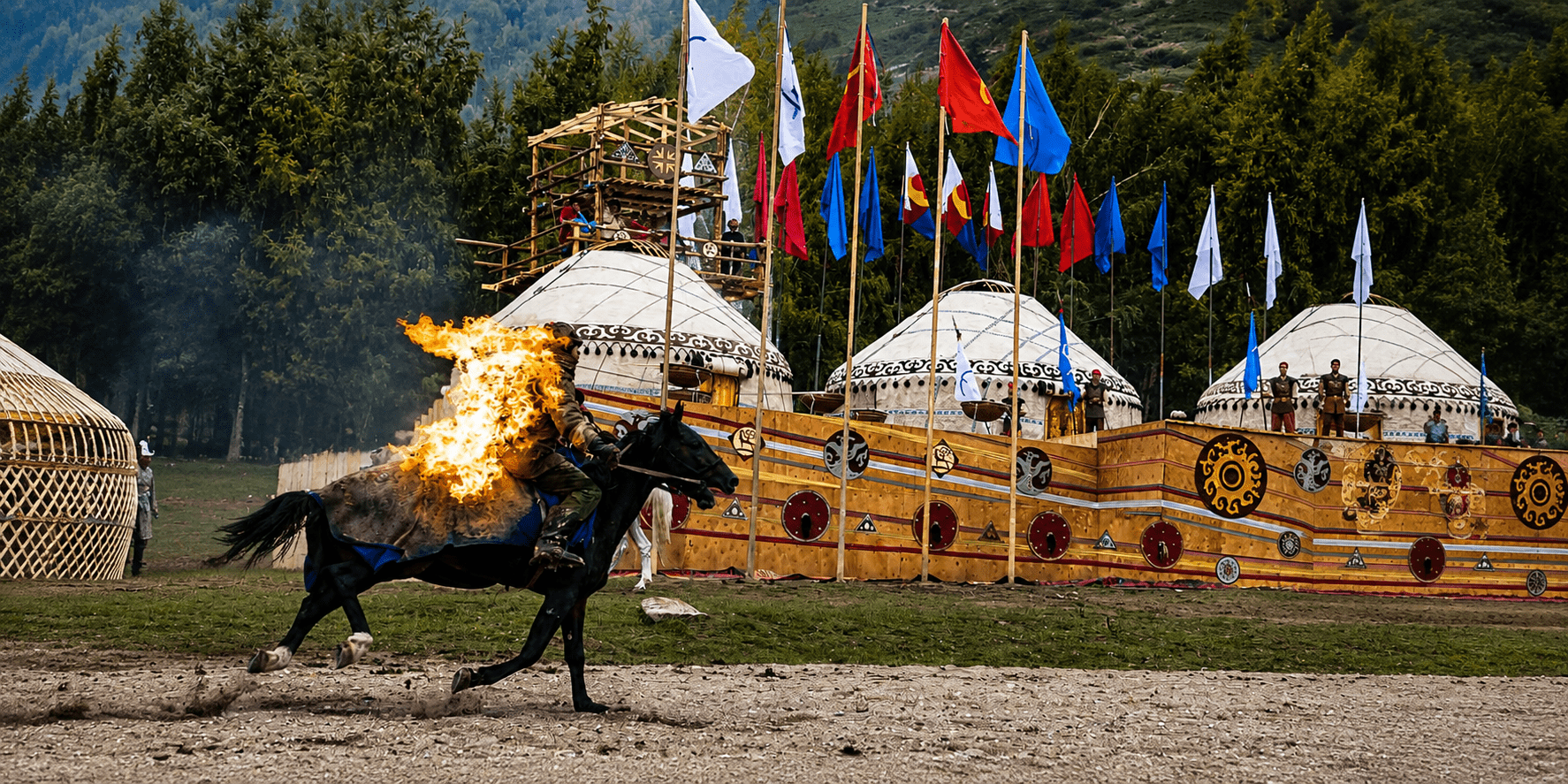
Image: International Secretariat of the World Nomad Games
Kyrgyzstan has spent more than a decade building toward this goal. The initiative was approved at the Turkic Council summit in Bishkek in 2012 before the first Games were staged in Cholpon Ata in 2014. Then, there were 583 athletes from 19 countries. Kyrgyzstan hosted again in 2016 and 2018, before the event moved to Turkey in 2022 and Kazakhstan in 2024.
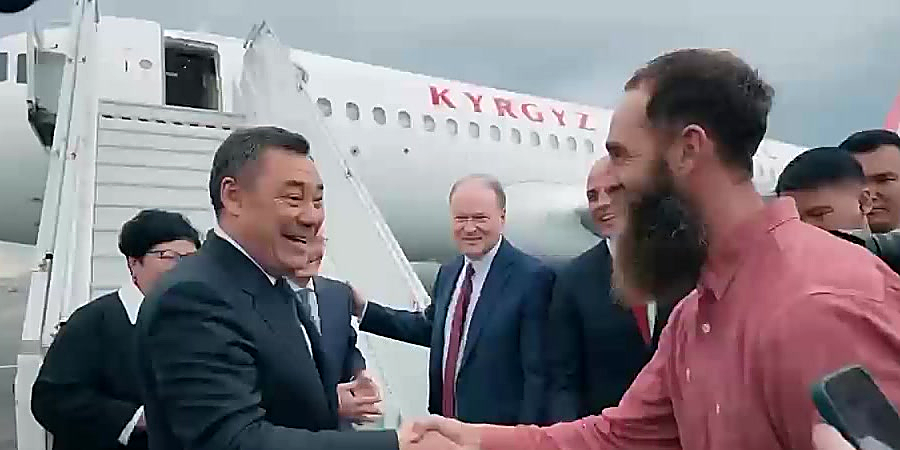
That decision could have diluted Kyrgyzstan’s ownership. Instead, each foreign edition strengthened the identity of the event Kyrgyzstan had started. In December 2025, founder Askhat Akibaev transferred the intellectual property rights to the Kyrgyz state. Cabinet Chairman Adylbek Kasymaliev called the Games “the flagship of our state’s cultural diplomacy.”
Akibaev explained the achievement succinctly after the first three editions. “We proved to ourselves and the world that a small country can do something global,” he told RFE/RL. Kyrgyzstan cannot match major powers through stadium budgets or international sports leagues, but the Games have given it access to an audience money alone could not buy.
The cultural case has also gained international recognition. In 2021, UNESCO selected “Nomad games, rediscovering heritage, celebrating diversity” for its Register of Good Safeguarding Practices. The program was praised for reviving traditional games and passing knowledge to younger generations, while bonding contestants across borders.
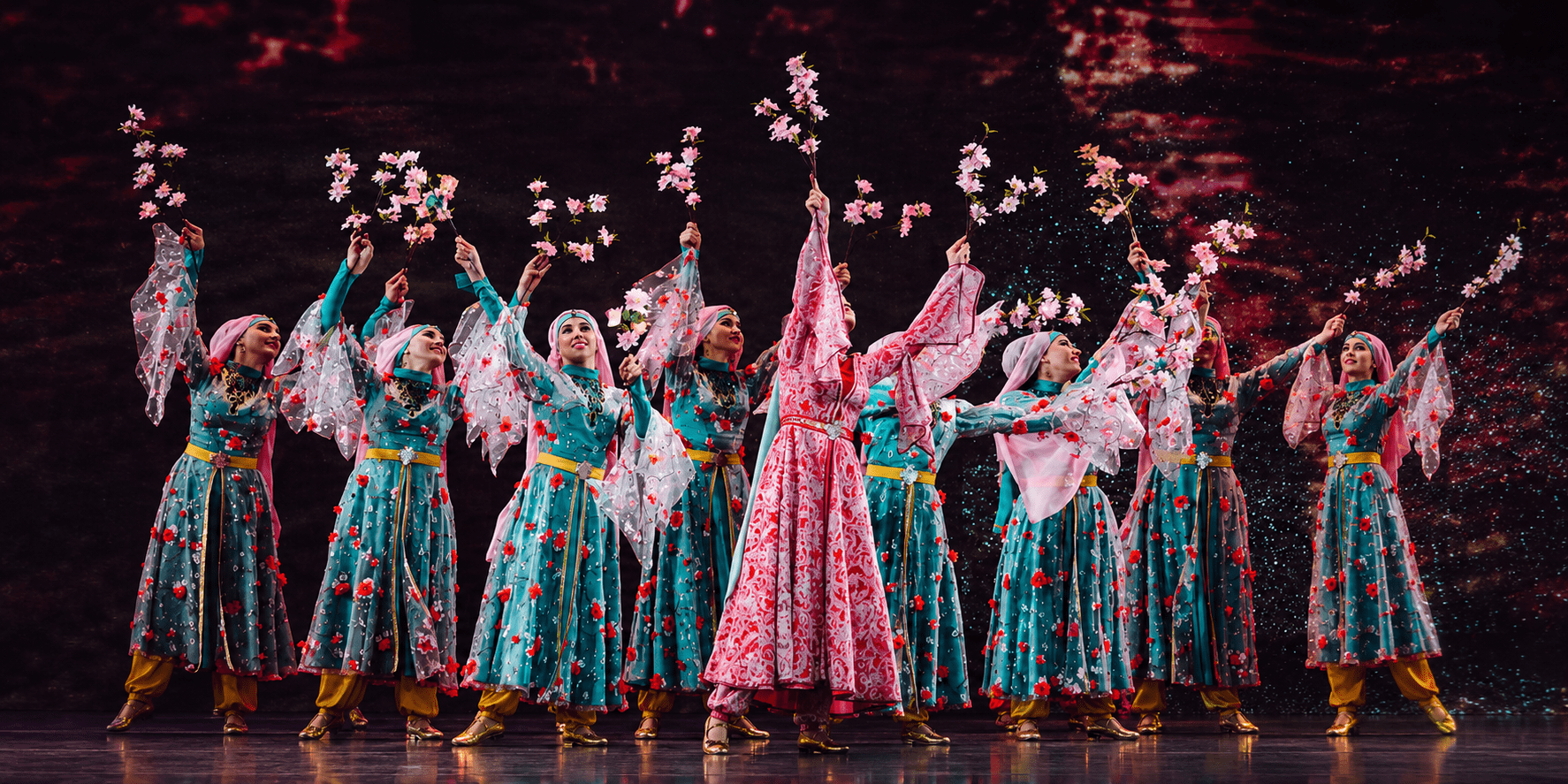
Image: International Secretariat of the World Nomad Games
The numbers tell their own story. Astana brought together 2,500 athletes from 89 countries in 2024. This year, around 3,000 athletes are registered from 113 countries for 43 sports. Local organizers say the field now reaches far beyond states with a direct nomadic heritage, with newcomers expected from New Zealand and several African countries.
Team GB offers one of the clearest examples. Britain competed in Astana in 2024, and is returning with a larger contingent. The team has expanded beyond tug-of-war and intellectual games into horseback archery and wrestling. The sole British competitor in the Alysh wrestling will be The Times of Central Asia contributor, Jonathan Campion.
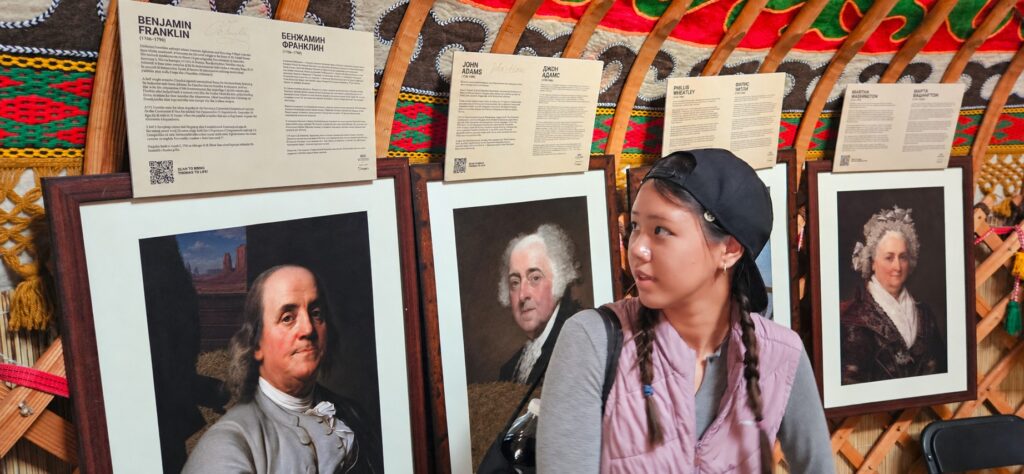
The British experience in Astana shows why the format is popular. Team GB described rival competitors helping with techniques during practice and inviting them to watch unfamiliar events. One athlete told TCA there was “a real community feel.” That kind of interaction does more for a country’s image than a glossy tourism slogan.
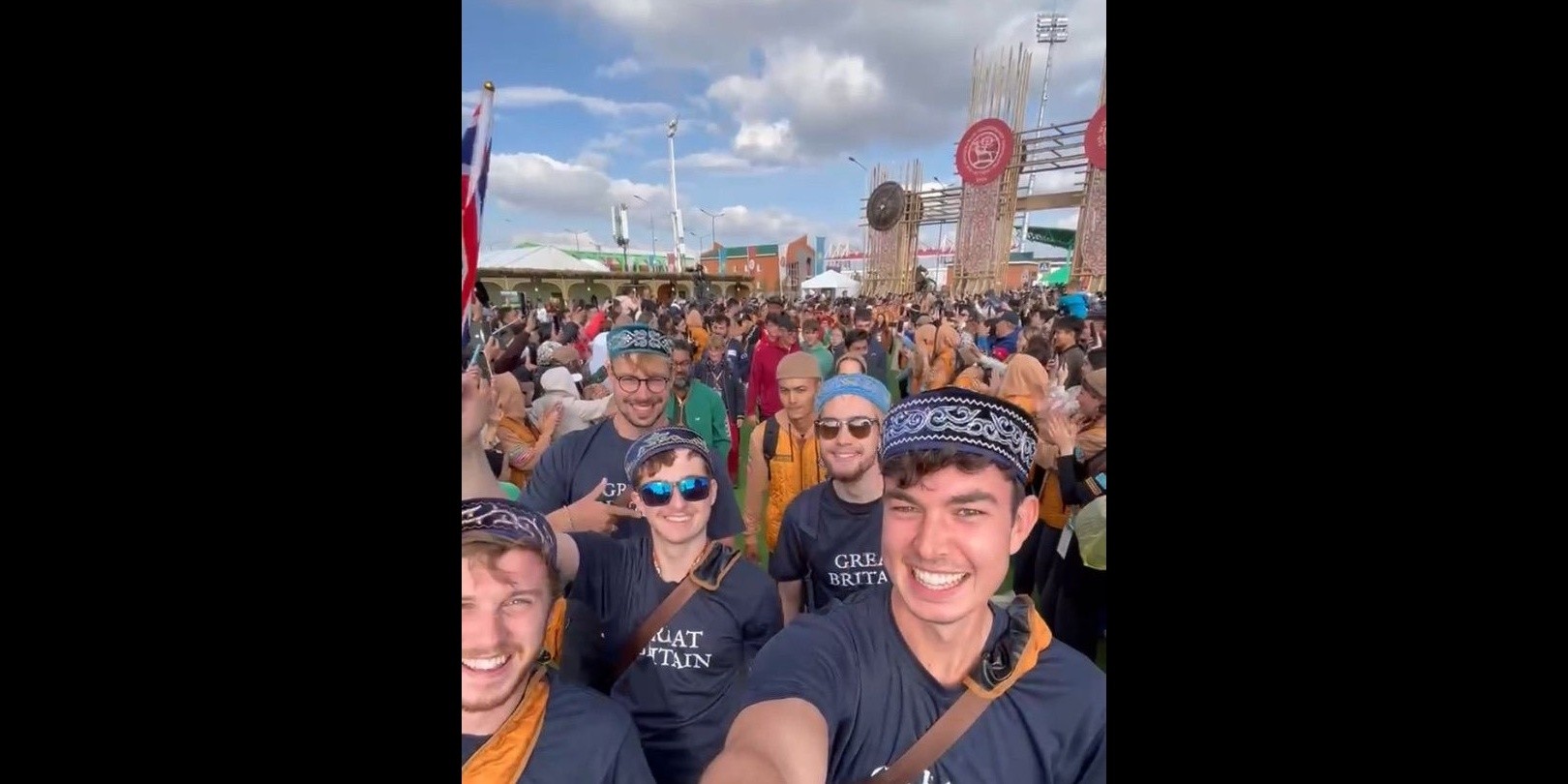
Image: Team GB
Kyrgyzstan also has an advantage that no branding agency could design. After the Bishkek opening, the Games move to Issyk-Kul, the vast alpine lake beneath the Tian Shan Mountains. Cholpon Ata will stage much of the sports, while Kyrchyn Gorge becomes the main cultural setting, with around 500 yurts planned across the ethno-town.
The sporting centerpiece is likely to be kok boru. Riders fight for control of a weighted serke at full gallop before driving toward the opposing goal. A new 10,000-seat arena at Issyk-Kul has been built for kok boru and kokpar. Organizers say the stands will be about ten meters from the field, rather than roughly 200 meters away at the hippodrome, allowing spectators to get up close and personal.
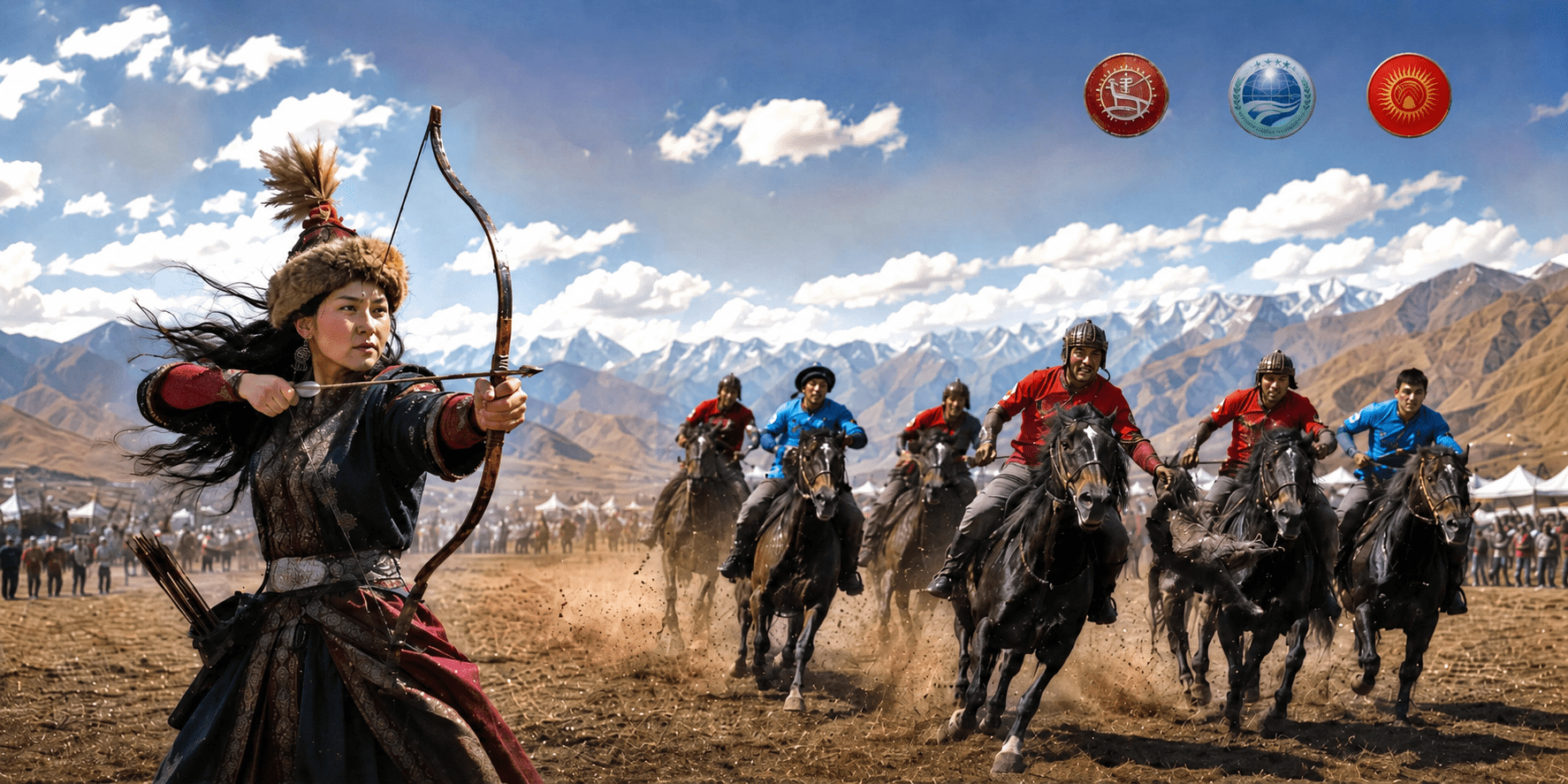
Wrestling and mounted archery are situated alongside horse racing, while hunting events with birds of prey bring a different rhythm to the program. These are living sports with formal rules and established federations. The rivalries are fierce, and the mountain setting will give them an authentic ambiance.
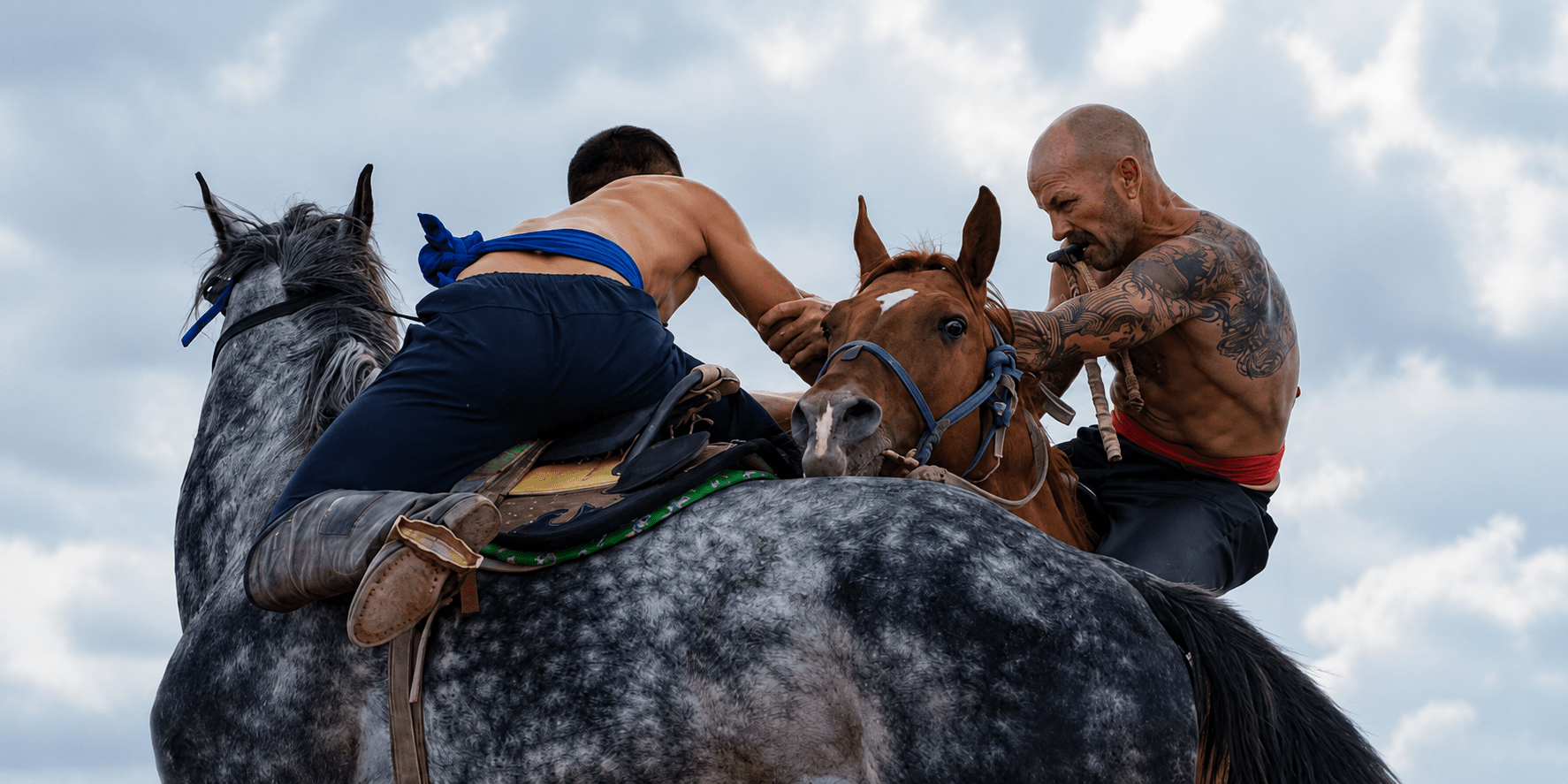
Image: International Secretariat of the World Nomad Games
The Games grew from a Kyrgyz initiative inside a Turkic political setting, so citing them as politically neutral is not quite accurate. In Astana, Russia and the United States competed alongside each other, with the Russian team appearing under its national flag. By then, the Games had become too large, too eclectic, and frankly too entertaining to be reduced to diplomatic alignments. Moscow and Washington arrived with their rivalry intact, but even geopolitics has to work hard to upstage kok boru.
The event also complements a broader diplomatic push. In June, Kyrgyzstan won its first seat on the UN Security Council. The result required backing well beyond Bishkek’s immediate partners. The Games operate in a different arena, but they reflect the same drive to make the state visible outside its sphere of influence.
Getting there is easier than the scale of the event might suggest. Tickets for the August 31 opening ceremony are on sale through Kyrgyzstan’s official ticketing platform from 5,000 som (about $57). Foreign buyers must provide passport or other identity-document details and complete Face ID verification. Tickets are personalized and non-transferable. On the day of the opening ceremony, private cars and taxis will not be permitted to access the Bishkek Arena directly, with spectators instead carried by dedicated shuttle buses from 22 points across the city.
TCA will be returning to capture all the exciting highlights with our on-the-ground World Nomad Games Special Coverage. Most competitions and cultural events are expected to be free. Organizers have said kok boru may require separate tickets. Tickets for the September 6 closing ceremony at Issyk-Kul have not yet gone on sale, although Culture Minister Mirbek Mambetaliyev has said they should cost between 1,000 and 5,000 som.
Visitors do not need to know the theory of soft power to understand the appeal. These are traditional sports played genuinely, in the landscape that forged them, by people who have crossed continents to take part. For one week, a place still absent from many Western travel itineraries will have a very good argument for being on them.
For more from our World Nomad Games 2026 special coverage, click here.