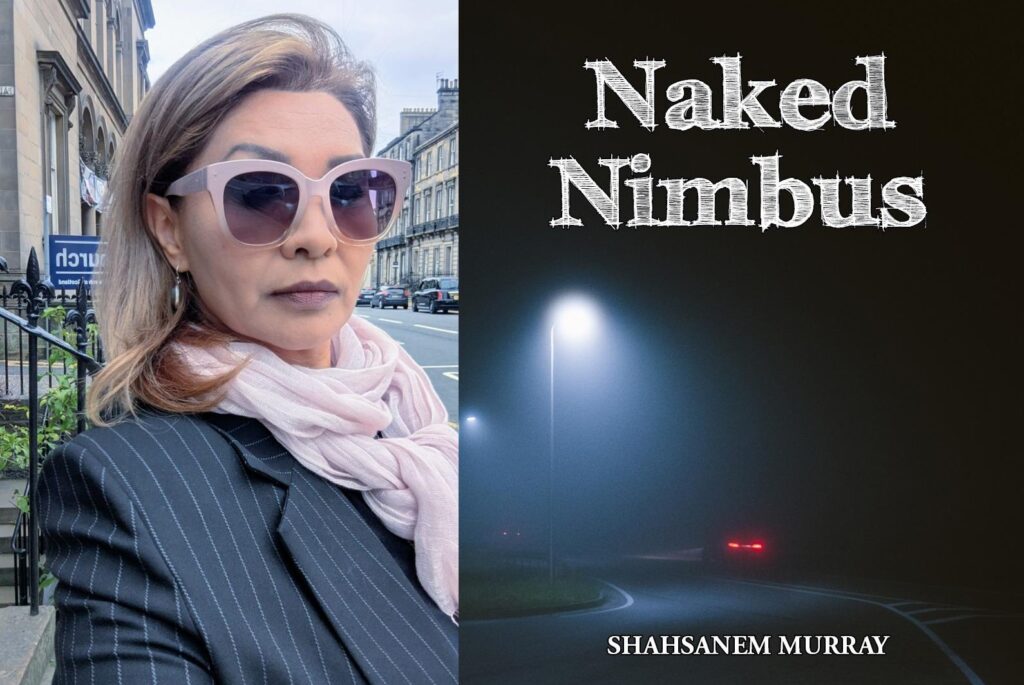
From Kyrgyzstan to Scotland: Shahsanem Murray’s Naked Nimbus Explores Love, Loss, and Belonging
In the wake of Finding the Holy Path, published in 2014, and Cold Shadows in 2016, Naked Nimbus is Shahsanem Murray’s long-awaited third novel. Once again, Murray’s multifaceted plot is woven with intrigue and mysticism, referencing the stark cultural contrasts between life in Central Asia under the Soviet regime and that in the West. The story focuses on Arthur, a young, ambitious artist struggling to find his way in the world and recognition for his craft. Haunted by his role in a fatal accident, he searches for atonement whilst battling to maintain his moral, personal, and professional integrity. Faced by numerous challenges, Arthur experiences a storm of emotions from despair to euphoria, and, highly sensitive to his surroundings and everyone he meets, the thin line between reality and fantasy blurs as he continues to hold out hope for true love. Friendships are put to a test, and he must muster the strength to forgive both himself and those closest to him for acts of disloyalty. Arthur’s journey takes him across the globe, from his Soviet homeland to Scotland, France, and finally, the wilds of Siberia. Often feeling dislocated, he finds himself questioning his identity and self-worth both as a man and an artist; a situation compounded by supernatural encounters. Murray further explores the human condition and the problems faced by society at large by introducing parallel stories of other characters’ lives, including Arthur’s acquaintances and his friend Alik’s father, Turdubek, as he searches for a soulmate under the Soviet regime. Like the Surrealist paintings which inspired it, this novel is filled with poignant visual imagery and symbolism, which, open to interpretation, lead the reader to ponder the outcome of events. Editor Laura Hamilton caught up with Shahsanem Murray to discuss the author’s new novel: LH: What is the meaning or inspiration behind the book’s title? SM: I wanted the title to be both poetic and to act as a key for the reader’s attention. After writing the first two chapters, I realized that the original title wouldn’t work. Then, one Sunday morning, my business partner Gordon Murray mentioned the word ‘nimbus.’ Unfamiliar with the term, I began searching for images and decided that ‘Naked Nimbus’ would be a perfect description of Arthur’s plight. As a man without wings, he is unable to fly, and so, if he is to soar in his life’s journey, he must explore, harness, and embrace the moral and cultural tenets of the society in which he lives and works. LH: The video trailer recreates the opening violent murder scene, but unlike typical crime fiction, the book focuses on its prolonged mental impact on the protagonist. Was it your intention that readers view crime from a different perspective? SM: The video trailer was carefully created as a marketing tool to entice readers. It sets the scene for the impact the accidental murder has on the protagonist’s life. I hope it doesn’t disappoint! [video width="1080" height="1920" mp4="https://timesca.com/wp-content/uploads/2025/10/WhatsApp-Video-2025-10-06-at-18.28.58.mp4"][/video] LH: In common with your previous novels, the new book...