Uzbekistan’s U.S. Package: What Supports the $12 Billion Figure?
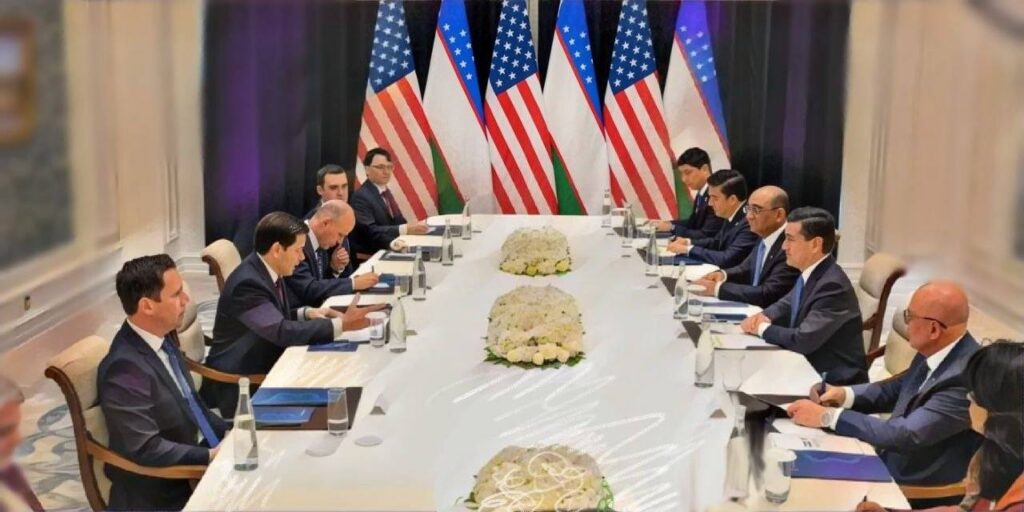
Uzbekistan announced a package of 54 agreements and prospective initiatives that it valued at about $12 billion during U.S. Secretary of State Marco Rubio’s visit to Samarkand on October 19. The Ministry of Investment, Industry and Trade lists engine supplies from GE Aerospace for new Uzbekistan Airways aircraft as part of the package. The investment ministry makes that value conditional on implementation. The presidency’s account says a comprehensive implementation program will be developed for the agreements and initiatives. October’s $12 billion may include projects still awaiting finance or development, but the values assigned to them must have an identifiable basis in project estimates or specific transactions. The official announcements identify counterparties and sectors, but the evidence examined does not provide the individual values needed to reconstruct the $12 billion total. Earlier Announcements and Additional Value In November 2025, Donald Trump announced that Uzbekistan would undertake roughly $35 billion in purchases and investment in American sectors over the following three years. The stated total did not separate the amounts assigned to purchases and investment. Uzbekistani purchases from American suppliers and investment in American sectors cannot be counted as an equivalent inflow of U.S. capital into Uzbekistan. Purchasing American equipment and receiving American investment give Uzbekistani participants different roles in the financing and implementation of projects. In September 2026, Investment Minister Laziz Kudratov said projects worth $7 billion had already been completed within a $35 billion portfolio. UzDaily described the figure as one-fifth of the value of the previous year’s agreements, without identifying the completed projects or defining completion. A transaction-level account would show what equipment was delivered, which facilities were commissioned, and what contract payments were made, giving the value and completion date of each transaction. October’s $12 billion cannot be added to the earlier figures without reconciling the transactions included in each package and the values assigned to them. The matching $35 billion figures do not establish that Kudratov and Trump referred to the same transaction list. An October agreement could introduce a fresh transaction or add obligations within an existing project, but it could also cover work already reflected in an earlier valuation. A company’s reappearance in successive announcements does not establish which relationship applies. What the Agreements Establish American Resources Corporation and ReElement Technologies announced an October 19 agreement with Uzbekistan Technological Metals Complex and the Fund for Reconstruction and Development, advancing their November 2025 memorandum. ReElement’s release describes a further stage of technical and commercial work under an existing partnership, but it provides no valuation showing how that work contributes to the $12 billion total. The companies report successful processing of Uzbek-sourced tungsten into high-purity oxide. The planned demonstration at ReElement’s U.S. facilities is intended to evaluate commercial viability, processing efficiency, and scalability; preliminary engineering and economic modeling concern possible refining operations in Uzbekistan. In the financial sector, the investment ministry describes Franklin Templeton, Oppenheimer, Citigroup, and BlackRock as helping to attract capital, but does not explain whether or how these arrangements contribute to the $12 billion...