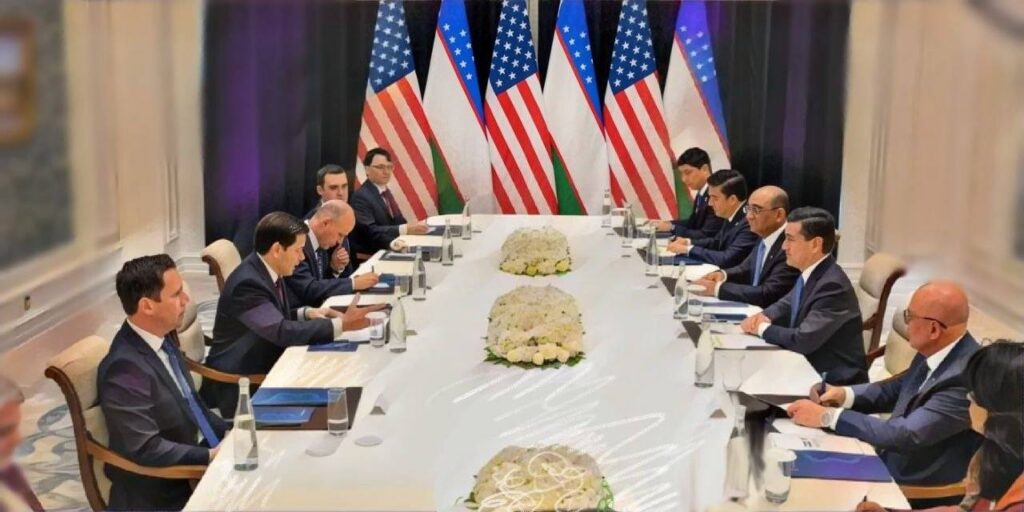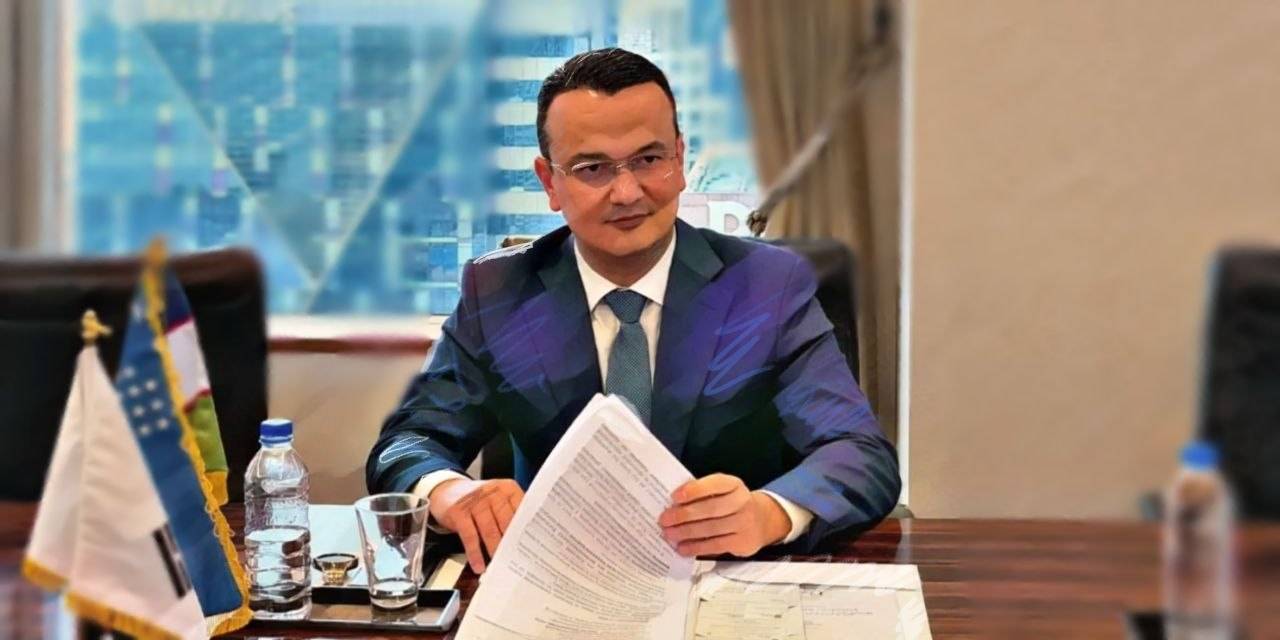
Uzbekistan announced a package of 54 agreements and prospective initiatives that it valued at about $12 billion during U.S. Secretary of State Marco Rubio’s visit to Samarkand on October 19. The Ministry of Investment, Industry and Trade lists engine supplies from GE Aerospace for new Uzbekistan Airways aircraft as part of the package. The investment ministry makes that value conditional on implementation. The presidency’s account says a comprehensive implementation program will be developed for the agreements and initiatives.
October’s $12 billion may include projects still awaiting finance or development, but the values assigned to them must have an identifiable basis in project estimates or specific transactions. The official announcements identify counterparties and sectors, but the evidence examined does not provide the individual values needed to reconstruct the $12 billion total.
Earlier Announcements and Additional Value
In November 2025, Donald Trump announced that Uzbekistan would undertake roughly $35 billion in purchases and investment in American sectors over the following three years. The stated total did not separate the amounts assigned to purchases and investment. Uzbekistani purchases from American suppliers and investment in American sectors cannot be counted as an equivalent inflow of U.S. capital into Uzbekistan. Purchasing American equipment and receiving American investment give Uzbekistani participants different roles in the financing and implementation of projects.
In September 2026, Investment Minister Laziz Kudratov said projects worth $7 billion had already been completed within a $35 billion portfolio. UzDaily described the figure as one-fifth of the value of the previous year’s agreements, without identifying the completed projects or defining completion. A transaction-level account would show what equipment was delivered, which facilities were commissioned, and what contract payments were made, giving the value and completion date of each transaction.
October’s $12 billion cannot be added to the earlier figures without reconciling the transactions included in each package and the values assigned to them. The matching $35 billion figures do not establish that Kudratov and Trump referred to the same transaction list. An October agreement could introduce a fresh transaction or add obligations within an existing project, but it could also cover work already reflected in an earlier valuation. A company’s reappearance in successive announcements does not establish which relationship applies.
What the Agreements Establish
American Resources Corporation and ReElement Technologies announced an October 19 agreement with Uzbekistan Technological Metals Complex and the Fund for Reconstruction and Development, advancing their November 2025 memorandum. ReElement’s release describes a further stage of technical and commercial work under an existing partnership, but it provides no valuation showing how that work contributes to the $12 billion total.
The companies report successful processing of Uzbek-sourced tungsten into high-purity oxide. The planned demonstration at ReElement’s U.S. facilities is intended to evaluate commercial viability, processing efficiency, and scalability; preliminary engineering and economic modeling concern possible refining operations in Uzbekistan.
In the financial sector, the investment ministry describes Franklin Templeton, Oppenheimer, Citigroup, and BlackRock as helping to attract capital, but does not explain whether or how these arrangements contribute to the $12 billion total. On October 21, InfinBANK announced a planned $300 million Eurobond placement arranged by Oppenheimer. This is proposed borrowing by InfinBANK, not a disclosed $300 million investment by Oppenheimer or a valuation of its arranging services.
The Central Bank’s October 21 account of the Samarkand meetings describes cooperation on financial infrastructure and reserve management but announces no financing amounts. Its earlier memorandum with BlackRock, signed in September, concerns cooperation on reserve management and expressly creates no investment mandate, transaction, or financial commitment for either party.
The presidency’s account of the Wabtec discussions covers locomotive supply, servicing, and local production but does not specify a procurement value or financing amount. The October 19 readout discusses participation by U.S. financial institutions, maintenance in Uzbekistan, component manufacturing, and personnel training.
In February 2026, the U.S. Export-Import Bank announced a heads-of-terms agreement advancing the bilateral industrial and infrastructure framework established the previous November. Further discussions in June focused on accelerating joint projects, but neither announcement identifies project-specific loan approvals or committed financing amounts. The October locomotive discussions with Wabtec referenced U.S. financial institutions but did not identify EXIM or disclose financing commitments.
Procurement, Borrowing, and Public Exposure
The conversion of eight options in November 2025 brought Uzbekistan Airways’ firm Boeing order to 22 aircraft. The September 2025 agreement had comprised a firm order for 14 aircraft and options for eight more. The U.S. Commerce Department attached an approximately $8.5 billion valuation to the agreement for up to 22 aircraft. The firm order does not by itself establish how much Uzbekistan Airways has borrowed. The official October accounts do not identify the earlier aircraft order as a component of the $12 billion package.
At a January 2026 press conference, the airline’s chairman put the start of aircraft deliveries around the end of 2030, with the schedule extending over three to four years. He cited expected 2025 net profit of more than $100 million to defend the purchase’s affordability, while declining to disclose the contract price. The chairman has stated the airline’s intention to borrow, but the sources examined do not establish agreed repayment terms or guarantees for the new order. Affordability depends on how the actual price and payment schedule relate to debt service and operating cash flows, rather than on the headline valuation alone.
Government guarantees on earlier aircraft loans show that repayment risk can extend beyond the airline itself. Those guarantees are recorded in the airline’s 2024 consolidated accounts and predate the new Boeing order; they do not establish whether its financing carries comparable guarantees. A guarantee can create contingent public exposure without making the entire purchase price an immediate budget expense. The new order’s public exposure therefore depends on its own borrowing and guarantee terms.
Implementation and Public Accountability
In March, Uzbekistan’s Agriculture Ministry reported that 33 irrigation systems had been installed in cooperation with Valmont across 1,569 hectares. Valmont also appears in the investment ministry’s October announcement. The systems are in Jizzakh and Tashkent regions. The ministry gives no dollar contribution from those installations to Kudratov’s $7 billion completion claim.
The government could show how it reached $12 billion by identifying the agreements and initiatives counted in the total and the values assigned to them. Such a breakdown should state each instrument’s status, identify its counterparties, and give the valuation basis and implementation period for the activity counted. Its account of the financing arrangements would specify who purchases or invests, who borrows, and who provides any public guarantee; procurement and financing for the same asset would be reconciled within the total. The government could publish these distinctions while protecting commercially sensitive clauses.
New locomotives supported by reliable servicing could improve transport performance, and domestic mineral refining could retain more processing activity in Uzbekistan. Their regional contribution would depend on connections with neighboring transport and production systems; their financing would determine repayment obligations and public exposure. The published announcements do not establish how the $12 billion total was calculated. They also provide insufficient detail on project costs, expected revenues, and financing terms for investors to assess affordability or judge whether expected returns justify the costs. The promised implementation program could address these gaps if published with an itemized account of what the total includes, how its components were valued, and their costs, revenue assumptions, and financing arrangements.