• KGS/USD = 0.01144 0%
  • KZT/USD = 0.00209 0%
  • TJS/USD = 0.10820 0.28%
  • UZS/USD = 0.00008 0%
  • TMT/USD = 0.28490 0%
  • KGS/USD = 0.01144 0%
  • KZT/USD = 0.00209 0%
  • TJS/USD = 0.10820 0.28%
  • UZS/USD = 0.00008 0%
  • TMT/USD = 0.28490 0%
  • KGS/USD = 0.01144 0%
  • KZT/USD = 0.00209 0%
  • TJS/USD = 0.10820 0.28%
  • UZS/USD = 0.00008 0%
  • TMT/USD = 0.28490 0%
  • KGS/USD = 0.01144 0%
  • KZT/USD = 0.00209 0%
  • TJS/USD = 0.10820 0.28%
  • UZS/USD = 0.00008 0%
  • TMT/USD = 0.28490 0%
  • KGS/USD = 0.01144 0%
  • KZT/USD = 0.00209 0%
  • TJS/USD = 0.10820 0.28%
  • UZS/USD = 0.00008 0%
  • TMT/USD = 0.28490 0%
  • KGS/USD = 0.01144 0%
  • KZT/USD = 0.00209 0%
  • TJS/USD = 0.10820 0.28%
  • UZS/USD = 0.00008 0%
  • TMT/USD = 0.28490 0%
  • KGS/USD = 0.01144 0%
  • KZT/USD = 0.00209 0%
  • TJS/USD = 0.10820 0.28%
  • UZS/USD = 0.00008 0%
  • TMT/USD = 0.28490 0%
  • KGS/USD = 0.01144 0%
  • KZT/USD = 0.00209 0%
  • TJS/USD = 0.10820 0.28%
  • UZS/USD = 0.00008 0%
  • TMT/USD = 0.28490 0%

Viewing results 1 - 6 of 4

Masdar Launches Construction of $1.4 Billion Wind Farm in Southern Kazakhstan

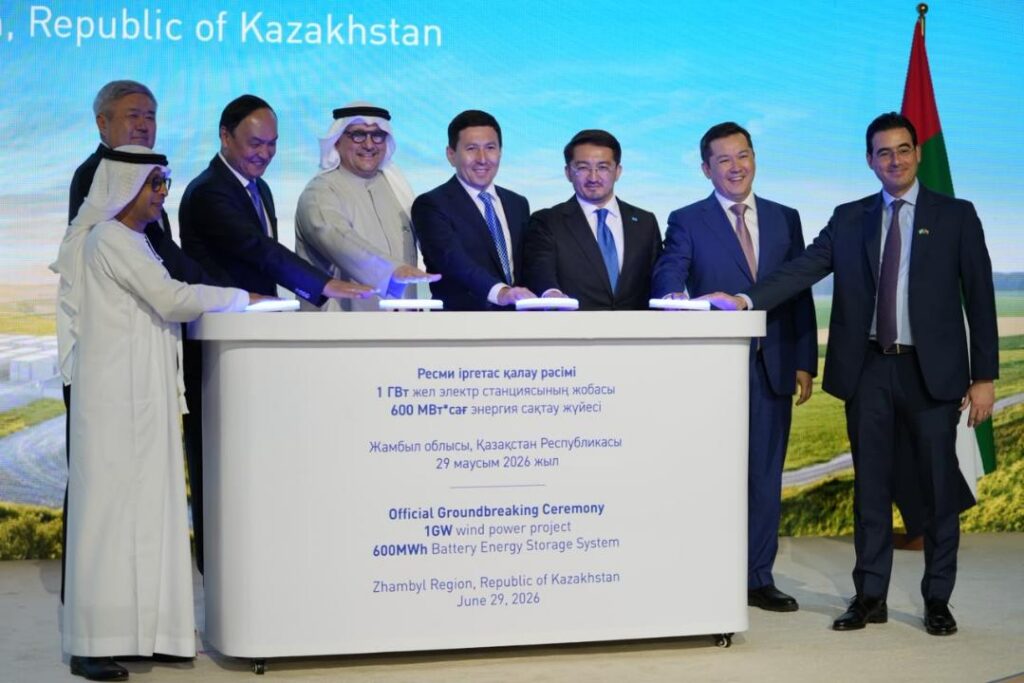
Construction has begun on one of Kazakhstan’s largest renewable energy projects, a 1-gigawatt wind power plant in the southern Zhambyl Region, as the country moves to address energy shortages and expand green generation capacity. The $1.4 billion project is being developed by a consortium of Kazakhstani companies and investors from the United Arab Emirates. The shareholders include Abu Dhabi-based clean energy company Masdar with a 40% stake, W Solar with 40%, Kazakhstan’s Qazaq Green Power, part of the Samruk-Kazyna fund, with 18%, and the Kazakhstan Investment Development Fund with 2%. The official groundbreaking ceremony took place on June 29 in a teleconference format, with the launch signal given from Astana by Kazakhstan’s Vice Minister of Energy Sungat Yessimkhanov, Samruk-Kazyna CEO Nurlan Zhakupov, and Masdar CEO Mohamed Jameel Al Ramahi. Commercial operations are scheduled to begin in the third quarter of 2029. “Partnership with Masdar contributes to the development of renewable energy and Kazakhstan’s progress toward carbon neutrality,” Yessimkhanov said. “This project will strengthen regional energy security and bring advanced technologies into the renewable energy sector.” The project’s key technical feature is its integration of wind generation with battery energy storage. The facility will include an energy storage system with a capacity of 300 MW and storage volume of 600 MWh. Officials say the battery system will help address one of the main challenges of renewable energy by stabilizing electricity supply during fluctuating weather conditions and peak evening demand. The wind farm is expected to reduce carbon dioxide emissions by 2.5 million tons annually, supporting Kazakhstan’s national climate targets. Masdar has been expanding its presence across Central Asia. In 2024, Uzbekistan signed an agreement with the UAE company to build Central Asia’s first solar power plant with battery storage in the Bukhara region. In 2022, Masdar also reached an agreement with Turkmenistan to build the country’s first utility-scale solar plant, with a planned capacity of 100 MW. The company faces growing competition from Chinese firms in the region. In May, China Energy International Group launched construction of a 500-MW wind farm in central Kazakhstan. Kazakhstan aims to generate 15% of its electricity from renewable sources by 2030 as part of its broader strategy to reduce dependence on coal and improve long-term energy security.

Foreign Investment in Uzbekistan Gains Strong Momentum

Foreign direct investment remains one of Uzbekistan’s key tools for supporting sustainable economic growth. The country is expanding capital inflows to finance large-scale projects in the power sector, industry, and infrastructure. According to the Eurasian Development Bank (EDB), accumulated investment in Uzbekistan from countries in the Eurasian region, China, the Gulf states, and Turkey reached $32.9 billion in 2025, 2.6 times the 2020 level. Over the five-year period, the total rose by more than $20 billion, making Uzbekistan one of the most active investment destinations in Eurasia. China remains the largest investor in Uzbekistan’s economy, with accumulated investment reaching $10.7 billion, more than five times the level recorded five years earlier. More than half of Chinese investment was directed into the power sector, mainly solar and wind energy projects. More than $3.3 billion went into industrial projects, including petrochemicals, automotive manufacturing, and construction materials production. The Gulf states recorded the fastest investment growth in Uzbekistan. Over five years, investment volumes rose nearly 19 times to $8.3 billion. Around 90% of these funds are concentrated in power generation and renewable energy projects. The largest investors include ACWA Power, with projects worth $4 billion, as well as Masdar and the Uzbek-Oman Investment Company. Turkey increased its investment in Uzbekistan 5.5 times to $3.1 billion, mainly in the power and manufacturing sectors. Among the leading Turkish investors is Aksa Energy, which is building thermal power plants across several regions of the country. Other Turkish firms are involved in beverage production, construction materials, and cement manufacturing. Thirteen countries in the Eurasian region, including the Commonwealth of Independent States, Georgia, Mongolia, and Ukraine, invested $10.8 billion in Uzbekistan, primarily in oil, gas, and petrochemicals. Russia remains the largest source of investment among these countries. Kazakhstan’s role has also expanded, with its investment in Uzbekistan rising more than 11 times to nearly $700 million. Speaking at the 5th Tashkent International Investment Forum on June 17, Uzbekistan’s President Shavkat Mirziyoyev said the country had attracted more than $150 billion in foreign investment over recent years, including $123 billion over the past five years. According to Uzbekistan’s Ministry of Investment, Industry and Trade, the total volume of investments implemented in the country in 2025 reached $43.1 billion, up 24% from the previous year. The ministry said foreign direct investment accounted for $38.2 billion, while funding from international financial institutions totaled $4.9 billion. In its macroeconomic outlook for 2026-2028, the EDB forecasts that Uzbekistan’s economy will grow by around 6.8% in 2026, supported by strong investment activity and favorable gold prices. Inflation is expected to continue declining toward the Central Bank of Uzbekistan’s target and may slow to 6.7% by the end of 2026. The EDB also said the national currency would be supported by high remittance levels and growth in metal exports.

TotalEnergies Launches Wind Farm Project in Southern Kazakhstan

French energy company TotalEnergies has launched construction of the Mirny wind farm, a 1-gigawatt renewable energy project in Kazakhstan’s Moyinkum District in the Zhambyl Region. Once completed, the facility is expected to become one of the largest wind power installations in Central Asia. The project provides for the installation of around 150 wind turbines supplied by Envision and SANY. It will also include a 600-megawatt-hour energy storage system developed by the French battery manufacturer Saft, designed to improve grid stability and optimize power distribution. Total investment in the project is estimated at about $1.1 billion. The wind farm is scheduled to be commissioned in the fourth quarter of 2028. Annual electricity generation is projected to reach up to 4 billion kilowatt-hours, which could reduce carbon dioxide emissions by at least 3.2 million tons per year. Kazakhstan’s authorities view the expansion of renewable energy as a key component of efforts to reduce the country’s carbon footprint. National greenhouse gas emissions stood at 375.4 million tons in 2020, declined to 328.4 million tons in 2021, and rose again to 353 million tons in 2022, according to previously reported data. The energy sector remains the largest source of emissions, accounting for approximately 281.9 million tons of greenhouse gases in 2022. The Ministry of Energy has said the TotalEnergies project will contribute to the development of green energy, strengthen energy security, and support the country’s broader decarbonization goals. Authorities also plan further expansion of renewable capacity. Ten new projects with a combined capacity of 245 megawatts are expected to be launched this year, covering wind, solar, and hydroelectric generation. Together with existing facilities, they are projected to produce around 8.8 billion kilowatt-hours of electricity. In addition to the Mirny wind farm, other major renewable initiatives involving foreign investors are underway. These include a $1.4 billion wind power project backed by the United Arab Emirates’ Masdar, as well as wind and solar developments led by China Power and China Energy in several regions. Competitive auctions remain the main mechanism for expanding renewable energy capacity. Kazakhstan plans to allocate 6.7 gigawatts of new capacity through auctions between 2024 and 2027. In the longer term, the government aims to bring more than 8 gigawatts of renewable energy capacity online by 2035. As previously reported by The Times of Central Asia, officials have also said the country intends to eliminate its electricity deficit and begin exporting power by 2027.

Opinion: Uzbekistan’s Winds of Change – A Blueprint for Renewable Energy Transformation in Central Asia

For much of its post-Soviet history, Uzbekistan’s energy system has been defined by natural gas. Its abundant domestic reserves provide a cheap and reliable source of electricity generation, export revenues, and industrial growth. However, this reliance has come at a cost, including vulnerability to fossil fuel volatility, carbon emissions inconsistent with global climate commitments, and an energy profile increasingly at odds with international investment trends. Today, a new landscape is emerging in Uzbekistan’s energy sector. The vast steppes and desert plateaus of the Karakalpakstan and Navoi regions have emerged as some of the most promising areas for wind turbines and energy sector development. This transformation could redefine not only Uzbekistan’s energy security but also the regional energy map of Central Asia. A Decade in the Making: From Pilot to Pioneer This story begins in 2020, when the United Arab Emirates’ renewable energy developer Masdar signed an agreement to construct the Zarafshan Wind Farm in the Navoi region. Initially, this was not a pilot project, as its proposed capacity was about 500 MW, making it the largest wind project among the Central Asian countries at the time. Its symbolism pulsed with an energy no less powerful than the current itself. For Uzbekistan, which had no operating commercial wind capacity, the project marked a significant shift from concept to execution. The Zarafshan Wind Farm reached financial close in 2020, commenced construction in 2022, and was officially inaugurated in December 2024 by Uzbekistan’s President Shavkat Mirziyoyev. Developer reports describe it as one of the largest operational wind farms in Central Asia. It represented a step forward toward sustainability and a message of resolve for energy resilience. In a region where fossil fuels still dominate, Uzbekistan has positioned itself as a regional leader in large-scale wind energy production.. Scaling Beyond Zarafshan: Kungrad and Nukus The breakthrough at the Zarafshan Wind Farm signaled the dawn of a larger journey. Subsequently, Saudi Arabia’s ACWA Power, a giant in renewable energy, agreed to set up the Kungrad Wind IPP. This project includes a transformative complex of three 500 MW wind farms with a total capacity of 1.5 GW of power generation. According to project plans, it will also be accompanied by a 300 MW battery energy storage system (BESS) and roughly 1,450 kilometers of new transmission infrastructure. This single project surpasses Uzbekistan’s earlier renewable efforts and, when completed, will represent one of the most significant clean energy undertakings in the region. Similarly, the Nukus II wind farm-plus-storage project, which secured financing from the Asian Development Bank (ADB) and other partners in mid-2025, seeks to expand renewable energy use, reduce reliance on fossil fuels, cut greenhouse gas emissions, and strengthen energy security. It includes building and operating a 200 MW wind power plant, a 100 MWh battery storage system, a 44 km transmission line, and an upgrade of the 220 kV Beruniy substation. This integration of renewables with flexible storage represents a new phase of Uzbekistan’s energy transition, one where renewables are not simply added to the grid...