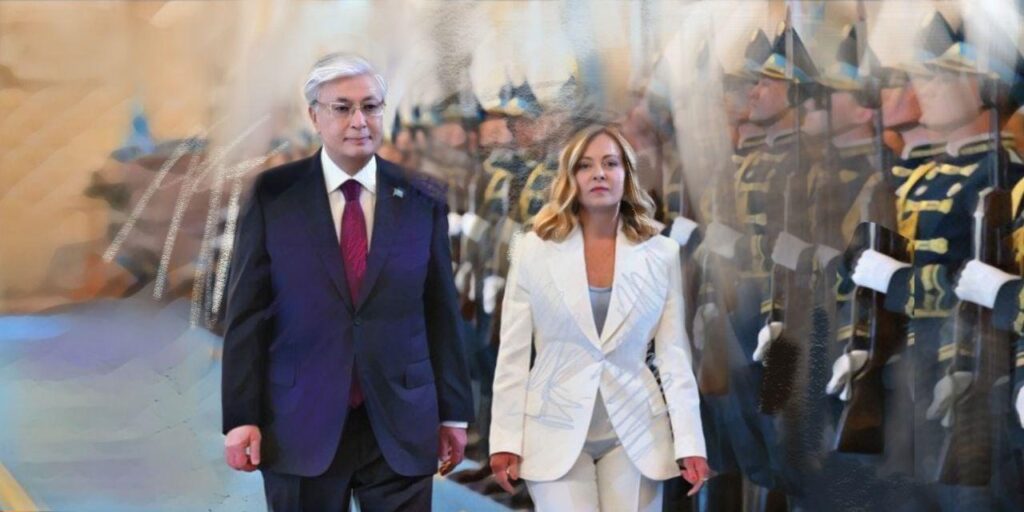
Kazakhstan and Italy Forge a New Strategic Nexus
Italian Prime Minister Giorgia Meloni's visit to Kazakhstan marks a pivotal moment in the deepening relationship between the two nations. This diplomatic mission comes on the heels of historical ties reinforced by Pope Benedict XVI’s 2022 visit to the Central Asian nation, where he met with President Kassym-Jomart Tokayev. Benedict’s trip was a testament to Kazakhstan’s role in promoting interfaith dialogue and global peace, a legacy that continues to shape its international relationships. Now, with a new American Pope at the helm of the Vatican, Meloni has renewed Italy’s commitment to strengthening its partnership with Kazakhstan. Her meeting with Tokayev and participation in the C5+Italy Summit underline her focus on fostering collaboration in energy diversification, regional stability, and economic growth. The terms for Meloni’s arrival in Astana were set by Kazakhstan’s previous engagements with Italy, including President Kassym-Jomart Tokayev’s visit to Rome in early 2024 and his meeting with Meloni in Abu Dhabi in January 2025. Those substantive bilateral talks set the bilateral agenda in the joint context of Italian active Eurasian diplomacy and Kazakhstan’s own strategic vision. Meloni’s direct discussions with Tokayev focused on deepening bilateral diplomatic and economic ties; expanding cooperation in energy, trade, and defense; and discussing regional security and joint training programs. As she put it prior to departing Italy, “This visit confirms the strategic value of our collaboration and the excellent level of relations between our nations.” Kazakhstan’s geography, resource wealth, and evolving political posture since independence over a third of a century have also enabled it to craft a nuanced foreign policy balancing traditional ties with Russia and China against emerging alignments with Europe and beyond. Italy’s diplomacy, underpinned by proactive outreach and sustained by major trade and investment flows, has become Kazakhstan’s principal EU partner and third-largest global trading counterpart. Meloni’s engagement with Kazakhstan underscores her broader strategic vision of positioning Italy as a pivotal player in the evolving geopolitical landscape. Central to this ambition is her ability to connect Italy’s foreign policy with global power structures, including her relationship with former U.S. President Donald Trump, a bond that has bolstered both her personal stature and Italy’s diplomatic leverage. This alignment, rooted in shared ideologies of nationalism and sovereignty, allows Italy to project itself as a transatlantic bridge linking Europe, the United States, and strategically critical regions like Central Asia. Beyond energy and trade, Italy’s approach aims to institutionalize its presence in the region, as demonstrated by the simultaneous hosting of the Central Asia–Italy Summit, which builds on the “5+1” dialogue launched in 2019 and its 2024 iteration at the foreign-ministerial level. Convening this summit at the head-of-government/head-of-state level in Astana subtly underscores Kazakhstan’s linchpin role in regional coordination and Italy’s capacity to frame its engagement as a multilateral and strategic enterprise. Meloni’s ambitions extend to securing Italy’s role in stabilizing ties with Central Asia and former Soviet states. For instance, strengthening relationships with energy-rich nations like Kazakhstan underpins her focus on energy diversification, critical for reducing Europe’s reliance on Russian gas while...