• KGS/USD = 0.01144 0%
  • KZT/USD = 0.00205 0%
  • TJS/USD = 0.10722 0%
  • UZS/USD = 0.00008 0%
  • TMT/USD = 0.28490 0%
  • KGS/USD = 0.01144 0%
  • KZT/USD = 0.00205 0%
  • TJS/USD = 0.10722 0%
  • UZS/USD = 0.00008 0%
  • TMT/USD = 0.28490 0%
  • KGS/USD = 0.01144 0%
  • KZT/USD = 0.00205 0%
  • TJS/USD = 0.10722 0%
  • UZS/USD = 0.00008 0%
  • TMT/USD = 0.28490 0%
  • KGS/USD = 0.01144 0%
  • KZT/USD = 0.00205 0%
  • TJS/USD = 0.10722 0%
  • UZS/USD = 0.00008 0%
  • TMT/USD = 0.28490 0%
  • KGS/USD = 0.01144 0%
  • KZT/USD = 0.00205 0%
  • TJS/USD = 0.10722 0%
  • UZS/USD = 0.00008 0%
  • TMT/USD = 0.28490 0%
  • KGS/USD = 0.01144 0%
  • KZT/USD = 0.00205 0%
  • TJS/USD = 0.10722 0%
  • UZS/USD = 0.00008 0%
  • TMT/USD = 0.28490 0%
  • KGS/USD = 0.01144 0%
  • KZT/USD = 0.00205 0%
  • TJS/USD = 0.10722 0%
  • UZS/USD = 0.00008 0%
  • TMT/USD = 0.28490 0%
  • KGS/USD = 0.01144 0%
  • KZT/USD = 0.00205 0%
  • TJS/USD = 0.10722 0%
  • UZS/USD = 0.00008 0%
  • TMT/USD = 0.28490 0%

Viewing results 1 - 6 of 45

Uzbekistan to Build a Nuclear Power Plant

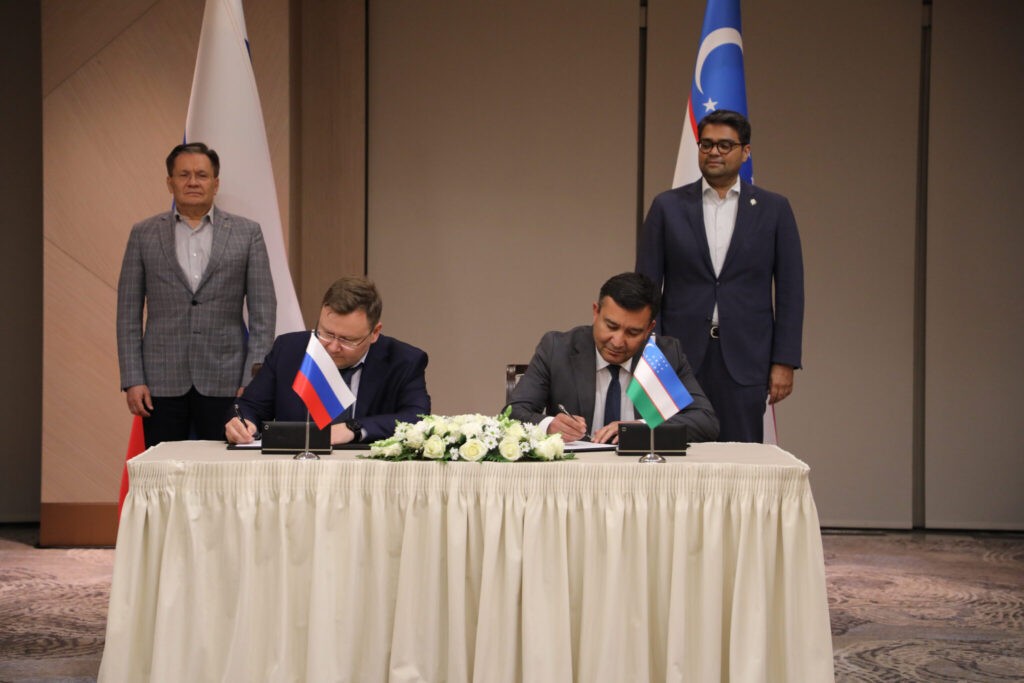
During the Russian president's state visit to Uzbekistan, a protocol on amending the intergovernmental agreement on cooperation between the two countries in the construction of a nuclear power plant in Uzbekistan was signed, Atom Media reports. On the margins of the event, Russia's Atomstroyexport joint stock company and the Directorate for NPP Construction under the Atomic Energy Agency of the the Cabinet of Ministers of the Republic of Uzbekistan signed a contract for the construction of a small-capacity nuclear power plant (SCNPP). The project envisages a Russian-designed ASMP in the Jizzakh region with a capacity of 330 MW (six reactors with a capacity of 55 MW each). Rosatom will be the general contractor for the construction of the plant, with local companies also be involved in the construction. Thus, Rosatom has signed the first-ever export contract to construct a small-capacity nuclear power plant. "According to forecasts, the demand for energy resources in Uzbekistan will almost double by 2050, and it is obvious that for the stable operation of the energy system and the development of the economy, our country must provide itself with a basic source of energy. All over the world, we are now seeing a growing interest in the creation of new nuclear facilities, both in terms of building large-capacity NPPs and small modular reactor projects. We believe that expansion of cooperation with Rosatom will allow us to strengthen our energy complex with advanced technologies in nuclear energy," Azim Akhmedkhadzhaev, director of the Atomic Energy Agency under the Cabinet of Ministers of the Republic of Uzbekistan commented on the signing. Construction work on the site will begin this summer. The project of construction of ASMM is based on the latest Russian development - the RITM-200n reactor. This development has been tested in Arctic conditions on the newest Russian icebreakers. Since 2012, 10 RITM-200 reactors have been manufactured for the universal nuclear icebreakers Arktika, Sibir, Ural, Yakutia and Chukotka. The first three have already been commissioned and are successfully fulfilling their obligations to guide caravans of ships in the western region of the Arctic. The safety of the planned low-capacity nuclear power plant will be achieved through multilevel systems and containment barriers. The combination of active (requiring power supply sources) and passive (operating without a power source) safety systems makes it possible to achieve the highest possible level of plant safety. These systems are implemented to prevent the possibility of an accident, and several levels of barriers incorporated in the plant design avoid the release of radioactive substances into the environment. According to the IAEA, approximately 50 ASMM designs and concepts are at various stages of development worldwide. Rosatom and Uzatom have yet to announce the cost and planned timing for the completion of the project.

Global Industry Experts to Meet in Almaty as Kazakhstan Ponders Nuclear Power

ALMATY, Kazakhstan - A group that represents the global nuclear industry will meet next week in Kazakhstan, which plans to hold a referendum this year to decide whether to build a nuclear power plant in order to ease power shortages. The London-based World Nuclear Association is holding the “working group” meetings in Almaty on April 15-16 in collaboration with the Energy Ministry of Kazakhstan, the world´s biggest uranium producer. Delegates at the Almaty meetings “will hear about and exchange views on the specific requirements of Kazakhstan for the deployment of nuclear power, the global landscape, and opportunities for the country in driving forward its nuclear power plans,” the association said. The periodic event, called World Nuclear Spotlight, gathers policymakers, stakeholders and industry leaders. The goal is to share best practices, conduct analysis and coordinate on economic, safety and environmental issues. A nuclear power plant in Kazakhstan would be the first since the 1990s, when the Soviet BN-350 reactor in the Caspian city of Aktau was decommissioned. Kazakhstan, however, faces conflicting energy and environmental pressures as it considers the plan to build a civilian nuclear plant. There are also geopolitical complications because of the potential involvement in the project of Russia and other foreign actors. Many people in Kazakhstan are uneasy about nuclear power, recalling the trauma caused by devastating contamination over decades at the Soviet nuclear testing site at Semipalatinsk.

Rosatom Looks to Promote Small-Scale Nuclear Power in Central Asia

The Russian state corporation Rosatom is discussing the construction of small-capacity nuclear power plants (SCNPPs) with Kyrgyzstan, Uzbekistan, Myanmar and some island nations in East Asia, according to Rosatom's general director Aleksey Likhachev. According to him, demand for small-scale nuclear plants is increasing globally, and, according to Rosatom analysis, in the next 10-15 years up to 30-40 GW of small-capacity reactors will be commissioned. The company is now discussing joint projects on SCNPP with Norilsk Nickel, Gazprom, Lukoil and Russian Platinum. Last December Rosatom and the Mongolian company Mon-Atom signed a memorandum on the construction of a low-capacity nuclear power plant in Mongolia. In early 2023 the parties signed a memorandum on cooperation in the field of peaceful atomic use, and development of a project for the Center for Nuclear Science and Technology. In Uzbekistan, the issue of joint construction of a nuclear plant with Russia has been under discussion since 2018. Under one agreement Rosatom will build two VVER-1200 units with a capacity of 1.2 GW each near Lake Tuzkan in the Jizzakh region. The nuclear plant's potential to compensate for energy shortages and to decarbonize the country's energy sector form a clear rationale for its construction. The project, which should take six years to build, is assessed as promising by both power engineers and environmentalists. Furthermore, considering that Uzbekistan is one of the world's five biggest producers of uranium, it should always be able to fully supply its nuclear reactors with fuel. Rosatom is proposing a "dry cooling tower" design for Uzbekistan -- a technically more complicated option, but, given the growing water shortage in Central Asia, increasingly relevant. South Korea's Hyundai has also expressed interest in building SCNPPs in Uzbekistan. Hyundai is proposing its latest modular reactors based on integrated systems (SMART), where high-pressure water is used for cooling. Such reactors, despite their small size, are capable of generating up to 110 MW of energy, and their compactness and mobility allow them to be installed in the remote mountainous terrain of Central Asia. In addition to Uzbekistan, Rosatom is considering building a nuclear power plant in neighboring Kyrgyzstan. Experts suggest installing two power units of 55 MW each. The corresponding memorandum was signed by Rosatom and Kyrgyzstan in January 2022 during the World Expo-2022 in the UAE. Experts believe that an SCNPP project could appear in Kyrgyzstan no earlier than 2028.