• KZT/USD = 0.00225
  • TJS/USD = 0.10860
  • UZS/USD = 0.00008
  • TMT/USD = 0.29850
  • KZT/USD = 0.00225
  • TJS/USD = 0.10860
  • UZS/USD = 0.00008
  • TMT/USD = 0.29850
  • KZT/USD = 0.00225
  • TJS/USD = 0.10860
  • UZS/USD = 0.00008
  • TMT/USD = 0.29850
  • KZT/USD = 0.00225
  • TJS/USD = 0.10860
  • UZS/USD = 0.00008
  • TMT/USD = 0.29850
  • KZT/USD = 0.00225
  • TJS/USD = 0.10860
  • UZS/USD = 0.00008
  • TMT/USD = 0.29850
  • KZT/USD = 0.00225
  • TJS/USD = 0.10860
  • UZS/USD = 0.00008
  • TMT/USD = 0.29850
  • KZT/USD = 0.00225
  • TJS/USD = 0.10860
  • UZS/USD = 0.00008
  • TMT/USD = 0.29850
  • KZT/USD = 0.00225
  • TJS/USD = 0.10860
  • UZS/USD = 0.00008
  • TMT/USD = 0.29850
17 November 2026

Viewing results 1 - 6 of 3

Oman Expands Uzbek Investments Despite Iran Conflict

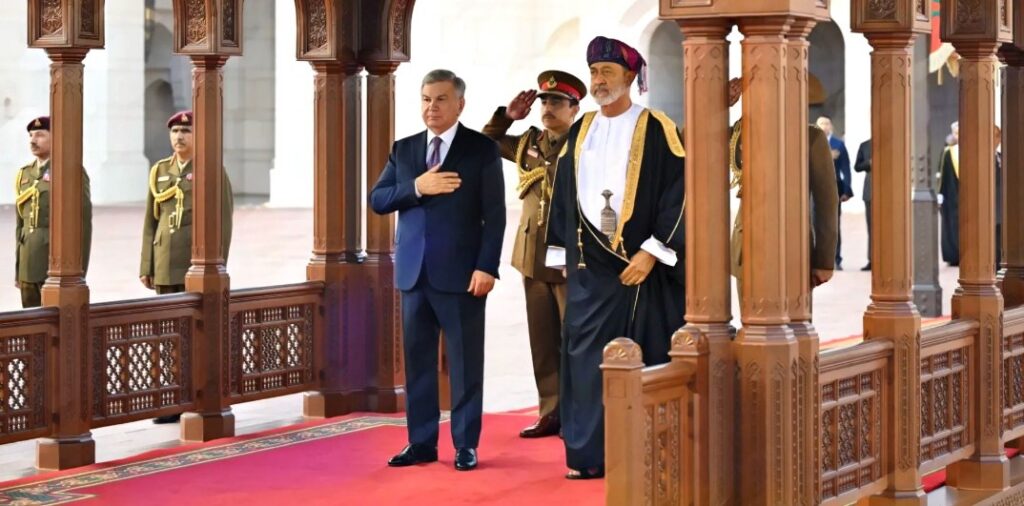
Oman’s Voltamp Energy has signed agreements to develop a $350 million solar plant and a transformer factory in Uzbekistan. The projects announced during President Shavkat Mirziyoyev’s visit to Muscat would supply the Uzbek electricity sector, giving Oman business opportunities despite war disrupting trade through Iran. The agreements add to Omani investments already operating in Uzbekistan. In June, logistics group Asyad acquired control of two Tashkent freight facilities that handle about a quarter of the country’s railway container traffic. Omani companies can sell electricity and equipment to Uzbek customers, while earning freight revenue from the country’s wider trade. Neither business requires a dependable shipping connection to Oman. That connection remains a longer-term ambition. Uzbekistan wants to move goods through Turkmenistan and Iran to Iranian seaports, then onward to Oman. However, the U.S. blockade of Iranian ports threatens the sea crossing, even where the destination lies outside the Strait of Hormuz. Mirziyoyev’s November 16–17 visit has combined investment agreements with efforts to improve access to overseas markets, but for Oman, the most immediate returns are likely to come from businesses serving Uzbekistan itself. Solar Power and Transformer Production Voltamp and Uzbekistan’s UET Construction signed a joint development agreement for a 500 MW solar plant in Ferghana. Uzbekistan’s Energy Ministry put the planned investment at $350 million, with site studies and preparation of the financial model preceding a commercial proposal. Voltamp also agreed with NURA Electric and the Uzbek-Oman Investment Company, known as UzOman, to establish a transformer factory. Uzbekistan’s electrical engineering association said it would produce high-voltage transformers, with planned annual capacity totaling 5,000 MVA. The factory would supply equipment used to connect power generation to the grid. Alongside the solar project, it gives Omani investors a role in both producing electricity and supplying the infrastructure to distribute it. Uzbekistan’s government announcement confirmed the signed documents covering energy and logistics at a business forum attended by more than 150 representatives. Before the visit, Oman’s Foreign Ministry said Uzbek Investment Minister Laziz Kudratov had announced preparations for around 30 agreements and documents. They covered projects and contracts worth approximately $5 billion. Kudratov also welcomed plans to raise UzOman’s authorized capital to $500 million. Omani Investors Already Serve Uzbek Customers Asyad’s June acquisition gave it controlling stakes in Universal Logistics Services and Highway Logistics Center. The transaction involved Orient Group and UzOman. Trade between Uzbekistan and Oman totaled $2.3 million in 2025 and $3.3 million in January–September 2026, according to Oman’s Foreign Ministry. Asyad’s terminals serve Uzbekistan’s broader import and export trade. Asyad plans to integrate the Tashkent terminals into its logistics network and direct more cargo through Omani ports. The terminals already provide freight handling and storage services within Uzbekistan, generating business while the southern shipping route remains disrupted. UzOman’s investment portfolio includes other businesses serving local customers, including interests in the Korzinka supermarket chain and commercial property, alongside an agrochemical facility under development with Türkiye’s Hektaş. Iran Remains the Obstacle to Sea Access Uzbekistan’s interest in Omani ports predates the current visit:...
Oman Set to Join Eurasian Development Bank as First Gulf Shareholder

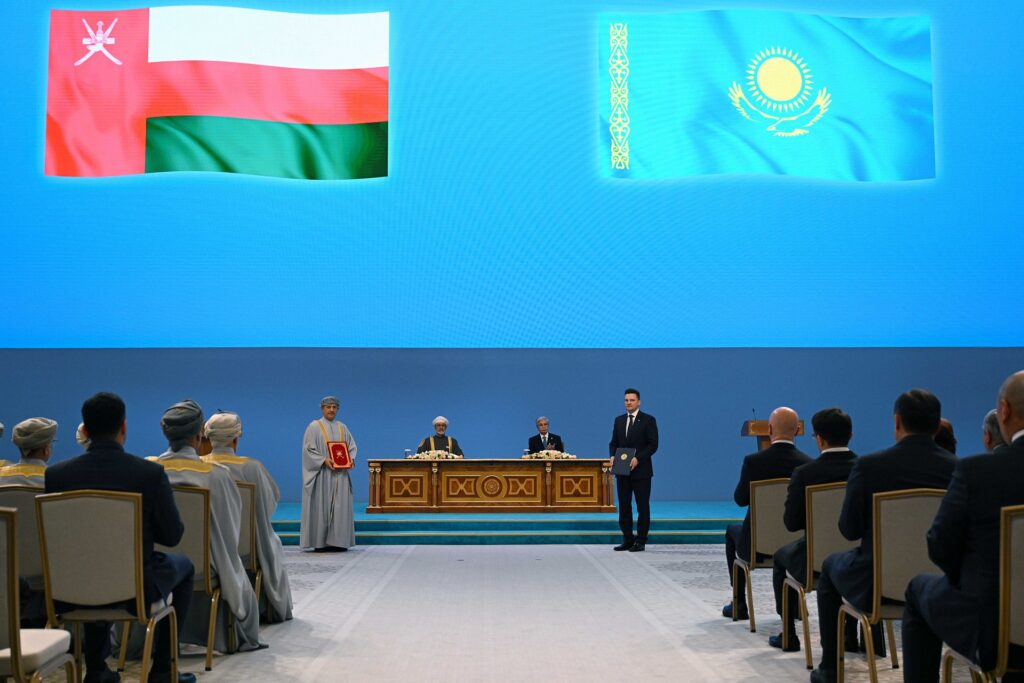
Oman is set to become the eighth shareholder of the Eurasian Development Bank (EDB) and the first Gulf state to join the institution. An agreement was signed in Astana on October 6 during Sultan Haitham bin Tarik Al Said’s state visit to Kazakhstan. The EDB’s current shareholders are Armenia, Belarus, Kazakhstan, Kyrgyzstan, Russia, Tajikistan, and Uzbekistan. Oman would become the first member from outside the former Soviet Union. The agreement, signed by Omani Finance Minister Sultan bin Salim Al Habsi and EDB Chairman Nikolai Podguzov, sets out the terms of the EDB’s operations in Oman. “This agreement reflects our shared intention to build a bridge between Central Asia and the Gulf region,” Podguzov said. Russia remains the bank’s largest shareholder, although its stake was reduced from about 66% to 44.8% in 2023. By the end of June 2026, the EDB’s cumulative portfolio comprised 348 projects with total investment of $22.1 billion. The bank finances projects including transport infrastructure, energy, and digital systems. On October 6, Kazakhstan and Oman signed an agreement on the mutual protection of investments, while Samruk-Kazyna and the Oman Investment Authority agreed to establish a joint investment vehicle to finance projects. As a landlocked country, Kazakhstan is seeking additional routes to the Indian Ocean, and the two sides discussed using Omani ports to transport its goods. Oman has proposed developing a trade corridor through its seaports. The talks in Astana also covered direct air links and other logistics projects. Kazakhstan is seeking to increase exports of grain, meat, and other agricultural products to Oman. In 2025, honey from Kazakhstan was exported to the sultanate for the first time. On October 5, the two countries’ chambers of commerce signed a memorandum aimed at expanding business ties, including in agriculture and logistics. Founded by Kazakhstan and Russia in 2006, the EDB has gradually expanded its membership, most recently with Uzbekistan in 2025.

Technology and Investment: What Kazakhstan Stands to Gain from Its Middle East Outreach

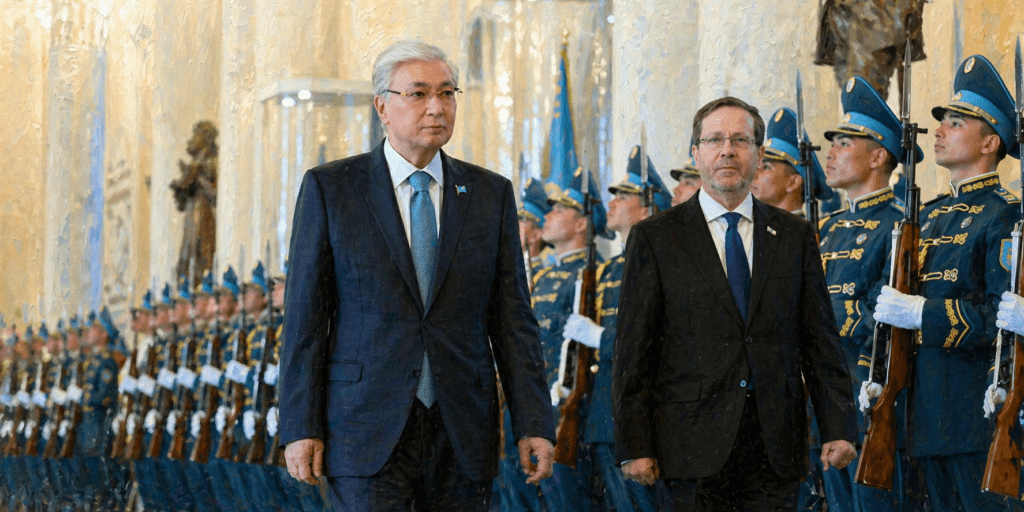
The ongoing escalation in the Middle East, with Iran at its epicenter, appears to be accelerating economic rapprochement between countries in the region and Central Asia. Kazakhstan’s diplomacy has emerged as a key driver of this process. In recent days, Kazakhstan’s foreign minister has visited several Gulf states, while Israeli President Isaac Herzog arrived in Astana on April 27 for an official visit. Kazakhstan’s Foreign Minister Yermek Kosherbayev has visited the United Arab Emirates and Qatar. In the UAE, he delivered a written message from Kassym-Jomart Tokayev to President Sheikh Mohammed bin Zayed Al Nahyan on bilateral relations, and held talks with Deputy Prime Minister and Minister of Foreign Affairs Sheikh Abdullah bin Zayed Al Nahyan. The sides discussed the consequences of Iranian missile strikes on the UAE and other countries, as well as their impact on international shipping security, energy supply, the global economy, and regional stability. Kosherbayev reaffirmed Kazakhstan’s support for the UAE in taking measures to protect its sovereignty, territorial integrity, and the safety of citizens and residents. Senior UAE officials responsible for energy and sustainable development also participated in the meeting. In Qatar, the minister met with Prime Minister and Foreign Minister Sheikh Mohammed bin Abdulrahman Al Thani. Discussions focused on investment cooperation, with both sides emphasizing the importance of implementing joint projects in priority sectors such as energy, telecommunications, digital technologies, agriculture, and transport and logistics. Regional escalation was also addressed, with Kosherbayev reiterating that President Tokayev’s proposal to host peace negotiations in Turkestan remains in place. While in Qatar, the minister also met with the leadership of Power International Holding and Milaha. Talks with Power International Holding Chairman Moutaz Al-Khayyat focused on cooperation in gas processing, natural gas transportation, and electricity generation. Transport and transit issues were central to discussions with Milaha CEO Fahad Saad Al-Qahtani. The parties explored opportunities to develop multimodal transport and expand access to port infrastructure, which could significantly increase cargo transit through Kazakhstan’s Caspian ports. Kazakhstan’s engagement with Middle Eastern countries is increasingly reciprocal. Representatives from the region are also visiting Astana. Recently, Oman’s Deputy Prime Minister for Economic Affairs, Sayyid Theyazin bin Haitham Al Said, visited Kazakhstan. President Tokayev, who received him, expressed support for the people of Oman during the current period of regional instability. According to the presidential press service, the sides discussed expanding trade and economic cooperation, with a focus on energy, metallurgy, transport and logistics, agriculture, and digitalization. They also emphasized the importance of strengthening cultural and humanitarian ties. At the conclusion of the meeting, Tokayev awarded Theyazin bin Haitham Al Said the Order of Dostyk (Friendship), First Class, for his contribution to strengthening bilateral cooperation. Kazakhstan and Oman currently maintain a joint portfolio of five major investment projects worth $3 billion. Two projects worth $1.1 billion, covering energy and railway transport, have already been implemented, while additional projects in ore processing are under development. The following day, in the presence of Olzhas Bektenov, Samruk-Kazyna and the Oman Investment Authority signed a Heads of...
