• KGS/USD = 0.01144 0%
  • KZT/USD = 0.00198 0%
  • TJS/USD = 0.10857 -0.18%
  • UZS/USD = 0.00008 0%
  • TMT/USD = 0.28571 0%
  • KGS/USD = 0.01144 0%
  • KZT/USD = 0.00198 0%
  • TJS/USD = 0.10857 -0.18%
  • UZS/USD = 0.00008 0%
  • TMT/USD = 0.28571 0%
  • KGS/USD = 0.01144 0%
  • KZT/USD = 0.00198 0%
  • TJS/USD = 0.10857 -0.18%
  • UZS/USD = 0.00008 0%
  • TMT/USD = 0.28571 0%
  • KGS/USD = 0.01144 0%
  • KZT/USD = 0.00198 0%
  • TJS/USD = 0.10857 -0.18%
  • UZS/USD = 0.00008 0%
  • TMT/USD = 0.28571 0%
  • KGS/USD = 0.01144 0%
  • KZT/USD = 0.00198 0%
  • TJS/USD = 0.10857 -0.18%
  • UZS/USD = 0.00008 0%
  • TMT/USD = 0.28571 0%
  • KGS/USD = 0.01144 0%
  • KZT/USD = 0.00198 0%
  • TJS/USD = 0.10857 -0.18%
  • UZS/USD = 0.00008 0%
  • TMT/USD = 0.28571 0%
  • KGS/USD = 0.01144 0%
  • KZT/USD = 0.00198 0%
  • TJS/USD = 0.10857 -0.18%
  • UZS/USD = 0.00008 0%
  • TMT/USD = 0.28571 0%
  • KGS/USD = 0.01144 0%
  • KZT/USD = 0.00198 0%
  • TJS/USD = 0.10857 -0.18%
  • UZS/USD = 0.00008 0%
  • TMT/USD = 0.28571 0%
05 December 2025

Viewing results 1 - 6 of 16

Aliyev–Tokayev Talks Rekindle Momentum for Trump’s Peace Corridor

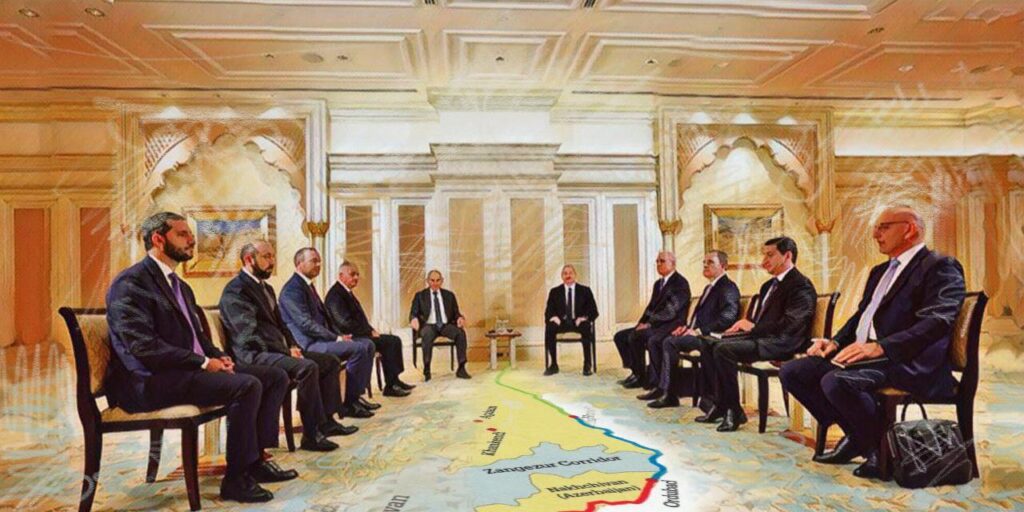
Azerbaijani President Ilham Aliyev’s state visit to Kazakhstan this week highlights the deepening strategic alignment between the two Caspian neighbors. Both are united by a drive to reshape Eurasia’s transport map through the Middle Corridor — a trans-Caspian route linking Central Asia to Europe — and its politically sensitive South Caucasus extension, the Zangezur Corridor. The meeting comes amid renewed optimism following the August 2025 U.S.-brokered declaration between Armenia and Azerbaijan. The accord envisions a transit route linking mainland Azerbaijan with its Nakhchivan exclave via a roughly 20-32 km stretch of Armenia’s Syunik region. Under the framework, the United States would receive exclusive long-term development rights for infrastructure (railways, pipelines, fibre-optic cables) on that corridor — while Armenia retains full territorial sovereignty and the route operates under Armenian law. U.S. President Donald Trump, who hosted the White House summit that produced the deal, said: “Thirty-five years they fought, and now they’re friends and they’re going to be friends for a long time.” The project is also known as the “Trump Route for International Peace and Prosperity” (TRIPP), From Framework to Reality TRIPP remains far from implementation: Armenia and Azerbaijan still must ratify the agreement as a binding treaty, finalize the terms of U.S. development rights, and attract major investment for rail, energy and digital networks. Meanwhile, peace between the two remains fragile. Resistance from Iran, wary of being bypassed, and Russia, whose influence has waned since the war in Ukraine, complicates progress. Turkey’s backing, as a champion of trans-Turkic connectivity, will be crucial. Whether the “peace route” becomes operational or stalls as another geopolitical mirage depends on political consensus and sustained stability. A Trans-Caspian Lifeline For Aliyev and President Kassym-Jomart Tokayev, these uncertainties strengthen the case for deeper transport cooperation. During the visit, the two leaders will focus on transport integration, energy transit, and digital infrastructure, with attention to coordination among the Aktau, Kuryk, and Baku ports, building on existing MoUs and ongoing Middle Corridor initiatives.  Discussions will also cover customs digitization and rail interoperability along the Trans-Caspian International Transport Route (TITR). Although the Zangezur Corridor is not formally on the agenda, diplomats in both capitals suggest it looms large behind the logistics talks. For Kazakhstan, a functioning Zangezur link would tighten its connection to Turkish and European markets, reducing dependence on routes that traverse Russian or Iranian territory. For Azerbaijan, it would complete the east–west chain that underpins Baku’s Middle Corridor strategy — linking the Caspian directly to the Mediterranean through a unified Turkic transport system. For Kazakhstan, the Middle Corridor represents a strategic alternative to disrupted Russian transport routes, preserving the continuity of its westward trade and reinforcing its role as a key Eurasian transit state. The route—linking Kazakhstan across the Caspian Sea to Azerbaijan, and continuing through Georgia and Turkey—provides access to European markets while reducing dependence on northern pathways. For Azerbaijan, it consolidates its position as a central hub connecting the Turkic world to global trade networks. Presidents Kassym-Jomart Tokayev and Ilham Aliyev have both framed...

Kazakhstan Backs Trump’s Gaza Peace Initiative

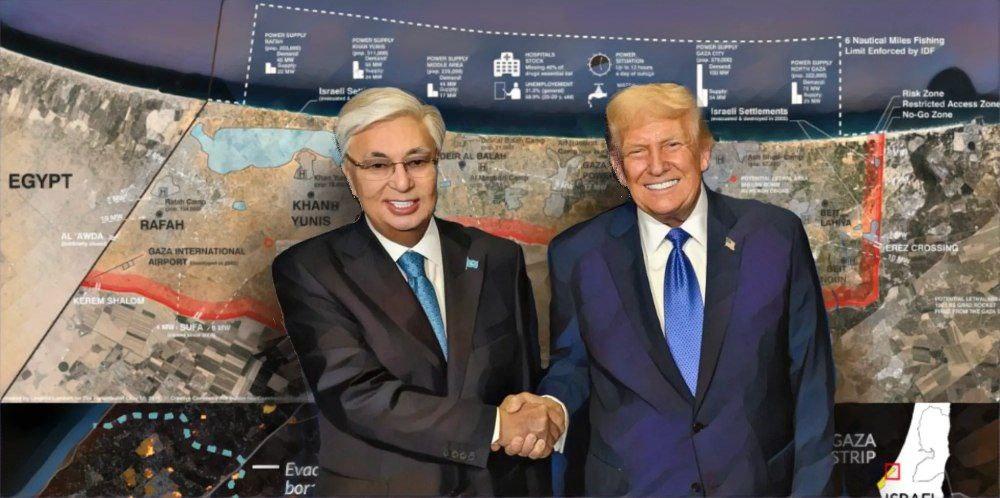
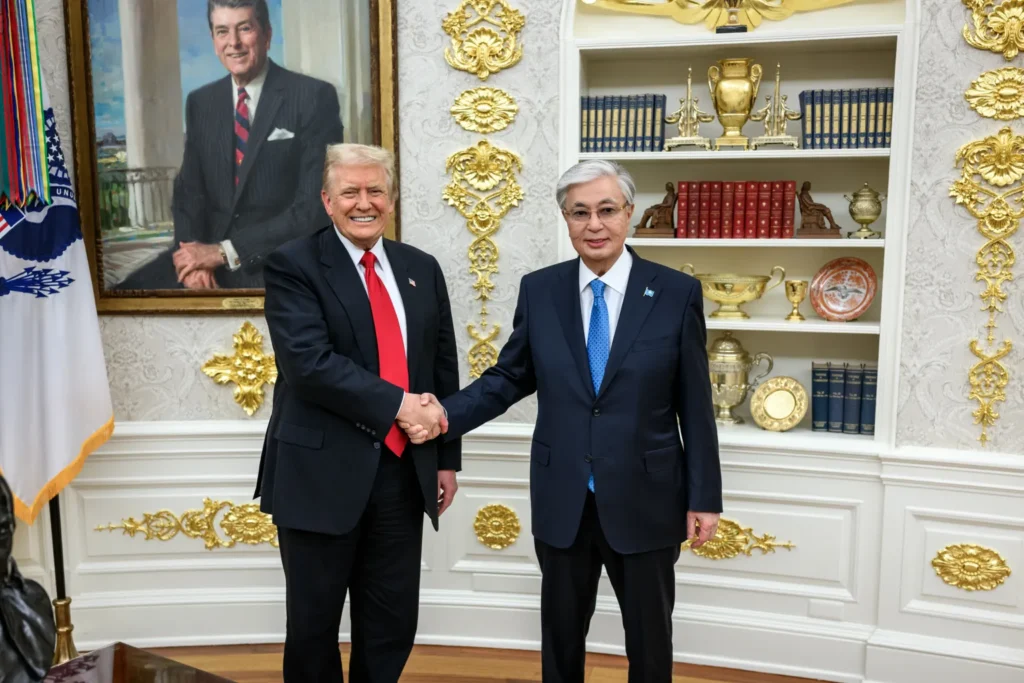
Kazakhstan has expressed support for President Donald Trump’s Comprehensive Peace Plan aimed at ending the conflict in Gaza. In a statement on X, Presidential Press Secretary Ruslan Zheldibay wrote that President Kassym-Jomart Tokayev considers the initiative a “unique opportunity” and “an important step toward resolving the situation in the Middle East, strengthening interstate trust, and establishing lasting and just peace in this region.” By describing the initiative as an “important step” rather than a definitive solution, Kazakhstan leaves room for diplomatic flexibility and avoids alienating partners that hold divergent views on Gaza. At the same time, the public endorsement is a clear gesture of support for the Trump administration’s leadership in addressing the central conflict of the Middle East, marking a notable moment where Astana aligns itself with Washington’s effort to shape the regional peace agenda. [caption id="attachment_36799" align="aligncenter" width="581"] Ruslan Zheldibay, President Tokayev’s press secretary, announced the position in a post on X[/caption] Trump’s Comprehensive Peace  Plan, released by the White House on September 29, 2025, ties Gaza’s governance to the broader framework of the Abraham Accords, proposing regional security guarantees, economic reconstruction measures, and expanded Arab participation as part of an effort to extend the accords’ realignment across the Middle East. Trump has repeatedly urged world leaders to expand the Abraham Accords, including appeals to Saudi Arabia, discussions with Israel’s Netanyahu, and even suggesting that Iran could join. At the 80th United Nations General Assembly (UNGA) last week, President Kassym-Jomart Tokayev pointed to the Abraham Accords as proof that reconciliation is possible in the Middle East. This endorsement is consistent with Tokayev’s broader diplomatic messaging and positions Kazakhstan as the only Central Asian state publicly backing the accords as a pathway to normalization at the UN meeting. Separately, UNGA week also saw Wabtec announce a $4.2 billion order from Kazakhstan’s national railway, a deal in line with Trump’s ‘America First’ policy that underscored the commercial dimension of U.S. engagement. The Gaza statement follows Tokayev’s remarks last week about the United Nations after technical failures during Trump’s UNGA appearance. Tokayev described the incident as “an extremely dangerous incident” and “a most serious shortcoming — one might even say a failure — of the UN Secretariat and the relevant services and departments.” He noted that, “The decision to conduct an investigation has already been made and is correct.” He linked the investigation into the failure to broader questions about the UN’s credibility, echoing Trump’s frustrations with the institution. Alongside these public remarks, Tokayev has made changes to Kazakhstan’s diplomatic team, recalling the ambassador to Washington and appointing a new foreign minister. While the reshuffle followed Tokayev’s return from New York, it also appears to reflect a deliberate recalibration of Kazakhstan’s diplomatic apparatus, with the new team brought in to carry forward these emerging foreign policy priorities. Taken together, these moves highlight Kazakhstan’s shift toward a more visible diplomacy, with Astana’s decisions increasingly aligned with Washington. By endorsing Trump’s Comprehensive Peace Plan, Tokayev has signaled a convergence with the former U.S....

Opinion: Washington Meeting and the Shifting Geopolitics of the Caspian

The Washington meeting between Armenia and Azerbaijan, hosted by President Donald Trump on August 8, 2025, may go down as a pivotal moment in the geopolitics of the Caspian and the wider Eurasian space. While on the surface the talks aimed to normalize relations between the two South Caucasus neighbors, the ripple effects extend far beyond bilateral reconciliation. For Azerbaijan, the meeting is not only about ending three decades of conflict with Armenia but also about positioning itself as a central bridge linking the Caspian Basin, Central Asia, and even Europe. The Caspian region has always been a security crossroads, where energy interests, military presence, and trade routes overlap. Russia’s war in Ukraine, the Iran-Israel conflict, and shifting Western engagement have made the region more volatile. In this context, a potential Armenia-Azerbaijan settlement offers a chance to stabilize the South Caucasus - the natural gateway between the Caspian and Europe. For Azerbaijan, peace with Armenia would solidify its position in the region where Baku has promoted several important transregional projects such as the Baku-Tbilisi-Ceyhan oil pipeline, the Southern Gas Corridor, and the Baku-Tbilisi-Kars railway. Azerbaijan is heavily investing in the development of the Caspian trade routes, energy infrastructure, and regional connectivity projects such as the Middle Corridor. Stability in the South Caucasus also makes it harder for external actors to exploit divisions - an especially significant factor given the previous attempt to exploit Armenia against Azerbaijan and Türkiye. That strategy brought no tangible results to Armenia, which remained regionally isolated and dependent on Russia. After the military defeats in 2020 and 2023, the Armenian leadership realized that peace and respect for the principle of territorial integrity is a much greater opportunity for the country rather than an irredentist project, which Prime Minister Nikol Pashinyan dubbed “mythical.” At the same time, a peace framework reduces the risk of military escalation spilling into the Caspian region. Naval modernization efforts by Russia and Iran in recent years have heightened anxieties. In short, normalization indirectly enhances Azerbaijan’s capacity to act as a stabilizing actor within the Caspian basin. Increasingly, Iran has also spoken about peace and cooperation, especially with Azerbaijan. Relations were tense a few years ago, but the incumbent President, Masud Pezeshkian, questioned the strategy employed previously by the Iranian clerics regarding Azerbaijan, which failed to gain any benefits. Perhaps the most significant geopolitical dividend for Azerbaijan lies eastward, across the Caspian. The Central Asian states - Kazakhstan, Uzbekistan, Turkmenistan, Kyrgyzstan, and Tajikistan - have long sought secure, diversified links to Europe. Russia’s war has made northern routes through its territory unreliable, while instability in the Red Sea undermines the traditional supply route. That leaves the Trans-Caspian link through Azerbaijan as promising. The Washington meeting, by promoting the peace agenda, reassures Central Asian partners that Baku is a reliable hub. Azerbaijan, Kazakhstan, and Uzbekistan signed an MOU about the transfer of alternative energy sources to Europe through another potential project – a Black Sea electricity cable from Georgia to Romania and Hungary. Azerbaijan...

Astana’s Delicate Role in Ukraine Peace Efforts

Despite its close economic, historical, and cultural ties with Russia, Kazakhstan has maintained constructive relations with Ukraine since Russia’s full-scale invasion in 2022. That diplomatic balance was on display again on August 10, when President Volodymyr Zelenskyy called President Kassym-Jomart Tokayev to discuss prospects for a peace agreement. According to official sources, Ukraine initiated the call, and Tokayev reaffirmed Kazakhstan’s “unconditional interest in establishing a lasting peace in Ukraine based on the principles of international law.” Astana supports a “joint search for a peaceful solution on a fair basis” and consistently advocates compliance with the UN Charter, the inviolability of borders, and the territorial integrity of sovereign states. Kazakh political analyst Marat Shibutov has suggested that Zelenskyy is seeking support ahead of a potential shift in the confrontation with Russia. “On the eve of the meeting between Donald Trump and Vladimir Putin in Alaska, Zelenskyy is calling the leaders of other countries. He is seeking not only to secure better conditions for Ukraine, but also to understand what his personal political future holds. Yesterday, he spoke with Macron, Meloni, Tusk, Stubb, von der Leyen, Sánchez, and Starmer. Today, he spoke with Swedish Prime Minister Kristersson, Ilham Aliyev, and President Tokayev,” Shibutov wrote. According to Shibutov, Zelenskyy emphasized European support for Ukraine’s participation in negotiations. However, Tokayev, an experienced diplomat, may have cautioned that the outcome of the U.S.-Russia talks is unpredictable. “They depend on domestic politics,” Shibutov noted. “In the U.S., Trump’s electorate wants an end to the war and military aid to Ukraine halted, while many in Russia want Ukraine’s complete defeat and elimination as a state. In such conditions, Ukraine will have to make concessions. Territorial integrity is good, but not at the cost of the state’s very existence.” The official statement from Tokayev’s office cited the old proverb: “A bad peace is better than a good war.” Support During the War On March 6, 2022, shortly after Russia’s full-scale invasion, an anti-war rally was held in Almaty. Participants carried Ukrainian flags, blue-and-yellow balloons, and anti-war posters. That same month, Kazakhstan sent humanitarian aid worth more than $2 million, including 25 types of medical supplies weighing 82 tons. Volunteers also collected food, hygiene products, medicines, and animal feed worth 150 million tenge. Kazakh entrepreneurs delivered aid and generators to Ukrainian hospitals. In the summer of 2023, a Kazakh company helped repair a medical facility in Mykolaiv damaged by Russian shelling. The installation of “yurts of indestructibility” in war-affected Ukrainian cities also gained wide recognition. In Kyiv alone, more than 100,000 people visited such a yurt to charge phones, warm up, and enjoy free Kazakh national dishes. Only According to the UN Charter Kazakhstan’s deep economic ties with Russia include oil and gas transit, gasoline supplies, and imports of food and medicine. The two countries share the world’s second-longest land border, spanning 4,750 miles. Cooperation on transboundary rivers is also critical. In contrast, Kazakhstan’s links with Ukraine are modest, consisting largely of historical ties and family connections. Pre-war trade...

How Could the Armenia-Azerbaijan Peace Accord Benefit Central Asia?

On August 8, Armenia and Azerbaijan signed a peace accord in Washington and committed to the construction of the Trump Route for Peace and Prosperity, a trade route that bisects Armenia, connecting the two parts of Azerbaijan. The deal may have far-reaching repercussions on the other side of the Caspian, potentially diversifying the Trans-Caspian Middle Corridor by allowing travel from Azerbaijan, through Armenia, and onwards to Turkey. The upbeat mood music may be premature, however. There remain numerous political hurdles to be jumped before any construction can commence, and the entry of the United States into a region where Russia, Iran, and Turkey all have interests could have unintended consequences. “It’s certainly an opportunity, but there are risks,” said Azerbaijani political analyst and non-resident fellow at the China-Global South Project, Yunis Sharifli. “The United States can be a stabilizing force, but it could go in the opposite direction. It can also create a spoiler.” The Problem Armenia and Azerbaijan have maintained ice-cold relations for almost their entire existence as independent states. For over three decades, they tussled over the status of Nagorno-Karabakh, a land which lies in the internationally recognized territory of Azerbaijan, but was, upon independence, populated mainly by Armenians. As well as costing thousands of lives and leading to hundreds of thousands of displaced persons, the enmity has also led to shuttered frontiers, which have choked trade across the South Caucasus. Armenia’s borders with both Azerbaijan and Turkey have been closed since 1993. While Armenia has been cut off from two of its four neighbors, Azerbaijan has also been severed in two, with the exclave of Nakhchivan, which borders Turkey, separated from the rest of the country by a sliver of Armenian territory, just 20 miles wide at its narrowest point. Conflicts in 2016, 2020, and 2023 saw Azerbaijan push Armenian troops from the region, with hundreds of thousands of Armenians fleeing Nagorno-Karabakh in fear of Azerbaijani reprisals. Since then, Baku has used its vast military superiority and geopolitical advantage to try to strongarm Armenia into accepting the construction of a corridor across its territory, threatening to use force on numerous occasions if Yerevan did not agree to its demands. The Solution Starting early this year, the United States began facilitating secretive negotiations between the pair, stepping into the vacuum left by Russia. The Kremlin has been sidelined from the process amid its deteriorating relations with both sides – many Armenians view Moscow as having betrayed them in the conflicts of 2020 and 2023, while Azeri-Russian relations have frayed significantly since the shooting down of Azerbaijan Airways Flight 8243 to Grozny earlier this year. The timing of the signing ceremony, on the anniversary of the Russian invasion of Georgia in 2008, was perhaps designed to reflect this shift in geopolitical alignment in the South Caucasus. Baku and Yerevan have signed up to a project which will see the construction of the corridor run by a U.S. private company, but under the laws of the Republic of Armenia. The...

Armenia’s PM to Visit Kazakhstan Amid Historic Peace Breakthrough and Economic Opportunities

Astana is preparing to host Armenian Prime Minister Nikol Pashinyan on an official visit scheduled for late 2025. On August 12, President Kassym-Jomart Tokayev had a call with Pashinyan, during which, according to an official statement, he praised the "outstanding qualities" of the Armenian Prime Minister, "as a politician with strong political will and a strategic vision of the national interests of his state." The forthcoming trip follows what U.S. Secretary of State Marco Rubio described as "the beginning of a peace deal" between Armenia and Azerbaijan, which was signed in Washington, D.C. on August 8, 2025, marking a pivotal moment in the South Caucasus after decades of conflict. At the White House, Pashinyan and Azerbaijani President Ilham Aliyev signed a framework pledging to respect each other’s territorial integrity, renounce the use of force, and dissolve the long-standing OSCE Minsk Group mediation format. The agreement also approved the creation of a major transit corridor — dubbed the Trump Route for International Peace and Prosperity (TRIPP) — linking Azerbaijan’s mainland to its exclave of Nakhchivan via Armenian territory. Kazakh President Kassym-Jomart Tokayev welcomed the accord as a “historic achievement” that not only ends a decades-long military standoff but also creates space for a deeper regional economic and diplomatic reset. In recent talks, Pashinyan briefed Tokayev on the details of the framework, the decision to dissolve the Minsk Group, and the TRIPP initiative. Both leaders emphasized the potential for new investment opportunities emerging from the stability the deal promises to bring and agreed to maintain an active political dialogue. For Kazakhstan, the visit reinforces its positioning as a neutral mediator between Eurasian powers, willing to offer diplomatic platforms for peace talks. In May 2024, Astana hosted ministerial-level Armenia–Azerbaijan negotiations in Almaty. With the TRIPP corridor set to enhance connectivity across the South Caucasus, Kazakhstan’s role in facilitating regional integration could expand beyond mediation into infrastructure, trade, and energy cooperation. Economically, the corridor offers Armenia new opportunities to become a transit hub between Central Asia and Europe, while Kazakhstan could benefit from more direct westward routes for its exports. Previous bilateral meetings have already laid the groundwork for business forums and joint initiatives in transport, technology, and investment, and the visit could provide the political momentum needed to bring these plans to fruition. Challenges remain, however. In Armenia, nationalist factions have criticized the peace deal, with border demarcation and the fallout from the Second Nagorno-Karabakh War remaining sensitive issues. Iran has also expressed opposition to the TRIPP corridor, citing concerns over shifting regional influence. Yet both Yerevan and Astana appear determined to use the current diplomatic window to solidify long-term cooperation. As the South Caucasus recalibrates, Pashinyan’s upcoming visit to Astana will test whether the political optimism generated in Washington can translate into tangible projects. For Kazakhstan, this presents an opportunity to deepen bilateral ties, demonstrate its growing influence as a stabilizing force, and secure a stake in the region’s new economic and geopolitical landscape.