


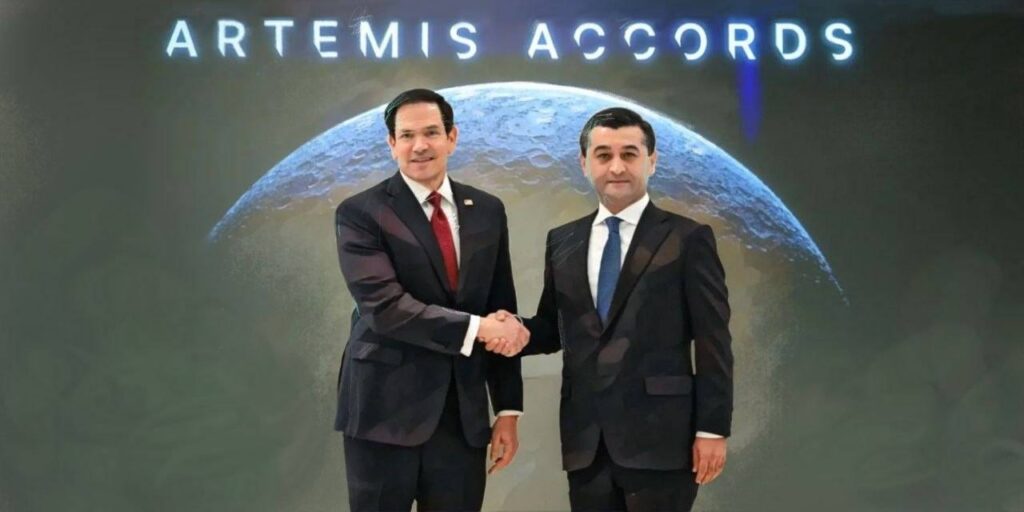
Uzbekistan Signs Space Accords as Rubio Opens Samarkand Talks
Uzbekistan joined the U.S.-led Artemis Accords on October 19 as Secretary of State Marco Rubio held talks in Samarkand. The signing accompanied the first Enhanced Strategic Partnership Dialogue between the two countries, with critical minerals among the priorities. Foreign Minister Bakhtiyor Saidov announced the signing after bilateral talks with Rubio. He said Uzbekistan had become the 77th country to join the framework for peaceful space exploration. Saidov said accession would support closer cooperation with NASA and other participating space agencies. He identified training for Uzbek specialists and access to space technologies as potential benefits. Established in 2020, the Artemis Accords set out principles for civilian space exploration. Signatories commit to peaceful operations and greater transparency, including sharing scientific data. The framework also addresses interference between missions and the preservation of historic sites in space. NASA describes the accords as nonbinding principles. Posting on X, Rubio confirmed he had met all five Central Asian foreign ministers during the C5+1 gathering. He said cooperation would expand commercial opportunities and strengthen regional security. American businesses also joined the visit as Washington seeks deeper economic ties across Central Asia. The visit follows the November 2025 White House summit, where Trump hosted all five Central Asian presidents. That meeting gave the partnership a stronger commercial focus, with aircraft orders and minerals projects featuring prominently. Samarkand brings ministers and businesses together to advance that agenda. The strategic dialogue focused on implementing agreements reached by the countries’ leaders and expanding economic cooperation. Saidov said the discussions covered energy and advanced technologies, alongside critical minerals. Education and security cooperation were also on the agenda. Rubio said separately that the talks addressed infrastructure and space cooperation, as well as engagement through C5+1, which brings together the United States and Kazakhstan, Kyrgyzstan, Tajikistan, Turkmenistan, and Uzbekistan. In a separate meeting with Kazakh Foreign Minister Mukhtar Tileuberdi, Rubio reaffirmed plans to expand economic and security cooperation. He thanked Kazakhstan for supporting “President Trump’s peace initiatives, including the Abraham Accords.” Speaking to reporters in Samarkand, Rubio said nearly 300 American businesses were represented, and that agreements potentially worth billions of dollars were under discussion. He presented the visit as the start of deeper U.S. economic engagement with Central Asia. “I think we’ll have some concrete deals to announce,” he said, according to Euronews. A final list of agreements and their value had not been circulated at the time of those remarks. Rubio identified critical minerals as a priority, arguing that concentrated supplies created risks for countries dependent on them. "This is not about coming here to say, stop talking to somebody else or stop working with some other country," he said. Days earlier, at the October 15 summit of the Conference on Interaction and Confidence Building Measures in Asia in Baku, Kazakhstan’s President Kassym-Jomart Tokayev proposed a transport strategy spanning several international initiatives. His proposal included China’s Belt and Road and the planned Trump Route for International Peace and Prosperity (TRIPP) through Armenia. It illustrated the region’s pursuit of transport links involving...

