• KGS/USD = 0.01144 0%
  • KZT/USD = 0.00204 0%
  • TJS/USD = 0.10434 0%
  • UZS/USD = 0.00008 0%
  • TMT/USD = 0.28571 0%
  • KGS/USD = 0.01144 0%
  • KZT/USD = 0.00204 0%
  • TJS/USD = 0.10434 0%
  • UZS/USD = 0.00008 0%
  • TMT/USD = 0.28571 0%
  • KGS/USD = 0.01144 0%
  • KZT/USD = 0.00204 0%
  • TJS/USD = 0.10434 0%
  • UZS/USD = 0.00008 0%
  • TMT/USD = 0.28571 0%
  • KGS/USD = 0.01144 0%
  • KZT/USD = 0.00204 0%
  • TJS/USD = 0.10434 0%
  • UZS/USD = 0.00008 0%
  • TMT/USD = 0.28571 0%
  • KGS/USD = 0.01144 0%
  • KZT/USD = 0.00204 0%
  • TJS/USD = 0.10434 0%
  • UZS/USD = 0.00008 0%
  • TMT/USD = 0.28571 0%
  • KGS/USD = 0.01144 0%
  • KZT/USD = 0.00204 0%
  • TJS/USD = 0.10434 0%
  • UZS/USD = 0.00008 0%
  • TMT/USD = 0.28571 0%
  • KGS/USD = 0.01144 0%
  • KZT/USD = 0.00204 0%
  • TJS/USD = 0.10434 0%
  • UZS/USD = 0.00008 0%
  • TMT/USD = 0.28571 0%
  • KGS/USD = 0.01144 0%
  • KZT/USD = 0.00204 0%
  • TJS/USD = 0.10434 0%
  • UZS/USD = 0.00008 0%
  • TMT/USD = 0.28571 0%

Viewing results 1 - 6 of 15

From GDP to AI: EAEU Leaders Review Integration Milestones in St. Petersburg

The leaders of the Eurasian Economic Union (EAEU) gathered on December 21 at the Yeltsin Presidential Library in St. Petersburg, Russia, to assess the bloc’s progress and outline future integration priorities. The summit was attended by the leaders of EAEU member states, President of Russia, Vladimir Putin, President of Belarus, Aleksandr Lukashenko, Prime Minister of Armenia, Nikol Pashinyan, President of Kazakhstan, Kassym-Jomart Tokayev, President of Kyrgyzstan, Sadyr Zhaparov, and Chairman of the Board of the Eurasian Economic Commission, Bakytzhan Sagintayev. In an expanded format, representatives of Uzbekistan, Indonesia, Iran, and Cuba also participated. The meeting took place against the backdrop of continued global economic fragmentation, as the EAEU looks to position itself as a stable integration platform within an increasingly multipolar economic order. [caption id="attachment_41254" align="aligncenter" width="2560"] Image: Akorda[/caption] Opening the meeting, Vladimir Putin proposed a year-end review and highlighted key decisions aimed at deepening cooperation. He stated that the EAEU has solidified its position as an independent and self-sufficient center within the evolving multipolar world. Putin pointed to rising combined GDP figures and noted that EAEU membership has contributed to economic stability and improved living standards across member states. These assessments framed the EAEU not only as a regional trade bloc but as a long-term economic center adapting to shifting global alignments. [caption id="attachment_41258" align="aligncenter" width="2560"] Image: Akorda[/caption] Putin also cited progress in building the union’s payment infrastructure, removing trade barriers, and enhancing transport connectivity. Among individual economies, Kyrgyzstan stood out with a GDP growth rate of around 10%. Much of the focus, however, remained on translating macroeconomic gains into deeper market integration across energy, finance, and logistics. Belarusian President Alexander Lukashenko, addressing the summit as chair of the EAEU, called for renewed approaches to economic engagement with third countries over the next five years. He endorsed deeper ties with what he termed the “global majority,” while acknowledging existing challenges, such as delays in establishing unified energy markets and hesitancy among member states to form a common financial market. Nonetheless, he described the Union State of Russia and Belarus as the “locomotive of integration” in the post-Soviet region. The discussion highlighted a recurring tension for the bloc: expanding external partnerships while still completing core internal market harmonization. [caption id="attachment_41259" align="aligncenter" width="2560"] Image: Akorda[/caption] Kazakh President Kassym-Jomart Tokayev emphasized the EAEU's milestone year as it entered its second decade. He projected a 2% increase in the union’s combined GDP in 2025 and noted that intra-union direct investment had surpassed $20 billion. Kazakhstan alone saw a nearly sevenfold increase in EAEU-related investment from $600 million in 2015 to $4 billion in 2024. [caption id="attachment_41260" align="aligncenter" width="2560"] Image: Akorda[/caption] Tokayev also proposed the systematic integration of artificial intelligence technologies into EAEU operations, from trade forecasting to customs duties assessment. He highlighted the union’s potential as a global transport and logistics hub and advocated for the swift implementation of the Caspian Sea shipping agreement. Uzbek President Shavkat Mirziyoyev noted that Uzbekistan’s trade with EAEU countries had nearly doubled to $20 billion over its...
Mirziyoyev Begins Japan Visit With Central Asia Leaders’ Reception in Tokyo

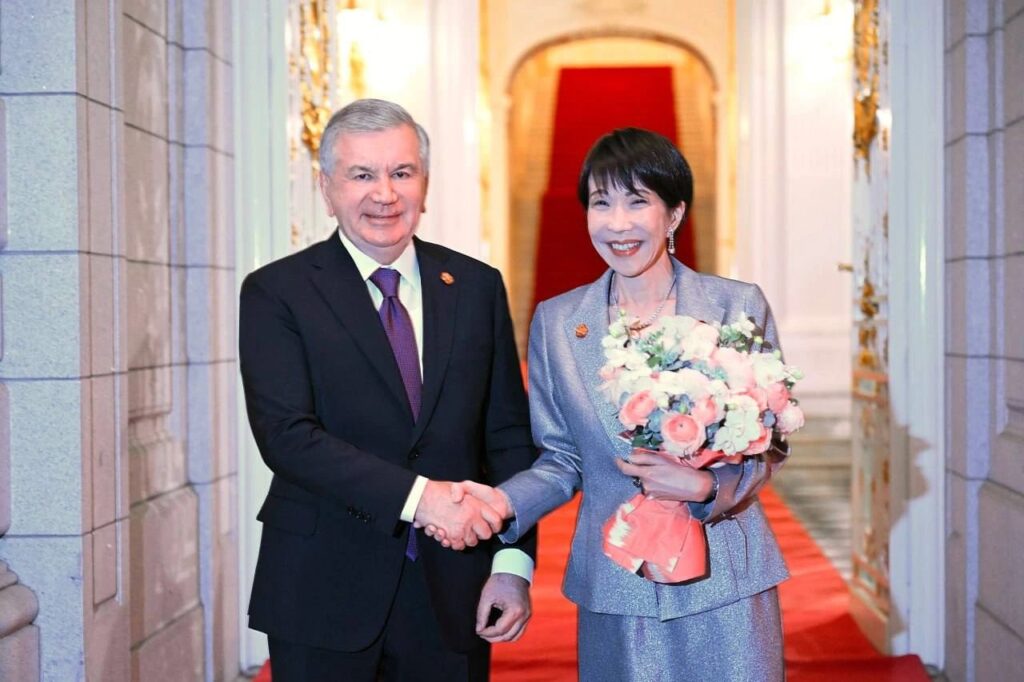
President Shavkat Mirziyoyev of Uzbekistan began his visit to Japan on Thursday by attending an official reception hosted by Japan’s Prime Minister Sanae Takaichi at the Akasaka Palace in Tokyo. The event marked the opening of a series of engagements bringing together the leaders of Central Asia and Japan, with a focus on strengthening regional cooperation. The reception brought together the presidents of all five Central Asian states. Alongside Mirziyoyev were President Kassym-Jomart Tokayev of Kazakhstan, President Sadyr Japarov of Kyrgyzstan, President Emomali Rahmon of Tajikistan, and President Serdar Berdimuhamedov of Turkmenistan. The gathering underscored Japan’s effort to engage the region as a group, rather than solely through bilateral ties. Mirziyoyev’s presence at the Akasaka Palace, a venue reserved for state-level diplomacy, highlighted Uzbekistan’s growing role in Central Asia and its expanding foreign policy outreach beyond the immediate region. In recent years, Tashkent has sought to deepen ties with Asian partners, including Japan, in areas ranging from infrastructure and energy to education and technology. According to the visit programme, Mirziyoyev will hold high-level talks with Japanese government officials on December 20. Those discussions are expected to focus on trade and investment, technological cooperation, and sustainable development, including green energy and climate resilience. Japan has been a long-standing development partner for Uzbekistan, providing loans, grants, and technical assistance through agencies such as the Japan International Cooperation Agency. The visit will feature the inaugural leaders-level “Central Asia + Japan” Dialogue Summit, bringing all six sides together in a multilateral format. The summit is intended to build on earlier dialogue mechanisms and explore joint approaches to economic connectivity, regional stability, and long-term growth. For Mirziyoyev, the Tokyo meetings offer an opportunity to reinforce Uzbekistan’s reform agenda on an international stage and to position the country as an active participant in shaping Central Asia’s collective engagement with major partners such as Japan.

CSTO Signs New Security Roadmap in Bishkek Amid Armenia Boycott and Putin Ukraine Remarks

The Collective Security Treaty Organization (CSTO) reaffirmed its commitment to regional security and political coordination during its annual summit in Bishkek, Kyrgyzstan, on November 27. Leaders from five of the bloc’s six members - Russia, Belarus, Kazakhstan, Kyrgyzstan, and Tajikistan - attended the event and signed off on a series of military, security, and strategic cooperation agreements. Armenia, the sixth CSTO member, boycotted the summit for the second year running, continuing its protest against the alliance’s refusal to intervene during Armenia’s conflict with Azerbaijan, and marking another low in Armenia’s engagement with the CSTO after months of public grievances against the bloc. Despite Yerevan’s absence, the other members adopted a wide-ranging joint declaration reaffirming the alliance’s collective defense commitments and outlining new initiatives to modernize its security framework. Notably, Armenia did not oppose the adoption of the summit documents in its absence. The CSTO, founded in 2002 and led by Russia, has a charter that guarantees mutual defense among members, though the bloc has often struggled to act decisively during regional crises. Still, it remains the only formal security alliance connecting Russia with post-Soviet Central Asian republics. Kyrgyz President Sadyr Japarov hosted the summit, marking the end of his country’s chairmanship. Japarov handed over the role to Russian President Vladimir Putin, who announced that Russia will lead the CSTO in 2026 under the motto “Collective Security in a Multipolar World: Common Goal—Shared Responsibility.” The bloc also appointed Kyrgyzstan’s Taalatbek Masadykov as the next Secretary General. The former deputy head of Kyrgyzstan’s Security Council will begin his three-year term on January 1, 2026. In remarks during the summit, Putin also addressed global concerns about the war in Ukraine, stating that a 28-point peace plan proposed by former U.S. President Donald Trump could serve as a “basis for future agreements.” He added that Russia has no intention of attacking Europe, seeking to dispel fears of escalation while reaffirming Moscow’s security agenda. The summit ended with the adoption of a large number of documents. Among them were a strategy to combat drug trafficking and plans to improve border security, peacekeeping readiness, and anti-terrorism efforts. Russia used the summit to offer CSTO members a rearmament initiative. Putin proposed supplying allies with modern Russian-made weapons that had “proven their effectiveness” in recent conflicts. The offer included expanded cooperation in joint production and training. Military exercises will continue under the newly adopted five-year cooperation plan. In 2025, the CSTO held drills in Kyrgyzstan, Belarus, and Tajikistan under the banner “Indestructible Brotherhood.” The plan outlines regular future training, integration of air defense units, and enhancements to peacekeeping logistics. The alliance also adopted an Anti-Drug Strategy for 2026–2030 and signed a joint resolution to intensify Operation “Kanal,” which targets drug routes through Central Asia. The CSTO committed to upgrading its counterterrorism strategy and enhancing cyber defense capabilities, with Russia proposing broader coordination on information security and biosecurity. Tajik President Emomali Rahmon, meanwhile, used the summit to urge partners to accelerate border security aid along Tajikistan’s porous southern frontier...

CSTO Summit in Bishkek: Armenia’s Boycott, Russia’s Agenda, and a New Secretary General

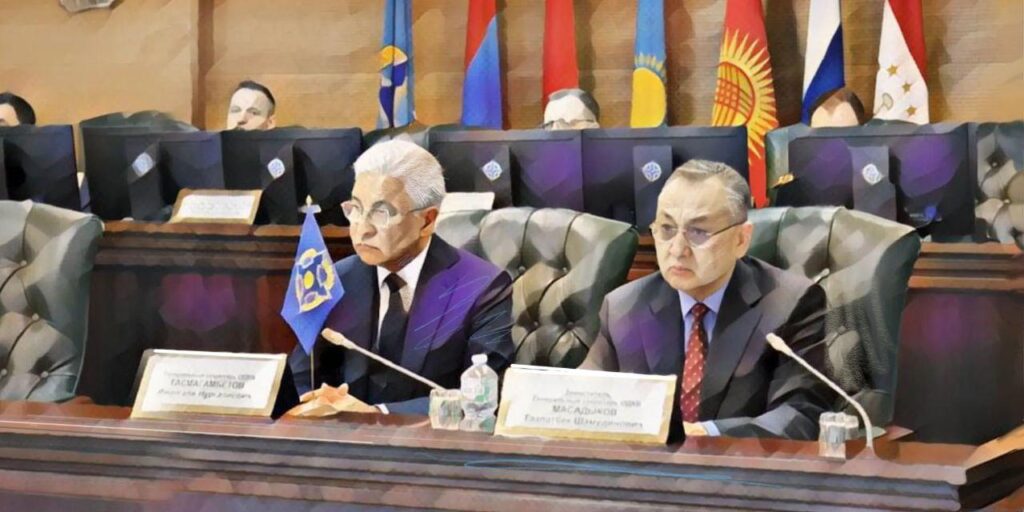
On November 27, Kyrgyzstan will host the annual summit of the Collective Security Treaty Organization (CSTO) in Bishkek, bringing together foreign ministers, defense ministers, and security council secretaries from member states. While often portrayed in Russian media as an Eurasian analogue to NATO, the CSTO remains an organization heavily dependent on Russian military power. Should Moscow withdraw or reduce its support, the Organization’s relevance would likely collapse. A stark illustration of this fragility is Armenia, whose Prime Minister Nikol Pashinyan will boycott the summit entirely. Russian Presidential Aide Yuri Ushakov confirmed that Armenia will not attend the session of the Collective Security Council, the CSTO’s highest governing body, though it does not object to the adoption of bloc-wide documents. According to the CSTO press service, the Council is expected to adopt a declaration outlining member states’ joint positions on current security challenges. Also on the agenda is the formal appointment of the next Secretary General for the 2026-2029 term, and the unveiling of Russia’s priorities for its upcoming presidency in 2026. President Vladimir Putin’s speech on these priorities is expected to dominate the summit. Armenia’s withdrawal highlights the CSTO’s waning cohesion, maintained largely by members' reliance on Russian security assistance, a dynamic in place since the Treaty’s inception in Tashkent on May 15, 1992. The original signatories included Armenia, Kazakhstan, Kyrgyzstan, Russia, Tajikistan, and Uzbekistan, with Azerbaijan, Belarus, and Georgia joining in 1993. The treaty entered into force in 1994. Its central provision, Article 4, mandates collective defense: an attack on one member is considered an attack on all, obligating military and other forms of assistance in line with Article 51 of the UN Charter. In 1999, Armenia, Belarus, Kazakhstan, Kyrgyzstan, Russia, and Tajikistan signed a protocol extending the treaty, establishing an automatic renewal every five years. The formal CSTO was created in 2002; its charter was registered with the UN the following year, and it has held observer status at the UN General Assembly since 2004. For Armenia, the CSTO’s relevance has waned dramatically since the bloc declined to intervene during the final phase of the Nagorno-Karabakh crisis. Yerevan’s disenchantment, however, predates 2023 and stretches back to the 2021–2022 border clashes, when it also felt the organization had failed to provide meaningful support. Kazakhstan, by contrast, remains a key beneficiary: the rapid CSTO deployment in January 2022 played a central role in stabilizing the country during a period of acute domestic unrest. As the current Secretary General, Imangali Tasmagambetov - an influential figure from the “Old Kazakhstan” elite - completes his term, the position is scheduled to rotate to Taalatbek Masadykov of Kyrgyzstan. Ushakov confirmed that Tasmagambetov will deliver a final report on the Organization’s activities and security concerns before officially stepping down on January 1. Masadykov, currently Deputy Secretary General, is expected to assume the role seamlessly. While Masadykov brings diplomatic gravitas, the question remains whether he can restrain Moscow and Minsk from pushing CSTO allies toward confrontation with NATO. Tasmagambetov leaves behind a significant legacy and an...

EU’s Kallas Tours Central Asia Ahead of Landmark Samarkand Summit

Last week, Kaja Kallas, the European Union's High Representative for Foreign Affairs and Security Policy and Vice-President of the European Commission, toured Central Asia in advance of the first-ever EU-Central Asia Summit. The notable meeting is set to take place in the ancient Uzbek city of Samarkand on April 3-4. EU-Central Asia Summit Samarkand, a city increasingly popular among international travelers, has hosted high-level gatherings before, including the Shanghai Cooperation Organization Summit in September 2022. However, the upcoming summit marks the first time the top leadership of all five post-Soviet Central Asian republics will convene with the EU at this level. Key topics on the agenda include energy cooperation, trade corridors, and climate change. The summit is expected to produce several agreements that will outline the progress of EU-Central Asia relations and establish strategic policy directions for the future. Visit to Turkmenistan Kallas began her tour in Ashgabat, where she chaired the 20th EU-Central Asia Foreign Ministers’ Meeting. There, she addressed the implications of EU sanctions on Russia. “The European Union has enacted 16 sanctions packages and is currently preparing the 17th. I understand these measures impact the region’s economies, but Russian companies must not be allowed to use Central Asia to circumvent them,” Kallas warned. The meeting also focused on the EU-Central Asia roadmap adopted in Luxembourg in October 2023. Discussions centered on deepening trade, economic, and transport ties, along with expanding digital connectivity as part of the EU's Global Gateway initiative. Kallas also met with Turkmen President Serdar Berdimuhamedov, praising Turkmenistan’s development and expressing appreciation for bilateral cooperation. Her remarks drew criticism from some observers. Belarusian political analyst Dzmitry Balkunets criticized Kallas on social media, accusing the EU of compromising its values by praising authoritarian regimes. Uzbekistan Visit In Tashkent, Kallas met with President Shavkat Mirziyoyev. Discussions highlighted the upcoming Samarkand summit and stressed the importance of deepening EU-Uzbek cooperation in trade, logistics, digitalization, green energy, and infrastructure. Both sides also explored steps toward a new enhanced partnership agreement and Uzbekistan’s accession to the World Trade Organization. Visit to Kazakhstan Kallas concluded her tour in Astana, where she met with President Kassym-Jomart Tokayev on March 28. A statement from Tokayev’s office underlined Kazakhstan’s cautious diplomatic approach to global tensions. "President Tokayev emphasized the importance of restraint and responsibility in evaluating complex global developments. Kazakhstan remains committed to resolving international conflicts through diplomacy," the statement read. Analysts suggest Kallas may have encouraged Tokayev to distance Astana from both Moscow and Washington, as Brussels often diverges from Washington on issues like the war in Ukraine. However, Tokayev reiterated Kazakhstan’s multi-vector foreign policy, which avoids aligning with any single global power. In a notable development, Tokayev met with Uzbek President Mirziyoyev last weekend in Almaty. Though unannounced, the working visit suggests that the two leaders were coordinating positions ahead of the Samarkand summit. Whether their joint stance aligns with Brussels' expectations remains to be seen.

EU Pledges Steady Support for Tajikistan Ahead of Historic Central Asia Summit

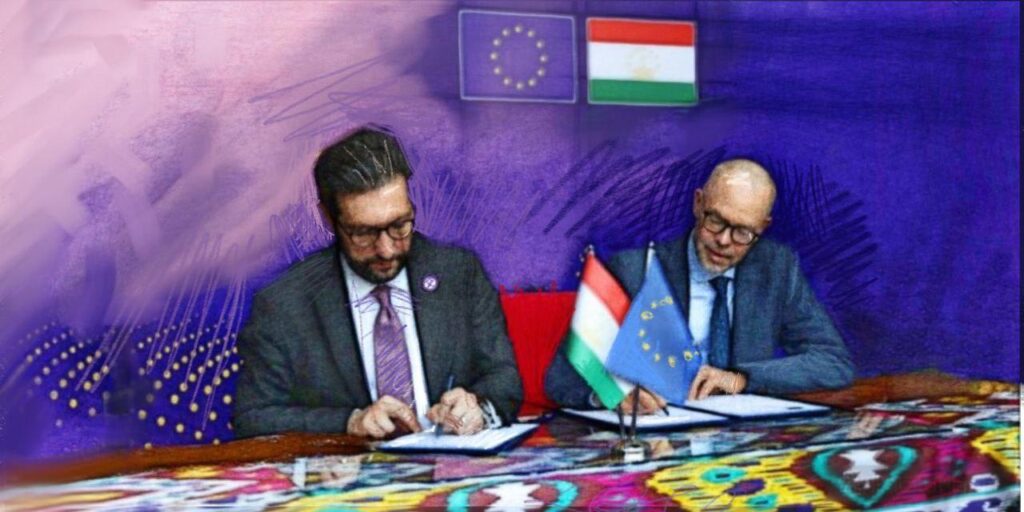
The European Union will maintain its current level of assistance to Tajikistan despite the recent suspension of U.S. funding through USAID, EU Ambassador to Tajikistan Raimundas Karoblis has confirmed. He emphasized that European and American aid programs operate independently and that EU support will remain unaffected. “Aid from the EU will continue and will not be reduced,” Karoblis stated. He added that the EU's assistance framework for Tajikistan is already set through 2027 and cannot be revised before then. Discussions about increased support may take place after that period.   EU and Central Asia: Toward a Historic Summit On March 27, Ashgabat will host the 20th meeting of foreign ministers from the European Union and Central Asia. The key objective of this gathering is to prepare for the first-ever EU-Central Asia Summit, scheduled for April 3-4 in Samarkand. The summit will bring together the President of the European Council, the head of the European Commission, and the leaders of all five Central Asian states. According to the EU Delegation in Tajikistan, the summit will mark a new milestone in EU-Central Asia relations, reflecting the EU’s deepening political engagement with the region. Financial Assistance and Strategic Priorities Between 2021 and 2027, the EU has committed more than €550 million in aid to Central Asia, with €142 million allocated to Tajikistan. The focus areas include building an inclusive green economy, investing in human capital, and ensuring sustainable management of natural resources. Under its Global Gateway initiative, the EU is working to develop smart and sustainable connectivity across transport, digital infrastructure, energy, and education. A key initiative is the Trans-Caspian Transport Corridor, to which the EU has allocated more than €88 million. Other efforts target enhanced digital and energy integration in the region. In the strategic domain of critical raw materials, the EU has earmarked €16 million to support local value chains and promote sustainable investments. Additionally, through the European Fund for Sustainable Development Plus (EFSD+), €30 million in guarantees have been allocated for renewable energy and raw material extraction projects. Security, Education, and Youth Engagement The EU plays an active role in regional security initiatives. Its BOMCA program supports border management and the fight against transnational crime, while the CADAP program focuses on drug use prevention. In Tajikistan specifically, the EU, in partnership with the OSCE, is implementing a project to strengthen the capacity of border guards along the Tajik-Afghan frontier. The EU also contributes to counter-terrorism efforts and collaborates with the government on related initiatives. Education and youth empowerment are additional EU priorities. From 2013 to 2027, €95 million has been directed toward reforming Tajikistan’s education sector. The Erasmus+ program received €73 million for 2021-2027, enabling students from Central Asia to study at European universities. Youth employment is also being addressed through the €10 million DARYA program, and the recently launched €4.5 million Regional Civil Society Fund (as of September 2024) is aimed at strengthening civic engagement. Karoblis reaffirmed the EU’s long-term commitment to Tajikistan, noting that assistance will remain consistent,...