• KGS/USD = 0.01143 0%
  • KZT/USD = 0.00200 0%
  • TJS/USD = 0.10593 0.09%
  • UZS/USD = 0.00008 0%
  • TMT/USD = 0.28575 0%
  • KGS/USD = 0.01143 0%
  • KZT/USD = 0.00200 0%
  • TJS/USD = 0.10593 0.09%
  • UZS/USD = 0.00008 0%
  • TMT/USD = 0.28575 0%
  • KGS/USD = 0.01143 0%
  • KZT/USD = 0.00200 0%
  • TJS/USD = 0.10593 0.09%
  • UZS/USD = 0.00008 0%
  • TMT/USD = 0.28575 0%
  • KGS/USD = 0.01143 0%
  • KZT/USD = 0.00200 0%
  • TJS/USD = 0.10593 0.09%
  • UZS/USD = 0.00008 0%
  • TMT/USD = 0.28575 0%
  • KGS/USD = 0.01143 0%
  • KZT/USD = 0.00200 0%
  • TJS/USD = 0.10593 0.09%
  • UZS/USD = 0.00008 0%
  • TMT/USD = 0.28575 0%
  • KGS/USD = 0.01143 0%
  • KZT/USD = 0.00200 0%
  • TJS/USD = 0.10593 0.09%
  • UZS/USD = 0.00008 0%
  • TMT/USD = 0.28575 0%
  • KGS/USD = 0.01143 0%
  • KZT/USD = 0.00200 0%
  • TJS/USD = 0.10593 0.09%
  • UZS/USD = 0.00008 0%
  • TMT/USD = 0.28575 0%
  • KGS/USD = 0.01143 0%
  • KZT/USD = 0.00200 0%
  • TJS/USD = 0.10593 0.09%
  • UZS/USD = 0.00008 0%
  • TMT/USD = 0.28575 0%
21 February 2026

Viewing results 1 - 6 of 107

Kazakhstan Eyes Revival of Ili River Corridor as Logistics Artery

River transport has long offered a cost-effective and environmentally friendly alternative for moving cargo. Inland waterways present an alternative route that could unlock new logistics pathways for Kazakhstan and the broader Central Asian region. Yet the development of river navigation remains hindered by several challenges. Kazakhstan’s inland waterway system faces numerous obstacles: insufficient investment, underdeveloped port infrastructure, an aging fleet, and bureaucratic red tape. Despite these issues, reviving river navigation could significantly boost mutual trade, increase cargo volumes, and ease pressure on overburdened road and rail networks. The government has initiated several projects aimed at doing just that. One notable initiative is the proposed route along the transboundary Ili River in the Almaty Region, connecting the city of Konaev with Yining in China’s Xinjiang Uyghur Autonomous Region. Originating in the Tien Shan mountains, where the Kunges and Tekes rivers merge, the Ili River stretches 1,439 km, with 620 km or 43% within Kazakhstan’s borders. [caption id="attachment_38136" align="aligncenter" width="2560"] Image: Ili River Port LLP[/caption] The project is a joint venture between Kazakhstan’s Ili River Port LLP and China International Water & Electric Corp. In an interview with The Times of Central Asia, Marat Julaev, CEO of Ili River Port LLP, stated that the navigable section of the route spans 450 km. Historically, the Ili served as a key transport artery, facilitating trade and connectivity with remote regions. “This route was navigable and operational until 1980. It was used to transport dry goods, ores, petroleum products, and consumer goods from China,” Julaev explained. Following the collapse of the Soviet Union, navigation along the Ili declined sharply. Extensive water usage in China caused water levels to fall, compounding the route’s inability to compete with road and rail alternatives. However, with mounting congestion and capacity constraints in land-based infrastructure, the river’s strategic role is being reconsidered. “In the Almaty Region, we’ve been allocated a 100-hectare plot on the coast of the Kapshagai Reservoir, providing a strategic advantage in reducing delivery time and costs,” Julaev told TCA. “Our Chinese partners, operating in Kazakhstan since 2006, are developing the route between Yining and Konaev.” [caption id="attachment_38137" align="aligncenter" width="2560"] Image: Ili River Port LLP[/caption] A central component of the project is the creation of a transport and logistics hub to consolidate and distribute cargo across Central Asia. The river port will offer terminal services, storage, sorting, equipment maintenance, and passenger transport. Plans also include developing production facilities and cargo terminals on-site. Commissioning is expected in 2027, with an initial cargo turnover capacity of one million tons annually, potentially rising to three million. According to Julaev, this development will enhance Kazakhstan’s foreign trade with China. Julaev emphasized one of the route’s key advantages: the ability to transport oversized cargo, including materials for Kazakhstan’s first nuclear power plant under construction in the village of Ulken on Lake Balkhash, which is fed primarily by the Ili. An equally critical issue is water availability. According to the UN Development Programme in Kazakhstan, over 44% of the country’s river flow originates in...

“Music Is Born in Pain”: Kazakh Composer Robert Ziganshin on Inspiration, Integrity, and Creative Freedom

Robert Ziganshin is one of Kazakhstan’s most in-demand film composers. A graduate of the Lyon Conservatory in France, where he studied classical guitar and earned master’s degrees in both music for the visual arts and musicology, he returned home to rapidly establish himself in the country's film and television industry. Ziganshin’s credits include music for popular TV series and films such as Alisher Utev’s crime drama 5:32 (IMDB), the box office hit Kazakh Business in Brazil, and Malika, a feature film by Russian director Natalya Uvarova about a family of Ingush migrants. In an interview with The Times of Central Asia, Ziganshin spoke about the influence of the French school, the ethics of film composition, and why writing music “that simply comments on the action” can mean sacrificing artistic integrity. TCA: Robert, you graduated from KIMEP in Kazakhstan. How did you end up in France? Ziganshin: I’ve been passionate about music since early childhood. Even when I was playing with building blocks, I was always humming something, as if adding a soundtrack to my own stories. I didn’t get into music school, and it wasn’t until I was fifteen that I started taking private guitar lessons. There were times I practiced six hours a day. There was no higher education in classical guitar in Kazakhstan at the time, so I enrolled at KIMEP. After graduating, I applied to two conservatories in France and was accepted to the one in Lyon. TCA: Why France? Ziganshin: I spoke fluent French. My father had sent me to language school, and I took part in competitions. Later, a professor from Lyon gave a master class in Almaty, and I helped translate for him. He assessed my level and encouraged me to apply to his course. TCA: Was tuition really that affordable? Ziganshin: For foreign students, it was about €900 per year, including health insurance. Compared to the UK, it was a bargain. I spent four years there and earned a bachelor’s degree. TCA: How did you shift into composing for film? Ziganshin: I met students from the program Musique appliquée aux arts visuels, music created for film, theater, performance, and media art. I wanted to try it. The entrance exam was creative: we had to score scenes and compose music for a three-minute video in a week. I got in on my second try, only twelve of us were accepted. It was a two-year program, starting with orchestration and sound engineering, then moving into practical work on student film projects. TCA: What was the subject of your master’s thesis? Ziganshin: When should a composer start work on a film? Personally, I prefer being involved from the script stage. After finishing that degree, I also enrolled in a master’s in musicology. In 2021, I returned to Kazakhstan. I struggled to find paid work in music and almost joined my father’s printing business. I even started hand-making notebooks, neat and beautiful ones. But soon, small offers started coming in, and I returned to composing full-time, initially...

How Uzbekistan Plans to Lead Central Asia’s Digital Future – An Interview With the Minister of Digital Technologies

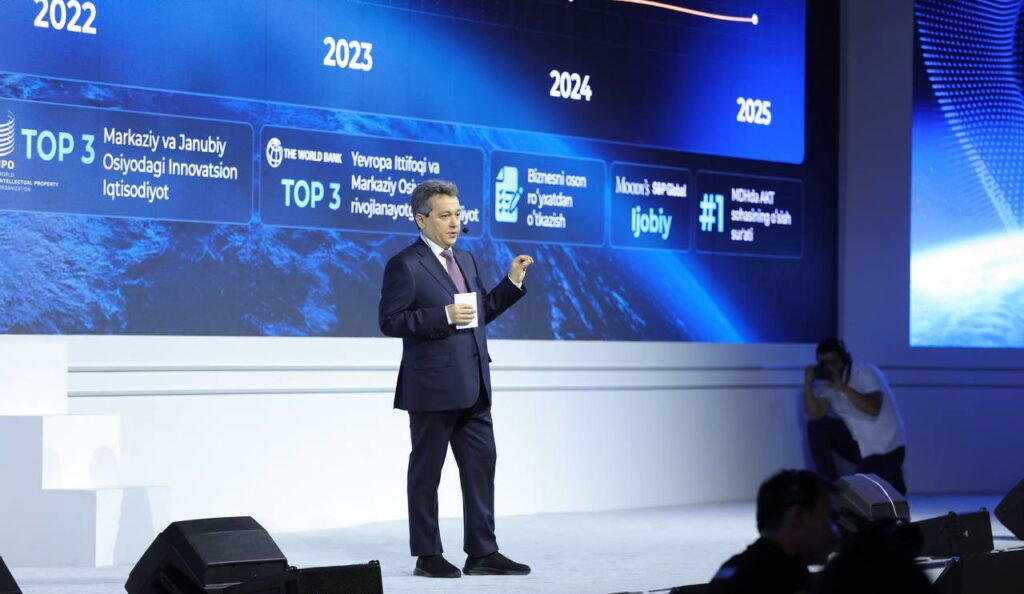
Uzbekistan’s ambitions to position itself as Central Asia’s digital powerhouse took center stage during ICT Week Uzbekistan 2025 this September - the country’s largest-ever technology forum, drawing more than 20 official delegations, 300 companies, and 20,000 participants from over 50 countries. With artificial intelligence and future technologies at its core, the event showcased how Tashkent aims to turn international partnerships into lasting investment, innovation, and talent pipelines. At the forefront of these efforts stands Sherzod Shermatov, Minister of Digital Technologies, who has overseen landmark initiatives extending IT Park incentives until 2040, launching the IT Visa for foreign specialists, and embedding AI education across Uzbekistan’s schools and universities. The Times of Central Asia spoke to Minister Shermatov to discuss how Uzbekistan plans to sustain investor confidence beyond ICT Week, prepare its workforce for an AI-driven economy, and balance rapid digitalization with data protection and national sovereignty. [caption id="attachment_37995" align="aligncenter" width="1280"] ICT Week 2025; image: The Ministry of Digital Technologies of the Republic of Uzbekistan[/caption] TCA: Uzbekistan showcased itself as a regional IT hub during ICT Week. What concrete steps will the Ministry take to ensure foreign investors and global tech firms remain engaged in Uzbekistan? Shermatov: In order to comprehensively stimulate and develop the activities of foreign investors and global technology companies in the Republic of Uzbekistan, a number of key preferences for IT Park residents have already been implemented. The Government of Uzbekistan has extended and reinforced the system of benefits and guarantees for foreign investors and IT Park residents, ensuring long-term stability and predictability of the investment climate. Among these measures, IT Park tax incentives have been officially extended until 2040, offering exemption from a range of taxes, a simplified foreign currency regime, and a 5% dividend tax for non-residents, provided that more than 50% of their revenue is generated from export activities. These reforms provide a reliable and attractive environment for both established global players and emerging startups. To further strengthen the country’s position as a regional digital hub, the Government has also introduced the IT Visa - a three-year visa designed for founders, investors, and foreign specialists of IT Park resident companies. The IT Visa facilitates simplified entry, residence, and employment procedures for international professionals and their family members, making Uzbekistan one of the most open and accessible markets for global technology talent. In parallel, a “One Stop Shop” service has been launched to streamline administrative procedures. It provides fast-track company registration, bank account opening, and work and residency permits, enabling investors and foreign specialists to begin operations in Uzbekistan with unprecedented efficiency. At the same time, the Ministry continues to expand cooperation between global technology partners and the national innovation ecosystem under the “ZERO Risk” and “Local to Global” mechanisms, as stated in the relevant decrees of the President of the Republic of Uzbekistan. These instruments create a foundation for long-term growth, stimulate venture financing, and support the international scaling of Uzbek startups. Also, comprehensive programs are being implemented to train highly qualified IT specialists to...

From Belt and Road to Backlash: Edward Lemon and Bradley Jardine Discuss China in Central Asia

As China invests billions in Central Asian oilfields, railways, and cities, the region’s response is anything but passive. In Backlash: China’s Struggle for Influence in Central Asia, Bradley Jardine and Edward Lemon document how Central Asians – from government halls to village streets – are responding to Beijing’s expanding footprint. The book provides a nuanced look at China’s engagement in Kazakhstan, Kyrgyzstan, Tajikistan, Turkmenistan, and Uzbekistan over the three decades since these nations gained independence. Drawing on more than a decade of fieldwork, Jardine and Lemon ask a timely question: can Beijing maintain its growing influence in an environment where local voices and interests are increasingly assertive? The Times of Central Asia spoke with the authors. TCA: Central Asia has become an increasingly strategic crossroads, rich in resources, young in demographics, and positioned between major powers. Yet China’s engagement appears far more ambitious than that of Western or regional players. In your view, what accounts for this asymmetry? Is it primarily a matter of geography and financial capacity, or has China been more politically and diplomatically attuned to Central Asia’s priorities than others? J/L: China’s dominance in Central Asia stems from both geography and political attunement. As we note in Backlash, Beijing views the region as an extension of its own security frontier, as both a buffer protecting Xinjiang and a potential source of terrorism. It has built deep ties through consistent, elite-level engagement since the 1990s. Its approach blends vast financial capacity with political instincts that resonate with local elites: prioritizing sovereignty, stability, and non-interference rather than the governance conditionalities that often accompany Western aid and investment. Through the Belt and Road Initiative, which was launched in the region in 2013, the Shanghai Cooperation Organization, which was established in 2001 with four Central Asian republics as founding members, and newer platforms like the China-Central Asia (C+C5) summit, China offers infrastructure, energy investment, and regime security in ways tailored to the needs of authoritarian partners. Unlike the episodic or values-driven engagement of Western actors, and with Russia’s attention increasingly divided, China’s steady, pragmatic diplomacy, backed by proximity and resources, has allowed it to entrench itself as the region’s indispensable power. TCA: China’s expanding presence across trade, infrastructure, and finance has reshaped Central Asia’s economic landscape. To what extent do these investments remain primarily commercial, and when do they start to carry political or strategic implications? How do local governments manage the risks of dependency or debt while pursuing development gains? J/L: China’s expanding economic footprint in Central Asia may be driven by trade and infrastructure, but the lines between commerce and strategy have become increasingly blurred. As we note in Backlash, Beijing’s investments, roads, pipelines, railways, and energy grids are rarely purely commercial. They create structural dependencies that bind Central Asian economies to China’s markets, finance, and technology. By 2020, roughly 45% of Kyrgyzstan’s external debt and more than half of Tajikistan’s were owed to China, while around 75% of Turkmenistan’s exports flowed to Chinese buyers. These imbalances give Beijing...

TCA Interview: Asia’s First New York Film Academy Campus Opens in Almaty

On 27 September, the New York Film Academy Kazakhstan (NYFA) opened the first branch of the world-renowned American film school in Central Asia. For young Kazakhstani and foreign students, this presents a unique opportunity to gain top-tier knowledge for future careers in the industry. The new campus was established through a partnership between Almaty University of Energy and Communications (Energo University) and the Dala Edge Creative Technology Park, with the opening ceremony attended by Michael Young, President and CEO of the New York Film Academy, and Sayasat Nurbek, Minister of Science and Higher Education of Kazakhstan. Gani Nygymetov, Rector of Energo University, spoke to The Times of Central Asia about the opportunities and prospects of NYFA Kazakhstan. TCA: How did the idea to establish the New York Film Academy Kazakhstan campus in Kazakhstan come about? GN: Energo University has been in existence for over 50 years and is one of the leading technical universities in Central Asia, specializing in engineering and energy. In February this year, we presented a new development strategy that includes a mission to remain a leader in energy education, while also expanding into telecommunications, IT, and techno-creative programmes. To achieve these goals, the 16-hectare Dala Edge Creative Technology Park was created near Almaty. Now, a branch of NYFA has opened there, its first campus in Asia. Previously, NYFA campuses were only located in Florence, New York, and Los Angeles. I am confident that the opening of the campus in Kazakhstan will give an additional impetus to the development of creative industries in the region and enable us to train specialists of international calibre. The Creative Technology Park will become a hub for professional training and innovative projects and will support the integration of students and professionals into the film, animation, and game design industries. TCA: Who teaches at NYFA Kazakhstan, exclusively American specialists, or are local experts also involved in the programme? What subjects are taught? GN: American specialists teach students in film directing, screenwriting, acting, 3D animation, visual effects, and game design. All programmes meet international standards, instruction is in English, and modern tools and methods used in the United States are employed. Inviting NYFA to Kazakhstan is part of a strategy to develop the country's academic potential. The Ministry of Science and Higher Education, led by Minister Sayasat Nurbek, is actively attracting leading international universities. Today, more than 40 renowned foreign universities have opened branches in Kazakhstan. This allows talented students to receive high-quality education at home and also attracts students from other countries in the region. Partnerships with international universities, including Anhalt University (Germany), which has also opened a branch at our university, and NYFA, help set high standards of education and expand opportunities for students. In the coming years, we plan to launch our own digital media faculty. [caption id="attachment_37086" align="aligncenter" width="353"] Gani Nygymetov, Rector of Energo University; image: Energo University[/caption] TCA: How many students are currently studying at NYFA Kazakhstan? Are there plans to expand the number of disciplines?  GN: NYFA...

From Kyrgyzstan to Scotland: Shahsanem Murray’s Naked Nimbus Explores Love, Loss, and Belonging

In the wake of Finding the Holy Path, published in 2014, and Cold Shadows in 2016, Naked Nimbus is Shahsanem Murray’s long-awaited third novel. Once again, Murray’s multifaceted plot is woven with intrigue and mysticism, referencing the stark cultural contrasts between life in Central Asia under the Soviet regime and that in the West. The story focuses on Arthur, a young, ambitious artist struggling to find his way in the world and recognition for his craft. Haunted by his role in a fatal accident, he searches for atonement whilst battling to maintain his moral, personal, and professional integrity. Faced by numerous challenges, Arthur experiences a storm of emotions from despair to euphoria, and, highly sensitive to his surroundings and everyone he meets, the thin line between reality and fantasy blurs as he continues to hold out hope for true love. Friendships are put to a test, and he must muster the strength to forgive both himself and those closest to him for acts of disloyalty. Arthur’s journey takes him across the globe, from his Soviet homeland to Scotland, France, and finally, the wilds of Siberia. Often feeling dislocated, he finds himself questioning his identity and self-worth both as a man and an artist; a situation compounded by supernatural encounters. Murray further explores the human condition and the problems faced by society at large by introducing parallel stories of other characters’ lives, including Arthur’s acquaintances and his friend Alik’s father, Turdubek, as he searches for a soulmate under the Soviet regime. Like the Surrealist paintings which inspired it, this novel is filled with poignant visual imagery and symbolism, which, open to interpretation, lead the reader to ponder the outcome of events. Editor Laura Hamilton caught up with Shahsanem Murray to discuss the author’s new novel: LH: What is the meaning or inspiration behind the book’s title? SM: I wanted the title to be both poetic and to act as a key for the reader’s attention. After writing the first two chapters, I realized that the original title wouldn’t work. Then, one Sunday morning, my business partner Gordon Murray mentioned the word ‘nimbus.’ Unfamiliar with the term, I began searching for images and decided that ‘Naked Nimbus’ would be a perfect description of Arthur’s plight. As a man without wings, he is unable to fly, and so, if he is to soar in his life’s journey, he must explore, harness, and embrace the moral and cultural tenets of the society in which he lives and works. LH: The video trailer recreates the opening violent murder scene, but unlike typical crime fiction, the book focuses on its prolonged mental impact on the protagonist. Was it your intention that readers view crime from a different perspective? SM: The video trailer was carefully created as a marketing tool to entice readers. It sets the scene for the impact the accidental murder has on the protagonist’s life. I hope it doesn’t disappoint! [video width="1080" height="1920" mp4="https://timesca.com/wp-content/uploads/2025/10/WhatsApp-Video-2025-10-06-at-18.28.58.mp4"][/video] LH:  In common with your previous novels, the new book...