River transport has long offered a cost-effective and environmentally friendly alternative for moving cargo. Inland waterways present an alternative route that could unlock new logistics pathways for Kazakhstan and the broader Central Asian region. Yet the development of river navigation remains hindered by several challenges.
Kazakhstan’s inland waterway system faces numerous obstacles: insufficient investment, underdeveloped port infrastructure, an aging fleet, and bureaucratic red tape. Despite these issues, reviving river navigation could significantly boost mutual trade, increase cargo volumes, and ease pressure on overburdened road and rail networks. The government has initiated several projects aimed at doing just that.
One notable initiative is the proposed route along the transboundary Ili River in the Almaty Region, connecting the city of Konaev with Yining in China’s Xinjiang Uyghur Autonomous Region. Originating in the Tien Shan mountains, where the Kunges and Tekes rivers merge, the Ili River stretches 1,439 km, with 620 km or 43% within Kazakhstan’s borders.
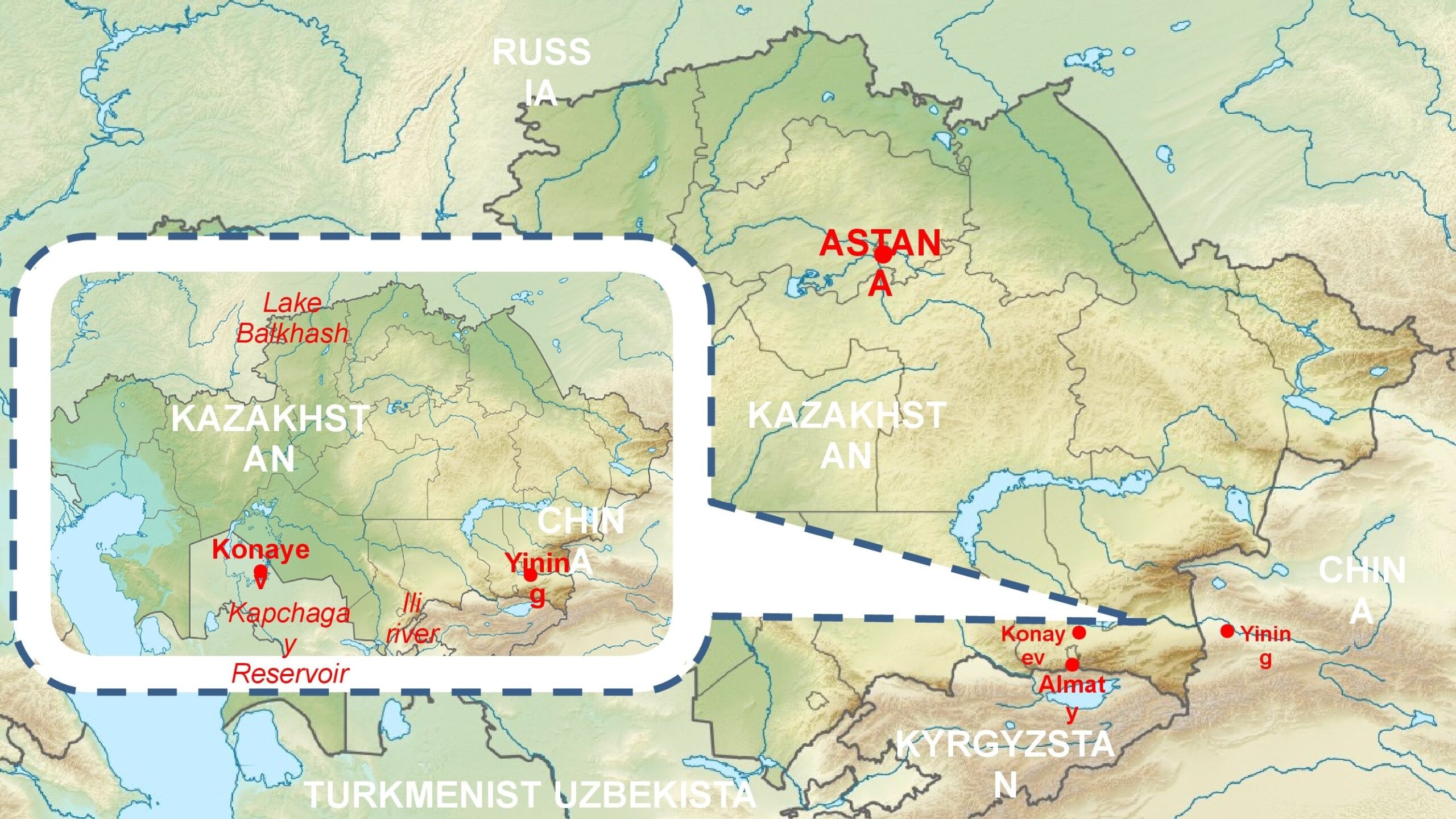
Image: Ili River Port LLP
The project is a joint venture between Kazakhstan’s Ili River Port LLP and China International Water & Electric Corp. In an interview with The Times of Central Asia, Marat Julaev, CEO of Ili River Port LLP, stated that the navigable section of the route spans 450 km. Historically, the Ili served as a key transport artery, facilitating trade and connectivity with remote regions.
“This route was navigable and operational until 1980. It was used to transport dry goods, ores, petroleum products, and consumer goods from China,” Julaev explained.
Following the collapse of the Soviet Union, navigation along the Ili declined sharply. Extensive water usage in China caused water levels to fall, compounding the route’s inability to compete with road and rail alternatives. However, with mounting congestion and capacity constraints in land-based infrastructure, the river’s strategic role is being reconsidered.
“In the Almaty Region, we’ve been allocated a 100-hectare plot on the coast of the Kapshagai Reservoir, providing a strategic advantage in reducing delivery time and costs,” Julaev told TCA. “Our Chinese partners, operating in Kazakhstan since 2006, are developing the route between Yining and Konaev.”

Image: Ili River Port LLP
A central component of the project is the creation of a transport and logistics hub to consolidate and distribute cargo across Central Asia. The river port will offer terminal services, storage, sorting, equipment maintenance, and passenger transport. Plans also include developing production facilities and cargo terminals on-site.
Commissioning is expected in 2027, with an initial cargo turnover capacity of one million tons annually, potentially rising to three million. According to Julaev, this development will enhance Kazakhstan’s foreign trade with China.
Julaev emphasized one of the route’s key advantages: the ability to transport oversized cargo, including materials for Kazakhstan’s first nuclear power plant under construction in the village of Ulken on Lake Balkhash, which is fed primarily by the Ili.
An equally critical issue is water availability. According to the UN Development Programme in Kazakhstan, over 44% of the country’s river flow originates in neighboring states, with intensive upstream water use leading to scarcity. The Ili River, flowing from northwestern China, has seen declining volumes since the 1970s, worsened by a 30% expansion of agricultural land along its banks in China over the past two decades. Further strain could disrupt the region’s ecological balance and threaten the viability of navigation.
Hence, maintaining the Ili’s water balance and that of Lake Balkhash is crucial. Kazakhstan has a strategic interest in ensuring bilateral cooperation with China, not only for logistics development but also for sustainable water resource management.
“Together with our Chinese partners, we’ve identified bottlenecks and developed measures such as dredging and shore reinforcement,” Julaev stated, noting that the project could also increase cargo traffic on the Trans-Caspian International Transport Corridor and enhance trade between Asia and Europe.
According to government targets, Kazakhstan aims to triple inland waterway freight volumes by 2027. The national strategy for developing transport and logistics potential through 2030 promotes shifting cargo from roads and rails to cleaner river-based alternatives. If successful, the Ili River project could provide a model for building out regional transit corridors, not only eastward toward China but westward via the Ural River to Russia, and northward via the Irtysh to the Northern Sea Route.