• KGS/USD = 0.01144 0%
  • KZT/USD = 0.00216 0%
  • TJS/USD = 0.10659 0%
  • UZS/USD = 0.00008 0%
  • TMT/USD = 0.28530 0%
  • KGS/USD = 0.01144 0%
  • KZT/USD = 0.00216 0%
  • TJS/USD = 0.10659 0%
  • UZS/USD = 0.00008 0%
  • TMT/USD = 0.28530 0%
  • KGS/USD = 0.01144 0%
  • KZT/USD = 0.00216 0%
  • TJS/USD = 0.10659 0%
  • UZS/USD = 0.00008 0%
  • TMT/USD = 0.28530 0%
  • KGS/USD = 0.01144 0%
  • KZT/USD = 0.00216 0%
  • TJS/USD = 0.10659 0%
  • UZS/USD = 0.00008 0%
  • TMT/USD = 0.28530 0%
  • KGS/USD = 0.01144 0%
  • KZT/USD = 0.00216 0%
  • TJS/USD = 0.10659 0%
  • UZS/USD = 0.00008 0%
  • TMT/USD = 0.28530 0%
  • KGS/USD = 0.01144 0%
  • KZT/USD = 0.00216 0%
  • TJS/USD = 0.10659 0%
  • UZS/USD = 0.00008 0%
  • TMT/USD = 0.28530 0%
  • KGS/USD = 0.01144 0%
  • KZT/USD = 0.00216 0%
  • TJS/USD = 0.10659 0%
  • UZS/USD = 0.00008 0%
  • TMT/USD = 0.28530 0%
  • KGS/USD = 0.01144 0%
  • KZT/USD = 0.00216 0%
  • TJS/USD = 0.10659 0%
  • UZS/USD = 0.00008 0%
  • TMT/USD = 0.28530 0%

Viewing results 1 - 6 of 39

Kazakhstan Freezes Projects with Iran Amid Military Conflict

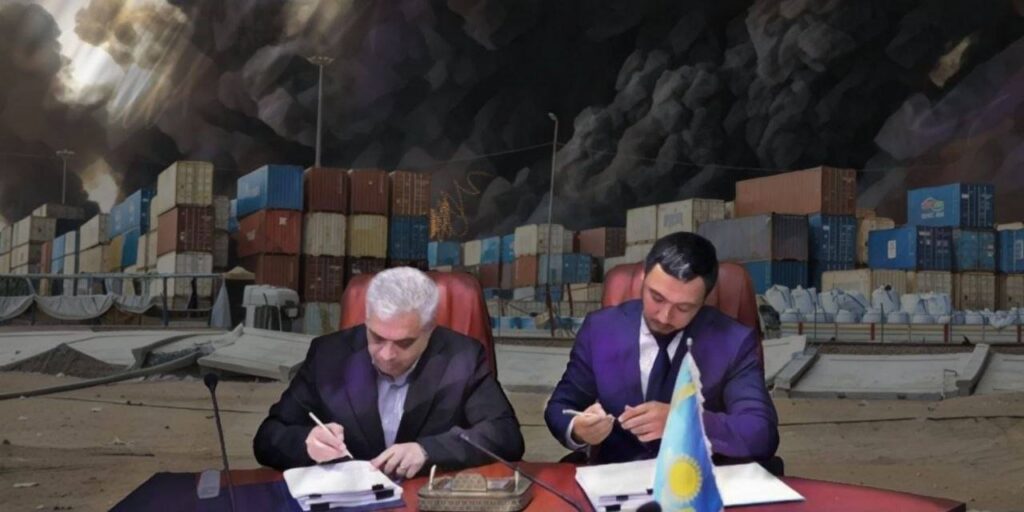
Kazakhstan has suspended several joint projects with Iran amid ongoing military hostilities in the country, Deputy Foreign Minister Arman Issetov has announced. The decision effectively puts on hold plans to expand trade and economic cooperation between Astana and Tehran, despite previously stated ambitions to significantly increase bilateral trade. On December 11, 2025, during the Kazakhstan-Iran business forum in Astana, Tokayev said bilateral trade had exceeded $340 million the previous year. The two sides set an initial goal of raising trade to $1 billion, with a longer-term aim of doubling that figure. However, the escalation of military activity in Iran has forced both sides to reconsider these plans. “The situation is currently very complicated. At this point, many of our projects with Iran have been frozen due to the country being in a state of war. As a result, our businesses and entrepreneurs are now in a wait-and-see position,” Issetov said. “Kazakhstan is not suffering major losses, as the volumes were relatively small and did not significantly impact the national economy. Nevertheless, given our strong partnership with Iran, there is an effect, though not a substantial one,” he added. Despite the growth in trade, Iran’s share in Kazakhstan’s foreign economic relations remains limited. According to the Ministry of National Economy, exports to Iran in 2025 amounted to $239.3 million, while imports totaled $191 million, equivalent to roughly 0.3% of the country’s total foreign trade turnover. The agricultural sector accounted for the bulk of trade: approximately 90% of Kazakhstan’s exports to Iran consisted of wheat and barley. In the first ten months of last year alone, grain shipments reached $280 million, exceeding the total agricultural trade volume for 2024 ($220 million). Government officials believe these volumes can be redirected to alternative markets if necessary. From a logistics perspective, Iran is not considered a critical transit route for Kazakhstan. This was previously confirmed by Deputy Prime Minister and Minister of National Economy Serik Zhumangarin. “I don’t think the conflict will have any impact on our logistics. Shipments through the Persian Gulf were never dominant for us,” he said. Despite its currently limited role, Iran had been viewed as a promising direction for the development of transport corridors. In December 2025, Tokayev announced plans to build a transport and logistics terminal at Shahid Rajaee Port, which was intended to provide direct access for Kazakh exports to global markets. Plans also included strengthening links between Kazakhstan’s ports of Aktau and Kuryk and Iran’s ports of Amirabad and Anzali, as well as integrating Bandar Abbas and Chabahar into regional logistics chains. “It is important for us to develop multimodal corridors connecting Central Asia with the Persian Gulf, and the Kazakhstan-Turkmenistan-Iran railway plays a key role in this,” Tokayev previously stated. According to his estimates, cargo traffic along this route could have doubled by 2030. For now, those plans are effectively on hold.

Kyrgyz Minister Sydykov Courts Investment in Washington

On the occasion of the annual IMF/World Bank meetings in Washington this week, the Prime Minister of Kyrgyzstan, Adylbek Kasymaliev, led a delegation to Washington D.C. for World Bank and IMF meetings, the Department of State Annual Bilateral Consultations, a meeting with Secretary of State Rubio, Deputy Secretary Landau and Under Secretary Hooker, as well as a number of other constructive dialogues and engagements with scholars, researchers, and authors. This trip marks the second high-level U.S. visit in a year, signaling Washington’s strategic interest and Kyrgyzstan’s willingness to deepen cooperation. Bakyt Sydykov, Kyrgyzstan’s Minister of Economy and Commerce, accompanied the Prime Minister. The delegation’s visit to Washington reinforces President Sadyr Japarov’s statement to President Donald Trump during the November 2025 C5+1 Summit, “I am confident that this event will provide an excellent opportunity for U.S. businesses to expand cooperation in sectors such as agriculture, e-commerce, information technology, transportation and logistics, tourism, and banking.” Following Japarov’s lead, Sydykov is actively engaging private and multilateral partners; state and Commerce meetings are meant to keep things moving and steady investor confidence. This shift towards deeper diplomatic, investment, and development ties is striking and certainly welcome in Washington. The shift reflects both an evolving Central Asian geopolitical landscape, post-Afghanistan dynamics, economic needs, diversification goals, and troubles in West Asia. Deeper engagement is also driven by ambitions to enhance regional transport and logistics integration. Kyrgyzstan’s approach departs from zero-sum logic, prioritizing win-win pragmatism and mutual gains. Minister Sydykov In an interview with The Times of Central Asia, Minister Sydykov said that this visit builds on the International Monetary Fund’s (IMF) recent official mission to Bishkek (March 18–April 1, 2026) and that “our banking sector is strong and well capitalized, as affirmed by the IMF, and we are well prepared against risk, enhancing oversight in the context of global volatility.” Commenting on the government’s fiscal management following the IMF’s guidance, Sydykov said: “To expand fiscal flexibility, we are mobilizing revenue across a range of standard taxation measures and raising expenditure efficiency with responsible internal wage policies, rationalized energy subsidies, and public investment management. We are pinpointing more prudent debt management measures, enhancing risk oversight, and rolling out tracking metrics to uphold long-term sustainability and credibility.” ⁠Looking forward, Sydykov noted that Kyrgyzstan is monitoring outlook risks related to external volatility, while also insisting that “we are working to hold down domestic inflation – always a challenge with rapid economic growth – and lower fiscal pressures. We assess that these endogenous variables remain manageable, even with increased exposure to cross-border trade and capital flows. While external volatility lies beyond our direct control, Kyrgyzstan is working with the IMF, other multilaterals, and domestic banks to maintain and build resilience. We are therefore strengthening buffers, recalibrating policies, and advancing accounting reforms to support performance and sustainable growth.” Responding to the ADB’s latest forecasts, Sydykov said Kyrgyzstan’s economy is moving toward greater stability and growth. After an 11.1% surge in 2025, growth is expected to slow to 8.9% in 2026 and 8.4%...

No Longer a Startup Market: Kazakhstan Makes Its Case to U.S. Investors

Washington D.C. - Acting on President Kassym-Jomart Tokayev’s push to convert strategic alignment with Washington into tangible commercial gains, senior Kazakh officials told U.S. investors on April 14 that the bilateral relationship is entering a deeper phase focused on energy, critical minerals, and transport infrastructure. Within that context, the country has undertaken constitutional reforms and other modernization efforts to digitize and improve the investment climate. The Kazakhstan delegation was led by Erzhan Kazykhan, President Kassym-Jomart Tokayev’s Special Representative for Negotiations with the United States on priority issues of bilateral cooperation, and included National Bank Governor Timur Suleimenov and Deputy Foreign Minister Alibek Kuantyrov, who traveled to Washington for the meetings. Kazakhstan’s Ambassador to the United States, Magzhan Ilyassov, also participated. A Delivering Partner, Not a Prospective One Kazykhan presented the new commercial push as a direct outgrowth of Tokayev’s November 2025 Oval Office meeting with President Trump, casting the Kazakh leader as a partner in a more ambitious phase of U.S.-Kazakhstan relations aimed at converting political trust into practical cooperation on energy security, critical minerals, and strategic transport corridors. He placed that agenda within the framework of Kazakhstan’s participation in U.S.-backed regional diplomacy as well, pointing to Kazakhstan joining the Abraham Accords and President Trump’s broader peace initiatives. Kazykhan also highlighted Kazakhstan’s role as a founding member of the Board of Peace, noting that Tokayev signed its charter in Davos in January and participated in its inaugural meeting in Washington on February 19. Kazakhstan is positioning itself as a constructive U.S. partner not only in Eurasian connectivity and resource security, but also in Middle East stabilization through support for reconstruction, healthcare, education, and longer-term peace-building efforts. Kazakhstan is seeking to set itself apart as a partner that delivers. While many countries pitch cooperation with Washington in terms of future potential, Astana’s message is that engagement has already produced tangible commercial outcomes. Following the Oval Office meeting, 29 agreements had been signed, including with Cove Capital, Boeing, Cerberus Capital Management, and Wabtec, with a combined value of more than $17 billion. Kazykhan added that more than 600 American companies operate in Kazakhstan and that cumulative U.S. investment has exceeded $60 billion, making the United States the country’s largest foreign investor. [caption id="attachment_47222" align="aligncenter" width="1429"] Kazakhstan Deputy Prime Minister and Minister of National Economy Serik Zhumangarin; Special Representative for Negotiations with the United States, Erzhan Kazykhan; and Kazakhstan's Ambassador to the United States Magzhan Ilyassov meet with U.S. Secretary of State Marco Rubio on April 15 to strengthen commercial ties and advance regional cooperation. Image: USDOS[/caption] No Longer a Startup Market Ambassador Ilyassov said the discussion was more in-depth than a typical roundtable, because the relationship with U.S. partners has matured over many years. The tone of the session matched that description. The discussion centered on specifics of expansion, supply chains, regulation, and long-term capital rather than general market entry. [caption id="attachment_47219" align="aligncenter" width="2048"] Kazakhstan’s Ambassador to the United States, Magzhan Ilyassov; image: Kazakhstan Embassy, U.S.[/caption] Unlike the rest of Central Asia,...

Central Asia Recalculates as the Iran War Enters a New Phase

Central Asia’s first response to the Iran war was public and urgent. Governments organized evacuations, welcomed a ceasefire, and watched the Strait of Hormuz because the region’s trade routes, fuel costs, and food prices were already under pressure. The next phase looks different. Following the April 12 collapse of U.S.-Iran talks in Islamabad, Washington moved to block maritime traffic entering and leaving Iranian ports. That step does not formally close Hormuz to all shipping, but it pushes the crisis into a more serious phase for any country or company still treating Iran as a viable corridor. That distinction is important in Central Asia because the region does not need a formal legal closure of Hormuz to feel the shock. It only needs insurers, banks, freight forwarders, airlines, and traders to decide that the southern option has become too risky for routine planning. That process was already underway. The route through Iran had come under strain in southern corridor traffic, food systems, and in the wider pricing of regional connectivity. A U.S. move against Iranian ports is likely to reinforce that view. Official statements across Central Asia still reflect the ceasefire moment more than the latest escalation. On April 8, Kazakhstan’s President Kassym-Jomart Tokayev welcomed the truce and said he hoped it would support global trade and prosperity. Kyrgyzstan’s Foreign Ministry also welcomed the ceasefire and praised efforts to reduce tensions. Uzbekistan’s Foreign Ministry did the same, calling the truce an “important step toward de-escalating tensions,” and stressing that it should serve as a pathway to a broader political settlement. Tajikistan’s Foreign Ministry also welcomed the ceasefire agreement between Iran and the United States. Turkmenistan, meanwhile, had already taken a practical line, saying on March 4 that it was keeping all international checkpoints open and providing passage for foreign citizens, vehicles, and rail stock across the Turkmen-Iranian border. Since then, public messaging has lagged behind the latest escalation. By April 13, Qazinform’s foreign news flow had shifted to the failed Islamabad talks and Trump’s blockade order, while the latest publicly visible official positions elsewhere in the region still reflected the April 8 ceasefire. That does not mean backchannel diplomacy has stopped, but it does suggest that Central Asian governments prefer caution in public as the conflict shifts from direct strikes to pressure on shipping and trade. For the region, the economic logic is now clearer than the politics. Approximately 20% of global oil supplies and one-third of global fertilizer trade move through the Strait of Hormuz, while urea prices surged by almost 46% between February and March 2026. The World Bank’s April Europe and Central Asia Economic Update said growth in the developing economies of Europe and Central Asia is expected to slow to 2.1% in 2026, down from 2.6% in 2025, as the Middle East conflict, wider geopolitical tension, and trade fragmentation weigh on the region. Those pressures were already significant. The collapse of the main post-ceasefire diplomatic effort, followed by oil rising back above $100 a barrel, has made them harder...

Investments, Resources, and Digital Transformation: How Central Asia Can Preserve Its Strategic Balance

Rising global demand for critical resources, the accelerating green transition, and the digitalization of the economy are turning Central Asia from a peripheral region into one of the key arenas of geoeconomic competition. Kazakhstan and its neighbors are increasingly in the focus of the United States, China, the European Union, and the Gulf states—as sources of raw materials, sites for infrastructure projects, and markets for the implementation of digital solutions. Under these conditions, the key question is no longer the volume of investment, but control over its quality, structure, and long-term consequences. The resource factor: from raw materials to a geoeconomic asset Central Asia is now becoming a strategic storehouse for the global green transition and high-tech industries. The region possesses enormous reserves of critical raw materials: Kazakhstan leads the world in uranium production, at about 40% of the global market, while deposits of copper, lithium, cobalt, uranium, and rare metals across Kazakhstan and the wider region are making Central Asia an increasingly important link in clean-energy and high-tech supply chains. Investment activity in the extractive sector is stimulating the development of related high-tech industries within the region. Global players are increasingly coming not simply for raw materials, but with proposals to localize processing. Thus, in November 2024, Kazakhstan’s first tungsten processing plant began operating at the Boguty deposit in the Almaty region. The project, valued at $300 million, is being implemented by Aral Kegen, a subsidiary of Jiaxin International Resources Investment. In addition, in the East Kazakhstan region, with the participation of the German mining company HMS Bergbau AG, two new industrial enterprises specializing in lithium extraction and processing are planned by 2029. Work is underway on the construction of a mining and processing plant, as well as a pegmatite ore processing facility. This allows the countries of the region to move away from the “quarry” model toward the model of a technological hub, where natural wealth becomes leverage for gaining access to Western and Eastern innovation. Investment transformation: from capital to ecosystems The traditional model, focused on extraction, is gradually giving way to the formation of value-added ecosystems. This presupposes the development of processing, the creation of high-tech production, and the formation of a scientific base. Kazakhstan’s national companies, such as Tau-Ken Samruk, Kazatomprom, and KazMunayGas, act as a strategic “anchor” for foreign capital, taking on the primary risks and bureaucratic burden. They absorb part of the early project risk, from licensing and exploration to infrastructure and coordination with the state, making entry into Kazakhstan easier for major foreign investors. This allows the state to retain control over strategic assets while using private capital for accelerated modernization of the sector. The main emphasis today is shifting from raw material extraction to the localization of higher value-added stages. Through the creation of joint ventures, national companies are introducing Western technologies and building plants with high added value, from the production of nuclear fuel assemblies to the manufacture of polyethylene and metal refining. In this way, they integrate Kazakh business...

Turkmenistan Opens the Door a Little Wider to Europe

Turkmenistan has historically been a difficult partner to deal with. The Turkmen government’s isolationist policies run counter to deep cooperation with any foreign party, but the Turkmen authorities seem to now perceive that these policies are costing them opportunities and revenue. In one of the latest shifts in foreign policy, Turkmenistan appears to be warming up relations with the European Union, though currently, the EU has its own reasons to boost interaction with Turkmenistan. Let’s Meet For decades, the EU and many other countries and international organizations have gone through frustrating efforts to establish a reliable relationship with Turkmenistan. Ashgabat’s form of governance is based on a cult of personality, a supposedly infallible leader capable of protecting the country from the evils of the outside world. The UN recognition in December 1995 of Turkmenistan’s neutrality was used by its government to seal off the country. It would normally be easy for the rest of the world to ignore Turkmenistan. However, Turkmenistan possesses the planet’s fourth-largest proven natural gas reserves, and it is located on what is developing into a key global trade route. On March 20, the European Investment Bank’s (EIB) regional representative for Central Asia, Olivier Kueny, complimented Turkmenistan for its “ambitions in transport and… projects that reduce greenhouse gases.“ Kueny noted that, “with direct access to the Caspian Sea, [Turkmenistan] is a key node” of the Trans-Caspian International Transport Corridor (TITR). He hinted the EIB could be interested in investing in Turkmenistan’s “rail, road, rolling stock and port infrastructure [that] could help reduce the cost and time needed to move goods between continents.“ On March 26, Charlotte Adriaen, the head of the EU division for Central Asia and Afghanistan, met in Ashgabat with Turkmenistan’s Deputy Foreign Minister, Myahri Byashimova, to discuss energy cooperation. The two also reviewed EU programs for sustainable energy, trade, and digital connectivity. On the same day, there was also a “New Horizons for Connectivity, Investment and Sustainable Growth” Turkmenistan-EU business forum in Ashgabat. Turkmenistan’s Minister of Finance and Economy, Mammetguly Astanagulov, addressed more than 200 delegates attending the forum, telling them his country is ready to expand trade, transport, and energy cooperation with the EU. Astanagulov noted EU-Turkmenistan trade increased from $1.1 billion in 2024 to $2.1 billion in 2025. EU Ambassador to Turkmenistan Beata Peksa also spoke at the forum. She noted Turkmenistan’s growing role in global transport corridors between Europe and Asia and said the EU is seeking to work more closely with Turkmenistan on improving investment conditions in the country. Peksa also mentioned helping Turkmenistan improve regulatory frameworks and investment in modern technologies to increase efficiency in moving cargo. On April 1, Adriaen met with representatives from Turkmenistan’s State Service of Maritime and River Transportation at the Turkmenbashi International Seaport on the Caspian coast to discuss the port’s role in the TITR and projects at the Balkan shipbuilding yard. And on April 7, the European Bank for Reconstruction and Development (EBRD) co-sponsored an “Export Experience Exchange” conference in Ashgabat, the aim...