• KGS/USD = 0.01144 0%
  • KZT/USD = 0.00216 0%
  • TJS/USD = 0.10663 0%
  • UZS/USD = 0.00008 0%
  • TMT/USD = 0.28530 0%
  • KGS/USD = 0.01144 0%
  • KZT/USD = 0.00216 0%
  • TJS/USD = 0.10663 0%
  • UZS/USD = 0.00008 0%
  • TMT/USD = 0.28530 0%
  • KGS/USD = 0.01144 0%
  • KZT/USD = 0.00216 0%
  • TJS/USD = 0.10663 0%
  • UZS/USD = 0.00008 0%
  • TMT/USD = 0.28530 0%
  • KGS/USD = 0.01144 0%
  • KZT/USD = 0.00216 0%
  • TJS/USD = 0.10663 0%
  • UZS/USD = 0.00008 0%
  • TMT/USD = 0.28530 0%
  • KGS/USD = 0.01144 0%
  • KZT/USD = 0.00216 0%
  • TJS/USD = 0.10663 0%
  • UZS/USD = 0.00008 0%
  • TMT/USD = 0.28530 0%
  • KGS/USD = 0.01144 0%
  • KZT/USD = 0.00216 0%
  • TJS/USD = 0.10663 0%
  • UZS/USD = 0.00008 0%
  • TMT/USD = 0.28530 0%
  • KGS/USD = 0.01144 0%
  • KZT/USD = 0.00216 0%
  • TJS/USD = 0.10663 0%
  • UZS/USD = 0.00008 0%
  • TMT/USD = 0.28530 0%
  • KGS/USD = 0.01144 0%
  • KZT/USD = 0.00216 0%
  • TJS/USD = 0.10663 0%
  • UZS/USD = 0.00008 0%
  • TMT/USD = 0.28530 0%

Viewing results 1 - 6 of 685

Electronic Queue System Launched at Key Kyrgyz-Uzbek Border Crossing

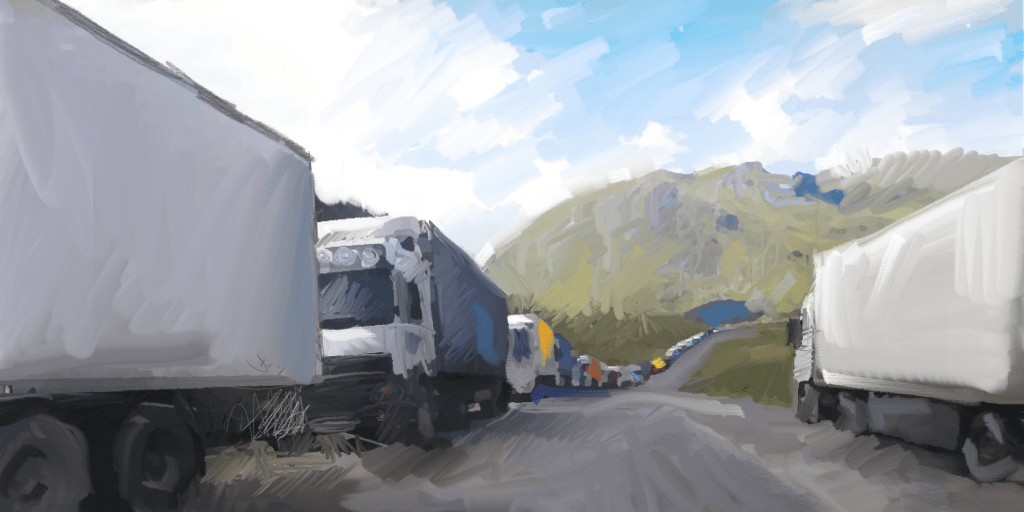
An Electronic Queue Management System (e-QMS) has been launched at the Dostuk border crossing, the primary checkpoint between Kyrgyzstan and Uzbekistan along the Osh-Andijon road. The initiative, developed through cooperation between the Kyrgyz government, the European Union, and the International Trade Centre (ITC), is part of the “Ready4Trade Central Asia” project (2024-2028), which aims to streamline trade procedures and boost economic competitiveness across the Trans-Caspian Transport Corridor. Funded by the European Union, the project is designed to simplify cross-border operations and improve conditions for small and medium-sized enterprises. The e-QMS platform, developed by the ITC in collaboration with Kyrgyzstan’s State Customs Service and Ministry of Economy and Commerce, allows transport operators to pre-book border crossing times online or via a mobile app. The system is expected to reduce waiting times, ease congestion, and improve the predictability of border transit, benefiting both carriers and customs authorities through greater transparency, efficiency, and safety. “For Kyrgyzstan, the implementation of e-QMS is a cornerstone in creating a business-friendly environment for exporters. The new system simplifies procedures, reduces costs for exporters and carriers, and makes trade more transparent and efficient,” said Iskender Asylkulov, Kyrgyzstan's Deputy Minister of Economy and Commerce. The system was initially piloted at the Kyzyl-Kiya border crossing in November 2024, where it processed more than 12,000 vehicles in its first six months. Following positive feedback from transport operators and significant reductions in wait times, the system has now been expanded to Dostuk, one of the region’s busiest crossings. In 2024 alone, over 87,000 vehicles passed through Dostuk, including more than 21,000 import consignments, nearly 8,000 export shipments, and over 58,000 transit movements. The deployment of the e-QMS is expected to further boost trade between Kyrgyzstan and Uzbekistan, which reached $846 million in 2024. From January to June 2025, bilateral trade turnover totaled $430.2 million, $50 million more than during the same period in 2024, according to data from Uzbekistan’s National Statistics Committee.

Kyrgyz-Chinese Trade and Economic Cooperation Center Opens in Chongqing

A new Kyrgyz-Chinese Trade and Economic Cooperation Center has officially opened in Chongqing, one of southwest China’s largest industrial and transportation hubs. According to Kyrgyzstan’s Ministry of Economy and Commerce, the 300-square-meter facility will serve as a platform for bilateral business cooperation. Kyrgyz entrepreneurs will be able to register their companies and conduct business activities in China free of charge. Also on September 26, Chongqing hosted the opening of Kyrgyzstan’s Trade Pavilion, which will showcase and sell national products such as honey, alcoholic beverages, confectionery, and handicrafts. China remains one of Kyrgyzstan’s most important trade partners, with an increasing share of transactions now carried out in Chinese yuan. Earlier this year, Kyrgyzstan’s state-owned Eldik Bank became the first bank in Central Asia to join China’s Cross-Border Interbank Payment System (CIPS). The system enables direct and instant settlements in yuan with Chinese partners and other participants, bypassing intermediaries and reducing transaction costs. Eldik Bank officials said the move would expand business opportunities and deepen bilateral economic ties. Trade between Kyrgyzstan and China surged by 44.7% in 2024, reaching $5.3 billion, according to Kyrgyz government statistics. Exports from Kyrgyzstan to China grew dramatically to $2.04 billion, 93 times higher than in 2023. China also remained Kyrgyzstan’s largest foreign investor, accounting for 23.9% of total foreign direct investment (FDI) in 2024, valued at $872.6 million.

Central Asia Deepens Trade Links with India Amid Growing Economic Ties

Trade between the countries of Central Asia and India is growing, edging closer to the $2 billion mark and signaling a new phase in cooperation across the Eurasian continent. According to data from the Eurasian Development Bank (EDB), this surge reflects the expanding economic footprint of both regions. Nikolay Podguzov, Chairman of the EDB, emphasized that Central Asia and India are not only continental neighbors but also markets with significant untapped potential. Of the bank’s seven member states, four — Kazakhstan, Kyrgyzstan, Tajikistan, and Uzbekistan — form the heart of Central Asia. Their growing engagement with New Delhi is now setting the tone for broader regional cooperation. Strong Growth as a Foundation The economic fundamentals supporting this trend are healthy. Central Asia has maintained steady growth of around 4.5% annually, while India’s economy continues to expand even faster, at roughly 6% per year. But despite this positive backdrop, there are still logistical hurdles. Trade routes between India and Central Asia must pass through intermediary countries such as Iran, Russia, or Azerbaijan — each adding layers of bureaucracy, customs costs, and delays. Experts argue that overcoming these transit bottlenecks will be crucial if India and Central Asia are to unlock the full potential of their partnership. New initiatives like the International North-South Transport Corridor and discussions on India’s role in developing Chabahar Port in Iran reflect ongoing efforts to make these pathways more efficient. Kazakhstan: The Leading Partner Kazakhstan is India’s largest trading partner in Central Asia, with bilateral trade crossing $1 billion — more than half of the region’s total trade with India. Astana supplies uranium, which is important for India’s civilian nuclear energy program, along with crude oil and steel products. In return, India exports pharmaceuticals, textiles, and consumer goods, with exports valued at around $260 million. The two countries also collaborate in strategic sectors such as energy security and defense. In 2022, India and Kazakhstan conducted joint military drills under the Kazind exercise, which reflects a broadening relationship beyond commerce. Uzbekistan: A Growing Market Trade with Uzbekistan has risen steadily, approaching $500 million in bilateral turnover, while India’s exports to Uzbekistan are valued at around $1.3 billion. Pharmaceuticals, machinery, and agricultural products dominate New Delhi’s exports, while Uzbekistan provides fruits, minerals, and cotton to the Indian market. Uzbekistan and India recently increased engagement through forums like the India-Central Asia Dialogue, where issues of connectivity, counterterrorism, and energy cooperation are regularly discussed. Tajikistan: Small but Strategic Although trade volumes with Tajikistan hover around $100 million, the partnership has strategic importance. Aluminium from Tajikistan’s massive TALCO smelter is a key export, while India provides medicines and consumer goods to Tajikistan. Beyond commerce, Dushanbe is a vital security partner for New Delhi. India operates a military facility in Tajikistan — the Farkhor Air Base, its only such presence abroad. Kyrgyzstan: Modest Trade, Strong Ties Kyrgyzstan’s trade with India is relatively small, at about $50 million, but the relationship is significant in the context of regional institutions like the Eurasian Economic Union...

Kazakhstan Trade Deficit with China Quadruples in 2025

Kazakhstan’s trade deficit with China reached $1.8 billion in the first half of 2025, a sharp increase compared to $400 million for the whole of 2024. According to the Association of Financiers of Kazakhstan (AFK), the growth in trade turnover was driven almost entirely by rising imports of Chinese goods. A review published by AFK noted that Kazakhstan’s trade balance with China has remained in deficit since 2023, with the gap continuing to widen. Despite this, China remains Kazakhstan’s largest trading partner, accounting for more than 20% of the country’s total foreign trade. From January to June 2025, mutual trade between the two countries increased by 5.9% to $14.9 billion. However, Kazakhstan’s exports fell nearly 10%, while imports surged by 22.8%. “The decline in export revenues is mainly due to falling oil and metal prices and weaker demand from China, which increases the vulnerability of Kazakhstan’s export-oriented raw materials model,” AFK experts stated. Imports are expanding in line with rising domestic consumption and the rollout of large-scale infrastructure projects. China’s share of Kazakhstan’s trade turnover rose to 22.6% in the first half of 2025, up from 20.7% a year earlier. The growth was fueled by imports, which increased their share to 28.6% from 23.9%, while exports fell to 17.8% from 18.4%. Kazakhstan did record modest export gains in certain categories, including animal and plant products (+$164 million) and vehicles (+$160 million). These, however, were outweighed by sharp declines in mineral product exports (-$599 million) and metals (-$408 million). Imports from China grew most significantly in vehicles (+$1.2 billion), metals (+$279 million), and chemical products (+$231 million). The increase in vehicle imports was aided by a 14% drop in average car prices from China. Imports of food, furniture, construction materials, and consumer goods also rose. Trade settlements are also shifting. While the dollar remains the dominant contract currency, the yuan is gaining ground in import transactions, with the euro ranking third due to Kazakhstan’s ongoing trade ties with Europe. As a result, Kazakhstan’s trade deficit with China widened to $1.8 billion in January-June 2025, compared to $0.4 billion in the whole of 2024. “Imports are likely to continue to grow amid high consumer and investment demand, while exports will remain dependent on commodity prices and industrial dynamics in China. China is becoming an increasingly pronounced ‘economic magnet’ for Kazakhstan,” the AFK report concluded. As The Times of Central Asia previously reported, Kazakhstan is experiencing a slowdown in manufacturing activity in 2025 following record growth at the end of last year.

Kyrgyzstan Begins Building Strategic Highway to China’s Xinjiang

Kyrgyzstan has begun construction on the Barskoon-Bedel highway, a key section of the future Barskoon-Uchturfan-Aksu corridor that will link the Issyk-Kul region with China’s Aksu prefecture in Xinjiang via the Bedel Pass. The new road is expected to shorten the distance between Aksu and Kyrgyzstan by 500 kilometers, saving at least 12 hours of travel time for freight carriers. Route and Infrastructure The highway will cross the Barskoon and Soek passes, the Kara-Sai valley, and the Ashuu-Suu pass. To ensure year-round use, the project includes construction of a 5.5 km tunnel under the Soek pass and a 3.8 km tunnel beneath the Ashuu-Suu pass, both areas prone to heavy winter closures. Timeline and Contractor Construction is being carried out by China Road and Bridge Corporation (CRBC). The main roadworks are scheduled for completion in September 2029, with full commissioning of the highway and supporting facilities expected by September 2030. The Bedel checkpoint, first opened under a simplified regime in September 2024, lies in a remote mountain zone roughly equidistant from Karakol in Kyrgyzstan and Aksu in China. Its full-scale development with international-standard infrastructure is slated for completion by 2027. Trade and Regional Connectivity Once finished, the Barskoon-Bedel corridor will become Kyrgyzstan’s third road crossing with China, alongside the Irkeshtam (Osh region) and Torugart (Naryn region) passes. Unlike the older routes, which are frequently closed during winter, the new corridor is designed to provide a more reliable and time-efficient link. The project is expected to strengthen Kyrgyzstan’s role as a transit hub for Chinese goods heading to third-country markets. Bilateral trade between Kyrgyzstan and China reached $23 billion in 2024, an eightfold increase in recent years. Chinese Support Speaking at the ceremony, Chinese Ambassador Liu Jiangping said the new highway is part of a wider set of strategic projects advancing between the two countries, aimed at accelerating cargo flows and expanding trade, investment, and economic cooperation.

Uzbek Trade Delegation Visits U.S. to Promote “Made in Uzbekistan” Exports

From July 23 to 29, a delegation from Uzbekistan’s Ministry of Investment, Industry and Trade (MIIT) visited the United States to promote Uzbek-produced goods, expand export channels, and strengthen bilateral trade ties, according to the ministry’s press service. As part of the mission, 25 Uzbek textile companies showcased their products under the national “Made in Uzbekistan” brand at three major trade exhibitions in New York: Texworld NYC, Apparel Sourcing USA, and Home Textiles Sourcing Expo. Delegates met with industry leaders and trade associations, including Bunzl plc, Levi Strauss & Co., PVH Corp., GIII Apparel Group, Kontoor Brands, American Eagle Outfitters, Tapestry Inc., Macy’s, the American Apparel & Footwear Association (AAFA), and the United States Fashion Industry Association (USFIA), to discuss integrating Uzbek brands into U.S. sourcing channels. In Washington, ministry representatives met with the U.S. Department of Commerce to explore opportunities for enhancing trade, reducing regulatory barriers, and increasing investment cooperation. They also engaged with the Commercial Law Development Program (CLDP) under the Commerce Department, agreeing to organize webinars and seminars aimed at helping Uzbek firms meet U.S. certification and packaging standards. A separate meeting with the U.S. Department of Agriculture and the U.S. Cotton Association addressed expanding Uzbekistan’s access to the GSM-102 export credit guarantee program, increasing credit limits, and launching a “Made from U.S. Cotton” initiative. The proposed initiative would allow processed Uzbek goods made from American cotton to carry the label in international markets. The delegation also explored ways to deepen investment cooperation with U.S. industry associations and develop mechanisms to integrate more Uzbek products into American retail and sourcing ecosystems. As previously reported by The Times of Central Asia, on April 30, U.S. Labor Secretary Lori Chavez-DeRemer announced the termination of more than $38 million in foreign aid programs during a cabinet meeting at the White House. This included funding for a labor rights initiative in Uzbekistan’s cotton sector. The program, launched in 2022 and scheduled to run through 2026, aimed to improve labor conditions and prevent forced labor. It received $2 million in its first year, with $1 million earmarked for 2025.