
• KGS/USD = 0.01144 0%
  • KZT/USD = 0.00203 0%
  • TJS/USD = 0.10563 -0.09%
  • UZS/USD = 0.00008 0%
  • TMT/USD = 0.28490 0%
  • KGS/USD = 0.01144 0%
  • KZT/USD = 0.00203 0%
  • TJS/USD = 0.10563 -0.09%
  • UZS/USD = 0.00008 0%
  • TMT/USD = 0.28490 0%
  • KGS/USD = 0.01144 0%
  • KZT/USD = 0.00203 0%
  • TJS/USD = 0.10563 -0.09%
  • UZS/USD = 0.00008 0%
  • TMT/USD = 0.28490 0%
  • KGS/USD = 0.01144 0%
  • KZT/USD = 0.00203 0%
  • TJS/USD = 0.10563 -0.09%
  • UZS/USD = 0.00008 0%
  • TMT/USD = 0.28490 0%
  • KGS/USD = 0.01144 0%
  • KZT/USD = 0.00203 0%
  • TJS/USD = 0.10563 -0.09%
  • UZS/USD = 0.00008 0%
  • TMT/USD = 0.28490 0%
  • KGS/USD = 0.01144 0%
  • KZT/USD = 0.00203 0%
  • TJS/USD = 0.10563 -0.09%
  • UZS/USD = 0.00008 0%
  • TMT/USD = 0.28490 0%
  • KGS/USD = 0.01144 0%
  • KZT/USD = 0.00203 0%
  • TJS/USD = 0.10563 -0.09%
  • UZS/USD = 0.00008 0%
  • TMT/USD = 0.28490 0%
  • KGS/USD = 0.01144 0%
  • KZT/USD = 0.00203 0%
  • TJS/USD = 0.10563 -0.09%
  • UZS/USD = 0.00008 0%
  • TMT/USD = 0.28490 0%
20 February 2026

Viewing results 1 - 6 of 54

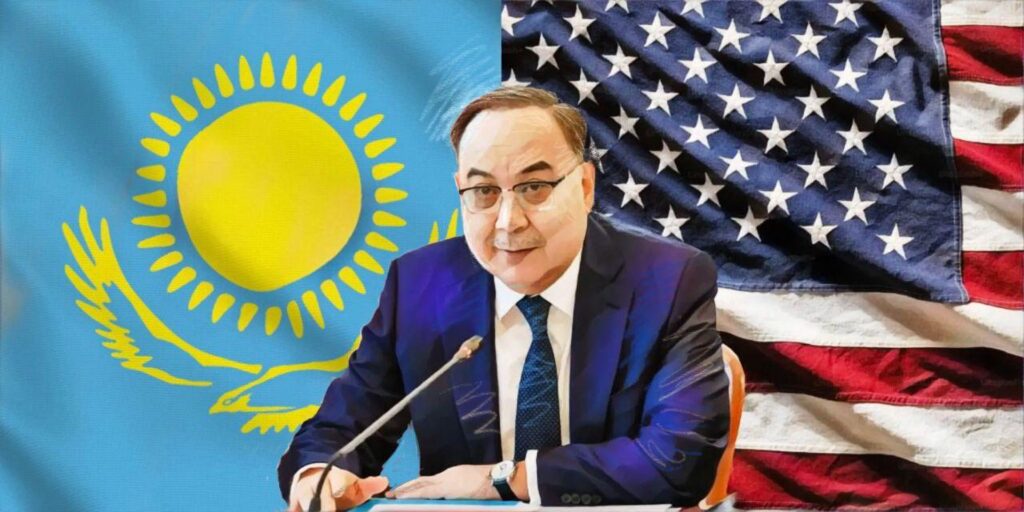
Kazakhstan Elevates U.S. Ties to Presidential-Level

Kazakhstan’s relationship with the United States is entering a more explicitly strategic phase under Kassym-Jomart Tokayev, marked by a shift in how Astana manages its most consequential external partnerships. As economic ties deepen and geopolitical coordination expands across energy, investment, and Eurasian connectivity, engagement with Washington is increasingly being treated as a presidential priority rather than a routine diplomatic file. In this context, Kazakhstan has formally elevated its engagement with the United States by appointing a presidential representative to steer bilateral negotiations on priority issues. By presidential decree, Ambassador Yerzhan Kazykhan—Kazakhstan’s Permanent Representative to the United Nations Office in Geneva and a veteran diplomat with prior postings as ambassador to the United States and the United Kingdom—has been designated as the President’s Representative for negotiations with Washington. The appointment places key aspects of the U.S. relationship under direct presidential oversight from the Akorda, the presidential office. Kazykhan has previously served as foreign minister and assistant to the president, and has held senior roles within both the Foreign Ministry and the presidential administration. His experience in Washington and in multilateral settings provides institutional continuity as the bilateral agenda broadens to encompass investment, energy security, and regional connectivity, while day-to-day execution remains within established diplomatic channels. Drivers Behind the Elevation of U.S.–Kazakhstan Engagement The decision reflects how rapidly the scope of U.S.–Kazakhstan engagement has expanded and how Kazakhstan is positioning itself as a major investment and strategic connectivity hub. The United States is Kazakhstan’s largest source of foreign direct investment, with hundreds of American companies operating across the economy. Chevron, Kazakhstan’s single largest foreign investor, has invested more than $50 billion over time, anchoring long-term U.S. corporate presence in the country’s energy sector. This investment relationship gained further momentum in 2025. At the C5+1 leaders’ summit in Washington, Kazakhstan and U.S. partners announced nearly $17 billion in new commercial agreements and investment commitments across energy, transport, and industrial cooperation. The package was publicly highlighted by U.S. Commerce Secretary Howard Lutnick, underscoring senior-level U.S. political backing for deeper economic engagement with Kazakhstan. Beyond investment, the bilateral agenda has expanded into strategic and geopolitical domains. Kazakhstan’s decision to join the Abraham Accords marked a notable political alignment with a U.S.-led diplomatic initiative, extending the framework’s reach beyond its original Middle Eastern focus. Connectivity has become central to U.S. policy thinking. The Middle Corridor is increasingly viewed as an eastward extension of the post-Azerbaijan–Armenia Caucasus transit framework, also called the ‘Trump Route for International Peace and Prosperity’, aimed at reopening and securing east–west routes across the South Caucasus. Extending it through Kazakhstan links Central Asia to Europe while reducing reliance on Russia or Iran. Trade and energy ties reinforce this trajectory. Kazakhstan is the world’s largest uranium producer and a major supplier to the United States, making the U.S. one of its most important export markets for nuclear fuel. As U.S. policy places greater emphasis on secure and diversified supply chains, Kazakhstan’s role in critical energy inputs and transit infrastructure has taken on added strategic...
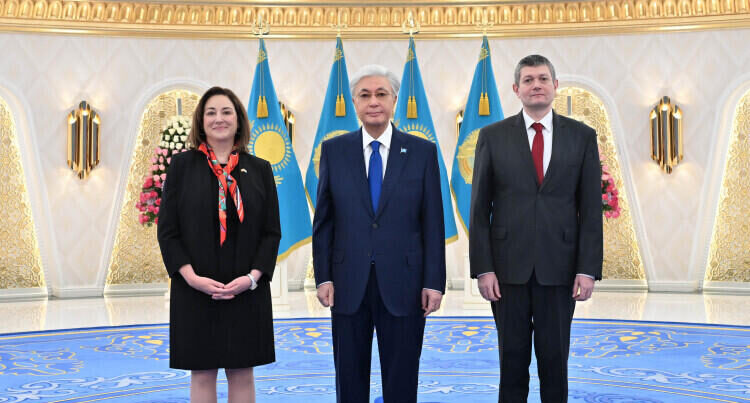

New U.S. Ambassador to Kazakhstan to Build “Momentum” on Trade, Diplomacy

Julie Stufft, the new U.S. ambassador to Kazakhstan, is a career diplomat who has said her goal is to ensure that U.S. companies in the Central Asian country have not just an “even playing field” but are also “the partners of choice” in a region where Russia and China are the dominant trading partners. Stufft, who made those remarks during her confirmation hearing in the U.S. Congress in July, presented her credentials to President Kassym-Jomart Tokayev of Kazakhstan in Astana on Friday. She has previously worked on COVID-19 travel policies and U.S. visa processing worldwide and was most recently deputy assistant to the president and executive secretary of the National Security Council. Stufft has served as deputy chief of mission in the U.S. Embassies in Moldova and Djibouti, and was also a diplomat in Russia, Ethiopia, and Poland. One of Stufft’s daughters, Nora, is a student at the U.S. Air Force Academy in Colorado. After the credentials ceremony in Astana, Stufft said Tokayev and U.S. President Donald Trump have a “very close relationship” and that there was impetus for further collaboration between Kazakhstan and the United States. “We have so much momentum from President Tokayev´s recent visit to Washington that we have to build on this,” Stufft said in reference to a November summit hosted by Trump and attended by the leaders of Kazakhstan, Kyrgyzstan, Tajikistan, Turkmenistan, and Uzbekistan. The meeting focused on securing big trade deals as well as U.S access to minerals in Central Asia that are critical to energy and other industries. Another U.S. goal is to counter the longstanding influence of Russia and China in Central Asian countries, whose leaders seek to balance their relationships with the big powers. Last month, in another round of diplomatic outreach, Trump invited Tokayev and President Shavkat Mirziyoyev of Uzbekistan to attend the G20 summit in Miami later this year. In addition to holding large reserves of critical minerals, Kazakhstan is a top uranium producer and a major oil exporter. China and Russia are its biggest overall trading partners. While U.S. trade with Kazakhstan is relatively small in comparison, the relationship is growing. “My goal as ambassador, if confirmed, would be to make sure that U.S. companies have an even playing field so that they can do investment in Kazakhstan, and also that U.S. companies are the partners of choice in Kazakhstan, instead of Chinese or other companies,” Stufft said in her confirmation hearing last year. The previous U.S. ambassador to Kazakhstan, Daniel Rosenblum, resigned from the post in January 2025.

Trump’s G20 Invitations: Why Kazakhstan and Uzbekistan Matter

On December 23, President Donald Trump said he would invite Kazakhstan and Uzbekistan to attend the United States–hosted 2026 G20 summit in Miami. The meeting is planned at Trump National Doral. The announcement followed separate telephone calls with Kazakhstan’s President Kassym-Jomart Tokayev and Uzbekistan’s President Shavkat Mirziyoyev, which Trump described as focused on peace and expanded trade, and cooperation. The G20 is a group of major economies, with membership based mainly on large nominal GDP and global economic importance, collectively representing about 85% of global GDP. Kazakhstan is ranked roughly 50th in the world by nominal GDP, at approximately $300 billion, while Uzbekistan is ranked around 62nd, with a nominal GDP of about $137–140 billion. According to Polish radio, the president of Poland stated that his country would also be on the guest list. Poland is the world’s 21st-largest economy. The G20 is a forum, not a treaty body. Leaders’ summits include member governments and a limited number of host-selected guest countries. Invitations to Kazakhstan and Uzbekistan would place their leaders physically at the table with G20 heads of state, allowing them to be seen, heard, and recognized by other leaders, without conferring membership or a formal role in shaping the summit agenda. On average, the host invites six to seven guests. One official host-country explainer notes that guest invitations allow non-members to bring their own perspectives. For them, the significance of attending is access, not membership. What Washington Wants and What Can Be Transacted The host typically uses the guest invitations to signal which countries and regions they regard as priorities. U.S. interest in Kazakhstan and Uzbekistan rests on an immediate material basis. The United States is rebuilding its nuclear-fuel supply chain away from Russian-origin material. Federal law now bans imports of certain Russian uranium products, with waivers terminating no later than January 1, 2028. U.S. agencies have been explicit that supply diversification is a policy objective. In 2024, Kazakhstan-origin material accounted for 24% of uranium delivered to U.S. owners and operators, while Uzbekistan-origin material accounted for about 9%. Kazakhstan’s structural advantage is scale and reliability. It remains the world’s leading uranium producer, with 2024 output around 23,270 metric tons of uranium and the largest share of global mine production. Astana has also signaled an interest in moving beyond extraction toward higher value-added fuel-cycle activity. Uzbekistan’s advantage is growth potential and its fit with Western joint-venture structures. Its uranium sector has attracted major external entrants, including Orano’s South Djengeldi joint venture Nurlikum Mining with the state partner Navoiyuran to develop a new mine alongside an Itochu (Japan) minority stake. The second instrument is the resource-focused diplomacy under the C5+1 umbrella. The State Department frames the C5+1 as organized around economy, energy, and security, within which framework it has elevated critical minerals to a dedicated track. The United States launched a C5+1 Critical Minerals Dialogue in early 2024, and subsequent U.S. statements have described it as a vehicle for geological exploration, mining, processing, and investment opportunities across the region. This...

Kazakhstan Turns from Pipelines to Processors

Kazakhstan’s strategic plan for advanced computing represents a diversification of its traditional oil, gas, and transit profile and of the wider national economy. A $2 billion Nvidia-linked initiative now turns on three main elements. First is a national supercomputer using Nvidia H200 chips, with headline AI performance around 2 exaflops. Second is a planned 100 MW data-center campus, designed to expand capacity for commercial users over several years. Third is a “sovereign AI hub” concept that promises long-term chip access for sensitive public-sector workloads. Prior to this package, Kazakhstan had already moved unusually quickly to build high-end AI and computing infrastructure, treating digital capacity as central to its development policy. The national supercomputer is now the most powerful system in Central Asia and is housed in a Tier III state data center intended for use by universities, startups, and corporate tenants. The hardware push accompanies a wider digital policy agenda, including new training programs with Nvidia to expand the country’s AI talent base. Parallel initiatives with the United States seek to anchor Kazakhstan more firmly within Western regulatory and connectivity frameworks, as part of a broader attempt to move beyond hydrocarbons and build domestic capability in computation-heavy activities. Kazakhstan’s New AI Statecraft Astana is presenting the Nvidia package as an economic instrument, not just a hardware upgrade. Senior officials now describe advanced computing as a new pillar of national development, on a par with hydrocarbons and transit. Recent policy statements frame AI and digital infrastructure as central, not a side theme of “innovation” policy. In parallel, the long-running “Digital Kazakhstan” agenda has moved from e-government and broadband roll-out into a second phase where data centers, national platforms, and specialized training come to the foreground. Within that shift, “sovereign AI” is becoming a core organizing idea. Officials and local specialists talk about national language models that can handle Kazakh, Russian, and other regional languages, and about keeping sensitive public-sector data on infrastructure under national jurisdiction. The new supercomputer and the sovereign AI hub are presented as the place where that work will happen at scale: training and serving models for government services, regulatory tasks, and domestic firms, rather than relying entirely on foreign platforms. The Nvidia partnership is therefore framed as a way to secure long-term access to leading chips for these “sovereign” workloads, even as global export rules tighten. The same initiative also underwrites a shift in Kazakhstan’s self-presentation from a “pipeline corridor” to Kazakhstan as a corridor for data and high-end digital services. The government has begun to link the sovereign AI hub and supercomputer to a set of fiber-optic projects across the Caspian that aim to tie Central Asia more tightly into Eurasian data routes. The same geography that once made Kazakhstan a crucial link for oil, gas, and rail freight can now make it a regional conduit for digital traffic and AI-enabled services. Kazakhstan is also using the package to deepen a specific diplomatic track with the United States. Joint announcements and working groups on digital transformation,...

InnoTech University to Launch in Almaty with Arizona State University Support

Kazakhstan’s Ministry of Science and Higher Education and Q Group have signed an agreement with Arizona State University (U.S.) to establish the University of Innovation and Technology powered by Arizona State University (InnoTech) in Almaty. According to the ministry, the creation of InnoTech aligns with Kazakhstan’s broader strategy to enhance international educational partnerships and foster the development of innovative technologies. The university is set to become a world-class platform offering academic mobility, scientific collaboration, and practice-oriented training in engineering, IT, entrepreneurship, artificial intelligence, and sustainable development. A distinctive feature of InnoTech will be its dual-degree offering: graduates will receive both a Kazakh diploma and an American degree from Arizona State University. This model is intended to boost the global competitiveness of Kazakh students in the international job market. Undergraduate and graduate programs are expected to begin in 2026, with preparations already underway for the construction of a modern campus in Almaty. [caption id="attachment_39097" align="aligncenter" width="960"] Image: gov.kz[/caption] In related news, the Ministry of Science and Higher Education, Arizona State University, and Mukhtar Auezov South Kazakhstan University have signed a memorandum of cooperation to promote academic collaboration. The agreement covers the implementation of internationally recognized educational programs, joint research initiatives, and expanded academic mobility for students and faculty of the Kazakh university. As part of the new collaboration, students enrolled in a dual-degree program will study for three years in Kazakhstan and one year at Arizona State University in the U.S., earning degrees in Computer Science/Informatics from both institutions. Additionally, for the first time in Kazakhstan, an Honors College will be established with Arizona State University’s support. The college will offer enriched academic programs for high-achieving students, including research opportunities and leadership development.

Kazakhstan Advances Digital Transformation with U.S. Partnerships

Kazakhstan, Central Asia’s largest economy, is rapidly positioning itself as a regional leader in digital transformation. Increasingly, United States partners no longer view Kazakhstan solely as a source of natural resources. Instead, future cooperation is expected to expand into digital technologies and artificial intelligence (AI). Advances in Digitalization In October, Kazakhstan reaffirmed its digital ambitions with a major technological breakthrough. Kaspi, the country’s leading fintech firm and a systemically important bank, launched Kaspi Alaqan, a palm-based payment system that requires no phone, card, or internet connection. The service will debut in December 2025 through dedicated ATMs in Almaty before expanding nationwide. Analysts say the innovation puts Kaspi on par with Amazon One and China’s WeChat, highlighting Kazakhstan’s readiness to adopt cutting-edge global technologies. Traditionally associated with oil, gas, and uranium, Kazakhstan is now investing heavily in becoming Central Asia’s digital hub, an evolution that presents strategic opportunities for the U.S. Partnerships in digital governance, AI, and innovation ecosystems align closely with Washington vision for expanded cooperation in Eurasia. According to the United Nations, Kazakhstan ranked 24th globally in digital development as of June 2025, placing in the top 10 for online public services. Services such as school enrollment, vehicle registration, and passport issuance have been fully digitized, requiring minimal citizen effort. In some cases, the process is faster than in many Western countries. Kazakhstan’s government aims to double its GDP to $450 billion by 2029, a target that will require more than a 2.5-fold increase in investment. Digital technologies are central to this strategy. To manage this transformation, a new Investment Board was established in October 2025 to oversee large-scale projects and determine economic priorities. In September, the Mazhilis (lower house of parliament) passed a landmark law on artificial intelligence. Deputies highlighted fairness, transparency, and the protection of personal data as key legal principles. The newly launched National Artificial Intelligence Platform hosts over 100 AI agents that support e-government functions and expand access to technology. Additionally, in July, Kazakhstan introduced a supercomputer powered by NVIDIA H200 GPUs. With performance reaching 2 exaflops (FP8), it is the most powerful computing system in Central Asia. Startups, universities, and research centers now have access to this infrastructure. The language models KazLLM and Alem LLM have also been introduced, capable of generating content in Kazakh, Russian, English, and Turkish. For the U.S., Kazakhstan’s AI ecosystem offers a valuable partner for collaborative research, ethical framework development, and State Department–supported initiatives using AI for sustainable development. Investing in the Future U.S.–Kazakhstan cooperation in digital innovation is already accelerating. In September, Amazon announced a $200 million investment in Kazakhstan’s internet infrastructure. A distribution agreement with Kazakhtelecom will bring Amazon’s Kuiper satellite network to the republic, improving connectivity and driving economic growth. Additionally, 24 startups from Central Eurasia have joined U.S. accelerator programs such as AlchemistX and Silicon Valley Residency. These initiatives, launched in September in Palo Alto, connect regional teams with U.S. venture capital and technology ecosystems. Kazakhstan is also advancing blockchain infrastructure. Astana recently launched the...
