• KZT/USD = 0.00225
  • TJS/USD = 0.10810
  • UZS/USD = 0.00009
  • TMT/USD = 0.29760
  • KZT/USD = 0.00225
  • TJS/USD = 0.10810
  • UZS/USD = 0.00009
  • TMT/USD = 0.29760
  • KZT/USD = 0.00225
  • TJS/USD = 0.10810
  • UZS/USD = 0.00009
  • TMT/USD = 0.29760
  • KZT/USD = 0.00225
  • TJS/USD = 0.10810
  • UZS/USD = 0.00009
  • TMT/USD = 0.29760
  • KZT/USD = 0.00225
  • TJS/USD = 0.10810
  • UZS/USD = 0.00009
  • TMT/USD = 0.29760
  • KZT/USD = 0.00225
  • TJS/USD = 0.10810
  • UZS/USD = 0.00009
  • TMT/USD = 0.29760
  • KZT/USD = 0.00225
  • TJS/USD = 0.10810
  • UZS/USD = 0.00009
  • TMT/USD = 0.29760
  • KZT/USD = 0.00225
  • TJS/USD = 0.10810
  • UZS/USD = 0.00009
  • TMT/USD = 0.29760
24 September 2026

Viewing results 1 - 6 of 64

Opinion: Almaty as a Model for the Future: Central Asia’s Role in the Global Agenda

Almaty is gradually becoming a hub for resolving issues of not only regional but also global significance. The recent opening of the UN Regional Center for Sustainable Development Goals (SDGs) for Central Asia and Afghanistan here was an event no less significant than the 80th anniversary session of the General Assembly in New York. This is no coincidence: the global agenda at the UN today is increasingly focused on the regional level. Central Asia is not a periphery, but a kind of “model for the future,” where climate, water resources, and security challenges are intertwined. For example, the Tian Shan glaciers have shrunk by more than 25% over the past decade and continue to melt faster than predicted, directly threatening the Amu Darya and Syr Darya rivers. These rivers are increasingly failing to reach the Aral Sea, and its dried-up bed is turning into a giant source of dust and salt. Air pollution levels in the region's cities, as measured by PM2.5, exceed World Health Organization guidelines by an average of 4–6 times. Extreme heat and drought are leading to the loss of agricultural land and the degradation of ecosystems, which affects not only regional but also global food security. Central Asia has already become a unique “testing ground for the future.” The region is testing mechanisms for cross-border cooperation. The CASA-1000 energy project connects Kyrgyzstan and Tajikistan with Afghanistan and Pakistan, creating a “green energy corridor.” Meanwhile, Afghanistan’s Qosh Tepa Canal is altering the balance of water usage on the Amu Darya, forcing neighboring countries to seek new models of agreement. The question is whether these nations can develop a system of joint water and energy management. The outcome will shape not only regional but also global processes. At the same time, the United Nations itself is grappling with a deficit of trust and effectiveness. The Security Council is paralyzed, while General Assembly resolutions often carry only advisory weight. In the face of nuclear risks, environmental upheavals, and the threat of epidemics, the global community is stalling. Even large-scale initiatives such as the Glasgow Financial Alliance for Net Zero (GFANZ) remain largely declarative rather than actually limiting “dirty” investments. Therefore, reform proposals are becoming increasingly vocal, in particular, to strengthen regional UN divisions that are capable of responding more quickly to crises and ensuring practical cooperation between countries. Another way to overcome the trust deficit could be to involve independent expert councils – scientists, NGOs, think tanks – more widely in the decision-making process, which would reduce the influence of political gridlock at the global level. Overall, Almaty can be seen as a model of a “UN in miniature” – a regional center capable of promptly addressing issues that may seem “too small” for New York, yet are critically important for the countries of the region. For instance, the SDG Center could initiate the creation of a regional water monitoring system with unified measurement standards and transparent data sharing. Such decentralization could form the basis for future UN reform....

UN Action Plan to Protect Religious Sites Presented in Astana

As part of the Congress of Leaders of World and Traditional Religions in Astana, a special session convened under the auspices of the United Nations presented an updated Action Plan to Protect Religious Sites around the world. The Congress, held every three years in Kazakhstan’s capital since its inception in 2003, has become a significant platform for interfaith dialogue and global cooperation. For the first time, this year’s forum included a dedicated session on safeguarding religious heritage. The revised plan was introduced by UN Deputy Secretary-General and High Representative for the Alliance of Civilizations Miguel Angel Moratinos, who praised Kazakhstan's longstanding commitment to promoting global peace and interreligious dialogue. He affirmed the UN’s readiness to support collaborative initiatives arising from the Congress. Kazakhstan Senate Chairman Maulen Ashimbayev emphasized the country's backing of the 2023 UN General Assembly resolution on interfaith dialogue and combating hate speech, along with the new UN Action Plan. “Throughout our history, temples and spiritual sites of different religions have coexisted peacefully and remain an integral part of our cultural heritage. Located at the crossroads of East and West, Kazakhstan has always played the role of a bridge connecting peoples, cultures, and religions. We attach great importance to the preservation and protection of these sacred places,” Ashimbayev said. Participants voiced concern over increasing threats to religious heritage in various parts of the world. Director of the UN Alliance of Civilizations Nihal Saad reminded attendees that the original plan was adopted in 2019 in response to a series of attacks on religious institutions. “Despite global efforts, we have witnessed numerous attacks on religious sites. The Alliance is convinced that all places of worship should be sanctuaries, not targets for terror and bloodshed. People should be able to practice their faith peacefully and without fear,” she stated. The session concluded with calls to establish sustainable legal and institutional frameworks to ensure the protection of sacred sites worldwide. As previously reported by The Times of Central Asia, spiritual leaders from across the globe are set to gather in Astana on September 17-18.

UN Special Rapporteur Urges Turkmenistan to Release Activist Murat Dushemov

Mary Lawlor, the United Nations Special Rapporteur on the situation of human rights defenders, has called for the immediate release of Turkmen civil activist Murat Dushemov, who was recently re-imprisoned under disputed circumstances. Lawlor stated that the new charges against Dushemov are fabricated and appear to be retaliation for his peaceful activism and exercise of free expression. “I will closely monitor the trial of civil activist Murat Dushemov, who has been in prison since 2021 and is now facing new criminal charges in apparent retaliation for his peaceful activism and for exercising his freedom of expression in Turkmenistan. I call for his immediate release,” Lawlor posted on X. Her call was echoed by the Regional Office for Central Asia of the UN High Commissioner for Human Rights, which reaffirmed support for Dushemov’s release. Renewed Persecution As previously reported by The Times of Central Asia, Dushemov was originally scheduled for release on June 14, after serving a four-year sentence. However, just days before his expected release, he was transferred to a pre-trial detention facility in Turkmenabat. Authorities have accused him of participating in a prison altercation, an allegation he claims is entirely fabricated. "The person who wrote the statement against me started banging his head against the wall, injuring himself and staining the wall with his blood. They want to slander me again to prolong my stay here," Dushemov reportedly said. Despite assurances from Prosecutor Agajan Nuryev that a hearing would take place in mid-July, no trial date has been announced. Details remain withheld even from Dushemov’s family, in clear violation of Turkmenistan’s judicial transparency laws. Background and First Conviction Dushemov was first detained in 2021. He was convicted of extortion and causing bodily harm and sentenced to four years in prison. Human rights groups say the trial was politically motivated, noting that Dushemov had openly criticized the government’s pandemic response, including mandatory mask policies and vaccination campaigns, which he considered unlawful. The initial charges centered on two incidents: an alleged extortion attempt involving a chief doctor, and accusations of assault made by fellow inmates, claims that mirrored the current allegations against him. Widening International Support Several human rights organizations have joined the campaign to secure Dushemov’s release. These include the Norwegian Helsinki Committee, Turkmen.News, the Turkmen Human Rights Initiative, the International Partnership for Human Rights, and the Association for Human Rights in Central Asia. “The authorities must drop the new criminal charges brought against civil activist Murat Dushemov as clear retaliation for his activities and release him immediately,” the organizations said in a joint statement. They also urged Turkmenistan’s international partners to pressure Ashgabat to cease persecution of activists, journalists, and dissenters. Human Rights Watch has also issued a statement supporting Dushemov, calling for his “immediate and unconditional” release and demanding an end to abuses prolonging his detention. Lawlor has previously highlighted rights violations in Turkmenistan. In April, she called for an investigation into the alleged poisoning of independent journalist Soltan Achilova. She is also monitoring the case of Baloch...

Tokayev Calls for Global Action at UN LLDC3 Summit in Turkmenistan

At the Third United Nations Conference on the Landlocked Developing Countries (LLDC3), held from August 5-8 in the Turkmen resort town of Awaza, Kazakhstan’s President Kassym-Jomart Tokayev urged the international community to deepen cooperation, enhance regional connectivity, and take decisive collective action in support of the 32 countries that lack direct access to the sea and remain on the periphery of global trade. A Global Call for Equality and Interconnectedness Speaking at the plenary session, Tokayev highlighted Kazakhstan’s leadership in advancing the LLDC agenda. In 2003, Almaty hosted the first UN conference on landlocked countries, which culminated in the Almaty Programme of Action (APoA). Two decades later, the president noted, structural barriers, such as limited market access, underdeveloped infrastructure, and high exposure to geopolitical shocks, remain largely unchanged. “Landlocked countries should be seen as equal and promising partners in global development,” Tokayev said. “Our voice must be louder and our cooperation deeper.” [caption id="attachment_34680" align="alignnone" width="300"] @akorda[/caption] The Awaza Action Programme: A Roadmap for 2024-2034 The centerpiece of LLDC3 was the adoption of the Awaza Action Programme for the coming decade, structured around five strategic priorities: structural transformation of economies, development of sustainable infrastructure, trade facilitation, regional integration, and resilience. Kazakhstan endorsed the plan and called for stronger political and financial support from transit countries, international institutions, and private investors. Tokayev emphasized the need for innovative financing tools to mobilize investment in transport, energy, and digital infrastructure. Addressing the Climate Challenge The president also highlighted the disproportionate climate-related vulnerabilities faced by LLDCs, including water scarcity, glacial melt, and desertification. He called for a balanced and inclusive approach to climate policy and invited participants to the Regional Environmental Summit, scheduled for April 2026 in Astana, to be co-hosted with the United Nations. Tokayev also pointed to Kazakhstan’s recent achievements in digital innovation and sustainability, citing the launch of the Alem.AI Artificial Intelligence Center and the commissioning of a new national supercomputer. “We are open to international scientific cooperation,” he said. [caption id="attachment_34681" align="alignnone" width="300"] @akorda[/caption] Central Asia as a Model of Regional Resilience Despite geographic constraints, Tokayev presented Central Asia as a case study in overcoming isolation through cooperation. “Geography does not determine destiny,” he said. “With political will, strategic investment, and international partnership, lack of access to the sea can become not a barrier but a source of growth.” Kazakhstan is investing heavily in transport corridors such as the Middle Corridor (Trans-Caspian International Route) and the North-South Corridor, strengthening its role in the Eurasian logistics network. Energy Diplomacy and Regional Projects On the sidelines of the conference, Central Asian leaders convened for informal talks, where they discussed priority areas of cooperation, including energy. Topics included development of Turkmenistan’s Galkynysh Gas Field, one of the world’s largest, and ongoing transport projects such as the Kazakhstan-Turkmenistan-Iran railway and the Turkmenbashi-Garabogaz-Kazakhstan border highway. According to the UN, trade costs in LLDCs are 74% higher than in coastal states, and cross-border shipping takes twice as long. Collectively, these countries account for only 1.2% of...

UN’s Guterres Back in Central Asia for Meetings About Development

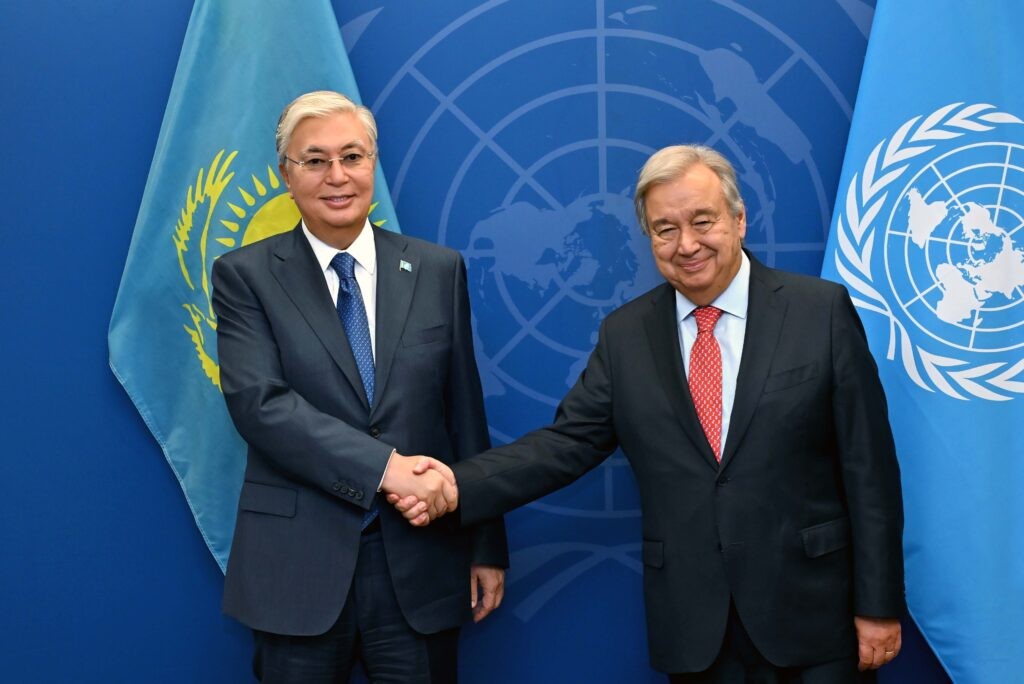
United Nations Secretary-General António Guterres is traveling to Central Asia this weekend to help promote stability and transformation in the region, his office says.  Guterres will be in Kazakhstan on Sunday to witness, alongside President Kassym-Jomart Tokayev, the signing of a host country agreement for a U.N. regional center for sustainable development goals for Central Asia and Afghanistan. Kazakhstan’s envoy to the U.N., Kairat Umarov, has said that the initiative aims to strengthen regional economies and trade networks, create jobs and cut migration flows.   “We are confident that over time, economic stability will pave the way for a gradual political transformation of Afghanistan, including progress in the field of women’s rights,” Umarov has said.  Trade between Central Asia and Afghanistan is increasing, but there are international concerns about Taliban-ruled Afghanistan’s humanitarian crisis, the threat of terrorism and human rights violations, particularly toward women and girls.  After the stop in Kazakhstan, Guterres will go to Awaza, Turkmenistan, to attend a U.N. conference on landlocked, developing countries.  “He will reaffirm the need to help the landlocked developing countries overcome physical barriers and connect to global markets, including by leveraging artificial intelligence to strengthen early warning systems,” said Farhan Haq, deputy spokesman for Guterres.  The August 5-8 conference will explore ways to expand the economic potential of countries that lack direct ocean access and rely on transit nations, thereby facing obstacles to trade and development. Countries that are classified as landlocked and developing by the conference include Afghanistan, ​Kazakhstan, Kyrgyzstan, Tajikistan, Turkmenistan and Uzbekistan.

UN Adopts AI Resolution for Central Asia at Tajikistan’s Initiative

On July 25, 2025, the United Nations General Assembly unanimously adopted a resolution titled “The Role of Artificial Intelligence in Creating New Opportunities for Sustainable Development in Central Asia.” The resolution was spearheaded by Tajikistan. A Historic Decision by the General Assembly According to Tajikistan’s Ministry of Foreign Affairs, the resolution sets a “historic precedent” in shaping a global framework for the ethical and secure use of artificial intelligence. It also emphasizes the importance of responsible governance, including mechanisms for national and regional self-regulation and oversight of AI technologies. Regional AI Center to Be Established in Dushanbe A central component of the resolution is the proposal to establish a Regional Artificial Intelligence Center in Dushanbe. The center will coordinate AI-related efforts across Central Asian countries, facilitating joint research, startup development, specialist training, and regulatory alignment. The center’s key objectives include: Launching joint educational initiatives and supporting AI start-ups via regional technology parks; Promoting scientific and applied research at universities, laboratories, and research institutes throughout Central Asia; Creating a unified data center network to improve access to computational resources; Harmonizing national monitoring and self-regulation systems in AI; Advancing international cooperation with global partners and specialized organizations. Tajikistan Steps onto the Global AI Stage The resolution stresses the need to develop “safe, trustworthy, and transparent AI systems,” promoting a balance between innovation and regulatory oversight. This, it states, will support sustainable development and digital transformation across the region. Tajikistan’s initiative, culminating in this UN resolution, marks a significant step in the country’s aspirations to position itself as a regional hub for artificial intelligence.