Alatau: Inside Kazakhstan’s $20 Billion “City of the Future”
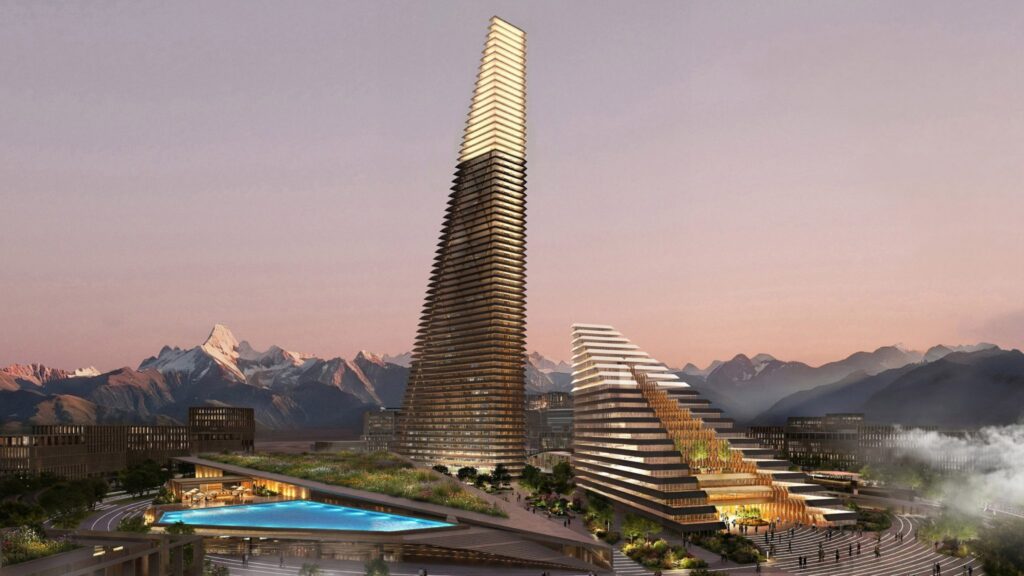
Details about the ambitious plans for Alatau city were presented to a joint session of Kazakhstan’s parliament on March 20. Authorities are moving ahead full-speed on the project to build the new city that one day could be home to some two million people. According to the plans, Alatau will be a unique city, not only in Kazakhstan, but in the world. [caption id="attachment_45827" align="aligncenter" width="1704"] Image: Skidmore, Owings & Merrill (SOM) [/caption] From Village to Metropolis Alatau city is being built on the site of what was the village of Zhetygen, some 50 kilometers north of Almaty. It will occupy an area of some 88,000 hectares, “larger than both Singapore and Seoul.” Relieving the congestion of Kazakhstan’s commercial capital was one of the major concerns when selecting a site for the new city. Another consideration was Alatau’s location along the Middle Corridor, the developing East-West trade route linking Europe and China. Alatau city will have an airport and railway junctions. Alatau city will have four districts – Green, Growing, Golden, and Gate. [caption id="attachment_45826" align="aligncenter" width="1704"] Image: Skidmore, Owings & Merrill (SOM) [/caption] The Gate district will be the business and financial area and is where the airport and railways will be located. It will also be the southern-most area of the city and therefore closest to Almaty. The Golden district will be the “hub of knowledge, healthcare, and innovation,” the location of hospitals and other medical facilities, tech centers, and educational institutions able to take 40,000 students are planned for the district. The Growing district will be the industrial and logistics center for export-oriented trade. It will include clusters for food, chemicals, building materials, and light industry. The Green district, on the shore of Kapchagay Lake and with the Kaskelen River running through it, will be the recreational and tourist area of the city. [caption id="attachment_45828" align="aligncenter" width="1704"] Image: Skidmore, Owings & Merrill (SOM) [/caption] Alatau city lies along the main road between the cities of Almaty and Konayev (the “gambling capital of Kazakhstan"). Deputy Prime Minister Kanat Boumbayev told parliament on March 20 that testing of air taxis to ferry people between Almaty and Alatau would start this year, and within two to three years, operations would open to the public. Bozumbayev said the flight time would be 10-15 minutes. Additionally, expansion of the Almaty metro system is progressing with plans for the Green Line to eventually reach Alatau. Alatau will be a smart city and will be developed under the principle “digital by default,” meaning people will be encouraged to go online as much as possible for goods and services, but will still offer support for those who prefer to use traditional means. Financing The Kazakh authorities are expecting construction of Alatau city to require some 10 trillion tenge (about $20.836 billion) of investment by 2050. Kazakhstan is seeking foreign investment and offering advantageous conditions to foreign companies. Deputy Prime Minister Bozumbayev said, “The tax model is described separately: incentives are proposed to be granted only...