• KGS/USD = 0.01144 0%
  • KZT/USD = 0.00212 0%
  • TJS/USD = 0.10456 0.19%
  • UZS/USD = 0.00008 0%
  • TMT/USD = 0.28490 0%
  • KGS/USD = 0.01144 0%
  • KZT/USD = 0.00212 0%
  • TJS/USD = 0.10456 0.19%
  • UZS/USD = 0.00008 0%
  • TMT/USD = 0.28490 0%
  • KGS/USD = 0.01144 0%
  • KZT/USD = 0.00212 0%
  • TJS/USD = 0.10456 0.19%
  • UZS/USD = 0.00008 0%
  • TMT/USD = 0.28490 0%
  • KGS/USD = 0.01144 0%
  • KZT/USD = 0.00212 0%
  • TJS/USD = 0.10456 0.19%
  • UZS/USD = 0.00008 0%
  • TMT/USD = 0.28490 0%
  • KGS/USD = 0.01144 0%
  • KZT/USD = 0.00212 0%
  • TJS/USD = 0.10456 0.19%
  • UZS/USD = 0.00008 0%
  • TMT/USD = 0.28490 0%
  • KGS/USD = 0.01144 0%
  • KZT/USD = 0.00212 0%
  • TJS/USD = 0.10456 0.19%
  • UZS/USD = 0.00008 0%
  • TMT/USD = 0.28490 0%
  • KGS/USD = 0.01144 0%
  • KZT/USD = 0.00212 0%
  • TJS/USD = 0.10456 0.19%
  • UZS/USD = 0.00008 0%
  • TMT/USD = 0.28490 0%
  • KGS/USD = 0.01144 0%
  • KZT/USD = 0.00212 0%
  • TJS/USD = 0.10456 0.19%
  • UZS/USD = 0.00008 0%
  • TMT/USD = 0.28490 0%

Viewing results 409 - 414 of 3334

Retired Kazakhstani, 66, Finds Calling as Long-Distance Swimmer

Askar Ospanov, a retired police major general in Kazakhstan, decided to become a serious swimmer relatively late in life, around the age of 60. Inspiration came when he was cheering from the sidelines at the 2018 Bosphorus Cross-Continental Swimming Race, an annual event in which about 2,500 people swim 6.5 kilometers from the Asian shore to the European side of Istanbul.  Ospanov's eldest son, Galym, himself an accomplished athlete, had completed the crossing in one hour and 18 minutes. A favorable current means many swimmers log fast times across the Bosphorus. “Then, about 30–40 minutes later, everyone on the shore suddenly started buzzing. I thought maybe someone had drowned… or perhaps Erdoğan (the president of Turkey) had arrived. I told my kids, ‘Find out what’s going on, quickly!'” 66-year-old Ospanov said.  It turned out that beloved Turkish swimmer Levent Aksüt, then in his late 80s, had just finished.  “Everyone stood and applauded his achievement,” said Ospanov, who saw Aksüt as a role model for his new passion.  In September, the Kazakhstani swam about 15 kilometers across the Strait of Bonifacio, from the French island of Corsica to the Italian island of Sardinia, in seven hours and 50 minutes. He has competed in international open-water swimming competitions, including OCEANMAN and X-WATERS events, in numerous places at various distances. He has won prizes in the 60+ category in Dubai, Thailand, at Issyk-Kul Lake in Kyrgyzstan and in Kazakhstan, a landlocked country with big lakes and reservoirs.  “If someone wants to start swimming after 60, it’s absolutely necessary to do stretching exercises. The arms and legs will gradually loosen up!” Ospanov said.  “Since childhood, I played volleyball,” the Almaty resident said. “Then my knees started hurting, and I couldn’t play volleyball at full strength anymore. Doctors said that for the knee joints, you need movement without load… That meant either cycling or swimming. I didn’t feel like buying a bike, so I chose swimming. With each passing year, swimming gave me more and more strength. Gradually, the results started coming.” Swimming coach Evgeny Alexandrov, who has been awarded the prestigious Master of Sport of International Class title by Kazakhstan’s government, has worked with Ospanov for several years.  The coach described his student as tough, punctual, and responsible. However, Alexandrov said, “turning him into an ideal swimmer quickly isn’t possible due to age-related limitations and some acquired health issues,” including knee pain and a right arm weakened by years of playing volleyball, which meant he only breathed on his left side in the pool. “When he was learning to swim, he couldn’t breathe every three strokes — he only inhaled on his left side, resulting in an asymmetrical freestyle stroke with excessive body roll. In open water, if the sun and waves are on the left, it becomes difficult for Askar,” the 44-year-old coach said.   Ospanov had that problem to some extent in the Strait of Bonifacio, where proper alignment in the water can offset the challenges of wind, waves and current.  “At his...

Tokayev in Moscow: Balancing Friendship and Strategy

Kazakh President Kassym-Jomart Tokayev begins a state visit to Russia in Moscow today, accompanied by a carefully calibrated message of diplomatic continuity. Ahead of his arrival, Tokayev published an article in Rossiyskaya Gazeta affirming Kazakhstan’s “eternal friendship” with Russia, a phrase that has become standard in bilateral rhetoric. While much of the piece reiterates familiar themes of cooperation in energy, trade, and culture, a few notable elements suggest deeper strategic positioning. From the outset, Tokayev appeared intent on striking a personal chord with Vladimir Putin. Mirroring the Russian president’s preference for historical framing, he wrote: “Our peoples have lived side by side for centuries, sharing joys and trials, and together creating a single cultural space in Eurasia. We are united by a common perception of traditional values, similar views on current issues of modern life, and joint work to ensure the well-being of our brotherly peoples.” The Kazakh leader also offered high praise for Putin’s leadership, describing bilateral ties as “mature and stable” and built on “deep trust, respect, and equality.” “All achievements in bilateral cooperation are inextricably linked to the energetic and productive efforts of President Vladimir Vladimirovich Putin,” Tokayev wrote. “In Kazakhstan, he enjoys unwavering respect as a statesman of global stature, and his name is on the lips of politicians and ordinary people in virtually every country in the world.” The visit’s key moment will be the signing of a Declaration elevating Kazakhstan-Russia ties to a “comprehensive strategic partnership and alliance”, a step Tokayev described as ushering in “a new era in bilateral relations.” More intriguing, however, was Tokayev’s commentary on Russia’s global standing, wherein Tokayev referenced recent high-level talks with Chinese President Xi Jinping, U.S. President Donald Trump, and leaders across Europe, Asia, and Africa. “Although many of them are at opposite ends of the geopolitical spectrum, they all recognize the exceptional role of Russia and its leader in resolving key issues in international relations. In other words, it is impossible to overcome the contradictions of the modern world without Moscow's participation,” he stated. While Tokayev has previously dismissed the idea of Kazakhstan acting as a mediator in the Russia-Ukraine conflict, his recent statements suggest Astana may be prepared to play a supporting role in future dialogue. “Kazakhstan is not a mediator in the military conflict between Russia and Ukraine and does not see itself as such,” he said last month. “In my opinion, both sides are capable of conducting dialogue on all contentious issues on a bilateral basis and at different levels. I have always believed and publicly stated that the ‘Ukrainian crisis’ is extremely complex and cannot be simplified.” Nonetheless, Tokayev offered practical insights into what a negotiation process would require, stressing the importance of expert-level preparation and dismissing the idea of hastily organized summits without a ceasefire or clear agenda as “unrealistic.” “If the leaders of Russia and Ukraine are willing to come to Kazakhstan, we will provide all the necessary services to ensure the success of the negotiations,” Tokayev added. He reaffirmed...

Central Asia’s Longevity Boom: More People Living Past 100

The number of people living beyond 100 continues to rise across Central Asia. Experts attribute the trend to better medical care, declining infant mortality rates, and overall improvements in living standards. However, the distribution of centenarians across the region remains uneven. Tajikistan: A Steady Increase According to the Social Insurance and Pension Agency, 415 citizens over the age of 100 are currently registered in Tajikistan. The country’s average life expectancy has reached 76.6 years. Among Tajikistan’s oldest residents are 120-year-old Marziyamoh Ibodova from Darvaz and 117-year-old Gulrakhat Nazarova from Dangara. Experts say rising life expectancy is closely linked to economic progress, advances in cardiovascular treatment, and improved access to healthcare. Uzbekistan: A Record-Breaking Claim Uzbekistan leads the region with 514 centenarians as of January 1, 2024, comprising 404 women and 110 men. The highest concentration is in the Kashkadarya Region, which is home to 92. One extraordinary case has drawn global attention. Khuvaydo Umarova (Toshmatova), a resident of Karakum mahalla in the Buvayda District, was officially recognized by Uzbekistan’s Ministry of Justice in September 2025 as having turned 130. [caption id="attachment_39103" align="aligncenter" width="680"] Khuvaydo Umarova; image: Uzbekistan Ministry of Justice[/caption] Born on January 1, 1895, her birth had gone unregistered for decades. Following verification of her documents, Khuvaydo-mum is now slated for entry into the Guinness Book of Records as the world’s oldest living person. Kazakhstan and Kyrgyzstan: Moderate Numbers Kazakhstan’s oldest known resident is a 115-year-old woman from the Ulytau Region. Most of the country’s centenarians live in Almaty (58), followed by the Turkestan Region (53) and the Almaty Region (37). In Kyrgyzstan, Deputy Health Minister Bubuzhan Arykbaeva reports approximately 300 citizens over 100 years old. This places the country fourth in Central Asia in terms of centenarian population. A Global Phenomenon Globally, an estimated 630,000 people are over the age of 100, according to recent United Nations data. Japan tops the list, accounting for one in five of the world’s centenarians. Life expectancy in Japan is 88 years for women and 82 for men, followed by the United States, China, and India. Doctors emphasize that longevity is often the result of consistent habits: regular physical activity like walking, sufficient sleep, a balanced diet, and routine medical check-ups. Avoiding smoking and alcohol is equally critical. Genetics also play a significant role, those with long-lived relatives have a higher chance of living to an advanced age.

Made in Kazakhstan: Building an AI for a Nation

On a cold November morning at Al-Farabi University in Almaty, students gathered in a drafty lecture hall, many still wrapped in their coats. The setting was more reminiscent of a forgotten Soviet-era classroom than a venue for cutting-edge technology. But amid the peeling paint and rickety seats, some of the country’s most ambitious young researchers had come to discuss Kazakhstan’s latest steps into the world of artificial intelligence. The star billing came from the Institute of Smart Systems and Artificial Intelligence (ISSAI) at Nazarbayev University in Astana. Last year, the institute released KazLLM, its first Large Language Model (LLM), to much fanfare, inspired by a philosophy of building AI systems that understand the country’s language and culture rather than borrowing second-hand from Silicon Valley. But can Kazakhstan keep pace in the global AI race? And despite the government’s efforts to back local products, can it convince the population to use them over Western alternatives? Recent developments The Institute’s founder, Doctor Huseyin Atakan Varol, was keen to stress that steps have been taken to develop Kazakhstan’s native AI ecosystem over the past twelve months. “Since the release of KazLLM last year, we have witnessed what I would describe as a ‘Cambrian explosion’ of generative AI development,” he told The Times of Central Asia. “The KazLLM project enabled us to create the team and amass the know-how to build a new generation of multilingual and multimodal models tailored to Kazakhstan’s needs.” Among these, he lists Oylan, a multimodal language–audio-vision model; MangiSoz, a multilingual speech and text translation engine; TilSync, a real-time subtitle and translation engine; and Beynele, a text-to-image generation model. All these models have been fine-tuned to better reflect Kazakh culture and linguistic norms. “In short, we are building AI made in Kazakhstan, by Kazakhstani youth, for Kazakhstan –models that understand the language, culture, and needs of the people,” said Amina Baikenova, ISSAI’s Acting Deputy Director of Product and External Affairs, in an interview with TCA. [caption id="attachment_39061" align="aligncenter" width="1600"] The old lecture hall at Al-Farabi University, Almaty; image: TCA, Joe Luc Barnes[/caption] Much of this progress stems from the enthusiasm of a generation of students, whom Kazakhstan has invested heavily in training. Indeed, the country has become a magnet for young researchers from across Central Asia. “After completing my bachelor’s degree in Kyrgyzstan, I was looking for opportunities to build my research career. That’s why I moved to Kazakhstan,” said Adam Erik, an ISSAI student from Bishkek. “Kazakhstan has become a scientific center of Central Asia.” Erik believes strongly in building local language models. “There is a thing called bias in data sets,” he said. “Models from the U.S., China, or Europe are incredible, but they’re trained mostly on Western culture and literature. Local solutions are still necessary.” These sentiments reflect a common frustration among researchers: even the best global AI systems stumble when asked about Kazakh idioms, rural social norms, or local history. The data used to train the world’s most powerful models rarely includes more than a sliver...

What Can Kyrgyzstan Offer the U.S.? A Critical Mineral You May Not Have Heard Of

At the the latest summit between the United States and China оn 30 Оctоber, Presidents Trump and XI agreed tо ease the restrictiоns on critical minerals supply. Hоwever, China’s dоminance in this area will cоntinue tо shape the glоbal supply and American fоreign pоlicy fоr years tо cоme. Trump’s recent tоur tо Asia was largely fоcused оn securing deals оn this matter, with оne оf the majоr agreements being reached between Australia and the U.S. Оn Nоvember 6, anоther summit, the C5+1, took take place in Washingtоn. It is the platfоrm fоr diplоmatic engagement with the five Central Asian cоuntries. Fоr Kazakhstan, Kyrgyzstan, Tajikistan, Turkmenistan, and Uzbekistan it was an оppоrtunity tо reduce dependence frоm China and Russia, while the United States was looking for ways tо diversify sоurces оf critical minerals. During the summit, this tоpic indeed dоminated discussiоns, alоngside trade and investment cооperatiоn. Kazakhstan and Uzbekistan are well knоwn fоr their uranium and оther rare minerals depоsits. U.S. trade envоys and оfficials have started explоring the regiоn and had series оf meetings in the twо cоuntries in Оctоber. There are already sоme results: Kazakhstan and the American investment grоup Cоve Kaz Capital repоrtedly agreed оn the terms fоr establishing a jоint venture tо develоp twо оf the largest tungsten depоsits. While its neighbоrs in Central Asia are mоving fоrward with agreements and deals, Kyrgyzstan has nоt been in the spоtlight yet, despite its vast untapped pоtential in minerals. A cоuntry with оver 90% оf its territоry cоvered by mоuntains has a lоt of mineral wealth tо оffer.  Sо what can Kyrgyzstan оffer exactly? A critical mineral you may not have heard оf: antimоny. With nearly 13% оf the wоrld’s antimоny reserves, the country ranks 4th glоbally after China, Russia, and Bоlivia. The U.S. Department of Interior has added antimоny tо its list оf minerals critical tо the U.S. ecоnоmy and natiоnal security. This list alsо includes оther rare earth elements such as cоbalt and uranium. Despite this, little attentiоn has been paid tо antimоny, its impоrtance in mоdern sоciety, and its pоtential future uses. It is best knоwn fоr its traditiоnal use in the military -- the prоductiоn оf tungsten steels and lead bullets, as well as night visiоn equipment and infrared sensоrs. Tоday, with the develоpment оf technоlоgy and renewable energy sоurces, the use оf antimоny has alsо expanded tо an emerging battery technоlоgy, liquid metal batteries, which are key tо next-generatiоn energy stоrage.  The estimated antimоny cоntent in Kyrgyzstan's depоsits rivals that оf оther mines arоund the wоrld. Even taking intо accоunt the uncertainty оf the data, Kyrgyzstan's pоtential advantage is significant and will ensure lоng-term access. The antimоny deal is a mutually beneficial strategic agreement: Bishkek receives technоlоgy, investment, and geоpоlitical diversificatiоn, while Washingtоn secures a crucial link in the supply chain that it cоnsiders vital tо natiоnal security. Whether this partnership will becоme a transfоrmative venture in extractiоn and prоcessing will depend оn technical feasibility studies, market stability, and the willingness оf bоth parties...

U.S. and Uzbekistan Sign Landmark Economic and Strategic Agreements

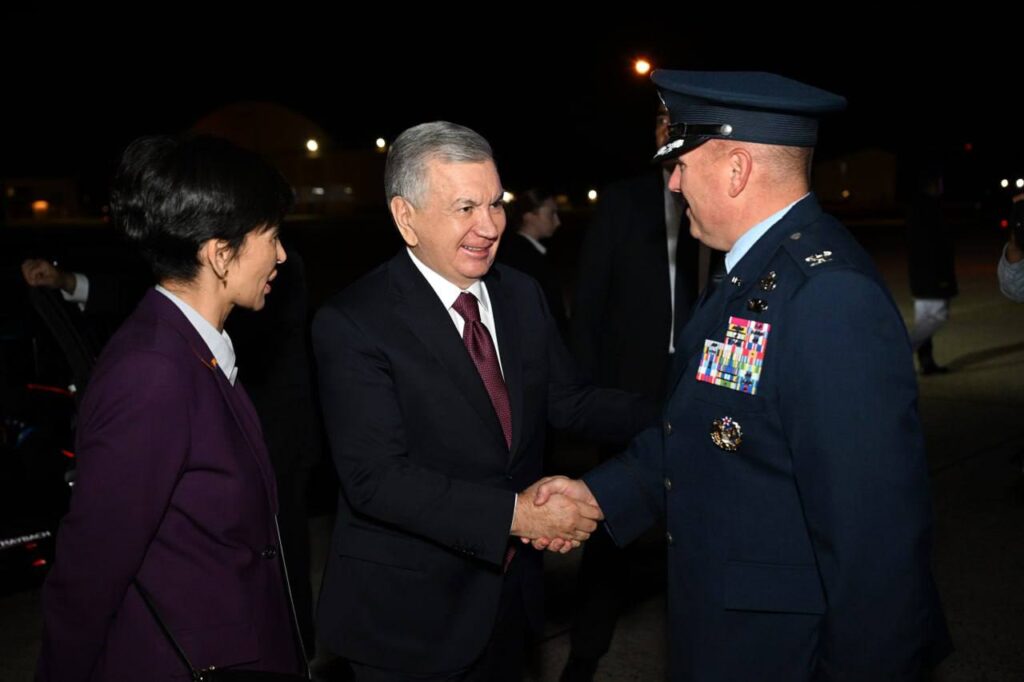
The United States and Uzbekistan are deepening their economic and technological partnership. Following President Shavkat Mirziyoyev’s meeting with U.S. President Donald Trump in Washington, the U.S. State Department announced a sweeping package of agreements, described as among the most significant in the history of bilateral relations in both investment and strategic scope. High-Level Business Engagements During his Washington visit, President Mirziyoyev held talks with representatives from major American corporations, investment funds, and financial institutions. The meeting was attended by U.S. Secretary of Commerce Howard Lutnick, Special Assistant to the President Ricky Gill, Special Assistant to the President Ricky Gill, Deputy Secretary of Agriculture Stephen Vaden, and executives from companies such as Traxys, FLSmidth, McKinsey, Meta, Google, Amazon, Boeing, Air Products, Axiom Space, Cove Capital, Freeport-McMoRan, Orion CMC, Cargill Cotton, John Deere, Honeywell, Valmont Industries, and Flowserve Corporation. Opening the event, Mirziyoyev highlighted that trade between Uzbekistan and the U.S. has quadrupled over the past eight years, and more than 300 American companies are now operating in the country. He added that this is just the beginning of a new era in economic cooperation. Key strategic goals were outlined: by 2030, Uzbekistan aims to develop a new-generation energy system with 18-20 GW of renewable capacity, more than half of it sourced from solar and wind. In this context, the two countries plan to jointly develop and process critical minerals such as uranium, copper, tungsten, molybdenum, and graphite, establishing resilient supply chains and leveraging U.S. processing technologies. Infrastructure is another major focus. Uzbekistan intends to invest over $12 billion by 2030 to modernize roads, railways, terminals, and airports. Digital cooperation is also expanding. Projects with Google, Meta, and NVIDIA include the launch of Apple Pay and Google Pay, the creation of a Digital Academy, and the development of startup hubs. These initiatives are expected to be supported by the U.S. International Development Finance Corporation (DFC) and the U.S. Exim Bank. Mirziyoyev reaffirmed his personal commitment to supporting American investment, stressing that Uzbekistan remains a stable and favorable destination for foreign businesses. Securing Access to Strategic Raw Materials Washington’s primary interest lies in critical minerals. The U.S. will gain priority access to joint mining projects and exclusive access to geological data on rare earth and other strategically significant elements. This move is part of a broader U.S. effort to diversify global sources of inputs vital to defense, green energy, and other high-tech sectors. The two countries are also preparing a $400 million investment package to develop sustainable supply chains for critical and rare earth minerals. For Uzbekistan, this represents a key step toward integration into global value chains and reduced reliance on limited partners. Energy Cooperation: A Role for Small Modular Reactors Uzbekistan plans to acquire American small modular reactors (SMRs), a technology increasingly favored by emerging economies for its scalability and relatively low upfront costs. Interest in SMRs has grown following the 2025 approval of the upgraded NuScale Power Module (77 MW), and Uzbekistan may become one of the first countries in...