
• KGS/USD = 0.01144 0%
  • KZT/USD = 0.00214 0%
  • TJS/USD = 0.10508 0.48%
  • UZS/USD = 0.00008 0%
  • TMT/USD = 0.28571 0%
  • KGS/USD = 0.01144 0%
  • KZT/USD = 0.00214 0%
  • TJS/USD = 0.10508 0.48%
  • UZS/USD = 0.00008 0%
  • TMT/USD = 0.28571 0%
  • KGS/USD = 0.01144 0%
  • KZT/USD = 0.00214 0%
  • TJS/USD = 0.10508 0.48%
  • UZS/USD = 0.00008 0%
  • TMT/USD = 0.28571 0%
  • KGS/USD = 0.01144 0%
  • KZT/USD = 0.00214 0%
  • TJS/USD = 0.10508 0.48%
  • UZS/USD = 0.00008 0%
  • TMT/USD = 0.28571 0%
  • KGS/USD = 0.01144 0%
  • KZT/USD = 0.00214 0%
  • TJS/USD = 0.10508 0.48%
  • UZS/USD = 0.00008 0%
  • TMT/USD = 0.28571 0%
  • KGS/USD = 0.01144 0%
  • KZT/USD = 0.00214 0%
  • TJS/USD = 0.10508 0.48%
  • UZS/USD = 0.00008 0%
  • TMT/USD = 0.28571 0%
  • KGS/USD = 0.01144 0%
  • KZT/USD = 0.00214 0%
  • TJS/USD = 0.10508 0.48%
  • UZS/USD = 0.00008 0%
  • TMT/USD = 0.28571 0%
  • KGS/USD = 0.01144 0%
  • KZT/USD = 0.00214 0%
  • TJS/USD = 0.10508 0.48%
  • UZS/USD = 0.00008 0%
  • TMT/USD = 0.28571 0%

Viewing results 487 - 492 of 3358

The Industrial Map of Central Asia: Projects That Could Reshape the Region’s Economy

Over the next decade, the countries of Central Asia are preparing to launch a wave of industrial projects: copper mines, gas-chemical complexes, hydropower and nuclear plants, fertilizer factories, and others. The largest initiatives, valued at tens of billions of dollars, could significantly alter the balance of global markets. Uzbekistan: Betting on Metallurgy and Gas Chemistry Uzbekistan has been particularly active in launching new industrial projects. The largest initiative is the $15 billion expansion of the Almalyk Mining and Metallurgical Combine (AMMC), designed to increase copper cathode production from 148,000 to 400,000 tons annually by 2030. This more than two-fold increase is driven by strong global demand for copper. In May 2024, prices exceeded $11,000 per ton due to anticipated shortages linked to the energy transition and rising consumption in green technologies. Copper has become a key metal for electrification, and Uzbekistan’s copper megaproject fits squarely into this global trend, positioning the country as an emerging player in the market. Another strategic direction is the deep processing of natural gas into chemical products. In spring 2024, construction began on a $5 billion methanol-to-olefins gas-chemical complex in Bukhara. The plant, located in the Karakul Free Economic Zone, will process 1.3 billion m³ of gas and 430,000 tons of naphtha per year, producing up to 1.1 million tons of polymers. Completion is expected in 2027. The facility will create 2,000 direct jobs, and about 4,000 more in related industries such as construction materials, textiles, automotive, and electronics. Equipment suppliers include companies from the United States, Germany, and China, and the project is led by Uzbekistan’s largest oil and gas company, Sanoat Energetika Guruhi (Saneg). An even larger $10 billion MTO project is planned for completion by 2028, creating about 3,000 jobs and further expanding polymer production based on methanol. Uzbekistan is also investing in modernizing existing facilities. The $1.8 billion expansion of the Shurtan Gas Chemical Complex is under way, and preparations are being made for the privatization of the $3.4 billion Uzbekistan GTL plant launched in 2021. In renewables, a 250 MW solar power plant with Masdar is being built in Bukhara region with UAE partner Masdar, scheduled to come online by late 2025. Turkmenistan: Fuel, Energy, and the Chemical Industry Turkmenistan, which holds the world’s fourth-largest natural gas reserves, is focusing on export-oriented energy projects and the development of gas-chemical production. A key regional initiative is the TAPI pipeline (Turkmenistan–Afghanistan–Pakistan–India), valued at more than $7 billion. In 2024, work began on the Turkmen segment from Serhetabat on the Afghan border to Herat, forming the central section of the route. TAPI aims to deliver Turkmen gas to South Asian markets and enhance regional energy security. Despite geopolitical challenges, construction continues under the government’s “Arkadag Bright Path” energy development strategy. The country is also expanding its domestic processing capacity. In 2019, Turkmenistan launched the world’s first industrial gas-to-gasoline (GTG) plant in Ovadan Depe, a $1.7 billion facility that converts 1.8 billion m³ of gas into 600,000 tons of A-92 gasoline annually. The fuel...

Q-Pop Is Back. Is Kazakhstan Ready This Time?

Around 2015, Kazakhstan saw the rise of Q-pop, led by the boy band Ninety One. A decade on, the cultural tension remains: while youth artists enjoy greater visibility, many observers argue that freedom of expression is still shaped by a silent boundary — ‘you can make music, but not stir too much controversy. A little over a decade ago, five young men in earrings and pastel clothes released “Aıyptama!” (“Don’t blame me”) - a slick, catchy track in Kazakh, with a video that looked like it came straight out of Seoul. The group, Ninety One, was born out of a reality TV show modeled on the K-pop system. At the time, Kazakh-language pop had little presence on mainstream radio or TV, where Russian-language and Western hits dominated. Much of the Kazakh-language music most people heard came from weddings and folk performances rather than commercial pop charts. Occidental pop, rock and Russian-language hip hop ruled the charts. So, when Azamat Zenkaev (AZ), Dulat Mukhamedkaliev (Zaq), Daniyar Kulumshin (Bala), Batyrkhan Malikov (Alem), and Azamat Ashmakyn (Ace) debuted as a group, they looked and sounded like nothing the local music scene had ever seen. Their appearance sparked outrage. In Karaganda, a 2016 concert was canceled after protests. “We are against them because they dye their hair and wear earrings!” a demonstrator shouted, captured in the 2021 documentary Men Sen Emes (Sing Your Own Songs) by Katerina Suvorova. “No parent would want their son to look like a woman,” a conservative activist added. Even their producer, Yerbolat Bedelkhan, noted, “They shook up Kazakh show business with their unusual looks.” And yet, their rise was unstoppable. Despite boycotts and online abuse, Ninety One topped national charts. Each video release became an event. Over time, their success helped make gender-fluid aesthetics more visible in Kazakhstan’s pop scene — and made singing in Kazakh fashionable again among young audiences. But their aesthetics stood in sharp contrast to the state-promoted model of Kazakh masculinity. [caption id="attachment_37776" align="aligncenter" width="770"] Ninety One; image: JUZ Entertainment[/caption] Revival and Restriction: The State’s Masculine Ideal In 2017, then-President Nursultan Nazarbayev launched Rukhani Zhangyru – a sweeping state program for “spiritual renewal.” Its goal was to forge a unified Kazakh national identity after decades of Soviet domination, largely by reigniting traditional values. Streets were renamed after historical khans, a National Dombra Day was established, and the country began shifting from Cyrillic to the Latin alphabet. But the cultural revival came with a gender script. School textbooks were rewritten, according to a 2021 Rutgers University study, to cast masculinity as a blend of strength, rationality, and emotional restraint. The ideal Kazakh man - the Batyr - was reimagined as a stoic warrior of the steppes. In this context, Ninety One’s aesthetics didn’t fit in. “Many thought Q-pop artists didn’t act like ‘real Kazakhs’,” Merey Otan, a musician and PhD candidate at Nazarbayev University told The Times of Central Asia. “Wearing makeup, earrings, or bright clothes, expressing emotions or sexuality – these all clashed with a...

Aliyev–Tokayev Talks Rekindle Momentum for Trump’s Peace Corridor

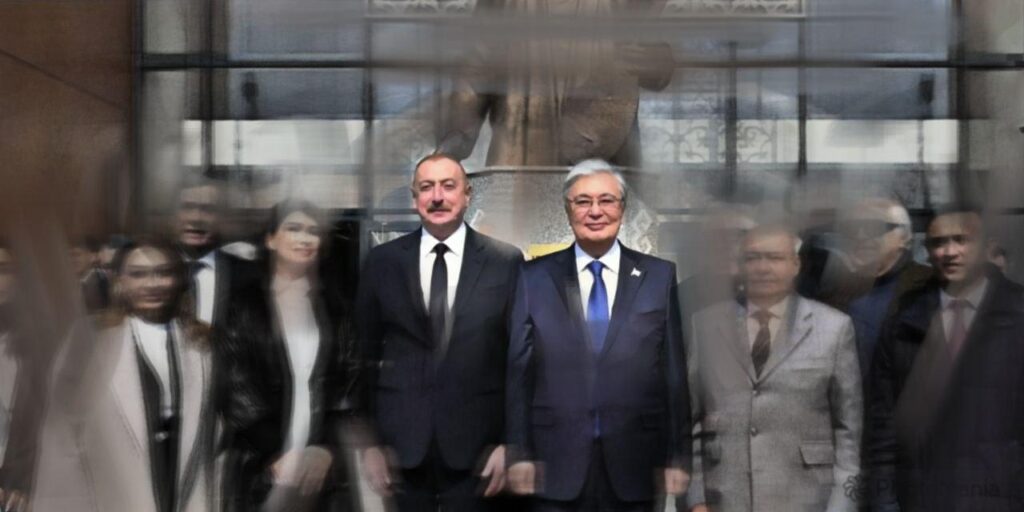
Azerbaijani President Ilham Aliyev’s state visit to Kazakhstan this week highlights the deepening strategic alignment between the two Caspian neighbors. Both are united by a drive to reshape Eurasia’s transport map through the Middle Corridor — a trans-Caspian route linking Central Asia to Europe — and its politically sensitive South Caucasus extension, the Zangezur Corridor. The meeting comes amid renewed optimism following the August 2025 U.S.-brokered declaration between Armenia and Azerbaijan. The accord envisions a transit route linking mainland Azerbaijan with its Nakhchivan exclave via a roughly 20-32 km stretch of Armenia’s Syunik region. Under the framework, the United States would receive exclusive long-term development rights for infrastructure (railways, pipelines, fibre-optic cables) on that corridor — while Armenia retains full territorial sovereignty and the route operates under Armenian law. U.S. President Donald Trump, who hosted the White House summit that produced the deal, said: “Thirty-five years they fought, and now they’re friends and they’re going to be friends for a long time.” The project is also known as the “Trump Route for International Peace and Prosperity” (TRIPP), From Framework to Reality TRIPP remains far from implementation: Armenia and Azerbaijan still must ratify the agreement as a binding treaty, finalize the terms of U.S. development rights, and attract major investment for rail, energy and digital networks. Meanwhile, peace between the two remains fragile. Resistance from Iran, wary of being bypassed, and Russia, whose influence has waned since the war in Ukraine, complicates progress. Turkey’s backing, as a champion of trans-Turkic connectivity, will be crucial. Whether the “peace route” becomes operational or stalls as another geopolitical mirage depends on political consensus and sustained stability. A Trans-Caspian Lifeline For Aliyev and President Kassym-Jomart Tokayev, these uncertainties strengthen the case for deeper transport cooperation. During the visit, the two leaders will focus on transport integration, energy transit, and digital infrastructure, with attention to coordination among the Aktau, Kuryk, and Baku ports, building on existing MoUs and ongoing Middle Corridor initiatives.  Discussions will also cover customs digitization and rail interoperability along the Trans-Caspian International Transport Route (TITR). Although the Zangezur Corridor is not formally on the agenda, diplomats in both capitals suggest it looms large behind the logistics talks. For Kazakhstan, a functioning Zangezur link would tighten its connection to Turkish and European markets, reducing dependence on routes that traverse Russian or Iranian territory. For Azerbaijan, it would complete the east–west chain that underpins Baku’s Middle Corridor strategy — linking the Caspian directly to the Mediterranean through a unified Turkic transport system. For Kazakhstan, the Middle Corridor represents a strategic alternative to disrupted Russian transport routes, preserving the continuity of its westward trade and reinforcing its role as a key Eurasian transit state. The route—linking Kazakhstan across the Caspian Sea to Azerbaijan, and continuing through Georgia and Turkey—provides access to European markets while reducing dependence on northern pathways. For Azerbaijan, it consolidates its position as a central hub connecting the Turkic world to global trade networks. Presidents Kassym-Jomart Tokayev and Ilham Aliyev have both framed...

Bottlenecked: Eurasia’s Freight Lifelines Falter

Amid heightened geopolitical tensions and stricter border regulations, key transit routes linking China and Europe via Kazakhstan and Belarus have experienced severe disruptions. The resulting bottlenecks have exposed the fragility of Eurasian logistics and cast doubt on the reliability of the overland corridors central to China’s Belt and Road Initiative. From Military Maneuvers to Transport Gridlock For over two decades, Kazakhstan has invested heavily in developing its transit potential, aiming to become the main bridge between China and Europe. But in September and October this year, logistical bottlenecks began to appear, chiefly at border crossings. The disruptions were triggered by the closure of Belarusian‑Polish checkpoints following the launch of the Zapad 2025 military exercises (12‑16 September 2025) conducted by Russia and Belarus. On September 12, the day the exercises began, Poland suspended road and rail traffic after drones reportedly entered its airspace. Belarus claimed the drones had veered off course due to electronic warfare measures involving Russia and Ukraine. Despite this explanation, Poland invoked Article 4 of the NATO charter, prompting the alliance to launch Operation Eastern Sentry to bolster its eastern flank. The closure lasted nearly two weeks, during which more than 130 freight trains from China, carrying cargo worth billions of euros, were stranded. The China Factor and Limited Alternatives China responded diplomatically: on 15 September, Foreign Minister Wang Yi held talks in Warsaw; on 22 September, Politburo member Li Xi visited Minsk. Despite these efforts, border reopening was not immediately expedited. Alternative routes proved inadequate. The Trans‑Caspian International Transport Route (Middle Corridor) — through Kazakhstan and the Caspian Sea — is growing but still modest in capacity. In 2022 its potential was assessed at around 80,000 TEU annually. Some forecasts estimate it may rise to 10 million tons per year by 2027, but it remains well short of the volumes handled by the northern rail corridor. According to Logistan, the route currently has a monthly capacity of under 10,000 TEU, far short of the 40,000 TEU demand. The World Bank estimates that upgrading Middle Corridor infrastructure will require $27-$29 billion over 15 years, primarily for rail and port development. Amid these limitations, China tested a new maritime option: in September, an ice-class container vessel departed Ningbo-Zhoushan for the UK via the Northern Sea Route. The move indicates Beijing’s growing interest in Arctic alternatives to land corridors. Kazakhstan-Russia Hubs and “Gray” Transit As disruptions continued on the western flank, issues emerged in the south. Since mid-June, Russian logistics companies have reported delays at Kazakhstan’s border crossings. Kazakhstan’s Ministry of Finance attributed the slowdowns to increased inspections aimed at intercepting counterfeit goods. Forbes reported that roughly 7,000 trucks, carrying Chinese cargo worth hundreds of millions of dollars, were stranded. Many shipments used simplified declarations, often disguised as textiles or raw materials, and sometimes included dual-use items. Despite denials from both Kazakh and Russian authorities, freight companies cited congestion stretching for kilometers. The situation worsened after Russia imposed new migration rules restricting Kazakh drivers to 90 days of stay per year. The Kazakh government...

Pipelines Under Pressure: Ukraine War Hits Kazakhstan Energy Arteries

The ongoing war between Ukraine and Russia continues to have indirect but notable implications for Kazakhstan’s energy sector. Following the September drone attack in Russia’s Novorossiysk that damaged the offices of the Caspian Pipeline Consortium (CPC) - which exports the majority of Kazakhstan’s oil - another incident has raised concern: the October 19 strike on Russia’s Orenburg Gas Processing Plant, which handles gas from Kazakhstan’s Karachaganak field. The CPC confirmed that its export terminal continued operating after the September 24 incident, though two employees were injured and part of its office complex was damaged. The consortium remains the backbone of Kazakhstan’s oil exports, handling over 80% of national crude shipments to world markets. This concentration has long been viewed as a vulnerability because nearly all flows depend on infrastructure inside Russian territory. The war has underscored that risk, prompting Astana to accelerate plans for alternative routes across the Caspian Sea toward Azerbaijan and Georgia. Astana has been working with Baku and Tbilisi to expand capacity along the Trans-Caspian International Transport Route (Middle Corridor), supported by EU and World Bank funding commitments. Kazakhstan’s Ministry of Energy confirmed that the plant, located about 150 kilometers northwest of Kazakhstan’s Karachaganak field across the Russian border, was temporarily shut down following the UAV strike. “According to information from PJSC Gazprom, on October 19, 2025, an emergency situation occurred at the Orenburg gas processing plant as a result of a UAV attack, in connection with which the plant temporarily stopped receiving raw gas from the Karachaganak field.” The Ministry added that gas supplies to domestic consumers remain unaffected and that consultations are underway with field operators to assess potential disruptions and losses. No details on the extent of the damage or repair timelines have been released by the Russian side. Ukraine’s military confirmed responsibility for the attack as part of its campaign against Russian energy infrastructure, according to statements reported by Interfax-Ukraine and Ukrainska Pravda. Industry analysts, however, remain cautious. Journalist Oleg Chervinsky noted that the Orenburg plant processes up to nine billion cubic meters of Karachaganak gas annually, a portion of which is returned to Kazakhstan’s northern regions. He warned that a prolonged shutdown could lead to supply shortages, particularly during the winter months. The timing of the Orenburg attack - just before the start of the heating season - adds a seasonal risk dimension. Olzhas Baidildinov, an expert in the energy sector, criticized delays in constructing a domestic gas processing facility at Karachaganak, arguing that reliance on foreign infrastructure heightens Kazakhstan’s vulnerability to regional conflict and economic disruptions. The replacement of damaged equipment, including components from France’s Technip, could also be complicated by sanctions and supply chain issues, ultimately impacting tariffs and consumer costs. The cumulative effect of reduced gas processing capacity and potential production slowdowns at Karachaganak could weigh on Kazakhstan’s already strained budget. While some observers note that reduced output may help the country align with its OPEC+ production commitments, previously exceeded at major fields including Kashagan, Tengiz, and Karachaganak, such...

Kazakh Surgeons Use MAKO Robotic System in Tashkent for the First Time

Kazakh surgeons have performed groundbreaking joint replacement procedures in Uzbekistan's capital Tashkent using the MAKO robotic system, an advanced technology in orthopedic surgery. The operations were a centerpiece of the event 'Days of Kazakh Medicine in Uzbekistan'. A surgical team led by traumatologist-orthopedist Timur Baidalin, head of the endoprosthetics department at the Batpenov National Scientific Center for Orthopedics and Traumatology, successfully conducted two joint replacements, one knee and one hip, using the MAKO robotic assistant. The system enables surgeons to plan and execute procedures with exceptional precision and reduced risk of complications. Developed by the U.S. based company Stryker, the MAKO system functions as an intelligent surgical assistant using 3D modeling technology. It creates a virtual replica of the patient’s joint, allowing the surgical team to pre-calculate the optimal implant angle, depth, and trajectory. During the procedure, the surgeon guides the MAKO manipulator, which operates with micromillimeter accuracy. This significantly lowers the risk of tissue damage and extends the lifespan of the implanted prosthesis. “The main advantage of MAKO is the ability to combine the surgeon’s experience with machine precision. This sets a new standard in endoprosthetics,” said Baidalin. For Uzbek specialists, the event served as a hands-on masterclass. In addition to observing the procedures, local doctors operated the system under the supervision of the Kazakh team. “We’ve been anticipating this technology for a long time. Today, we not only saw it in action but experienced the difference. This is a milestone for Uzbek orthopedics, and we’re grateful to our Kazakh colleagues for the opportunity to gain this experience,” said Odil Valiev, head of the adult orthopedics department at Uzbekistan’s Republican Specialized Scientific and Practical Center for Traumatology and Orthopedics. This collaboration follows another recent highlight: in spring 2025, Kazakh specialists from UMC, led by cardiac surgeon Yuri Pii, presented the ALEM device at EXPO 2025 in Osaka. The technology enables the long-term preservation of donor organs and represents another significant advance in regional medical innovation.
