• KGS/USD = 0.01144 0%
  • KZT/USD = 0.00208 0%
  • TJS/USD = 0.10439 0%
  • UZS/USD = 0.00008 0%
  • TMT/USD = 0.28571 0%
  • KGS/USD = 0.01144 0%
  • KZT/USD = 0.00208 0%
  • TJS/USD = 0.10439 0%
  • UZS/USD = 0.00008 0%
  • TMT/USD = 0.28571 0%
  • KGS/USD = 0.01144 0%
  • KZT/USD = 0.00208 0%
  • TJS/USD = 0.10439 0%
  • UZS/USD = 0.00008 0%
  • TMT/USD = 0.28571 0%
  • KGS/USD = 0.01144 0%
  • KZT/USD = 0.00208 0%
  • TJS/USD = 0.10439 0%
  • UZS/USD = 0.00008 0%
  • TMT/USD = 0.28571 0%
  • KGS/USD = 0.01144 0%
  • KZT/USD = 0.00208 0%
  • TJS/USD = 0.10439 0%
  • UZS/USD = 0.00008 0%
  • TMT/USD = 0.28571 0%
  • KGS/USD = 0.01144 0%
  • KZT/USD = 0.00208 0%
  • TJS/USD = 0.10439 0%
  • UZS/USD = 0.00008 0%
  • TMT/USD = 0.28571 0%
  • KGS/USD = 0.01144 0%
  • KZT/USD = 0.00208 0%
  • TJS/USD = 0.10439 0%
  • UZS/USD = 0.00008 0%
  • TMT/USD = 0.28571 0%
  • KGS/USD = 0.01144 0%
  • KZT/USD = 0.00208 0%
  • TJS/USD = 0.10439 0%
  • UZS/USD = 0.00008 0%
  • TMT/USD = 0.28571 0%

Viewing results 301 - 306 of 2318

Afghanistan Absent, Not Forgotten – Central Asia’s UNGA Strategy

From September 23–29, 2025, the UN General Assembly’s general debate unfolded without an Afghan delegation addressing those assembled amid the unresolved UN seat issue. Yet Afghanistan was hardly absent. Central Asian presidents used their platform to project a collective stance that stopped short of recognition while rejecting isolation. Their message reflected a regional doctrine of managed engagement: keep the neighbor connected enough to limit collapse, through corridors, energy grids, and humanitarian channels. President Shavkat Mirziyoyev of Uzbekistan offered the clearest blueprint, urging the international community to “prevent [Afghanistan’s] isolation,” and calling for support to develop transport and energy corridors across Afghan territory. That language aligns with initiatives already underway: a multilateral framework signed in Kabul on July 17 to move the Trans-Afghan railway toward feasibility, and fresh agreements on the 500 kV Surkhan–Pul-i-Khumri line designed to stabilize Afghanistan’s power supply while linking it to a regional grid. Mirziyoyev’s message was a bid to convert geography into risk management. Kazakhstan struck a technocratic note. Kassym-Jomart Tokayev told the Assembly that “inclusive development in Afghanistan” is the basis for long-term regional peace and stability. This phrasing matches Almaty’s UN-backed hub for the Sustainable Development Goals and Astana’s self-image as the region’s administrative center. The goal is to stabilize the weakest link so trade and transit do not fracture. Kyrgyz President Sadyr Japarov used part of his brief UN address to demand that roughly $9 billion in Afghan central-bank assets frozen in Western jurisdictions be returned to “the Afghan people,” and called isolation “unacceptable.” In a remittance-dependent economy like Kyrgyzstan’s, collapse next door risks hunger, displacement, and crime. His remarks were both moral and practical, and marked the sharpest public challenge to Western policy voiced by any Central Asian leader this week. Traditionally, Tajikistan has taken the hardest line on the Taliban. This time, Emomali Rahmon emphasized humanitarian assistance, citing drought-hit regions and areas devastated by the August 31 eastern Afghanistan earthquake, and said Dushanbe supports peace, stability, and socio-economic development next door. The quake killed more than 2,000 people and destroyed thousands of homes across Kunar, Nangarhar, and Laghman just as aid budgets were shrinking. Turkmenistan took a different approach. President Serdar Berdimuhamedov did not mention Afghanistan, instead promoting Ashgabat’s permanent neutrality as a proposed UN agenda item, “Neutrality for Peace and Security,” along with broad transport and energy initiatives. This approach preserved flexibility on projects like TAPI without committing to specifics in New York. What makes these speeches consequential is how closely they mirror work on the ground. The Trans-Afghan railway, long dismissed as only a plan, now has a political framework and a declared security pledge from Kabul. Whether it moves forward depends on both capital and security, but for Tashkent, a southern outlet to Pakistani ports is the difference between landlocked and land-linked. The Surkhan–Pul-i-Khumri line is more conventional and urgent: a 200-kilometer fix to keep the lights on and the revenues flowing. The long-troubled CASA-1000 power corridor is also inching back into view after being paused post-2021, with...
Kazakh Tulips to Bloom in Paris

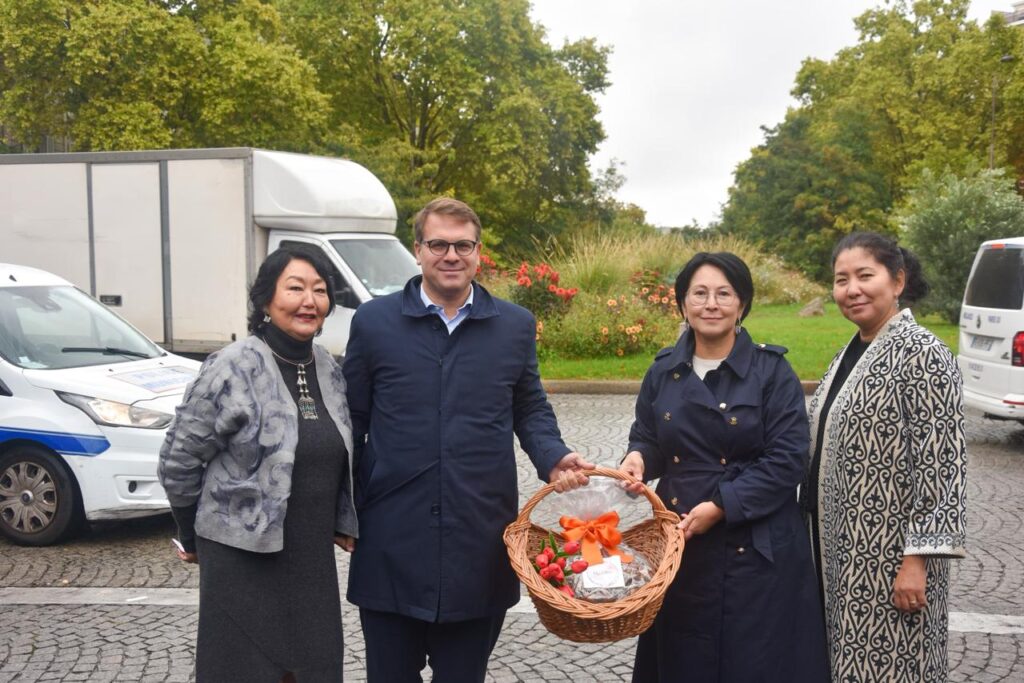
Bulbs of native Kazakh tulips from the steppes near Shymkent have made their way to Paris as part of a broader program of botanical cooperation between Kazakhstan and France. These tulips, originally native to the territory of modern-day Kazakhstan, have long been admired in Europe, especially since the “tulip mania” of the 17th century. Today, Paris officials are eager to add these new specimens from the Kazakh steppe to the city's botanical heritage. The initiative was spearheaded by the Association of Kazakh Women in France, “QazElles,” with support from the Embassy of Kazakhstan in France and in close collaboration with the mayor’s office of Paris’s 17th arrondissement. A flower bed dedicated to Kazakh tulips will be established on Place de Wagram, with Shymkent’s city administration selecting and donating the finest local varieties for the project. [caption id="attachment_36767" align="aligncenter" width="352"] @Aliya Syzdykova[/caption] The symbolic planting ceremony was attended by Kazakhstan’s Ambassador to France, Gulsara Arystankulova; the mayor of the 17th arrondissement, Geoffroy Boulard; and QazElles president Madina Kulmanova. “I have good impressions from participating in the symbolic planting of Kazakh tulips in our district, where 160,000 people live. This is a sign of friendship with Kazakhstan. In addition, tulips are an environmentally sustainable plant, which is important to us. Together with the mayor of Shymkent, we are pleased to participate at our level in strengthening ties between France and Kazakhstan,” said Mayor Boulard. [caption id="attachment_36768" align="aligncenter" width="350"] @Aliya Syzdykova[/caption] The ceremonial handover of the tulip bulbs was conducted in the presence of Paris’s landscaping services, which will be responsible for planting and maintaining the flower bed. A total of 300 tulips are scheduled to bloom on the square by April next year. “And now there will be a little piece of Kazakhstan in this place, and we will admire it every spring. This is a great joy for us Kazakhs living here, but our tulips will also make one of the most beautiful cities in the world, Paris, even more beautiful,” said Meruert Tazhenova, a QazElles member and one of the event’s organizers.

Woosong University Kazakhstan Campus Officially Opens

On September 25, Woosong University launched its new branch, Woosong University Kazakhstan, which will initially offer a program in AI and Big Data, with plans to expand into broader technology and software engineering fields. At the opening ceremony, former Deputy Prime Minister Yermek Kusherbayev, who assumed the post of Minister of Foreign Affairs the following day, highlighted the significance of the event: "To date, 40 strategic partnerships of various formats have been implemented, including 33 branches of foreign universities. Today, we are witnessing a historic event, the opening of a branch of one of the leading universities of the Republic of Korea in the spiritually rich and ancient Turkestan. This university will become not just an educational platform but also a center for international cooperation, innovation, and the training of highly qualified specialists who will shape the intellectual capital of our country." Minister of Science and Higher Education Sayasat Nurbek added that Kazakhstan aspires to become Central Asia’s leading educational hub, with foreign university branches playing a central role in this transformation. Expanding Kazakh-Korean Cooperation Several higher education partnerships are already underway between Kazakhstan and South Korea: Dong-Eui University is collaborating with Akhmet Baitursynov University to train engineers for automobile manufacturing in Kostanay. Korkyt Ata University in Kyzylorda has launched dual-degree programs with the Seoul National University of Science and Technology (SeoulTech). Satbayev University in Almaty is working with the Korea Advanced Institute of Science and Technology (KAIST) to establish a center for rare earth metals processing. Kazakhstan as an International Education Hub As previously reported by The Times of Central Asia, Kazakhstan is attracting an increasing number of prestigious foreign institutions: On September 3, Cardiff University (Wales) opened Cardiff University Kazakhstan in Astana Germany’s Anhalt University of Applied Sciences launched a branch in Almaty Italy’s Marche Polytechnic University, based in Ancona, has opened a branch campus at Zhetysu University in Taldykorgan. Looking ahead, two additional institutions are set to establish campuses in 2026: Grenoble INP-Phelma, UGA, France’s premier engineering school in physics, electronics, and materials science, will open a branch in Almaty. The Colorado School of Mines will open its first international campus in Zhezkazgan, specializing in geology and mining.

Uzbekistan and Ukraine Pledge to Strengthen Ties During UN Assembly Meeting

Uzbekistan’s Foreign Minister Bakhtiyor Saidov met with his Ukrainian counterpart Andrii Sybiha on the sidelines of the UN General Assembly, Saidov announced via his official Telegram channel. According to Saidov, the ministers discussed a broad range of issues, including trade, investment, education, cultural exchange, and multilateral cooperation within international organizations. “Our meeting reaffirmed the mutual commitment of Uzbekistan and Ukraine to deepen dialogue, strengthen partnership, and explore new opportunities that will benefit our peoples,” Saidov wrote. Sybiha also confirmed the outcome of the talks on X, stating: “I was sincerely glad to meet with Bakhtiyor Saidov at UNGA. We agreed to resume political dialogue and enhance bilateral and multilateral cooperation in areas of mutual interest. Ukraine is committed to developing relations with Uzbekistan and strengthening ties with Central Asia.” The meeting took place amid recent reports in Ukrainian media that 13 Uzbek citizens had been subjected to forced labor at a greenhouse in the Kyiv region. Following these reports, officials from Uzbekistan’s embassy in Ukraine visited the site and later confirmed that the case was under full consular control. In response, the embassy issued official notes to Ukraine’s Foreign Ministry and Prosecutor General’s Office, demanding legal protection for the affected citizens. The embassy stated that a criminal case had been opened, suspects were facing trial, and measures were being taken to repatriate the workers. It emphasized that consular and legal support was ongoing, and that the rights and interests of Uzbek nationals remained a top priority.

Kazakhstan Recasts Its Foreign Policy at the United Nations

Several days ago I argued here that Kazakhstan’s diplomacy had begun to try to move from survival-mode balancing into a more entrepreneurial phase, testing its accumulated diplomatic capital on the world stage. President Kassym-Jomart Tokayev’s September 24, 2025, speech to the United Nations General Assembly confirms this. It was a statement of intent, marking a departure from decades of careful multivectorism toward a doctrine of initiative and responsibility. The speech sought to anchor a claim that Kazakhstan is not only balancing among vectors but weaving them into a systemic position of leverage to support active participation in the agenda-setting of global affairs. The multivector line, crafted under Nazarbayev, kept Moscow, Beijing, and Western capitals equidistant during a period when Kazakhstan’s priority was survival and gradual integration. The price of that prudence was that the distinct voice that Astana was trying to cultivate could not be heard. The country appeared more like a venue for great-power competition rather than an autonomous actor in favor of its own interests. On the UNGA stage, Tokayev did not abandon the old formula outright. Instead, he pressed it into service as a platform for what he called “bridge building,” but which looks in practice like a bid to shape the rules of the international order, instead of merely accommodating them. Railways, Corridors, and Diplomacy in Motion Tokayev declared to the Assembly: “Kazakhstan today carries eighty percent of all overland freight between Asia and Europe. By 2029, we will build five thousand kilometers of new railway to strengthen the Middle Corridor.” These words accompanied the announcement, only a few days before, of a multibillion-dollar deal with the American company Wabtec for the purchase of three hundred locomotives over ten years. Timed with his UN appearance itself, the announcement highlighted Tokayev's view of infrastructure as diplomacy. In systems terms, railways are not discrete projects but nodes in a meso-level build-out capable of reconfiguring macro-level flows. By embedding a commercial contract into the theater of UNGA, Tokayev gave it a transformational headline. The “Middle Corridor” now functions in two registers. In one, it is freight tonnage, Caspian ferry capacity, Azerbaijan–Georgia transit. In the other, it is a political instrument. Only weeks before UNGA, Astana hosted talks that facilitated the U.S.-backed Armenia–Azerbaijan declaration. By enabling that dialogue, Kazakhstan projected itself into the South Caucasus as an intermediary claiming credibility with both sides. Hosting the South Caucasus dialogue projected Astana's view of itself as a systems-level creator of interdependence at the infrastructural level. From there, the loop feeds back to the structuration of political behavior. Economically, Kazakhstan remains the only Central Asian state with diversified sources of foreign direct investment (FDI). The Netherlands and the United States together still outpace China and Russia in cumulative FDI. Uzbekistan, despite rising visibility, remains structurally dependent on its two large neighbors. By contrast, Astana uses diversification to demonstrate optionality. The locomotive deal is one example; the C5+1 dialogues with Washington are yet another. Reforming the Global Order Tokayev spoke about a “crisis of...

Uzbek Singer Concert Raided in Krasnoyarsk by Russian Guard

A concert by Uzbek singer Jaloliddin Ahmadaliyev in Russia’s Krasnoyarsk region was abruptly interrupted when officers from the Russian National Guard (Rosgvardiya) raided the venue with sniffer dogs and began conducting mass document checks. According to Russian state media RIA Novosti, the raid took place on September 22 at the Korona banquet hall in the Yemelyanovo district. Authorities said the operation was aimed at identifying foreign nationals in violation of migration laws and individuals potentially linked to drug trafficking. More than 600 people attended the event, and officers reportedly checked the documents of 620 individuals, including 210 foreign citizens. Witnesses said some attendees were forcibly removed from the venue, but no illegal substances or contraband were discovered during the sweep. Uzbekistan’s Ministry of Foreign Affairs confirmed the incident, stating that eight Uzbek nationals were found to be in violation of Russian migration regulations. Four were fined and ordered to be deported, while the remaining four were placed in a temporary detention facility for foreign citizens in Krasnoyarsk. The ministry stated that law enforcement actions must have a legal basis and should not disrupt cultural events. The Consulate General of Uzbekistan in Novosibirsk is providing legal assistance to the detained individuals. In a statement published via its official Telegram channel, the consulate clarified that the concert had not been coordinated with local authorities. In contrast, a previous Ahmadaliyev performance in Novosibirsk was formally approved and took place without incident. The consulate noted that the event in Krasnoyarsk was privately organized by Russian citizens in a venue not designed for large-scale cultural gatherings. While acknowledging that Russian authorities have the right to enforce migration regulations, the consulate urged that such operations not interfere with cultural events. It added that all required documentation has been submitted to local law enforcement in Krasnoyarsk for a legal review of the incident.