• KGS/USD = 0.01144 0%
  • KZT/USD = 0.00215 0%
  • TJS/USD = 0.10599 -0.28%
  • UZS/USD = 0.00008 0%
  • TMT/USD = 0.28571 0%
  • KGS/USD = 0.01144 0%
  • KZT/USD = 0.00215 0%
  • TJS/USD = 0.10599 -0.28%
  • UZS/USD = 0.00008 0%
  • TMT/USD = 0.28571 0%
  • KGS/USD = 0.01144 0%
  • KZT/USD = 0.00215 0%
  • TJS/USD = 0.10599 -0.28%
  • UZS/USD = 0.00008 0%
  • TMT/USD = 0.28571 0%
  • KGS/USD = 0.01144 0%
  • KZT/USD = 0.00215 0%
  • TJS/USD = 0.10599 -0.28%
  • UZS/USD = 0.00008 0%
  • TMT/USD = 0.28571 0%
  • KGS/USD = 0.01144 0%
  • KZT/USD = 0.00215 0%
  • TJS/USD = 0.10599 -0.28%
  • UZS/USD = 0.00008 0%
  • TMT/USD = 0.28571 0%
  • KGS/USD = 0.01144 0%
  • KZT/USD = 0.00215 0%
  • TJS/USD = 0.10599 -0.28%
  • UZS/USD = 0.00008 0%
  • TMT/USD = 0.28571 0%
  • KGS/USD = 0.01144 0%
  • KZT/USD = 0.00215 0%
  • TJS/USD = 0.10599 -0.28%
  • UZS/USD = 0.00008 0%
  • TMT/USD = 0.28571 0%
  • KGS/USD = 0.01144 0%
  • KZT/USD = 0.00215 0%
  • TJS/USD = 0.10599 -0.28%
  • UZS/USD = 0.00008 0%
  • TMT/USD = 0.28571 0%

Viewing results 97 - 102 of 1644

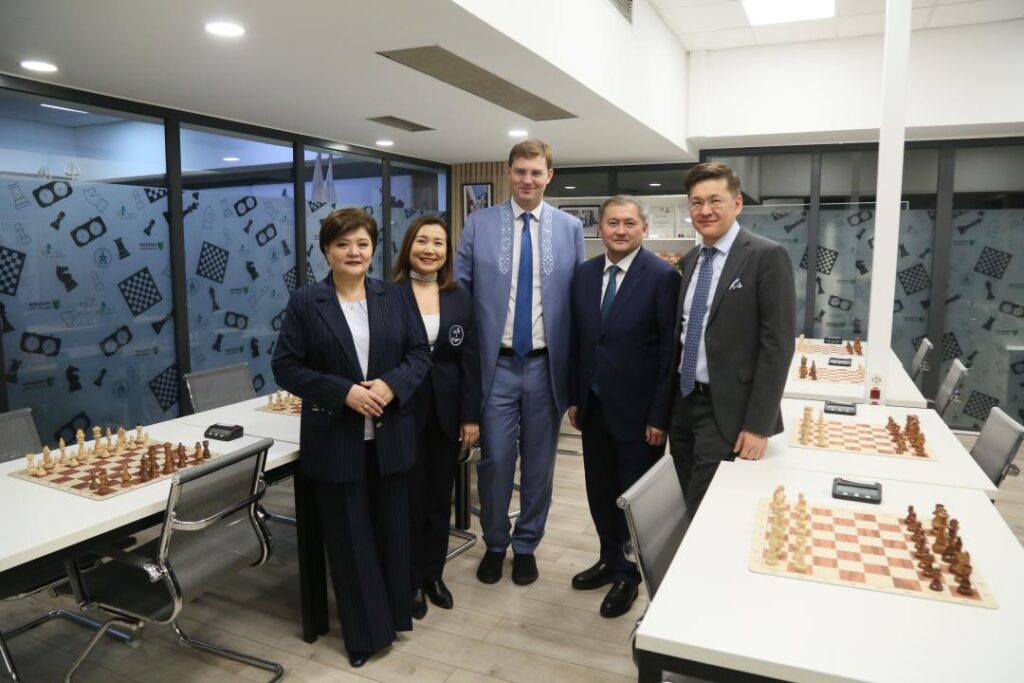
KazChessLab Opens in Kazakhstan Amid Plans to Teach Chess in Schools

The KazChessLab innovation laboratory has been officially inaugurated at the Kazakh National Women's Pedagogical University (QyzPU) in Almaty. The project is supported by the Ministry of Science and Higher Education and is a partnership between QyzPU and the Kazakhstan Chess Federation. KazChessLab is a modern educational platform designed to prepare chess teachers for secondary schools. The program is intended for students majoring in pedagogy and is offered as a minor. Upon completion of the course, graduates will receive certificates confirming their eligibility to teach chess in Kazakh schools. At the opening ceremony on February 20, Minister of Science and Higher Education Sayasat Nurbek highlighted the importance of developing chess in Kazakhstan. “In 2023, on the instructions of President Kassym-Jomart Tokayev, a strategic chess development plan was approved. Every child should be introduced to chess and master the game from an early school age. Today, Kazakhstan demonstrates high achievements in chess, and qualified teachers are essential for further development,” the minister said. “The opening of KazChessLab at our university is an important step aimed at updating educational content and enhancing the professional potential of future teachers,” said Beibitkul Karimova, Chair of the Board and Rector of QyzPU. “Chess is not just a game, but a tool for developing strategic thinking, responsibility, and perseverance. Training teachers capable of teaching this subject at a professional level is one of the pressing challenges of our time.” Timur Turlov, President of the Kazakhstan Chess Federation, described the opening of the laboratory as a milestone. “Kazakhstani chess has been consistently moving toward this goal for several years. These young specialists will not only teach children the rules of the game but also contribute to their intellectual development. I am confident that the synergy of modern infrastructure, a strong teaching school, and government support will take chess and chess education in Kazakhstan to a whole new level,” he said.

Uzbek Janitor Awarded for Saving Child from Seventh-Floor Fall in St. Petersburg

A janitor from Uzbekistan who saved a seven-year-old boy from a seventh-floor fall in St. Petersburg has been awarded state and public honors following the dramatic rescue. The Times of Central Asia reported yesterday that the incident took place on Petrozavodskaya Street, where the child was seen standing on the ledge outside an open window. Moments later, the boy lost his balance and fell. A janitor identified as Khayrullo, a native of Uzbekistan, was working near the building at the time. He noticed the danger and moved closer. As the child fell headfirst, Khayrullo caught him midair and held him tightly against his body, absorbing much of the impact. According to a presidential decree, President Shavkat Mirziyoyev awarded Khayrullo Saydullayevich Ibadullayev the Jasorat medal for bravery. The decree stated that he acted in an emergency situation, risking his own life and health to save the child and demonstrating courage and selflessness. Russian media also reported on the recognition. Margarita Simonyan, editor-in-chief of the television network RT, announced on X that the 38-year-old Uzbek citizen had received the fourth Tigran Keosayan Award for his heroism. The award, established by Simonyan, is presented to individuals who demonstrate bravery and dedication, particularly in protecting children and vulnerable people. In addition to the honor, Ibadullayev will receive a monetary prize of one million rubles, equivalent to approximately $13 000. The child survived the fall and was hospitalized. Doctors described his condition as stable.

Reporter Christopher Wren, Member of 1974 Team That Found Climbers´ Bodies on Lenin Peak, Has Died 

Christopher S. Wren, a journalist for The New York Times who was part of a 1974 American expedition that discovered the bodies of seven Soviet women climbers on Lenin Peak, on today’s border between Kyrgyzstan and Tajikistan, has died at the age of 89. Wren died at home in Vermont on February 15, the newspaper reported, quoting his daughter Celia Wren. The journalist reported extensively from the Soviet Union and China during the Cold War, as well as other regions, and his report on the discovery of what he called “one of the worst tragedies in modern mountaineering” was among his most dramatic dispatches. Wren, an experienced mountaineer, was with a team that found the bodies of the all-female Soviet group on Lenin Peak, a 7,134-meter mountain in what was then part of the Soviet Union. Many international climbers had gathered there that year at a time when the Cold War dominated global politics. The body of an eighth Soviet climber was found after Wren and his teammates left the site. “The Soviet press did not report the deaths of the country’s best women climbers until after I had returned to Moscow and revealed the disaster in The New York Times,” Wren wrote in his 1990 book The End of the Line: The Failure of Communism in the Soviet Union and China. Usually accessed from the Kyrgyz side, Lenin Peak is not the highest mountain in Kyrgyzstan, nor is it considered the most technically difficult. Russian climber Natalia Nagovitsina and an Italian friend, Luca Sinigaglia, died last year on Pobeda Peak, the country’s highest mountain at 7,439 meters above sea level. Kyrgyzstan’s Mountaineering and Sport Climbing Federation says Lenin Peak is popular among “beginner climbers.” The peak, the federation says, “is one of the most accessible 7000s in the world for climbing, one of the five world peaks in terms of popularity, and its base camp - Achyk-Tash - is the most convenient in terms of infrastructure accessibility among peaks of this height.” Infrastructure and communications at the mountain were more basic half a century ago, and the perils of high altitude, the cold, winds and storms are significant. In 1974, Russian expedition leader Elvira Shatayeva and her party got into trouble in a storm as they descended from the summit. In radio calls, she told base camp that they were dying and, according to Wren’s book, her last words were: “Please forgive us. We love you. Goodbye.” Heading toward the summit after the storm cleared, Wren and his group found the bodies of the stranded Soviet women. “A body is stretched on the snow before us. With a chill of recognition, I know it is Elvira Shatayeva, the women's team leader with whom I sat and talked one evening several weeks earlier,” Wren wrote in a 1974 article. The Soviet media blamed the storm for the disaster. But Wren said he wondered if more transparency and communication among climbing teams at Lenin Peak, despite heightened tension and rivalry between...

American AI Company to Help Kazakhstan Develop University Admissions Exam

Kazakhstan’s Ministry of Science and Higher Education and the AI-based education company ETS say they are developing a new university admissions exam, the Admissions Insight Test (AIT), as part of a partnership launched in November 2025 to modernize the country’s national admissions system. Officials say the test is also meant to support the international recognition of results in future. “The Admissions Insight Test represents a decisive step forward for Kazakhstan’s higher education system,” said Sayasat Nurbek, Kazakhstan’s Minister of Science and Higher Education. “By building this new admissions exam in partnership with ETS, we are strengthening trust, fairness, and global alignment in how students enter our universities. This work positions Kazakhstan to lead in education innovation while ensuring our students are prepared for success in a rapidly changing, international, and AI-driven world.” ETS, which is headquartered in Princeton, New Jersey with offices worldwide, said the AIT would be modular. “Subject Modules” would align with the school curriculum and a student’s intended field of study. Separate “Skills Based Tests” would measure critical thinking, academic writing and research skills, communication, quantitative and digital literacy, and creative or design thinking.  The ETS Research Institute is expected to work alongside Kazakhstan’s education leaders and National Testing Center specialists, using AI and advanced analytics to streamline development and deepen the insights universities get from results. Kazakhstan already uses nationwide testing as a central gateway into university, and policymakers have linked admissions changes to a broader push to become a regional education hub. “Around the world, governments are rethinking how education systems measure readiness for the future and they are turning to ETS because trust, rigor, and global expertise matter,” said Kadriye Ercikan, Senior Vice President of Global Research at ETS. “Our work with Kazakhstan reflects the same responsibility we bring to partnerships with education systems worldwide: applying the strongest measurement science, responsible innovation, and AI-enabled approaches to help countries build assessment systems that are fair, credible, and internationally respected.” The project sits alongside Kazakhstan’s higher education transformation and its decision to join OpenAI’s Education for Countries program as officials look to prepare students for an AI-shaped economy.

Kazakhstan Moves to Export Its Legendary Aport Apples

Kazakhstan is preparing to introduce its iconic Almaty aport apples to international markets after the variety attracted strong interest from European partners at Grune Woche 2026 in Germany. During the exhibition, QazTrade and the Association of Almaty Aport Producers signed a memorandum aimed at promoting aport apples and their processed products abroad, according to the Ministry of Trade and Integration of Kazakhstan. The aport is one of Kazakhstan’s most distinctive apple varieties and is closely associated with the natural and cultural heritage of Almaty, widely regarded as the ancestral home of apples. Known for their large size, rich aroma, and juiciness, aport apples are also highly demanding to cultivate. High-quality aport can only be grown at elevations between 850 and 1,250 meters above sea level, primarily in the foothills surrounding Almaty. Unlike commercial apple varieties that begin bearing fruit within four to six years, aport trees typically require eight to nine years before producing their first harvest. Despite the longer maturation period, the apple’s distinctive qualities and heritage value position it as a premium niche product. “The main advantage of aport is its uniqueness. Unlike mass-produced varieties designed for volume and long storage, aport stands out for its vivid taste, rich aroma, and large fruit size. Our orchards are located above 850 meters above sea level, which affects the firmness of the pulp and depth of flavor. In Germany, we presented not only fresh apples but also processed products such as fruit pastilles and apple chips. We also produce aport-based juice, vinegar, and dried fruit,” said Roman Safarov, president of the Association. According to QazTrade, participation in Grüne Woche confirmed strong export potential, particularly for processed aport products. “The Almaty aport is registered as a geographical indication. This status confirms its unique characteristics shaped by the natural conditions of the Almaty foothills, special soils, clean water, and temperature fluctuations. The geographical indication protects the brand and allows it to be promoted as a premium product in international markets,” said QazTrade CEO Aitmuhammed Aldazharov. Horticulture is increasingly viewed as a strategic growth area within Kazakhstan’s agro-industrial sector. According to Yerbol Taszhurekov, apple orchards in Kazakhstan now cover nearly 29,000 hectares, concentrated mainly in the southern regions of Almaty, Turkestan, Zhambyl, and Zhetisu. In the Almaty and Zhetisu regions alone, orchards span more than 2,400 hectares and include over 416,000 trees. Kazakhstan is also working to revive the aport variety, which had previously faced near extinction. Under a targeted 2024-2028 program involving private investors and specialized nurseries, authorities aim to produce certified saplings and expand commercial cultivation. By 2027, plans call for planting at least 110 hectares of new aport orchards.

Uzbek Janitor Saves 7-Year-Old Boy from Apartment Fall in St. Petersburg

A janitor from Uzbekistan saved a seven-year-old boy who fell from a seventh-floor window in St. Petersburg, according to the news outlet ExpressAsia. The incident occurred on Petrozavodskaya Street, where the child was seen standing on the ledge outside an open window. Neighbors shouted, urging him to return indoors, but he did not respond. Moments later, the boy lost his balance, slipped from the partition, and fell. At the time, a janitor identified as Khayrullo, a native of Uzbekistan, was working near the building. He was the first to notice the open window and the child playing near it. The man called out to the boy and, realizing that the child was climbing further outside and risked falling, moved closer to the building. As the boy fell headfirst, Khayrullo managed to catch him midair. Holding the child tightly against his body, he absorbed much of the impact. He then carried the boy into the building entrance and attempted to provide assistance while neighbors called an ambulance. The child survived and is currently in intensive care. Doctors have described his condition as stable. Khayrullo sustained bruises but did not suffer serious injuries. The building’s management company stated that he has been employed there for only a few months. ExpressAsia highlighted that the incident could have ended in tragedy without the janitor’s quick reaction. The outlet has previously reported similar incidents involving Central Asian migrants in Russia. In one recent case in Moscow, a taxi driver originally from Kyrgyzstan noticed a car speeding toward a pedestrian crossing where children were present. With little time to react, he opened his car door to draw the driver’s attention and prompt him to slow down. The maneuver helped prevent a possible collision, and no injuries were reported.