• KZT/USD = 0.00215
  • TJS/USD = 0.10810
  • UZS/USD = 0.00009
  • TMT/USD = 0.29760
  • KZT/USD = 0.00215
  • TJS/USD = 0.10810
  • UZS/USD = 0.00009
  • TMT/USD = 0.29760
  • KZT/USD = 0.00215
  • TJS/USD = 0.10810
  • UZS/USD = 0.00009
  • TMT/USD = 0.29760
  • KZT/USD = 0.00215
  • TJS/USD = 0.10810
  • UZS/USD = 0.00009
  • TMT/USD = 0.29760
  • KZT/USD = 0.00215
  • TJS/USD = 0.10810
  • UZS/USD = 0.00009
  • TMT/USD = 0.29760
  • KZT/USD = 0.00215
  • TJS/USD = 0.10810
  • UZS/USD = 0.00009
  • TMT/USD = 0.29760
  • KZT/USD = 0.00215
  • TJS/USD = 0.10810
  • UZS/USD = 0.00009
  • TMT/USD = 0.29760
  • KZT/USD = 0.00215
  • TJS/USD = 0.10810
  • UZS/USD = 0.00009
  • TMT/USD = 0.29760
30 August 2026

Viewing results 49 - 54 of 3997

Kok Boru and the Art of Being Noticed: The World Nomad Games as Kyrgyzstan’s Calling Card

A stampede throws up a great wall of dust as a scrum of white, sweating stallions tears past. A roar rises from the stands. With horsemen in hot pursuit, a rider bursts from the pack, swinging a 30-kilo plastic simulation of a goat carcass. As they charge toward the goal, the horses bare their teeth. This is the spectacle awaiting travelers from far and wide at this year’s World Nomad Games. For Kyrgyzstan, the Games are a source of pride. Born beside Lake Issyk-Kul, twelve years on, the sixth edition will see 100,000 visitors descend on a town of 13,000. The timing in 2026 makes the aspiration hard to ignore. The opening ceremony falls on Kyrgyzstan’s Independence Day, while leaders are also gathering in Bishkek for the Shanghai Cooperation Organization summit. Presidential spokesman Askat Alagozov has said 21 heads of state are expected. The Games will open before many of them in the new 51,000-seat Bishkek Arena. [caption id="attachment_54493" align="aligncenter" width="1774"] Image: International Secretariat of the World Nomad Games[/caption] Kyrgyzstan has spent more than a decade building toward this goal. The initiative was approved at the Turkic Council summit in Bishkek in 2012 before the first Games were staged in Cholpon Ata in 2014. Then, there were 583 athletes from 19 countries. Kyrgyzstan hosted again in 2016 and 2018, before the event moved to Turkey in 2022 and Kazakhstan in 2024. That decision could have diluted Kyrgyzstan’s ownership. Instead, each foreign edition strengthened the identity of the event Kyrgyzstan had started. In December 2025, founder Askhat Akibaev transferred the intellectual property rights to the Kyrgyz state. Cabinet Chairman Adylbek Kasymaliev called the Games “the flagship of our state’s cultural diplomacy.” Akibaev explained the achievement succinctly after the first three editions. “We proved to ourselves and the world that a small country can do something global,” he told RFE/RL. Kyrgyzstan cannot match major powers through stadium budgets or international sports leagues, but the Games have given it access to an audience money alone could not buy. The cultural case has also gained international recognition. In 2021, UNESCO selected “Nomad games, rediscovering heritage, celebrating diversity” for its Register of Good Safeguarding Practices. The program was praised for reviving traditional games and passing knowledge to younger generations, while bonding contestants across borders. [caption id="attachment_54490" align="aligncenter" width="1774"] Image: International Secretariat of the World Nomad Games[/caption] The numbers tell their own story. Astana brought together 2,500 athletes from 89 countries in 2024. This year, around 3,000 athletes are registered from 113 countries for 43 sports. Local organizers say the field now reaches far beyond states with a direct nomadic heritage, with newcomers expected from New Zealand and several African countries. Team GB offers one of the clearest examples. Britain competed in Astana in 2024, and is returning with a larger contingent. The team has expanded beyond tug-of-war and intellectual games into horseback archery and wrestling. The sole British competitor in the Alysh wrestling will be The Times of Central Asia contributor, Jonathan Campion. The British...

Kazakhstan’s Uranium Advantage Is Difficult to Replicate

Kazakhstan supplies about two-fifths of the world’s mined uranium, making it a critical supplier to nuclear markets in Asia, Europe, and the Americas. What sets it apart is not simply its resource base, but its ability to produce and deliver uranium at scale. Kazakhstan already dominates global uranium mining. It produced 25,839 tonnes in 2025, about 40% of world mine output, and production rose another 9% in the first half of 2026. It has been the world’s largest producer since 2009. Kazakhstan holds about 14% of identified global uranium resources, while Australia, Canada and others also have large deposits. Its advantage is that production capacity is already in place. Developing comparable new supply elsewhere would take years. Demand is meanwhile expected to rise. The OECD Nuclear Energy Agency and International Atomic Energy Agency project annual uranium requirements could rise by about 50% by 2050 in their lower case, and more than double in their higher case. In either scenario, Kazakhstan’s existing production base would be hard to quickly replace. A Uranium Supplier Across Major Markets Kazakhstan supplies markets whose fuel-security priorities increasingly differ. Asia accounted for 56% of Kazatomprom’s consolidated uranium sales in 2025, according to its May 2026 investor handout. The Americas accounted for 25%, and Europe for 19%. The sales map gives commercial weight to Kazakhstan’s multi-vector foreign policy. China is a major customer and industrial partner. Russia remains an important partner through joint ventures, enrichment services, and long-term supply arrangements. European and North American utilities, meanwhile, buy Kazakh uranium as part of increasingly diversified procurement portfolios. Kazatomprom widened that customer base in 2025, adding buyers in Switzerland and the Czech Republic, and expanding relationships with Japan and India, according to its full-year financial results. What distinguishes Kazakhstan is the combination of scale and cross-market integration. It supplies Asian, European, and North American markets while maintaining industrial ties with China, Russia, and Western partners. That gives Kazakhstan room to tailor commercial arrangements to different markets. For Western buyers, this could support additional processing and transit options that meet their commercial and regulatory requirements. Kazakhstan could develop these while continuing to serve established Asian markets, attracting new investment while preserving its multi-vector position. Kazakhstan’s importance to the U.S. market is substantial. Kazakh-origin uranium accounted for 28% of deliveries to American civilian reactor operators in 2025, second only to Canada, according to the U.S. Energy Information Administration. Kazakhstan was also the EU’s second-largest source of natural uranium in 2025, accounting for 20.3% of deliveries to EU utilities, according to the Euratom Supply Agency. Kazakhstan’s production share does not mean that equivalent volumes are available for new customers. Twelve of Kazatomprom’s 14 mining operations are partially owned through partnerships, and much of their output is already committed under long-term contracts. Budenovskoye’s 2026 production, for example, is reserved under an existing offtake agreement for Russia’s civilian nuclear industry. Additional capacity would give Kazakhstan more flexibility to respond to demand across multiple markets. Kazakhstan’s Stability Underpins Global Uranium Supply Kazakhstan’s importance to uranium...

Tokayev Calls for Firm Handshakes in Kazakhstan

Kazakhstan’s President Kassym-Jomart Tokayev has called for a return to more restrained forms of greeting, saying men should exchange firm handshakes and refrain from embracing or kissing one another. Tokayev made the remarks during a press briefing after casting his ballot in Sunday’s election for the new unicameral Kurultai. Asked whether traditional ethics were becoming accepted public norms, he said he had initiated what he described as a new code of conduct. Arguing that some current forms of greeting do not belong to Kazakhstan’s customs, Tokayev objected to men embracing or kissing when they meet and also criticized kisses between men and women. He singled out military personnel and generals, saying a handshake should be firm and likening a limp one to a “warm patty or a twig.” Placing the right hand over the heart would also be appropriate when someone was especially pleased to see another person, he added. Although Tokayev described the proposal as a code of conduct, no draft accompanied his remarks, and he gave no details about what form it might take or how it would be introduced. His comments came as Kazakhstan held its first election for the Kurultai, which replaced the country’s bicameral parliament under a new Constitution that took effect on July 1. Tokayev voted at polling station No. 520 in Astana’s Palace of Independence before speaking to reporters.

Kyrgyzstan and Uzbekistan Show What Diplomacy Can Deliver as Vast Rail Project with China Advances

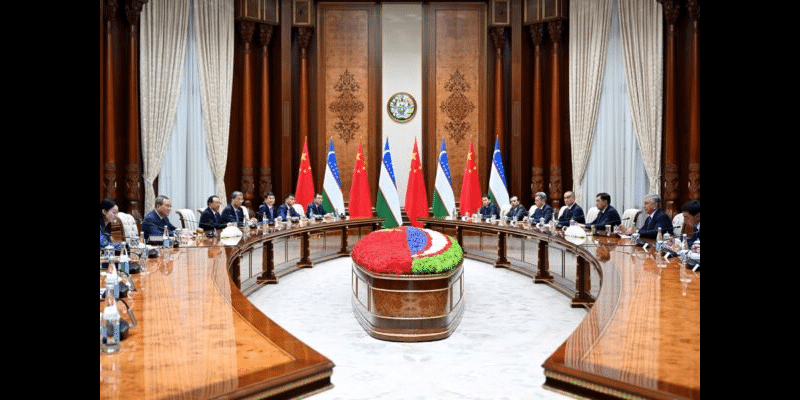
Kyrgyz President Sadyr Japarov and Uzbek President Shavkat Mirziyoyev met on July 30 on the shores of Kyrgyzstan’s Lake Issyk-Kul, in Cholpon Ata, to sign the Treaty on Allied Relations. It was much more than business as usual. In their press conference, the leaders largely set aside the diplomatic boilerplate and expressions of mutual approbation that usually attend such summits. Instead, the meeting focused on putting a decisive end to mutual Kyrgyz-Uzbek grievances and rivalry, opting for dialogue over confrontation, stability over tension, and partnership over the quest for primacy in their bilateral relationship. Without ceding any of their sovereignty, they stressed that teamwork and shared responsibility—not the pursuit of great-power patronage or one-upmanship—are the surest way to advance common interests. Japarov, like Mirziyoyev, made clear that strategic-level collaboration always trumps short-term transactional gains. One of the biggest takeaways from the Japarov–Mirziyoyev summit was the confident demeanor and optimism with which they spoke about the future of Kyrgyz-Uzbek relations. Veering from his scripted notes and speaking in Russian to the press, Mirziyoyev said: “What an atmosphere we have today [here in Kyrgyzstan]. Look at what we're doing today— we're making history. This alliance — all of this will remain in history forever and ever.” Friendship, mutual respect, and hard work will produce “dynamic development” and “steady economic growth,” leading to “the well-being of peoples.” Business Development and Ahead of Schedule Once dismissed as an engineer's pipedream or a financier's nightmare, Japarov and Mirziyoyev said they’re staying the course on building strategic connectivity, energy, and water infrastructure, singling out the China–Kyrgyzstan–Uzbekistan railway and the Kambarata-1 Hydropower Plant (HPP), projects that some considered unrealistic. The leaders made it plain that this railway will deliver huge benefits. As Mirziyoyev put it: "We will work together non-stop to develop trade and logistics infrastructure along this railway route." Beyond offering transit times faster than the northern routes, the China–Kyrgyzstan–Uzbekistan railway will boost tourism and bring Kyrgyzstan and Uzbekistan hundreds of millions of dollars in transit revenue. Most importantly, it will unlock untapped economic resources, fueling new jobs, businesses, and logistics hubs along the corridor. After the Japarov-Mirziyoyev meetings, The Times of Central Asia spoke with Akramjon Nematov, First Deputy Director of Uzbekistan's Institute for Strategic and Regional Studies. Having been on site, he noted that the numbers and progress on the ground speak louder than any words or communiqués: "Construction is active at 83 of 107 planned sites on the Kyrgyz line, with over 10,000 workers and 7,000 units of heavy machinery deployed. Crews are drilling 26 tunnels through the Tian Shan, with over 13.5 kilometers of the main tunnel already cut, while 38 of 50 bridges are underway. The pace is staggering. I've watched this railway move Kyrgyz-Uzbek relations from friction to cooperation – and I measure progress not in words, but in cubic meters of earth moved." China has committed to supplying most of the capital and engineering capacity.  The project carries a total capitalization of roughly $4.7 billion, structured as a $2.3...

Kazakhstan’s Role in Pax Silica After WAICO

Kazakhstan became the first Central Asian country to join the U.S.-led Pax Silica initiative. It also signed the agreement establishing China’s World Artificial Intelligence Cooperation Organization, or WAICO. That dual participation could now become consequential. Reuters reported on August 14 that the State Department had prepared an undated draft letter warning the 35 signatories of the U.S. AI Opportunity Statement that participation in Pax Silica could be incompatible with membership in competing initiatives. Kazakhstan is the only country presently known to have joined both frameworks. The draft could still change, and the State Department has not publicly adopted the position it contains. Kazakhstan’s decision to join both initiatives also reflects its long-standing multi-vector foreign policy. Astana has sought practical relations with competing powers rather than exclusive alignment with any one bloc, an approach its official foreign-policy concept describes as maintaining mutually beneficial relations with states and organizations of practical interest to Kazakhstan. Joining a U.S.-led supply-chain initiative and a China-led AI organization fits that pattern, although it also makes the question of compatibility more consequential. Washington’s concern is understandable. Pax Silica is intended to create trusted supply chains, strengthen investment security and protect sensitive technology and infrastructure from undue access or control. Membership is meant to represent more than attendance at another diplomatic forum. The question is what Kazakhstan has agreed to do through WAICO, how those commitments will be implemented, and whether they create competing expectations or affect specific Pax Silica projects. Kazakhstan’s Role in the Supply Chain Pax Silica spans the AI supply chain from energy and mineral processing to semiconductors, data centers and models. Kazakhstan also has ambitions in digital infrastructure and AI services, but its strongest existing capabilities relevant to Pax Silica are concentrated in energy, mineral production, selected processing and Eurasian connectivity. The framework is designed to combine the different industrial strengths of its participants rather than reproduce the entire technology chain in every country. Kazakhstan produced about 40% of the world’s mined uranium in 2025. Kazakh-origin material accounted for 28% of uranium delivered to U.S. civilian reactor operators that year, second only to Canada. Kazakhstan’s most immediate relevance is not semiconductor production, but its role as an energy, minerals and processing partner. Uranium is the clearest example, providing large-scale fuel supplies for the power systems on which expanding AI infrastructure depends. As TCA recently noted, Kazakhstan sits at the nexus of resources, processing capacity and connectivity, and its role extends beyond raw-material extraction. Ulba Metallurgical Plant produces uranium dioxide powders and nuclear-fuel pellets, along with beryllium, tantalum and niobium products. Kazakhstan also produces copper, titanium, silver, aluminum and zinc used across power, communications, aerospace and advanced manufacturing. Its position on the Middle Corridor also gives it a logistics role connecting Central Asian production with Caspian and European markets. Other contributions remain prospective. Eurasian Resources Group (ERG) plans a 15-tonne-a-year gallium facility backed by a long-term supply agreement with Mitsubishi, while a U.S.-supported tungsten project is moving forward with plans to mine and refine the...

Bukharan Jewelry: How an Uzbek Jeweler Is Preserving a Traditional Craft

In 2024, Uzbek jeweler Zokir Negmatov published a handbook of Bukharan jewelry making. Traditional Bukharan jewelry making left little technical documentation. Instead, its skills were transmitted largely through observation. "In jewelry making, much knowledge has traditionally been passed directly from master to apprentice," he explains. "For me it was important to preserve the tradition for future generations." A man in his mid-forties, Negmatov was born and trained in Bukhara and has nearly three decades of experience as a jeweler. His native city has been a center of gold and silver work for well over a millennium, and craftsmanship helped shape the city itself: as many as two hundred crafts are believed to have flourished here, with each neighborhood, or mahalla, tied to a particular one. At the center of the old town stands Toqi Zargaron, the Jewelers' Dome, a covered bazaar built in 1569–70 that once housed thirty-six jewelers' workshops and shops, where gold, precious stones, and coral were traded. It still stands, the largest of the surviving domes, and now sells spices and souvenirs. Across Uzbekistan, silver was the dominant metal, but Bukhara's jewelers were unusual in their preference for gold. The city lies in the Zarafshan oasis, named after the river whose Persian name means 'spreader of gold' and refers to gold-bearing sands in its upper reaches. By the nineteenth century, Bukhara ranked with Khiva, Samarkand, Karshi, and Kokand among Central Asia's principal jewelry centers, each with a recognizable style. A jeweler was a zargar, a Persian word that survives in the name of the dome. The trade was organized, with hierarchies, patron saints, and its own written texts: the risola, a pamphlet setting out the legend of how the craft's patron founded it and the prayers required of a craftsman. What those texts did not contain were the technical aspects of the craft: how to do the work. That knowledge was carried largely through the usta-shogird relationship. Usta, from the Persian ustad, means master and functions as a title; a man is addressed as Usta before his name. The shogird attaches himself to one master for years, works for little at the outset, and learns by being present at the bench. Negmatov's handbook is a different kind of text. Where the risola preserved the craft's spiritual charter, his book sets down the methodology. It arrives at a moment when Bukhara and the traditions of Uzbekistan are drawing interest not only from tourists but also from the broader world of art and culture. [caption id="attachment_54454" align="aligncenter" width="932"] Image courtesy of Zokir Negmatov[/caption] Family Traditions Zokir Negmatov grew up in a family where culture and tradition were central. His father was an educator. His mother, Gauhar Negmatova, was a master of zardozi, the gold embroidery for which Bukhara is equally known, creating figurative patterns and traditional ornament by hand in gold thread. "There were no professional jewelers in my family, but craftsmanship and traditional art were always highly valued," recounts Negmatov. "From childhood, I was surrounded by traditional ornament...