
• KGS/USD = 0.01144 0%
  • KZT/USD = 0.00212 0%
  • TJS/USD = 0.10432 -0.29%
  • UZS/USD = 0.00008 0%
  • TMT/USD = 0.28490 0%
  • KGS/USD = 0.01144 0%
  • KZT/USD = 0.00212 0%
  • TJS/USD = 0.10432 -0.29%
  • UZS/USD = 0.00008 0%
  • TMT/USD = 0.28490 0%
  • KGS/USD = 0.01144 0%
  • KZT/USD = 0.00212 0%
  • TJS/USD = 0.10432 -0.29%
  • UZS/USD = 0.00008 0%
  • TMT/USD = 0.28490 0%
  • KGS/USD = 0.01144 0%
  • KZT/USD = 0.00212 0%
  • TJS/USD = 0.10432 -0.29%
  • UZS/USD = 0.00008 0%
  • TMT/USD = 0.28490 0%
  • KGS/USD = 0.01144 0%
  • KZT/USD = 0.00212 0%
  • TJS/USD = 0.10432 -0.29%
  • UZS/USD = 0.00008 0%
  • TMT/USD = 0.28490 0%
  • KGS/USD = 0.01144 0%
  • KZT/USD = 0.00212 0%
  • TJS/USD = 0.10432 -0.29%
  • UZS/USD = 0.00008 0%
  • TMT/USD = 0.28490 0%
  • KGS/USD = 0.01144 0%
  • KZT/USD = 0.00212 0%
  • TJS/USD = 0.10432 -0.29%
  • UZS/USD = 0.00008 0%
  • TMT/USD = 0.28490 0%
  • KGS/USD = 0.01144 0%
  • KZT/USD = 0.00212 0%
  • TJS/USD = 0.10432 -0.29%
  • UZS/USD = 0.00008 0%
  • TMT/USD = 0.28490 0%

Viewing results 595 - 600 of 1904

Kazakhstan, Turkmenistan, Russia, and Iran to Boost Cargo Transport Along North-South Corridor

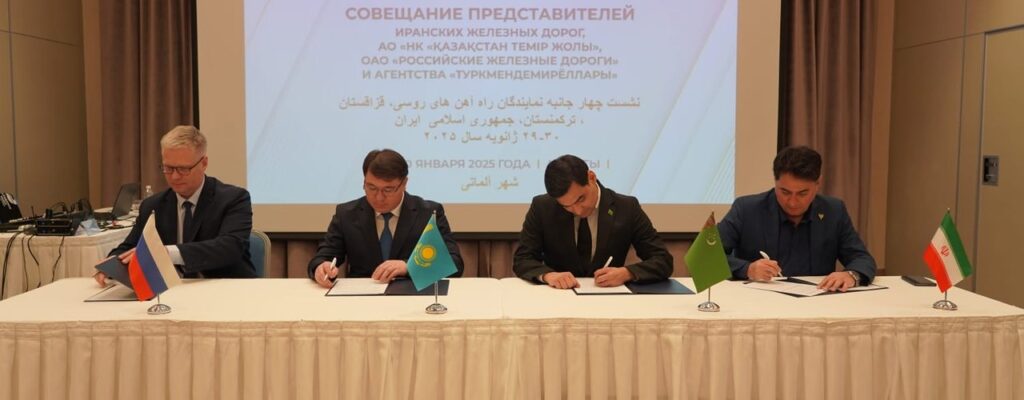
Kazakhstan, Turkmenistan, Russia, and Iran have reaffirmed their commitment to increasing cargo transportation along the North-South transport corridor. Representatives of national railway companies from the four countries met on January 30 in Almaty to discuss ways to enhance the corridor’s attractiveness and establish favorable end-to-end tariffs for shipments passing through Russia, Kazakhstan, and Turkmenistan to Iran’s Bandar Abbas port. According to Kazakhstan Temir Zholy (KTZ), the country’s national railway company, the meeting also addressed cargo transportation across Kazakhstan, particularly through the Bolashak rail station, located on the border between Kazakhstan and Turkmenistan. In 2024, 1.6 million tons of cargo was transported via this station. The North-South corridor, linking Russia, Kazakhstan, Turkmenistan, and Iran, has an annual capacity of 10 million tons of cargo. In July 2024, Kazakhstan hosted its first international meeting on the North-South transit and trade corridor, bringing together delegations from Azerbaijan, Armenia, Afghanistan, Kazakhstan, Russia, Belarus, Turkmenistan, the UAE, Iran, Iraq, Oman, and Uzbekistan. During that meeting, Kazakhstan, Iran, Turkmenistan, and Russia signed a roadmap for the eastern route of the corridor. The plan aims to expand the corridor’s capacity to 15 million tons annually by 2027 and 20 million tons by 2030. By connecting Russia and Belarus to Iran’s Persian Gulf ports, with further access to India, the North-South corridor is expected to enhance trade opportunities and further solidify Kazakhstan’s role as a key transit hub in the region.

Kazakhstan Secures 11 Billion Cubic Meters of Irrigation Water from Central Asian Neighbors

Kazakhstan will receive 11 billion cubic meters of irrigation water by April 2025 under an agreement reached in Dushanbe at a meeting of the Interstate Water Management Coordination Commission of Central Asia. The meeting brought together water management officials from Kazakhstan, Uzbekistan, Tajikistan, and Turkmenistan. Discussions focused on managing water resources in the Syr Darya and Amu Darya River basins. The allocated volume will flow into the Shardara Reservoir in Kazakhstan’s Turkestan region via the Syr Darya River. Of this total, 1.6 billion cubic meters will be directed to the Aral Sea to support its ecosystem. Kazakhstan’s Minister of Water Resources and Irrigation, Nurzhan Nurzhigitov, stated that the agreement will help the country secure sufficient irrigation water for the upcoming agricultural season while sustaining ecosystems in southern Kazakhstan. Nurzhigitov highlighted the stark contrast between the south and other parts of the country: “There are no large-scale floods in the south as there are in the west and north. In the summer, the demand for irrigation water is extremely high. That’s why we take a different approach to water management in the south, where water diplomacy is a priority. Through negotiations, we ensured an uninterrupted water supply to the region last year. We continue to resolve water distribution and transboundary water protection issues in cooperation with our Central Asian colleagues.” Kazakhstan’s agriculture, particularly in its arid southern regions, depends heavily on irrigation water from upstream Central Asian neighbors. As a result, regional water management remains a crucial factor in both economic and political relations among the countries of Central Asia.

Afghanistan Advances TAPI Gas Pipeline Construction as Kazakhstan Explores Participation

Afghanistan has made significant progress in constructing the Turkmenistan-Afghanistan-Pakistan-India (TAPI) gas pipeline. According to Ariana News, citing the Herat provincial governor’s office, approximately six kilometers of pipeline have already been laid since work began last month. Herat Governor Maulana Islam Jar assured project representatives of his full support, stating that TAPI will play a crucial role in strengthening the economy and promoting regional stability. Afghanistan's section of the pipeline is expected to take approximately two years to complete and represents a significant milestone for the broader project. TAPI is designed to connect Central Asia’s vast gas reserves with the rapidly growing energy markets of South Asia. During a recent meeting, TAPI’s general director in Afghanistan, Abdullah Yoof, updated Governor Jar on construction progress and outlined further plans for the project, including job creation and infrastructure development in Herat province. Meanwhile, Kazakhstan is actively exploring the possibility of joining the TAPI pipeline. The country’s Ministry of Energy has confirmed ongoing negotiations between the national gas company, QazaqGaz, and Turkmengaz, which owns an 85% stake in TAPI Pipeline Company Limited. However, officials have refrained from disclosing details, citing the confidentiality of the discussions. Kazakhstan’s interest in the project was first officially announced by Deputy Energy Minister Yerlan Akkenzhanov. Speaking at the Kazakhstan-Afghanistan Business Forum in October 2024, he highlighted that participation in TAPI could provide Kazakhstan with access to new markets, including Pakistan and India while attracting additional investment to the country’s gas sector. The TAPI pipeline, spanning over 1,800 kilometers, will traverse: Turkmenistan – 214 kilometers Afghanistan – 774 kilometers Pakistan – 826 kilometers The pipeline will terminate in India, providing a crucial energy link between Central and South Asia.

Kazakhstan Trains a Thousand Specialists for Future Nuclear Power Plants

Six universities in Kazakhstan are currently training personnel for the nuclear and atomic industries. According to Gulzhan Dzharasova, Deputy Chairman of the Committee of Higher and Postgraduate Education at the Ministry of Science, approximately 1,000 students are pursuing engineering degrees related to the nuclear sector. Kazakhstan’s decision to build its first nuclear power plant (NPP) was made last fall following a referendum, in which more than 70% of the population voted in favor of nuclear energy. The first plant is set to be built in the Almaty region and is expected to be operational by 2035, as the country anticipates an energy shortage by that time. The plant will require a workforce of at least 2,000 employees, and the Ministry of Energy aims to train specialists domestically to meet this demand. To support this initiative, local colleges will introduce training programs for key technical roles, including dosimetrists, steam turbine equipment repair specialists, nuclear power plant maintenance and mechanical repair specialists, and IT professionals specializing in nuclear energy. Currently, 921 students are enrolled in nuclear engineering programs at Kazakhstan’s higher education institutions, with nearly all (96%) receiving government-funded scholarships. “As part of a strategic partnership in this field, branches of leading foreign universities are being established. The National Research Nuclear University has been created at the Kazakh National University (KazNU). Additionally, a consortium of German technical universities has launched a new training format for engineers in the electric power industry. In 2024, a branch of Anhalt University opened at the Almaty University of Power Engineering and Communications, where specialists in electrical and power engineering are being trained,” Dzharasova said. Kazakhstan’s Growing Need for Nuclear Energy Experts Kazakhstan’s Minister of Energy, Almasadam Satkaliyev, addressed concerns about the demand for nuclear energy specialists. He stated that the country will need at least three nuclear power plants, which would require a workforce of 5,000 to 6,000 trained professionals. “The sites for all three plants will be selected based on a comprehensive plan. It is not feasible to plan one station first and then another separately. We must first analyze the network configuration, power distribution schemes, cross-border energy flows, grid voltage levels, the necessary number of substations, and the feasibility of using direct current (DC) technology for long-distance transmission,” Satkaliyev explained. Accelerating Nuclear Power Plant Construction At a recent briefing, Satkaliyev also stated that the first nuclear power plant unit in Kazakhstan could be completed within eight years. “Even considering the average global timeline for such projects, we will push vendors to explore the possibility of expediting construction so that we can have the first unit operational within eight years,” he said. The Times of Central Asia previously reported that Kazakhstan plans to select a contractor for the construction of its first nuclear power plant in the first half of this year.

Kazakhstan Reports Record Grain Harvest of 26.7 Million Tons in 2024

Kazakhstan harvested 26.7 million tons of grain in 2024, marking its largest grain yield in 13 years, according to the Ministry of Agriculture. The latest figures, published on January 29, slightly revise the previously reported total of 26.5 million tons, gathered from 16.7 million hectares of farmland. Kazakhstan is the largest grain producer and exporter in Central Asia, annually shipping 8 to 9 million tons of grain abroad, including 6.5 to 7.5 million tons of wheat. In 2024, exports reached 8.1 million tons. For the 2025 season, Kazakhstan aims to export approximately 12 million tons of newly harvested grain. While traditional markets such as Central Asia, Afghanistan, China, Turkey, and Italy remain key destinations, Kazakhstan is also expanding into Azerbaijan, Iran, Pakistan, Indonesia, Brazil, and Malaysia. Kazakhstan has already begun exporting grain from the new harvest, with 3.7 million tons shipped between September and December 25, 2024 - a 54% increase compared to the same period in 2023.

Kazakhstan Bans Export of Gasoline and Diesel Fuel

Kazakhstan has officially banned the export of gasoline and diesel fuel by road and rail, according to a government decision that came into effect on January 29, 2025. The restriction is outlined in amendments to the joint order “On Some Issues of Export of Oil Products from the Territory of the Republic of Kazakhstan,” which were approved by the Minister of Energy, the Chairman of the National Security Committee (KNB), and the Ministers of Finance and Internal Affairs. Scope of the Ban and Exceptions Under the new regulations, the export of petroleum products - including to member states of the Eurasian Economic Union (EAEU) - is prohibited via road transportation. "Introduce a ban on the export of gasoline, diesel fuel, and certain types of petroleum products from the territory of the Republic of Kazakhstan, including to the EAEU member states, by road transport," the official statement reads. However, the government has outlined several exceptions: Lubricating oils may still be exported. Fuel contained in vehicle gasoline tanks is permitted for export, provided it meets factory specifications. Aviation fuel may be exported for scientific research, additive testing, laboratory studies, and industrial production, subject to government approval. Petroleum products designated for humanitarian aid are exempt from the ban during the period from September 29, 2024, to March 29, 2025. In addition to road transport, railway exports are also restricted, with limited exceptions. Gasoline exports within the framework of state-approved plans, as well as fuel deliveries for humanitarian aid and disaster relief efforts, will be permitted between February 1 and March 29. Government’s Rationale for the Ban The Ministry of Energy stated that the new restrictions aim to prevent fuel shortages in the domestic market. The move comes amid discussions about phasing out state regulation of fuel prices. As The Times of Central Asia previously reported, the Kazakh government is considering a gradual liberalization of gasoline and diesel fuel prices to reduce price disparities with neighboring countries and curb the illegal export of fuel and lubricants.
