• KGS/USD = 0.01144 0%
  • KZT/USD = 0.00198 -0%
  • TJS/USD = 0.10901 0%
  • UZS/USD = 0.00008 0%
  • TMT/USD = 0.28490 0%
  • KGS/USD = 0.01144 0%
  • KZT/USD = 0.00198 -0%
  • TJS/USD = 0.10901 0%
  • UZS/USD = 0.00008 0%
  • TMT/USD = 0.28490 0%
  • KGS/USD = 0.01144 0%
  • KZT/USD = 0.00198 -0%
  • TJS/USD = 0.10901 0%
  • UZS/USD = 0.00008 0%
  • TMT/USD = 0.28490 0%
  • KGS/USD = 0.01144 0%
  • KZT/USD = 0.00198 -0%
  • TJS/USD = 0.10901 0%
  • UZS/USD = 0.00008 0%
  • TMT/USD = 0.28490 0%
  • KGS/USD = 0.01144 0%
  • KZT/USD = 0.00198 -0%
  • TJS/USD = 0.10901 0%
  • UZS/USD = 0.00008 0%
  • TMT/USD = 0.28490 0%
  • KGS/USD = 0.01144 0%
  • KZT/USD = 0.00198 -0%
  • TJS/USD = 0.10901 0%
  • UZS/USD = 0.00008 0%
  • TMT/USD = 0.28490 0%
  • KGS/USD = 0.01144 0%
  • KZT/USD = 0.00198 -0%
  • TJS/USD = 0.10901 0%
  • UZS/USD = 0.00008 0%
  • TMT/USD = 0.28490 0%
  • KGS/USD = 0.01144 0%
  • KZT/USD = 0.00198 -0%
  • TJS/USD = 0.10901 0%
  • UZS/USD = 0.00008 0%
  • TMT/USD = 0.28490 0%
08 December 2025

Viewing results 751 - 756 of 1312

Ethnic Kazakhs Continue To Return to Kazakhstan

In 2024, a total of 12,325 ethnic Kazakhs returned to their ancestral homeland, gaining the status of "Kandas," a term for ethnic Kazakhs and/or members of their families of Kazakh nationality who have not previously held citizenship of the Republic of Kazakhstan. Since independence, Kazakhstan has welcomed 1.14 million returnees. This year, 45.6% of the arrivals came from China, 39.2% from Uzbekistan, and the remainder almost exclusively from Turkmenistan, Mongolia, and Russia. As of September 1, 2024, the majority of these individuals are working-age adults (58.2%) with higher or secondary education. Many have secured employment and received support for resettlement in labor-deficient regions, such as Akmola and Kostanay. Kazakhstan actively supports these returnees with relocation subsidies of 258,400 tenge ($540) per family member, and offers housing and utility subsidies for a year. Economic mobility programs also provide assistance towards purchasing housing and obtaining favorable mortgage rates. Furthermore, the process to obtain Kandas status has been streamlined, allowing applications through Kazakhstani embassies without the need to enter the country. This pilot program, started in 2023, has already processed 17,158 applications. Since 2020, the term "Kandas," meaning "tribesman" or "one-brother," has replaced "Oralman," reflecting a more positive and respectful connotation. This change is part of a broader effort to simplify citizenship processes for returnees, offering access to residency and citizenship through streamlined procedures, boosting the nation's labor potential and economic growth.
Crew of Record-Breaking Cosmonauts Land in Kazakh Steppe

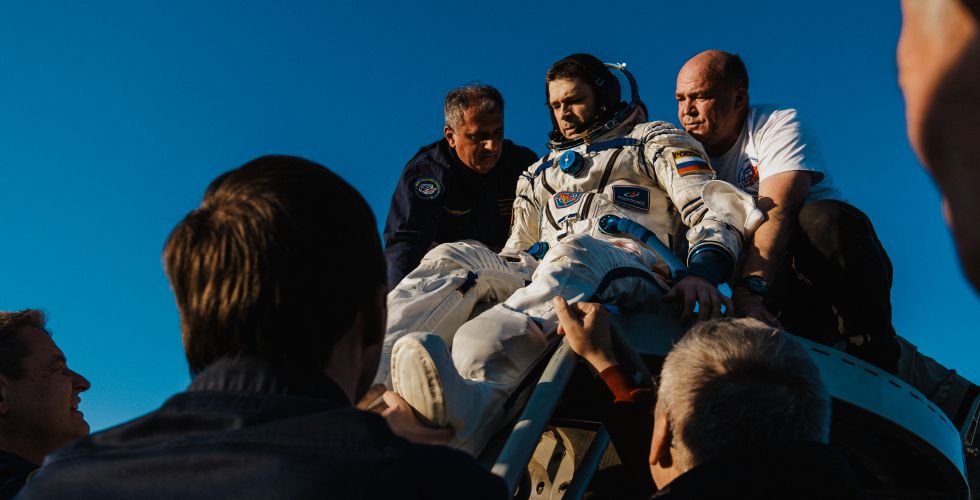
The descent vehicle of the Soyuz MS-25 spacecraft has successfully landed in the steppe of Kazakhstan, near the town of Zhezkazgan. Russian cosmonauts Oleg Kononenko, Nikolai Chub, and NASA astronaut Tracy Dyson were on board. Cosmonauts Kononenko and Chub spent 374 days in space, making their mission one of the longest in International Space Station (ISS) history. This is second only to the flights of Valery Polyakov and Sergey Avdeev, who spent 438 and 380 days in space, respectively, on the Mir station. Tracy Dyson stayed in orbit for 184 days. During their mission, Kononenko and Chub participated in several scientific experiments, took four Progress MS cargo ships, and conducted two spacewalks. The flight was an important contribution to the development of applied and fundamental research on the ISS. The spacecraft landed yesterday at 14:59, Moscow time. Kononenko and Chub's flight was a significant event for the space programs of Roscosmos and NASA. Despite completing their mission, the crew of the 72nd long-duration expedition, including Russian and American cosmonauts and astronauts, continues to work on the ISS. The station crew includes Roscosmos cosmonauts Alexei Ovchinin, Ivan Wagner, and Alexander Grebenkin, and NASA astronauts Donald Pettit, Matthew Dominick, Michael Barratt, Jeanette Epps, Barry Wilmore, and Sunita Williams. The International Space Station (ISS) is one of mankind's most impressive engineering projects. It was launched in 1998, and is the product of 16 countries. The station revolves around the Earth every 90 minutes, allowing the crew to observe 16 sunrises and sunsets daily. In addition, the ISS is the largest object ever built in space, measuring about 109 meters long. The ISS is also considered the most expensive object built by humans, costing an estimated $120 billion by 2014, alone. According to NASA, the ISS "costs about $3 billion a year, roughly a third of NASA’s annual human space flight budget."

From Test Sites to Power Plants: Kazakhstan’s Journey Towards a Nuclear Referendum

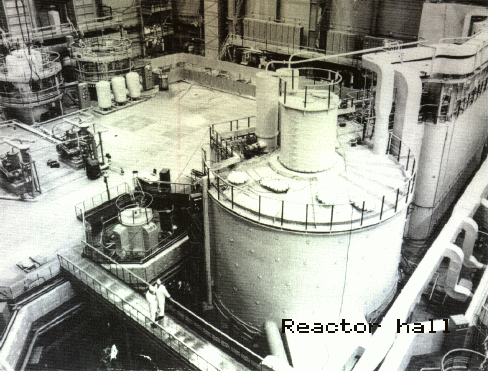
The history of nuclear power in Kazakhstan has many chapters: the arms race, the suffering of people due to test sites, the highest achievements in the name of science, and the service of the nuclear industry for the benefit of society are closely intertwined here. On the eve of the referendum on Kazakhstan's first atomic power plant, it is necessary to revisit these pages in history.   A dark past Construction of the Semipalatinsk nuclear test site began in the Kazakh Soviet Socialist Republic in 1947. The test site is located on the border of the Semipalatinsk (now Abay), Pavlodar, and Karaganda regions, 130 kilometers northwest of Semipalatinsk (now Semey), on the left bank of the Irtysh River. On its territory is the previously closed city of Kurchatov, renamed as such in honor of Soviet-era physicist, Igor Kurchatov. The first nuclear weapons test held in the Soviet Union was conducted at this site on August 29, 1949. The power of the bomb totaled 22 kilotons. From 1949 to 1989, at least 468 nuclear tests were conducted at the Semipalatinsk nuclear test site. The long-term operation of this site and its negative impact on residents' health and the surrounding environment help to explain the fear of nuclear energy in Kazakhstan. Two million people were affected across 300 square kilometers; with all agriculture banned, a vast swathe of land still remains off-limits. Pregnancies are still screened for possible termination, with 6% of babies born “polygon” (the name for the "closed zone".) [caption id="attachment_23475" align="aligncenter" width="1200"] Polygon baby, National Museum of Kazakhstan, Astana; image: TCA, Stephen M. Bland[/caption]   Shutdowns and shortages On August 29, 1991, Kazakhstan's first president, Nursultan Nazarbayev, closed the Semipalatinsk test site. Prior to this, citizens had held rallies protesting against nuclear testing and its development. By 1994, Kazakhstan had voluntarily relinquished its part of the USSR's nuclear arsenal. On May 15, 1992, the National Nuclear Center in the city of Kurchatov was established based on the complex of the former Semipalatinsk test site. The Center deals with eliminating the consequences of nuclear tests and also conducts active and multidisciplinary scientific activities on the remaining research reactors in Kurchatov. Scientific research occurs internationally and touches upon safety technologies, the space program, and more. In 1957, the Institute of Nuclear Physics of the Kazakh SSR Academy of Sciences was founded near Almaty (then Alma-Ata), where the VVR-K reactor, which is still operating today, was launched in 1967. The reactor was shut down in the late 1980s after the Chernobyl disaster and the earthquake in Spitak (Armenia); it was restarted in 1997, and the complex underwent safety and seismic reinforcement modernization. The Institute owns eight experimental facilities: the VVR-K research reactor, a "Критический стенд" lit. "critical stand," and six charged particle gas pedal complexes. In 1972, a unique fast neutron reactor BN-350 was launched in Aktau (then Shevchenko) at the Mangistau Atomic Energy Combine (MAEC). The reactor provided the Mangistau Peninsula with electricity and heat, and supported the operation of desalination plants...

The First-Ever Audio Recording of Kazakh Music

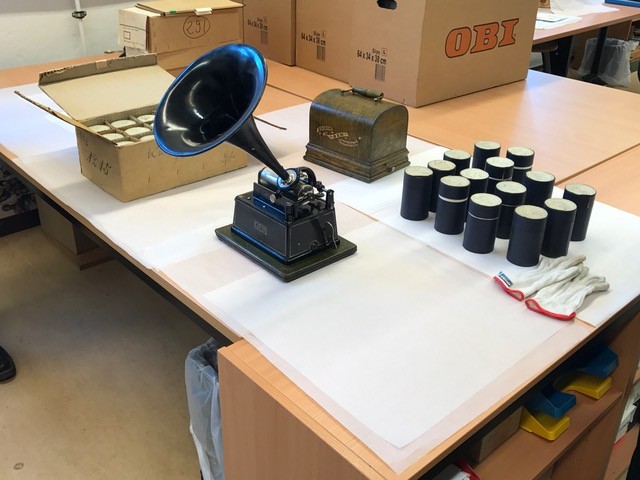
It was long believed that the world's first audio recording of Kazakh music was made in 1925 during the performance of singer, Amre Kashaubaev, at the Exposition Internationale des Arts Decoratifs et Industriels Modernes in France. However, the Berlin Museum of Visual Anthropology and Ethnology has recordings of Kazakh folk music, voices, and ritual chants, which were made in western Kazakhstan twenty years earlier. These recordings were made during the Acoustic Era, when sound waves were still recorded through analog methods. In 1857, Frenchman, Édouard-Léon Scott de Martinville invented the so-called phonautograph. Three years later, the world's first song was recorded. It was a French folk song, “By the Light of the Moon”. In 1877, Thomas Edison invented the phonograph. This invention could both record and playback audio and marked the start of the Acoustic Era. Later, in 1900, Carl Stumpf, a professor of psychology at the University of Berlin, established a phonogram archive in Berlin, where, at the same time, an orchestra from Thailand was touring. Stumpf recorded the Thai music, which was considered exotic to Europeans at that time. This recording became the first in the rich Ethnomusicology collection of the Ethnological Museum of Berlin. These recordings were originally discovered at the Institute of Russian Literature, also known as Pushkin House, which is part of the network that is affiliated with the Russian Academy of Sciences. Dr. Efim Rezvan, a well-known scholar of Turkology, showed the TCA team the wax rollers - cylindrical wax containers that can be played using Edison's phonograph. The first-ever audio recordings of Kazakh music were made using these devices. The German scientist Richard Karutz recorded them in the early 20th century when he organized an expedition to the steppes of Turkestan. As a result of his expedition, he wrote a book called Among the Kirghiz and Turkmens in Mangyshlak. During his expedition, Karutz took many photos and collected audio recordings of the local peoples' art. In addition to his scientific research, Karutz pursued other goals; for instance, he wrote about the health benefits of tea, which the locals consumed in large quantities. He claimed that drinking tea in large quantities when the air temperature was over 40 degrees Celsius helped them to bear the heat. Karutz wrote that, “It is necessary for our troops to weigh the importance of tea consumption during summer maneuvers and campaigns.” Richard Karutz was born into a mercantile family. In 1886, he went to study medicine at the University of Jena 1891. Completing his studies and receiving his doctorate in 1891, he then worked as a doctor aboard a ship. Whilst on working as a surgeon on a ship, Karutz traveled to South America and West Africa. After these trips, Karutz became interested in ethnography. In 1896, he was appointed head of the ethnographic collection of the Museum of Ethnology in Lübeck. Karutz enriched the museum's collection with artifacts from his travels, and encouraged other merchants and travelers to bring items from other countries for the collection. The...

Tokayev Gets Pundits Talking with “Invincible” Russia Remark

Carl von Clausewitz, the Prussian military theorist, described war as “the realm of uncertainty.” So, is Russia militarily invincible? Kazakh President Kassym-Jomart Tokayev´s emphatic statement earlier this week that Russia can’t be defeated on the battlefield had analysts, observers and history buffs musing about whether the proposition is actually true, and what if any politics were behind the widely reported remark. Tokayev made the point in a conversation with visiting German Chancellor Olaf Scholz as part of a general argument for peace more than two years after Russia’s full-scale invasion of Western-backed Ukraine. The official English-language translation of Tokayev’s comment didn’t include “invincible,” but basically said the same thing: “It is a fact that Russia cannot be defeated militarily.” For some people, the remark was a blunt assessment of a grinding conflict that, according to a report this week in The Wall Street Journal, has killed and injured about one million Russians and Ukrainians. For others, it amounted to a kind of pro-Russian defeatism, even though Kazakhstan and other Central Asian countries have angled for neutrality, not endorsing the invasion but maintaining traditional ties with Moscow. Roland Kater, an analyst and former commander in the Germany military, said he agreed – with caveats - with Tokayev’s assessment that Russia was militarily invincible. “With regard to the war in Ukraine, I would say yes at the moment, under the given conditions,” Kater said on Germany’s Welt news channel. He noted that NATO, which supports Ukraine won’t enter the war “as an institution.” “The result is that Ukraine cannot actually win this war at the moment and that the Russians there are, I don’t want to say unbeatable, but they are in the lead,” Kater said. Russia earned a reputation for resilience in past wars, after initial setbacks on its own territory and at great cost. It prevailed over Charles XII at the Battle of Poltava in 1709 after the Swedish king’s invasion of Russia; prevailed over Napoleon during the disastrous 1812 invasion in which the French emperor seized Moscow but was forced to retreat as disease, harsh weather and other problems took a toll; and prevailed over Adolf Hitler when the German invasion of the Soviet Union in 1941 eventually faltered with massive casualties on both sides. Still, the Washington-based Central Asia Consulting group, a critic of Russia, said there was no basis for Tokayev’s comment about Russia’s military invincibility and made some unflattering historical references. “Russia has faced defeats in the past wars (Crimean War, Russo-Japanese War, WWI, Winter War, Afghanistan, First Chechen War, Tajikistan War),” the group said on X. In his remarks, Tokayev also said “further escalation of the war will lead to irreversible consequences” for humanity, in what appeared to be a message for the West since he was in the company of Scholz when he said it. Scholz agreed that peace was the best option but that Russia could end the war anytime by stopping its aggression. Ukrainian President Volodymyr Zelenskyy, meanwhile, is expected to present what...

Redefining Diplomacy: Kazakhstan’s Strategic Shift in Relations With Afghanistan

On September 9, 2024, President Kassym-Jomart Tokayev signed a decree dismissing Alimkhan Yesengeldiyev from the position of Kazakhstan's Ambassador to Afghanistan. Yesengeldiyev has been at the post since April 2018. Local media have not yet reported on the appointment of a new ambassador. Previously, Astana has made bold diplomatic steps towards normalizing relations with Afghanistan under Taliban rule. For instance, Kazakhstan accredited Taliban diplomats in April 2023, and removed the Taliban from its list of banned organizations in December 2023. On August 21 of this year, Kazakhstan accredited the head of the Afghan diplomatic mission as charge d'affaires in the country. Astana continues to increase trade, economic, and humanitarian cooperation with the de facto authorities, and has actively engaged in various international platforms for initiatives in Afghanistan. Moreover, President Tokayev outlined Kazakhstan's position on the situation in Afghanistan just a month after the Taliban seized Kabul, when the world was still in shock. “Kazakhstan sees the future Afghanistan as a truly independent and united state living in peace with itself and its neighbors," he stated. "At this crucial historical moment, the multinational people of Afghanistan should not be left alone in the face of unprecedented difficulties.” By changing the head of its diplomatic mission in Kabul, it appears that the authorities in Kazakhstan intend to qualitatively improve the state of their relations with the Taliban. The eventual appointment of a new head of the Kazakh embassy will symbolize a new page in relations. In all likelihood, according to recognized international practice, a diplomat will be presented to the Taliban not in the rank of Ambassador Extraordinary and Plenipotentiary but as the Charge d'Affaires of Kazakhstan. This will preserve the principle of parity and be understandable given international disputes surrounding recognition of the Taliban. Overall, Kazakhstan's foreign policy steps have always been characterized by consistency and an unwavering focus on international law. It seems that the world as a whole is now acclimatizing to the idea of pragmatic dialog with the authorities in Kabul, with whom it is necessary to maintain constant bilateral and multilateral diplomatic contacts. On September 27, at the official request of the British government, the embassy of the former Islamic Republic of Afghanistan in London will officially cease operations. The embassy building will not be handed over to the Taliban or any other political representation. The embassy in Oslo representing the former government in Afghanistan has also ceased functions since September 12 at the request of the authorities there. Neither the British nor the Norwegian authorities are currently commenting on the situation. A few days ago, Deutsche Welle reported that the German Foreign Ministry has accepted the Taliban's application to recognize their consulate general in Munich as the sole center for providing consular services in Germany. In July, the Taliban Foreign Ministry declared that documents issued by 14 Afghan missions abroad are illegitimate. They were located in Britain, Berlin and Bonn in Germany, Belgium, Switzerland, Austria, France, Italy, Greece, Poland, Australia, Sweden, Canada, and Norway. Currently, the...