• KGS/USD = 0.01144 0%
  • KZT/USD = 0.00212 0%
  • TJS/USD = 0.10456 0%
  • UZS/USD = 0.00008 0%
  • TMT/USD = 0.28490 0%
  • KGS/USD = 0.01144 0%
  • KZT/USD = 0.00212 0%
  • TJS/USD = 0.10456 0%
  • UZS/USD = 0.00008 0%
  • TMT/USD = 0.28490 0%
  • KGS/USD = 0.01144 0%
  • KZT/USD = 0.00212 0%
  • TJS/USD = 0.10456 0%
  • UZS/USD = 0.00008 0%
  • TMT/USD = 0.28490 0%
  • KGS/USD = 0.01144 0%
  • KZT/USD = 0.00212 0%
  • TJS/USD = 0.10456 0%
  • UZS/USD = 0.00008 0%
  • TMT/USD = 0.28490 0%
  • KGS/USD = 0.01144 0%
  • KZT/USD = 0.00212 0%
  • TJS/USD = 0.10456 0%
  • UZS/USD = 0.00008 0%
  • TMT/USD = 0.28490 0%
  • KGS/USD = 0.01144 0%
  • KZT/USD = 0.00212 0%
  • TJS/USD = 0.10456 0%
  • UZS/USD = 0.00008 0%
  • TMT/USD = 0.28490 0%
  • KGS/USD = 0.01144 0%
  • KZT/USD = 0.00212 0%
  • TJS/USD = 0.10456 0%
  • UZS/USD = 0.00008 0%
  • TMT/USD = 0.28490 0%
  • KGS/USD = 0.01144 0%
  • KZT/USD = 0.00212 0%
  • TJS/USD = 0.10456 0%
  • UZS/USD = 0.00008 0%
  • TMT/USD = 0.28490 0%

Viewing results 289 - 294 of 2007

World Happiness Index: Central Asian Countries Stand Out With “Warm Social Climate”

Kazakhstan has been named the happiest country in Central Asia, according to the World Happiness Report 2025 published by the Oxford Wellbeing Centre. Ranking 43rd globally, Kazakhstan outperformed its regional neighbors in metrics such as social support, trust, and freedom of choice.  The report evaluates national well-being based on six key indicators: GDP per capita Social support (help from family, friends, and society) Healthy life expectancy Freedom to make life choices Generosity (willingness to help others) Perceived absence of corruption Kazakhstan scored 6.38 out of 10, demonstrating especially strong performance in trust and honesty. The country ranked 30th globally for the likelihood of returning a wallet to a neighbor and 42nd for returning it to a stranger. Uzbekistan followed at 53rd place with a score of 6.2. The country stood out for its high levels of charitable giving (29th) and public trust in law enforcement (19th). Kyrgyzstan ranked 75th with 5.9 points and was recognized as the regional leader in helping strangers. Tajikistan placed 90th with a score of 5.4 but made the global top four in volunteering, an indicator linked to longstanding traditions of mutual aid. Turkmenistan was excluded from the ranking due to insufficient data. The report highlights that Central Asian countries exhibit some of the world’s highest levels of kindness. The region's mutual aid index ranges from 0.30 to 0.36, compared to the global average of 0.33. “Despite economic differences, the region maintains strong social ties and a culture of collectivism, where helping others and participating in community life remain important values,” the report notes. According to the authors, happiness is influenced less by income than by trust, stability, and personal freedom. Central Asia, they conclude, fosters a “warm social climate,” where interpersonal kindness often offsets institutional shortcomings and economic hardship. Globally, Finland topped the 2025 rankings, followed by Denmark, Iceland, Sweden, and the Netherlands. At the bottom of the list were Sierra Leone (146th) and Afghanistan (147th), where happiness levels remain the lowest worldwide.
U.S. Envoys Hail Stronger Kazakhstan Partnership Ahead of C5+1 Summit

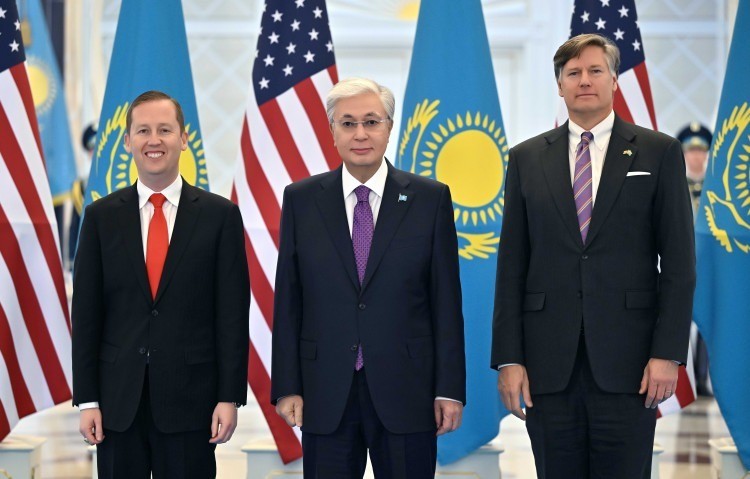
On October 29, Unites States Special Envoy for South and Central Asia Sergio Gor and Deputy Secretary of State Christopher Landau concluded their visit to Kazakhstan ahead of the upcoming C5+1 summit in Washington. During their trip, the U.S. envoys met with President Kassym-Jomart Tokayev and held discussions with representatives of Kazakhstan’s government and business community, which they described as highly productive. “We are concluding a memorable trip to Kazakhstan in the beautiful capital, Astana, which did not even exist 30 years ago and now boasts a population of more than 1.5 million,” Landau posted on social media. He also stated that bilateral relations between the U.S. and Kazakhstan “have never been so strong” and expressed gratitude for the hospitality.  Gor and Landau held talks with Prime Minister Olzhas Bektenov and key cabinet members, including Minister of Trade and Integration Arman Shakkaliev, Minister of Energy Yerlan Akkenzhenov, Minister of Transport Nurlan Sauranbayev, and Deputy Prime Minister and Minister of National Economy Serik Zhumangarin, to discuss Kazakhstan’s economic priorities and areas for expanding bilateral cooperation. According to the Kazakh government, the talks focused on expanding trade and investment cooperation between the two countries. Priority areas included transport and logistics, energy, agriculture, the digital economy, and artificial intelligence. During their visit, the U.S. envoys also met with Deputy Prime Minister Murat Nurtleu, who reaffirmed Kazakhstan’s readiness to cooperate on sustainable development and energy security. The meetings demonstrated Kazakhstan’s active engagement with the United States in the lead-up to the upcoming Central Asia–U.S. summit. Deputy Prime Minister and Minister of National Economy Serik Zhumangarin, who highlighted Kazakhstan’s economic strengths during talks with Gor and Landau, had recently returned from a high-level visit to the United States. His delegation, which included Deputy Head of the Presidential Administration Erbolat Dossaev and Chairperson of the Agency for Regulation and Development of the Financial Market Madina Abylkasymova, held meetings in New York and Washington with American business leaders and members of Congress. During the visit, the Kazakh delegation presented the country’s economic growth strategy, highlighted ongoing GDP expansion, and discussed the potential listing of government securities on the New York Stock Exchange. They also raised the possible repeal of the Jackson–Vanik Amendment, a long-standing priority for Kazakhstan’s diplomatic agenda. Against this backdrop, the White House’s decision to convene a summit between President Donald Trump and the leaders of the Central Asian republics may partly reflect Kazakhstan’s sustained diplomatic outreach. In that context, Gor and Landau’s remarks of appreciation as they departed Astana underscored recognition of Kazakhstan’s role in shaping this evolving partnership.

U.S. Envoys Experience Kazakhstan’s Living Nomadic Traditions

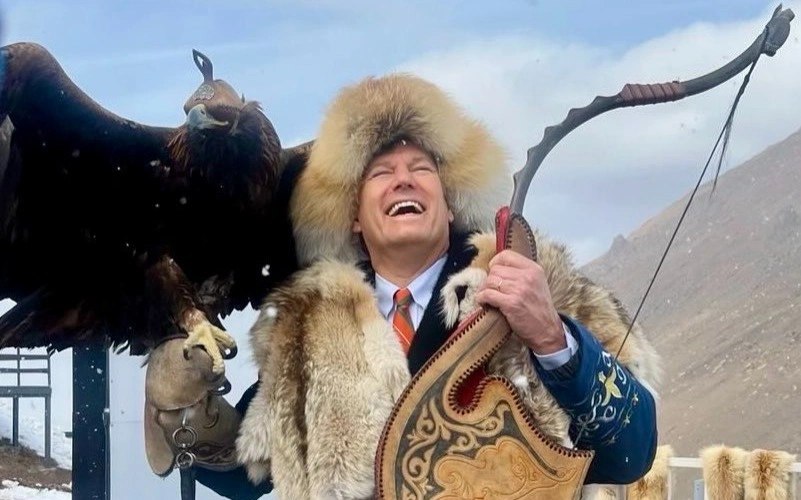
U.S. Special Representative for South and Central Asia Sergio Gor and Deputy Secretary of State Christopher Landau recently visited Kazakhstan as part of preparations for the upcoming C5+1 summit. While official releases highlighted meetings on regional cooperation and stability, local media also noted cultural engagements showcasing Kazakhstan’s living nomadic traditions. While in Almaty, the U.S. delegation also toured the Shymbulak ski resort and the Medeu high-altitude skating rink. Amidst the picturesque alpine scenery, they participated in traditional archery, an enduring symbol of the nomadic peoples’ skill and heritage. Archery: A Living Legacy Traditional archery, known as sadak atu, is experiencing a revival in Kazakhstan. As in the past, both boys and girls train in the discipline, a tradition rooted in the realities of steppe life, where women were equally taught to hunt and defend their communities. Far more than a sport, archery reflects a nomadic philosophy. In ancient times, the bow served both as a hunting tool and a weapon of war, requiring intricate craftsmanship using wood, bone, and animal tendons. Archers learned to shoot from horseback, relying on instinct and experience rather than sights. Today, this heritage is inspiring a resurgence of interest among young Kazakhs. Archery clubs are opening across the country, competitions are being held, and the traditional art is gaining popularity. The 5th World Nomad Games, held in Astana in 2024, prominently featured sadak atu among other ethnic sports. Petropavl also hosted the Kazakhstan Youth Traditional Archery Championship, drawing 400 participants aged 10 to 17, many in national attire. Meanwhile, Uralsk hosted the 4th Republican Traditional Archery Championship, with 270 athletes from 18 regions competing. Coaches expect the popularity of sadak atu and zhamba atu, mounted archery, to grow, offering Kazakhs a tangible link to their ancestral culture and a spectacle that continues to impress international visitors. [caption id="attachment_22863" align="aligncenter" width="909"] Horseback archery at the World Nomad Games 2024; image: TCA, Ilyas Otan[/caption] The Tazy: A National Symbol The Tazy dog, sometimes referred to as the Kazakh or Central Asian greyhound, holds a special place in Turkic heritage. Once indispensable to nomadic hunters, the breed’s cultural and historical value is now protected by state policy. In 2023, Kazakh President Kassym-Jomart Tokayev was gifted a Tazy puppy called Nauryz, which is named after the spring festival celebrating renewal. The president emphasized the importance of promoting the Tazy and Tobet breeds internationally and called on the Ministry of Foreign Affairs to participate in preservation efforts. A special law was adopted to support this cause. By 2024, President Tokayev had three Tazy dogs under his care. He is known to walk them personally in his free time. That same year, he gifted two Tazy puppies to French President Emmanuel Macron. Delivered to Paris, the puppies were named Jules and Jeanne. [caption id="attachment_38363" align="aligncenter" width="1200"] The Tazy; image: TCA, Stephen M. Bland[/caption] Hunting with Birds of Prey: The Wings of Victory The tradition of hunting with birds of prey, kusbegilik, has deep roots in Turkic culture, dating back millennia. Archaeological...

Petropavl – A City of Two Tales

No one seems to like the name Petropavl. The city, situated in northern Kazakhstan in a peninsula of territory that juts into Russian Siberia, has long lived between two worlds. From monuments to manhole covers, there have long been conflicting stories about who belongs here. In the Russian telling, the city was founded as a fortress on “empty steppe” in 1752 by Tsarist troops, named for Saints Peter and Paul – in Russian, Petropavlovsk. For over a century, it remained a frontier post that guarded the empire’s edge before the push into Central Asia in the mid-nineteenth century. Yet for Kazakhs, this place was never empty: long before the Cossacks came, nomadic Kazakhs from the Middle Zhuz grazed their herds here along the Ishim River, calling the place Qyzyljar – “the red ridge”. [caption id="attachment_38326" align="aligncenter" width="1600"] Manhole covers imprinted with Qyzyljar; image: TCA, Joe Luc Barnes[/caption] Since independence, Kazakhstan has restored the names of thousands of cities, towns, and villages across the country in order to give the land a more Kazakh stamp. But Qyzyljar has not returned. Instead, the authorities’ immediate solution has been to Kazakh-ify the Russian name, leaving us with Petropavl. It’s a fudge that satisfies no one, and the official name is rarely heard on the city streets. In this overwhelmingly Russian-speaking city, most continue to call it “Petropavlovsk,” or even “Piter,” echoing Saint Petersburg’s nickname. Ethnic Russians Ethnic Russians now make up just under half the population of the North Kazakhstan region. In individual cities such as Petropavl, the proportion is far higher, although official information is hard to come by. The boundaries of Kazakhstan’s provinces, or oblasts, were gerrymandered in 1997 to soften perceptions of Russian dominance, but a mere walk around the city makes it clear that about two-thirds of the population is not Kazakh. These numbers and the region’s proximity to Russia have long made it a focus of uneasy attention. When Moscow annexed Crimea in 2014, President Vladimir Putin remarked that Kazakhstan had “never had statehood” before Nursultan Nazarbayev, and Dmitri Medvedev called it an “artificial state” in 2022 (although he subsequently claimed to have been hacked). Other Russian lawmakers have called northern Kazakhstan “a gift from Russia,” while nationalist commentators as far back as Solzhenitsyn have called for Northern Kazakhstan to be “reunited” with Russia. Dr. Petr Oskolkov, affiliated researcher at the Begin-Sadat Center for Strategic Studies, was part of a team that undertook research on the ethnic Russian population in Kazakhstan in 2020-21, and believes that these fears are overblown. “Initially, there was a lack of public trust in the prospects of Kazakhstani statehood, especially among Russian-speakers. Nowadays, these doubts are absent,” he told The Times of Central Asia. “Moreover, the overall level of the identification with Kazakhstan, and the quality of life, have both grown significantly since the 1990s, so the idea [of separatism] has lost its main appeal.” [caption id="attachment_38320" align="aligncenter" width="1200"] Soviet mosaic; image: TCA, Joe Luc Barnes[/caption] Nevertheless, doom-mongers in Astana worry that Petropavlovsk...

C5+1 at 10: Washington Seeks Concrete Outcomes With Central Asia

A leaders’ summit between Central Asia and the United States is scheduled for 6 November in Washington, D.C. Kazakhstan’s presidency has said the meeting will take place on that date, and President Kassym-Jomart Tokayev has confirmed his attendance. Others have confirmed as well. The meeting would bring the heads of state of Kazakhstan, the Kyrgyz Republic, Tajikistan, Turkmenistan, and Uzbekistan to Washington for only the second leaders’ level C5+1 meeting, after the first took place on the margins of the UN General Assembly in September 2023. The timing is notable as 2025 marks the C5+1’s tenth year. Since 2015, the C5+1 format, linking the five Central Asian states with the United States, has steadily become Washington’s primary channel for strategic diplomacy in the region. With Russia constrained by the war in Ukraine and China expanding Belt and Road finance and logistics, the U.S. is building a durable presence through programmatic work, published procedures, and predictable commitments. Public calls in the United States to mark the tenth year with a Washington meeting have focused on concrete results. Stakeholders such as U.S. and Central Asian ministries, regulators, banks, carriers, and investors now expect clear schedules for practical work on corridor performance, compliance guidance under evolving sanctions, critical minerals cooperation, grid reliability, aviation access, and investment risk-sharing. The success of the summit depends on more than words that have characterized prior summits. One metric of success could be the consummation of a final joint communiqué including 90-day and 180-day check-backs with a designated lead and co-lead for each item - identified by name, title, and agency - and a requirement to publish brief progress notes. The summit was preceded by a visit of U.S. officials to the region: on October 25, U.S. Special Representative for South and Central Asia Sergio Gor and Deputy Secretary of State Christopher Landau arrived in Tashkent, met senior officials and U.S. companies, continued to Samarkand, and then to Almaty. The trip was not publicly scheduled; initial confirmation came via embassy Telegram posts. Discussions reportedly covered rare-earth processing and other sensitive cooperation areas, signaling agenda-setting ahead of November 6. How Washington Can Regularize Intensified C5+1 Coordination This meeting would normalize leaders’ level C5+1 engagement after the first such gathering in September 2023. That shift matters. Since 2015, the format has moved from occasional ministerials to a steadier dialogue built around defined themes, even when leaders have met on the sidelines of larger events. With Washington now hosting, observers will compare outcomes to the 2023 joint-statement themes - security, economic resilience, sustainable development, climate, and sovereignty - and to readouts that set a precedent for presidential-level participation. In this sense, the Washington summit represents not only a procedural step but a test of whether the United States can institutionalize its Eurasia policy with a more proactive diplomacy. An annual leaders’ cycle, spring ministerials, and quarterly sherpa meetings pre-scheduled through Q4 2026 would signal a commitment to deepen the process. In Washington, there is bipartisan pressure to show continuity and delivery...

Kazakhstan’s Strong Bond Sale Anchors Regional Capital Markets

The Republic of Kazakhstan once again captured global investor attention with its highly successful sovereign bond issuance in October 2025, underscoring its status as Central Asia’s benchmark borrower. The Ministry of Finance sold a $1.5 billion five-year Eurobond at a record-low 4.412% yield, about 85 basis points above U.S. Treasuries, after attracting nearly $4.4 billion in orders from a geographically diverse investor base spanning Europe, the U.S., and Asia - almost three times oversubscribed. Strong Market Reception and Competitive Pricing This five-year issue achieved the lowest yield in Kazakhstan’s independent history and was one of the tightest-priced five-year sovereign bonds among investment-grade peers, pricing inside higher-rated Poland, and modestly above Qatar’s comparable five-year yield. The Finance Ministry credited the result to investors’ confidence in Kazakhstan’s macroeconomic management and fiscal credibility, strengthened by the country’s ongoing budget and tax reforms enacted in 2025. These measures have reinforced perceptions of policy discipline and institutional reliability, enabling Kazakhstan to secure funding at exceptionally low costs. June 2025: Dual-Tranche Success In June 2025, Kazakhstan executed a $2.5 billion dual-tranche Eurobond comprising a 7-year $1.35 billion note at 5.0% and a 12-year $1.15 billion note at 5.5%. Investor demand was exceptional, with orders roughly twice the issue size from global funds across Europe, the U.S., and Asia. The transaction priced tightly against comparable BBB sovereigns, reflecting market confidence in Kazakhstan’s low debt levels, ample reserves, and consistent reform momentum. Together, the June and October offerings have demonstrated Kazakhstan’s ability to tap international markets repeatedly in 2025 on favorable terms, even amid global volatility. Fiscal Strength and Ratings Support Kazakhstan’s strong market performance rests on a robust fiscal foundation and solid credit ratings. Fitch Ratings has affirmed Kazakhstan’s long-term foreign-currency issuer default rating at ‘BBB’ with a Stable Outlook, noting the country’s low government debt - around 25% of GDP - and substantial sovereign net foreign assets supported by the National Fund and foreign-exchange reserves. Combined reserves and National Fund assets total roughly $93 billion, equal to about 31% of GDP. S&P Global Ratings, which upgraded Kazakhstan’s outlook to Positive in August 2025, forecasts 5.5–5.6% GDP growth and has commended progress in deficit reduction and institutional reform. The agency noted that Kazakhstan’s new Budget and Tax Codes, along with tighter fiscal rules and improved oversight of quasi-fiscal activities, are expected to strengthen fiscal consolidation and institutional transparency. These reforms, together with the country’s moderate debt burden and substantial sovereign assets, have helped sustain investor confidence. Kazakhstan’s ability to issue Eurobonds at yields tighter than some A-rated peers demonstrates that credibility in practice, and market participants now view the country as the regional benchmark sovereign in Central Asia. Uzbekistan: Reform Progress, Higher Yields In February 2025, Uzbekistan raised roughly $1.5 billion equivalent through a multi-currency sovereign issue — a $500 million 7-year U.S. dollar tranche at 6.95%, a €500 million 4-year euro tranche at 5.1%, and a UZS 6 trillion 3-year local-currency note at 15.5%. Total demand reached about $4.2 billion, nearly 2.8 times oversubscribed, underscoring strong...