
• KGS/USD = 0.01144 0%
  • KZT/USD = 0.00210 0%
  • TJS/USD = 0.10528 0.19%
  • UZS/USD = 0.00008 0%
  • TMT/USD = 0.28571 0.28%
  • KGS/USD = 0.01144 0%
  • KZT/USD = 0.00210 0%
  • TJS/USD = 0.10528 0.19%
  • UZS/USD = 0.00008 0%
  • TMT/USD = 0.28571 0.28%
  • KGS/USD = 0.01144 0%
  • KZT/USD = 0.00210 0%
  • TJS/USD = 0.10528 0.19%
  • UZS/USD = 0.00008 0%
  • TMT/USD = 0.28571 0.28%
  • KGS/USD = 0.01144 0%
  • KZT/USD = 0.00210 0%
  • TJS/USD = 0.10528 0.19%
  • UZS/USD = 0.00008 0%
  • TMT/USD = 0.28571 0.28%
  • KGS/USD = 0.01144 0%
  • KZT/USD = 0.00210 0%
  • TJS/USD = 0.10528 0.19%
  • UZS/USD = 0.00008 0%
  • TMT/USD = 0.28571 0.28%
  • KGS/USD = 0.01144 0%
  • KZT/USD = 0.00210 0%
  • TJS/USD = 0.10528 0.19%
  • UZS/USD = 0.00008 0%
  • TMT/USD = 0.28571 0.28%
  • KGS/USD = 0.01144 0%
  • KZT/USD = 0.00210 0%
  • TJS/USD = 0.10528 0.19%
  • UZS/USD = 0.00008 0%
  • TMT/USD = 0.28571 0.28%
  • KGS/USD = 0.01144 0%
  • KZT/USD = 0.00210 0%
  • TJS/USD = 0.10528 0.19%
  • UZS/USD = 0.00008 0%
  • TMT/USD = 0.28571 0.28%

Viewing results 511 - 516 of 2031

Urban Expansion in Astana: Strengths and Strains

July 6 marked Capital Day in Kazakhstan, a national holiday celebrating the country's capital. To mark the occasion, Energyprom.kz released an in-depth analysis of Astana’s socio-economic standing, painting a mixed picture of rapid growth and persistent strain. Competition with Almaty and Global Standing In the 2025 Global City Ranking by Oxford Economics, Astana ranks 276th out of 1,000 cities worldwide. Almaty ranks slightly higher at 258th. While Astana outperforms Almaty in terms of ecological conditions and economic momentum, it lags behind in human capital and quality of life. Both cities are considered national leaders, yet remain far behind the world's top urban centers. According to the National Statistics Bureau, Almaty contributes 21.8% of Kazakhstan’s GDP (29.2 trillion KZT or approximately 56.2 billion USD), while Astana accounts for 11.5% (15.5 trillion KZT or around 29.8 billion USD). In terms of GDP per capita, Astana ranks fourth in the country, behind Atyrau, Ulytau, and Almaty. Its economy is heavily concentrated in services, which make up nearly 80% of its gross regional product. A Magnet for Opportunity and Strain Astana continues to attract internal migrants, particularly from rural regions, largely due to its relatively high wages. The average monthly salary in the capital is 538,000 KZT (around 1,035 USD). Higher salaries are found in resource-rich regions such as Atyrau (633,300 KZT) and Mangistau (580,900 KZT). In Astana, the highest-earning sectors include finance and insurance (1.2 million KZT or 2,310 USD), mining (981,300 KZT or 1,890 USD), and IT (824,600 KZT or 1,587 USD). However, this economic pull has placed growing pressure on the city’s infrastructure. Astana faces ongoing issues related to water supply, sewage systems, disorganized construction, and environmental management. These problems have been highlighted by both President Kassym-Jomart Tokayev and the public. The High Cost of Living Astana leads the country in housing prices. In 2023, the average cost of a new apartment reached 595,500 KZT per square meter (approximately 1,146 USD). In the secondary market, the average price rose to 649,800 KZT (around 1,250 USD). A typical 50-square-meter two-bedroom apartment costs nearly 29.8 million KZT (about 57,370 USD). For a resident earning the city’s average wage, saving for such a home without loans would take 55 months, or over four and a half years. In comparison, it would take just 2.5 years in Atyrau. Rental prices are also high. The average monthly rent for a 50 square meter apartment in Astana was 248,000 KZT in 2023 (around 477 USD), consuming over 46% of the average monthly wage. Only Almaty and Shymkent have higher rent-to-income ratios at 54.4% and 60.3% respectively. Food costs place additional strain on household budgets. Food accounts for 52% of the average consumer budget in Astana, equivalent to 181,600 KZT (around 349 USD) per person per quarter. Prices for 14 of 19 socially significant food items, including chicken, milk, butter, and vegetables, exceed national averages. Food inflation in the capital remains among the highest in the country. A Capital at a Crossroads Astana remains the political and administrative...

What Does the Arrest of a Former Top Anti-Corruption Official Signal for Kazakhstan?

On Friday, July 4, Kazakhstani media erupted with news of the arrest of Talgat Tatubayev, former head of the National Anti-Corruption Bureau, predecessor to the current Anti-Corruption Agency. Yet the significance of Tatubayev’s arrest may extend far beyond his own record. Many believe the case is the opening move in a broader probe that could ensnare Kairat Kozhamzharov, a former senator and top security official under Kazakhstan’s first president. Tatubayev’s arrest was amplified by a post from Aset Mataev, head of the KazTAG news agency and the son of Seytkazy Mataev, the current chairman of the Union of Journalists of Kazakhstan. Both father and son were previously prosecuted during Kozhamzharov’s tenure, a period marked by high-profile anti-corruption investigations, including the conviction of former economy minister Kuandyk Bishimbayev. While Kozhamzharov’s leadership was once praised for exposing major corruption cases, many in Kazakhstan’s media remained skeptical. The elder Mataev's case in particular shook the journalistic community, which saw his prosecution as politically motivated. It is widely believed that the Mataevs were targeted after refusing to sell KazTAG to allies of then-Mazhilis Speaker Nurlan Nigmatulin. “In 2016, I had two encounters with Deputy Head of the Financial Police, Talgat Tatubayev,” Aset Mataev wrote on his Telegram channel. “He offered us a deal under Article 65 of the Criminal Code, exemption from liability in exchange for a guilty plea. Others close to Nigmatulin, Yeseyev, Baybek, Zhumagaliyev, and Mailybayev took that route. We refused”. At the time, the Union of Journalists was gaining influence in the blogosphere amid growing distrust in traditional media. According to Aset Mataev, this created an opportunity for authorities to undermine the Mataevs’ reputation and isolate them professionally. Tatubayev’s damaging interview, published on Ratel.kz, appeared to many as a tool in this campaign. “He tried to intimidate us, saying, ‘We have orders, and we’ll crush you anyway,’” Mataev wrote. After Seytkazy’s arrest, Tatubayev allegedly contacted Aset from his father’s phone, urging him to stop speaking to the press. “He promised the case would be dropped. Of course, he lied. We were tortured until the verdict was handed down, while he gave interviews claiming my father admitted guilt.” Unlike Ratel.kz, which was seen as aligned with certain state actors, other outlets mentioned by Mataev allegedly served figures like Bulat Utemuratov, long considered the financial backer of former President Nursultan Nazarbayev, and Karim Massimov, who moved from prime minister to head of the National Security Committee in 2016. The Mataev prosecution sparked widespread condemnation among journalists, who viewed it as a watershed moment in Kazakhstan’s clampdown on press freedom. To this day, the Mataev case is widely believed to have been orchestrated by Nigmatulin and his political allies. Now, with Tatubayev under arrest once more, this time for alleged torture in the notorious Khorgos customs embezzlement case, some observers see the return of unfinished business from the “Old Kazakhstan.” Khorgos, a major border post linking Kazakhstan and China, was the center of large-scale corruption investigations under Kozhamzharov’s leadership. The General Prosecutor’s Office confirmed...

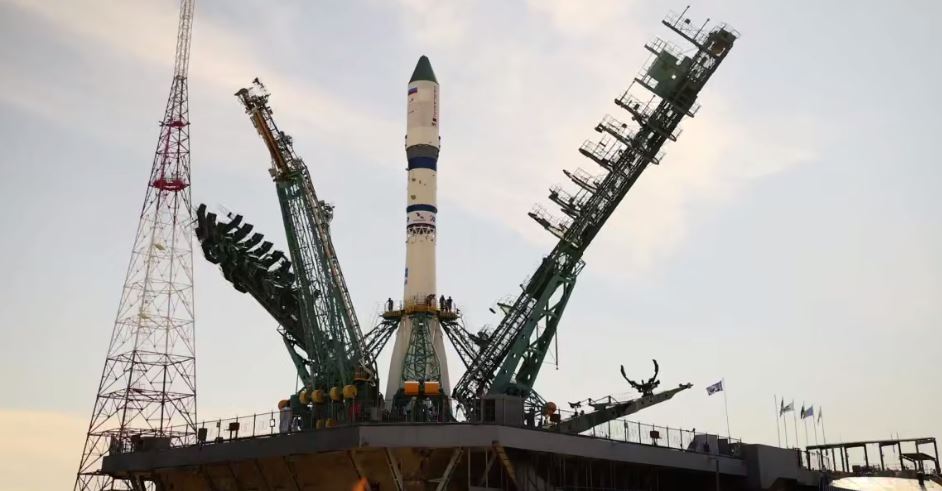
Latest Baikonur Launch Pays Tribute to 1975 Apollo-Soyuz Mission

In July 1975, millions of people watched on television as a U.S. Apollo spacecraft docked with a Soviet Soyuz capsule in a crewed mission in orbit that symbolized collaboration between the two superpowers at the height of Cold War enmity. That remarkable moment 50 years ago is being commemorated on a Soyuz rocket carrying a Russian cargo spacecraft that launched from the Baikonur Cosmodrome in Kazakhstan – early on Friday, Baikonur time - and is scheduled to reach the International Space Station after a two-day trip. The spacecraft is loaded with more than 2.5 tons of fuel, drinking water, food, medicine, science equipment, and other supplies for the crew on the station. The Soyuz rocket currently heading to the ISS is painted white and blue and has an emblem marking the anniversary of the Soyuz-Apollo docking, which was the first international space mission. It had begun on July 15, 1975, when two Soviet cosmonauts launched from Baikonur and, hours later, three American astronauts blasted off from Cape Canaveral, Florida. The Russians and the Americans connected in space two days later, shaking hands, exchanging gifts, and sharing a meal. The show of comity in space contrasted with the intense competition between the two global rivals that was known as the “space race,” which included the Soviet launch of the Sputnik satellite into orbit in 1957 and the Apollo 11 landing of American astronauts on the moon in 1969. “I really believe that we were sort of an example … to the countries. We were a little of a spark or a foot in the door that started better communications,” Apollo astronaut Vance Brand had said, according to a NASA account of the Apollo-Soyuz mission. Tensions between Russia and the United States escalated after Moscow launched a large-scale invasion of Ukraine in 2022, though relations improved after U.S. President Donald Trump took office for a second term in January. The U.S. and Russian space agencies have continued to collaborate over the course of the protracted war. Roscosmos, the Russian space agency, refers to the cargo spacecraft currently in orbit as Progress MS-31, while the U.S. agency NASA uses the term Progress 92 because it’s the 92nd Russian resupply craft to launch in support of the International Space Station since its construction began in 1998. The Apollo-Soyuz mission has been described as a precursor of the ISS project.

How Can Britain Benefit From the Middle Corridor?

On July 2nd, a roundtable held at the House of Lords, the upper chamber of the British parliament, brought together diplomats, trade envoys, logistics professionals, and academics to promote the Middle Corridor – the overland route connecting China to Europe via Kazakhstan, the Caspian Sea, Azerbaijan, Georgia, and Turkey. The session aimed to highlight the strategic and economic case for British involvement in the corridor. However, in a crowded political landscape, the pitch struggled to gain airtime. On the same day, British economic minister Rachel Reeves shed tears in parliament’s lower chamber, sparking fears of political instability, and, a few miles away, the Wimbledon tennis season had just begun. In short, Westminster and the British media were elsewhere. Nonetheless, speakers made their case for the corridor’s importance to China-Europe freight. The Middle Corridor has gained attention as an alternative to the Northern Corridor – a rail network that runs from China through Kazakhstan, Russia, and Belarus, all members of the Eurasian Economic Union (a shared customs zone). The Northern route could, in theory, deliver goods from China to Europe in as little as ten days. But its viability has been damaged by Russia’s invasion of Ukraine and the sanctions regime that followed. Since then, cargo traffic along the Middle Corridor has surged. “Before the war in Ukraine, 99% of goods travelled along the northern corridor, and just 1% along the Middle Corridor,” said Dr Chris Brooks, Global Director of Risk, Quality and Compliance at Bertling Logistics. “Now it’s about 90% along the Middle Corridor.” In raw numbers, the increase has been stark. Back in 2021, cargo volume transported through the Middle Corridor was around 800,000 tonnes; that stood at 4.5 million tonnes at the end of 2024. “It is never going to be an alternative to the maritime route,” Brooks said, estimating that even with major investment, capacity would top out at around 16,000 tonnes per month, which is dwarfed by maritime trade between China and Europe, which totals around 800,000 tonnes a month. However, he did call the route a “strategic insurance policy,” citing its neutrality, flexibility, and compliance with Western sanctions. For automotive, electric, and fast-moving consumer goods (FMCG) with short shelf lives, the route will prove particularly useful. “Whether you're going through the Red Sea or around the Cape of Good Hope, maritime typically takes anything between 35 and 52 days. The Northern Russian corridor is 10 to 20 days. The Middle Corridor can actually do similar.” But Brooks added that infrastructure and the weather remain limiting factors, meaning that lead times are anything between 14 and 45 days, with some shipments taking up to two months. “We have as many as 400 trucks queuing up… not because of customs – they’re just queuing to get onto the ferry from Baku to Kazakhstan… Drivers are waiting anything from one week to one month,” he said, adding his concerns that the corridor also has limited capacity to move large cargo. [caption id="attachment_33653" align="aligncenter" width="960"] Image: middlecorridor.com[/caption] Many speakers...

Kazakhstan Confronts Major Data Leak in High-Stakes Security Crackdown

A detective thriller worthy of a Hollywood script is quietly playing out in the daily lives of Kazakhstani citizens, one with implications for nearly every household. At its core lies the largest leak of personal data in Kazakhstan’s history, unfolding across Almaty and Astana. The incident touches on something deeply personal: data that could be weaponized by fraudsters for illicit gain. Sixteen Million Records Exposed In early June, the Telegram channel SecuriXy.kz, known for its cybersecurity reporting, revealed a massive breach of Kazakh citizens' personal data. "A CSV file containing the personal data of Kazakh citizens, containing 16.3 million lines, has been discovered. The table contains the following fields: Last name, First name, Middle name, Gender, Date of birth, ID number, IIN [Bank Identification Number], Mobile phone number, Work phone number, Home phone number, Citizenship, Nationality, Address, Confirmed address, Start and end dates of residence," the channel stated. The analysis identified 16,302,107 records, 16.9 million unique phone numbers, and 15,851,699 unique individual identification numbers (IINs), the number of citizens whose information had been compromised. “The ‘address’ field often contains the addresses of dental clinics, polyclinics, the Tax Committee, universities, and other organizations,” the channel noted. The leak included highly sensitive personal data such as contact details and IINs, which the channel warned could be used for: “Phishing, social engineering, document forgery, and telephone fraud.” The data appears to have been compiled over a significant period. SecuriXy.kz reported that, “Most of the records were entered into the system after 2011,” with over two million added in 2022 alone. Data from 2023-2024 also appears, underscoring the leak's relevance. The revelation sparked swift reactions from officials. The Ministry of Digital Development, Innovation, and Aerospace Industry (MCIAI) released a statement confirming an investigation in collaboration with law enforcement and intelligence agencies. “It should be noted that the initial analysis indicates that the information may have originated from private information systems. No hacker attacks or leaks of personal data from state information systems have been recorded at this time. It is premature to draw final conclusions or confirm the accuracy of the information until the investigation is complete,” the ministry stated, adding that similar past incidents often involved outdated data compiled by service sector firms or microfinance institutions. “The ministry is monitoring the situation," the authorities concluded. "Additional information will be posted after the investigation is complete.” Cybersecurity experts, however, were less dismissive. Enlik Satieva, vice president of the TSARKA Group, a cybersecurity firm affiliated with the government, stressed the seriousness of the breach. "These are not just names," she stated. "The published database contains the most important personal data of citizens. In particular, it includes surnames, first names, patronymics, gender, dates of birth, IINs, citizenship, nationality, residential addresses, registration and residence periods, as well as mobile, home, and work phone numbers." Satieva suggested that some of the data may have been sourced from medical organizations, and that the leak might stem from a specific entity or multiple sources linked through IINs. Criminal Case and Contradictions...

Almaty Grapples with Year-Round Nitrogen Dioxide Crisis, Study Warns

A new study has revealed persistently dangerous levels of nitrogen dioxide (NO₂) pollution in Almaty, Kazakhstan’s largest city, with motor vehicles identified as the primary source. Conducted by the Almaty Air Initiative over 2023-2024, the research highlights aging vehicles, inadequate emissions oversight, and coal-based heating as key contributors to chronically high NO₂ levels throughout the year. With more than 600,000 vehicles on the roads daily, Almaty’s outdated and poorly regulated transport fleet is having a significant environmental impact. According to the Ministry of Internal Affairs, nearly one-third of the city’s vehicles are over 20 years old, many lacking catalytic converters that are standard in other countries. NO₂ Levels Far Exceed Global Health Standards Data from over 50 monitoring stations, installed as part of an Asian Development Bank-supported program, show that annual NO₂ concentrations in Almaty were 4.6 times higher than the World Health Organization’s recommended limits in 2023, and 4.2 times higher in 2024. Only 16 days in 2024 met the WHO’s daily NO₂ threshold of 25 µg/m³. On 143 days, concentrations exceeded 40 µg/m³, posing health risks to vulnerable groups such as children, the elderly, and people with respiratory issues. On seven days, levels surpassed 100 µg/m³, considered extremely hazardous for the general population. Kazhydromet, Kazakhstan’s national weather agency, documented over 11,000 violations of the country’s maximum permissible concentration (MPC) for NO₂ in 2024, an average of nearly 30 per day. Pollution Persists Across All Seasons Unlike particulate matter (PM2.5), which typically spikes during the heating season, NO₂ pollution remains elevated year-round. Peak monthly averages reached nearly 100 µg/m³ in January 2023 and 80 µg/m³ in December 2024. Even in summer, concentrations hovered around 30-35 µg/m³, well above WHO guidelines. In 2024, Almaty recorded 164 “clean” days based on PM2.5 levels (below the WHO’s 15 µg/m³ threshold), but just 16 days met the corresponding standard for NO₂, underscoring the pollutant’s persistent presence and underrecognized health risks. Additional Contributors: Coal and Industry Beyond traffic emissions, NO₂ levels are exacerbated by emissions from two coal-fired thermal power plants, as well as numerous private heating systems and small-scale boiler houses. The study also criticized Kazakhstan’s vehicle inspection system, which it says fails to identify or enforce emissions violations. Study Urges Comprehensive Action To tackle the NO₂ crisis, researchers recommend a suite of policy measures, including: Transitioning public transport to gas and electric power Phasing out coal-based heating in favor of gas Installing emissions filters at thermal power plants and residential heating units Establishing low-emission zones across Almaty Encouraging walking and cycling for short trips Strengthening vehicle inspection and emissions monitoring systems With NO₂ now considered one of the most serious and persistent air quality threats in Central Asia, Almaty’s situation serves as a stark warning for other rapidly urbanizing cities in the region.