
• KGS/USD = 0.01144 0%
  • KZT/USD = 0.00216 0%
  • TJS/USD = 0.10456 0%
  • UZS/USD = 0.00008 0%
  • TMT/USD = 0.28571 0%
  • KGS/USD = 0.01144 0%
  • KZT/USD = 0.00216 0%
  • TJS/USD = 0.10456 0%
  • UZS/USD = 0.00008 0%
  • TMT/USD = 0.28571 0%
  • KGS/USD = 0.01144 0%
  • KZT/USD = 0.00216 0%
  • TJS/USD = 0.10456 0%
  • UZS/USD = 0.00008 0%
  • TMT/USD = 0.28571 0%
  • KGS/USD = 0.01144 0%
  • KZT/USD = 0.00216 0%
  • TJS/USD = 0.10456 0%
  • UZS/USD = 0.00008 0%
  • TMT/USD = 0.28571 0%
  • KGS/USD = 0.01144 0%
  • KZT/USD = 0.00216 0%
  • TJS/USD = 0.10456 0%
  • UZS/USD = 0.00008 0%
  • TMT/USD = 0.28571 0%
  • KGS/USD = 0.01144 0%
  • KZT/USD = 0.00216 0%
  • TJS/USD = 0.10456 0%
  • UZS/USD = 0.00008 0%
  • TMT/USD = 0.28571 0%
  • KGS/USD = 0.01144 0%
  • KZT/USD = 0.00216 0%
  • TJS/USD = 0.10456 0%
  • UZS/USD = 0.00008 0%
  • TMT/USD = 0.28571 0%
  • KGS/USD = 0.01144 0%
  • KZT/USD = 0.00216 0%
  • TJS/USD = 0.10456 0%
  • UZS/USD = 0.00008 0%
  • TMT/USD = 0.28571 0%

Viewing results 85 - 90 of 1472

Foreign Internet Platforms Paid Nearly $18 million in Taxes in Kazakhstan in January

Foreign digital platforms transferred nearly $18 million to Kazakhstan’s state budget in digital services tax, commonly known as the “Google tax”, in January 2026, according to the press service of the State Revenue Committee under the Ministry of Finance. Kazakhstan has applied the digital services tax since 2022. Over this period, 120 foreign companies have registered as taxpayers in the country, including 22 in 2025. Total revenue from the Google tax since its introduction has reached approximately $277.5 million. Of that amount, $117.5 million was collected in 2025, and more than $17.75 million in January 2026 alone. Under the Tax Code, second-tier banks and payment organizations are required to provide tax authorities with information on foreign companies that have undergone conditional registration. This data is used to assess the completeness and timeliness of VAT payments in e-commerce and the provision of digital services to individuals in Kazakhstan. Based on comparisons of bank data, payment system information, and actual VAT payments, tax authorities conduct desk audits. If arrears or underpayments are identified, notifications outlining the discrepancies are issued. Additional enforcement measures came into force on January 1, 2026. Under Article 89 of the Tax Code, state authorities are now authorized to block the internet resources of foreign marketplaces that fail to comply with desk audit notifications or evade VAT registration requirements. The State Revenue Committee emphasized that these measures are intended to ensure a level playing field for domestic and foreign market participants, improve tax compliance in the digital sector, and reduce the shadow economy without conducting on-site tax inspections. As previously reported by The Times of Central Asia, international companies including Google, Apple, Netflix, and Amazon have already registered in Kazakhstan under the Google tax regime. In May 2025, the U.S. company OpenAI also completed tax registration in the country.

Kazakhstanis Spend 57% of Their Household Budgets on Food

Despite reported growth in certain macroeconomic indicators, the financial situation of Kazakhstani households continues to deteriorate, according to analysts at Finprom.kz, who note a sharp increase in the share of food expenditures, now accounting for more than half of total consumer spending. In the third quarter of 2025, food expenditures reached 57.2% of overall household consumer spending, the highest level since 2021. A higher figure was recorded only in 2020, the first year of the COVID-19 pandemic, when the share stood at approximately 58%. For comparison, in developed countries, food spending typically accounts for 10-15% of household budgets. In international practice, a level above 50% is generally regarded as an indicator of significant pressure on household incomes. Regionally, the burden is even more pronounced. The highest share of food expenditures between June and September 2025 was recorded in the Zhetysu region, at 65.8%. In the Turkestan region, the figure was 65.3%, and in the Almaty region, 62.2%. These regions are largely agriculturally oriented and have less diversified economies. The rising share of food expenditures is considered a key socio-economic indicator. An increase in this share reduces the resources available for education, healthcare, housing, and long-term savings or investment. The gap between urban and rural areas persists. In the third quarter of 2025, food spending accounted for 58.7% of total expenditures in rural areas, compared to 56.5% in urban areas. In absolute terms, urban food expenditures increased by 15.5% year-on-year, while rural expenditures rose by 11%. In cities, the largest increases were recorded in spending on meat and meat products (22.3%), fruit (18.6%), vegetables (16.8%), and oils and fats (16.4%). In rural areas, growth was more moderate, and spending on some categories, such as sugar and confectionery, declined. Differences are also evident in dietary structure. Rural residents spend more on bread and cereals, about $176 compared to $139 among urban residents, while urban households allocate more to dairy products, at $118 versus $93 in rural areas. The increase in the food burden has already been accompanied by a reduction in non-food spending. In urban areas, the share of non-food expenditures fell from 26% to 22.2%, and in absolute terms from $492 to $450. The sharpest declines were observed in spending on automotive goods and fuel, telecommunications, household appliances, home repairs, and interior renovation. At the same time, spending on medicines increased.

Kazakhstan’s Reservoirs Prepared for Spring Flooding

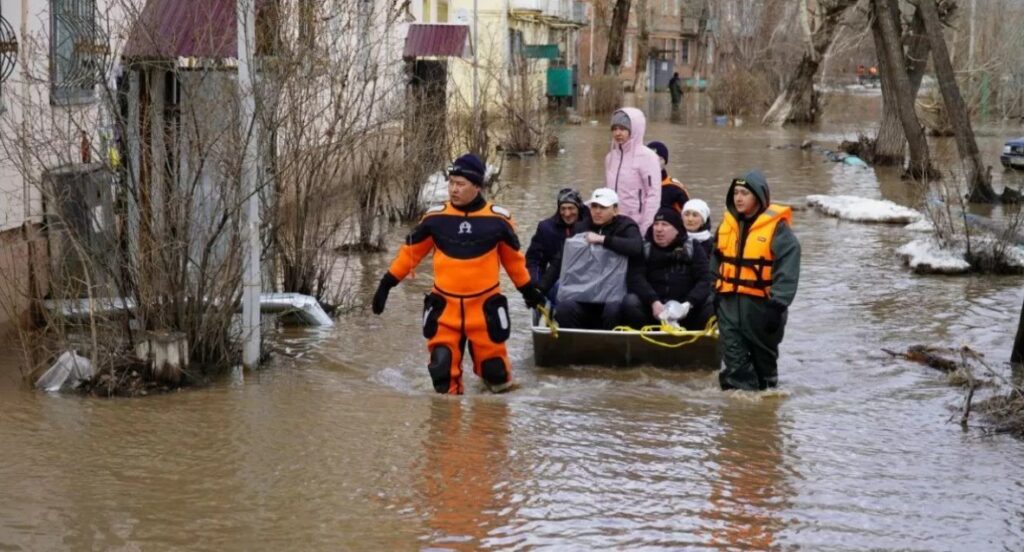
Kazakhstan’s authorities have announced that the country’s water management infrastructure is prepared for the spring flood period. According to the Ministry of Water Resources and Irrigation, the total available storage capacity in the country’s large reservoirs exceeds the projected volume of snowmelt inflows, with the highest water levels currently recorded in the eastern regions. Flood preparedness has remained a priority for the government since 2024, when Kazakhstan experienced its most severe spring flooding in 80 years. The disaster affected dozens of settlements and forced the evacuation of more than 120,000 people, drawing sharp criticism of local authorities. In response, the central government intensified coordination efforts and preventive measures. As of February, the ministry reported that the total available storage capacity in large reservoirs exceeds 14.3 billion cubic meters. Projected spring inflows are estimated at between 9.1 billion and 13.9 billion cubic meters. The ministry also announced inspections of hydraulic infrastructure and ongoing repair work at 39 facilities. Major repairs have been completed at the Charske Reservoir in the Abai region, the Akzhar Reservoir in Shymkent, the Sholak Dam in the Aktobe region, and the reconstructed dam in the village of Stepnoye in the Kostanay region. In addition, riverbed preparation measures are underway. Under the 2025-2027 Roadmap for River Rehabilitation, nearly 167 kilometers of riverbeds in western, central, and northern regions have already been cleaned and deepened. In 2026, similar work is planned across six additional regions, covering approximately 193 kilometers. Kazakhstan has also strengthened coordination with neighboring countries. In 2025, a joint working group was established with Russia to address flooding and elevated water levels, including along the transboundary Ural River. The final forecast for water levels in the basin is expected in early March. According to Kazakh officials, the Russian side has stated that water discharges from the Iriklinskoye Reservoir during the flood period will not exceed 200 cubic meters per second. An emergency notification and monitoring system for transboundary water flows along the Irtysh River is also in operation with China, including regular exercises and communication checks. The Times of Central Asia previously reported that in 2025 Kazakhstan began releasing water from key reservoirs as early as January to increase available storage capacity ahead of the spring flood season.

Kazakhstan Launches High-Resolution Weather Forecast Powered by Supercomputer

Kazakhstan has introduced a new high-resolution digital weather forecasting system powered by the country’s most powerful supercomputer, marking a significant step toward strengthening national hydrometeorological security. The National Hydrometeorological Service, Kazhydromet, has deployed the Weather Research and Forecasting (WRF) model across the entire territory of the country. The system provides forecasts with a spatial resolution of 2 kilometers, significantly enhancing the accuracy and detail of weather predictions. All computations are carried out on Central Asia’s most powerful supercomputer at the Farabi Supercomputer Center, located at Al-Farabi Kazakh National University in Almaty. According to Amirkhan Temirbayev, Director of the Farabi Supercomputer Center, the new model strengthens Kazakhstan’s ability to anticipate hazardous natural phenomena and respond more effectively to climate-related risks. “The new system improves early warnings of dangerous weather events, particularly in the mountainous regions of Almaty and southeastern Kazakhstan and enhances the country’s hydrometeorological security. Accurately modeling atmospheric processes requires millions of calculations that conventional servers cannot handle. A supercomputer is no longer just a scientific instrument, it is infrastructure of national importance,” Temirbayev said. He added that the initiative demonstrates how university-based high-performance computing resources are increasingly being used to address applied government needs. While the supercomputer is currently dedicated to weather forecasting, potential future applications include flood and mudflow modeling, climate analysis, air quality monitoring, and digital urban simulations. Kazhydromet plans to publish outputs from the new WRF model on its official website, where users will have access to interactive weather maps and detailed forecasts for all regions of Kazakhstan.

Trade Accounted for More Than a Quarter of Kazakhstan’s Economic Growth in 2025

The trade sector accounted for 26% of Kazakhstan’s total economic growth in 2025, according to the Ministry of Trade and Integration. Data from the National Statistics Bureau show that the country’s GDP grew by 6.5% in January-December 2025, equivalent to $20.1 billion in nominal terms, bringing the total size of the economy to $305.9 billion. More than a quarter of this growth was generated by trade. At a government meeting, the Ministry of Trade and Integration reported that domestic trade turnover reached $162.3 billion in 2025, while investment in the sector amounted to $2.6 billion. Non-resource exports totaled $41 billion, and services exports increased by 3.7% to $12.3 billion. Speaking at the meeting, Deputy Prime Minister and Minister of National Economy Serik Zhumangarin said the ministry’s objective is not only to maintain current momentum but also to raise trade to a new level of efficiency and competitiveness. Key priorities include expanding wholesale and retail turnover, increasing the share of domestically produced goods in the market, ensuring stable supplies of socially important products, shortening the supply chain between producers and retailers, boosting exports, and systematically reducing the shadow economy in the trade sector. Special emphasis was placed on measures to curb inflation and ensure adequate food supplies for the domestic market. According to Zhumangarin, a preliminary pool of approximately 1,500 projects has been formed under the “Investment Order” initiative. These projects are aimed at expanding the production of goods with high import dependence, including more than 500 in the agro-industrial complex, over 400 in manufacturing, and the remainder in infrastructure. The ministry’s key task is to secure guaranteed sales channels for products manufactured within these projects. The Times of Central Asia previously reported that trade between Central Asian countries and China exceeded $100 billion in 2025, setting a new record.

Kazakhstani Skater Denis Ten, Killed in 2018, Is Honored As Nation Celebrates Olympic Gold  

After Olympic figure skater Mikhail Shaidorov won gold for Kazakhstan, he was quick to pay tribute to Denis Ten, a Kazakhstani who got the bronze medal in the same event at the 2014 Winter Olympics and was killed in an attempted robbery in Almaty four years later. It was a bittersweet moment. Shaidorov, 21, was basking in his extraordinary accomplishment in Milan, Italy last weekend even as he honored an inspiring figure whose violent death in 2018 shocked Kazakhstan, a country that was delighted when Ten made it onto the podium in Sochi, Russia. “I think my medal would have meant a lot to Denis Ten,” Shaidorov said in comments posted on social media by Kazakhstan’s Olympic team. “He opened the way for us. This path was thorny for him and for me. And I want to express my gratitude to Denis for what he did for our sport.” A pioneer of the sport in Kazakhstan, Ten skated as a boy at a shopping center rink in Almaty and later trained in Russia. He was a popular figure and had his own skating show called “Denis Ten and Friends.” Shaidorov followed a similar path, developed early skills in Almaty and, at one point, attending a master class led by Ten. Shaidorov received extensive training in Russia under Olympic champion Alexei Urmanov. While crediting Urmanov for helping him become a world class figure skater, Shaidorov bristles at the idea that he is closer to Russia than the country where he was born. "I was born, lived, and still live in Almaty, and I spend a lot of time in Kazakhstan, in my beloved city,” he said in an interview with the Russian outlet Sport24 last year. “But I started skating at the Ramstore shopping center, where many figure skaters got their start, including Denis Ten. It had one of the very first rinks in Kazakhstan.” Ten was fatally stabbed during a robbery attempt in Almaty. Two men were sentenced to long prison terms for his murder. Thousands, many weeping, turned out for Ten’s funeral at a sports venue. The skater was of Korean descent and he was also mourned in South Korea. Shaidorov, who wears teeth braces, has a disarming quality. He has skated in a bulky panda suit in exhibitions. He performed with assurance at the Olympics as other skaters, particularly the American favorite Ilia Malinin, made missteps. It was the first gold medal for Kazakhstan in any sport at a Winter Olympics since the games in Lillehammer, Norway in 1994. Shaidorov skated to music performed by Kazakhstani singer Dimash Kudaibergen, who said he would give a car to the Olympian for his achievement. “You did not let down Denis, the pride of our country, my friend, your brother, whom our nation sadly lost,” the international star said in a video message to Shaidorov. “You fulfilled your duty to him, to the country, and to the people with honor and at the highest level.” Ten also skated at times to...