• KGS/USD = 0.01144 0%
  • KZT/USD = 0.00209 0%
  • TJS/USD = 0.10523 0%
  • UZS/USD = 0.00008 0%
  • TMT/USD = 0.28530 -0.14%
  • KGS/USD = 0.01144 0%
  • KZT/USD = 0.00209 0%
  • TJS/USD = 0.10523 0%
  • UZS/USD = 0.00008 0%
  • TMT/USD = 0.28530 -0.14%
  • KGS/USD = 0.01144 0%
  • KZT/USD = 0.00209 0%
  • TJS/USD = 0.10523 0%
  • UZS/USD = 0.00008 0%
  • TMT/USD = 0.28530 -0.14%
  • KGS/USD = 0.01144 0%
  • KZT/USD = 0.00209 0%
  • TJS/USD = 0.10523 0%
  • UZS/USD = 0.00008 0%
  • TMT/USD = 0.28530 -0.14%
  • KGS/USD = 0.01144 0%
  • KZT/USD = 0.00209 0%
  • TJS/USD = 0.10523 0%
  • UZS/USD = 0.00008 0%
  • TMT/USD = 0.28530 -0.14%
  • KGS/USD = 0.01144 0%
  • KZT/USD = 0.00209 0%
  • TJS/USD = 0.10523 0%
  • UZS/USD = 0.00008 0%
  • TMT/USD = 0.28530 -0.14%
  • KGS/USD = 0.01144 0%
  • KZT/USD = 0.00209 0%
  • TJS/USD = 0.10523 0%
  • UZS/USD = 0.00008 0%
  • TMT/USD = 0.28530 -0.14%
  • KGS/USD = 0.01144 0%
  • KZT/USD = 0.00209 0%
  • TJS/USD = 0.10523 0%
  • UZS/USD = 0.00008 0%
  • TMT/USD = 0.28530 -0.14%

Viewing results 187 - 192 of 1474

Central Asia Watches as Venezuela Drama Unfolds  

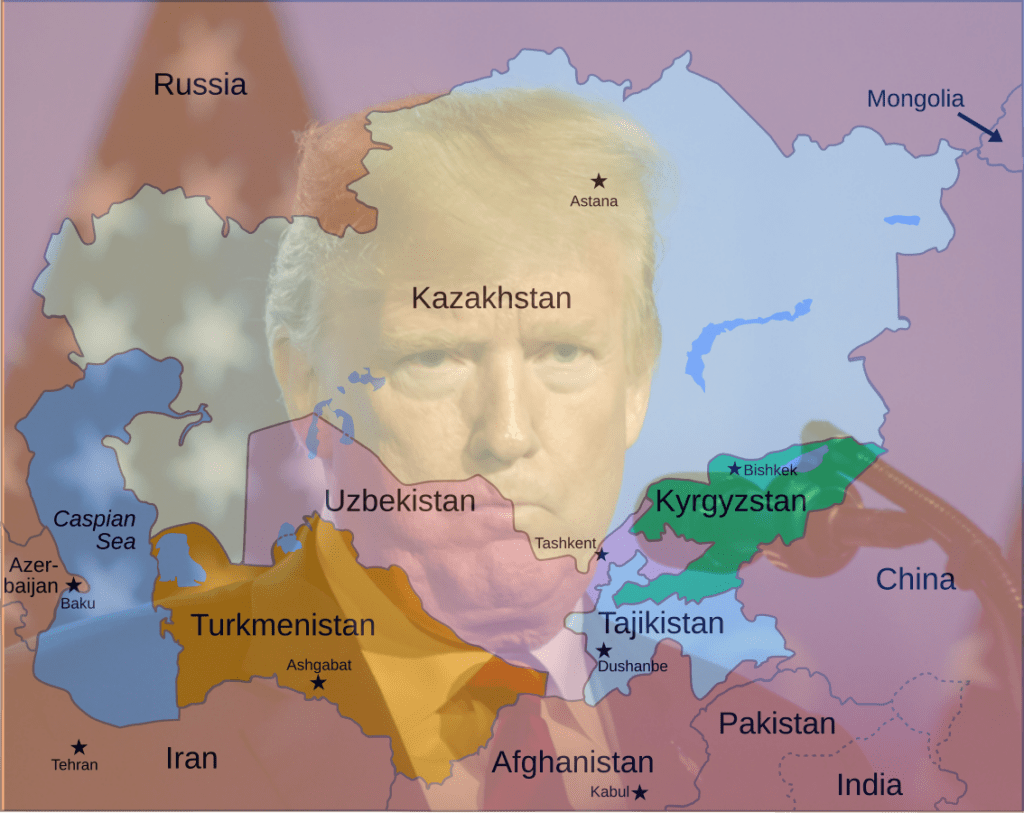
Governments in Central Asia have not made any public comment, so far, on the U.S. military operation that captured Venezuelan President Nicolás Maduro, at a time when relations between Central Asian countries and the administration of President Donald Trump are growing closer. The operation on Saturday involved more than 150 American aircraft and extracted Maduro and his wife, Cilia Flores, from their compound in Caracas, prompting celebrations from many Venezuelan expatriates who viewed Maduro as a dictator, criticism from countries including Russia and China, and concerns that the complex attack violated international law. Additional questions about Venezuela’s sovereignty emerged after Trump said the United States will “run” the country ahead of a transition and that American oil companies will help to rebuild its oil infrastructure. The U.S. has argued that Maduro himself effectively hijacked Venezuelan sovereignty through electoral fraud, repression and by allegedly funneling illegal drugs to the U.S. Maduro, who has been indicted on narco-terrorism and other charges, denies the allegations. Countries in Central Asia are more than 10,000 kilometers away from Venezuela and their trade with the Latin American country is minimal, suggesting the uncertain and evolving situation there lies far outside their immediate area of interest. In May, Tokayev met Maduro in Moscow and invited him to visit Kazakhstan after describing Venezuela as an important partner. “However, he acknowledged that, due to objective reasons, significant achievements in bilateral cooperation have yet to be realized,” Tokayev’s office said at the time. Still, Tokayev and other Central Asian leaders have spoken in general terms of their adherence to United Nations principles of sovereignty, an issue that is being vigorously debated in some international circles after the U.S. military operation. U.N. Secretary-General António Guterres, who visited Central Asia in 2024 and 2025, has said that the U.S. military operation that extracted Maduro to New York constitutes a "dangerous precedent" and that he was concerned that the rules of international law had not been respected. The U.S. capture of the leader of oil-rich Venezuela has not had a major impact for now on global oil prices, indicating that Central Asia’s oil and natural gas producers will not see any big fallout. Even so, at a time of ongoing geopolitical tension, a major shock or event in one region could influence distant regions in ways that are difficult to discern. Russia and China, which are close trading partners with Central Asia and nurtured trade and political ties with Maduro’s government, condemned the U.S. military operation in Venezuela. But the Central Asian countries – Kazakhstan, Uzbekistan, Kyrgyzstan, Tajikistan and Turkmenistan – have not joined in the criticism, much as they have refrained from publicly supporting any side over Russia’s invasion of Ukraine. Central Asia’s balancing act reflects efforts to maintain good ties with major powers even when they are in conflict, and comes during a period of increasing trade collaboration with the United States. The five leaders from Central Asia traveled to Washington in November for a summit with Trump, who later invited...

Kazakhstan Plans to Send 35 Athletes to 2026 Winter Olympics in Italy

Kazakhstan plans to send a team of 35 athletes to compete at the XXV Winter Olympic Games, which will take place in Italy in 2026 in Milan and Cortina d’Ampezzo. The 2026 Winter Olympics will be held from February 6 to 22, bringing together approximately 3,000 athletes from 93 countries. A total of 116 sets of medals will be contested. Kazakhstan’s athletes will compete in 10 disciplines across 58 medal events. These include biathlon, speed skating, figure skating, short track, alpine skiing, Nordic combined, cross-country skiing, ski jumping, freestyle moguls, and freestyle aerials. Among the strongest medal contenders are figure skaters Mikhail Shaydorov and Sofya Samodelkina; freestyle skiers Anastasia Gorodko and Yulia Galysheva; speed skater Evgeny Koshkin; and a group of short track skaters, including several world championship medalists. Shaydorov is the current world silver medalist in men’s singles figure skating. Galysheva won bronze in moguls at the 2018 Winter Olympics and was crowned world champion in 2019 in the same discipline. Gorodko has twice earned bronze in parallel moguls at the World Championships, in 2021 and 2025. Kazakhstan has participated in every Winter Olympics since 1994, when skier Vladimir Smirnov won the country’s first and so far only, Winter Olympic gold medal in Lillehammer, Norway. To date, Kazakhstan has won eight medals at the Winter Games: one gold, three silver, and four bronze. The Lillehammer Games remain the country’s most successful, with three medals and a 12th-place finish in the overall medal standings. At the most recent Winter Olympics in Beijing in 2022, Kazakh athletes did not reach the podium. However, the national team delivered a strong performance at the 2025 Winter Asian Games, finishing fourth in the overall standings with 20 medals.

What’s Really Happening With Waste Processing in Kazakhstan

Official statistics suggest that Kazakhstan is making steady progress in recycling solid municipal waste (SMW), but a closer look reveals a significant technological shortfall. According to an analysis by Energyprom.kz, behind the rising recycling percentages lies a troubling gap between reported sorting and actual reuse. As of December 2025, the share of municipal waste reportedly recycled or reused had reached 28.6%, up from 25.9% at the end of 2024. On paper, this suggests progress toward the Ministry of Ecology’s target of 40% by 2040. However, the real picture is more complex. Only 1.1% of all municipal waste actually results in the production of secondary raw materials. Analysts emphasize the wide gap between the amount sorted and the amount truly recycled. According to Kazakhstan’s National Statistics Bureau, the country generates between 4.2 million and 4.8 million tons of municipal solid waste annually. In 2024, the figure hit a peak of 4.8 million tons. Of that, about 1.3 million tons were sorted and recorded as recycled or reused, more than one-quarter of the total. But crucially, this refers only to the volume that passed through sorting facilities. Much of the remaining 4.5 million tons was ultimately sent to landfill, including a significant share of the sorted waste. In 2024, 37.1% of sorted municipal waste, about 490,400 tons, was still landfilled. In other words, more than a third of the “recycled” waste never became usable raw material. In some regions, the situation is even more stark. At certain waste processing plants, including in Almaty, up to 85% of sorted waste ends up in landfill due to outdated technologies and limited processing capacity. Without substantial upgrades to equipment and processes, this is unlikely to change. That said, there has been measurable improvement. In 2023, 65.9% of sorted waste was landfilled, compared to 37.1% in 2024. Meanwhile, the volume of waste actually sent for recycling rose from 358,900 tons to 588,200 tons. Even so, only 49,200 tons of waste were ultimately processed into secondary raw materials, just 8.4% of the sorted waste and a mere 1.1% of Kazakhstan’s total municipal waste. For comparison, the figure was just 0.7% the previous year. More than 40% of waste processed at SMW facilities in 2024 consisted of plastic and paper, with plastic being the most straightforward to recycle. That year, 112,400 tons of plastic were recycled, an 8.5% increase over 2023. Waste paper collection reached 124,400 tons. Other materials processed include glass, metals, and used tires. Tire recycling has grown particularly quickly, with volumes increasing nearly twentyfold year-on-year. Despite this modest progress, Kazakhstan’s waste accumulation problem remains severe. The country has already amassed 48.3 million tons of solid waste. Of the approximately 3,000 landfills currently in operation, only 20.6% meet national standards. The best-performing regions include Zhambyl and Ulytau, as well as the cities of Astana and Shymkent. The worst conditions are found in North Kazakhstan, Turkestan, and Abai regions, where fewer than 3% of landfills comply with regulations. In 7 of Kazakhstan’s 20 largest cities, landfill capacity...

Kazakhstan Accelerates Shift Away from Cash Payments

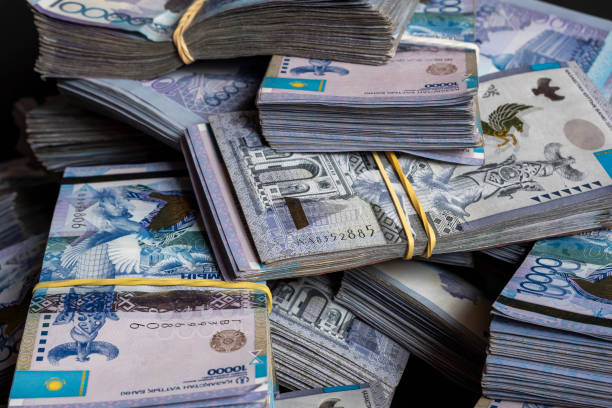
Kazakhstan is rapidly embracing cashless payments, with the share of cash withdrawals in card transactions continuing to decline each year, according to data from the National Bank. While the country has not yet reached the levels seen in leading digital economies, recent trends suggest Kazakhstan is closing the gap. A recent study by analysts at Finprom.kz compares Kazakhstan’s transition to cashless payments with global trends. It highlights the persistent divide between countries where cash is nearly obsolete and those where it remains dominant. The global variation is illustrated by the Cash Index, compiled by FOREX.se, which ranks 122 countries based on the share of daily transactions made with cash. Using data from Statista, Numbeo, central banks, and other global sources, the index offers an average estimate of cash usage across the world. According to the Cash Index, countries with the lowest rates of cash use, just 10%, include South Korea, Norway, China, Iceland, and Australia. Similarly low figures are reported for Scotland, England, and Denmark (12% each). Analysts attribute this to strong fintech ecosystems, widespread broadband internet, high smartphone penetration, and robust consumer protection frameworks. In contrast, cash remains dominant in countries where poverty, limited banking access, and weak infrastructure prevail. In Myanmar, daily cash transactions account for 98% of all payments, followed by Ethiopia and Gambia at 95%. Other high-cash-use countries include Albania, Cambodia, Laos, Lebanon, Nepal, and Pakistan, all averaging around 90%. While Kazakhstan is not included in the Cash Index due to its tourism orientation, National Bank statistics provide insight into local trends. From January to October 2025, cash withdrawals via Kazakhstani and foreign payment cards totaled $44.37 billion, an 8.6% increase compared to the same period in 2024. Yet the overall trend favors non-cash transactions. The share of cash withdrawals in total card turnover fell from 13.5% to 12.9% over the year, comparable to figures seen in developed economies. By contrast, in 2019, cash accounted for more than half of card-based transactions. This dropped to 34.1% in 2020 and has continued its steady decline. Regional data reveal that the shift to cashless payments is uneven across the country. In January-October 2025, the share of cash withdrawals in total card transactions ranged from 8.3% to 27.4%, depending on the region. The lowest shares were recorded in the Almaty region (8.3%), Almaty city (9%), and the Turkestan region (9.4%). Astana and the Atyrau region followed with 14.4% and 14.8%, respectively. The North Kazakhstan region reported the highest share of cash withdrawals.

Beshbarmak, Pilaf, and Olivier Salad: What Will Be Served on New Year’s Eve Tables in Central Asia

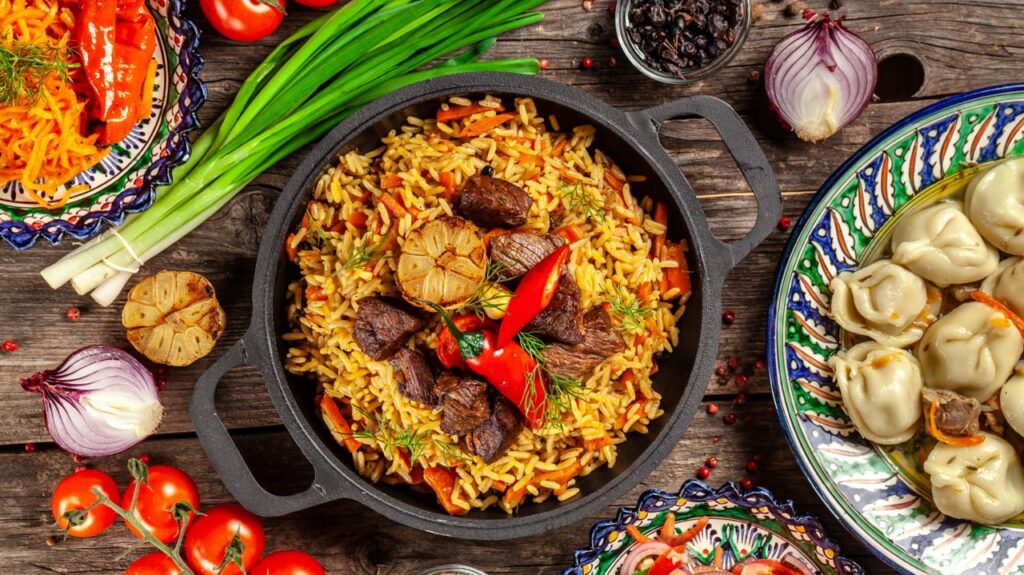
New Year remains one of the most significant holidays in Central Asia. While its scale and prominence have gradually declined due to rising religiosity, many residents still regard it as the foremost secular and ideology-free celebration of the year. Across the region, households prepare their most beloved dishes to ring in the occasion. No New Year Without Olivier Salad For many families, traditional fare is an essential part of New Year’s Eve. Olivier salad has long been a staple of the holiday table. Originally created in the 1860s by a French chef in Russia, the dish once featured ingredients such as hazel grouse and seafood. Over time, particularly during the Soviet era of shortages, the recipe evolved. Today, Olivier salad typically includes beef, chicken (or boiled sausage), potatoes, green peas, pickled cucumbers, and mayonnaise. It is usually prepared in large batches to ensure there is enough for all guests. Other popular salads include herring under a fur coat, vinaigrette, and “Tenderness”, hearty dishes that can leave guests too full for main courses. Even in modest households, red caviar often finds its way to the table, adding a touch of festivity and indulgence. Kazakhstan: Beshbarmak with a Twist In Kazakhstan, beshbarmak remains the centerpiece of the New Year’s feast, as it is for most major celebrations. Traditionally, the dish combines three cuts of horse meat, kazy, karta, and zhay, served with flat noodles and onions. However, some families are adapting their menus in line with the Chinese zodiac. As the Year of the Red Horse approaches, online advice has suggested avoiding horse meat out of respect for the symbolic animal. A vegan version of beshbarmak, featuring mushrooms and pumpkin, is gaining traction. Baked koktal fish is another showpiece dish, while kuydak (lamb with potatoes and onions) and khan syrbaz (a rich stew of lamb, vegetables, barley, and broth) are popular additions. Desserts often include traditional fermented milk products such as zhent, katyk, and irimshik, and the table is rarely without kumys, a fermented mare’s milk beverage. Uzbekistan: Pilaf Reigns Supreme In Uzbekistan, New Year is celebrated with great enthusiasm. According to folklore, Korbobo, a local version of Santa Claus, arrives on a donkey with his granddaughter Korgyz to distribute gifts to well-behaved children. Pilaf, or plov, is the dominant holiday dish. Made with rice, carrots, onions, meat, and spices, regional variations might include raisins or quince for added sweetness. Each area boasts its own version of the national favorite. Samsas, meat-filled pastries baked in a tandoor, are also served, as are manti, large, steamed dumplings filled with lamb, beef, or pumpkin. Other popular dishes include kazan-kabob (fried meat and potatoes). For dessert, chak-chak (fried dough with honey) and halva (made from sesame, semolina, or nuts) are perennial favorites. Kyrgyzstan: Boorsoki and Beshbarmak In Kyrgyzstan, beshbarmak, prepared with either horse meat or lamb, is also a central dish. Families commonly serve manti, baked chicken, and boorsoki (known in Kazakhstan as baursaki), fried dough balls that are a holiday staple. Other meat-based specialties...

Drone Delivery Pilot Project to Launch in Almaty

A pilot project for drone-based goods delivery is set to launch in Kazakhstan’s largest city, Almaty. The initiative follows the signing of a memorandum between the Ministry of Artificial Intelligence and Digital Development of Kazakhstan and the private company Freedom Lifestyle. According to the ministry, the agreement outlines plans to jointly test drone delivery services in urban settings, with an emphasis on safety, regulatory compliance, and public convenience. Freedom Lifestyle will finance and implement the project, integrating unmanned delivery into its digital platforms. Since early 2025, the company has been building a team of drone operators and testing technology at its Freedom X R&D laboratory. The ministry will focus on developing regulatory frameworks, ensuring aviation safety, and facilitating the integration of drone technology into the urban infrastructure. Gizzat Baitursynov, Chairman of the Committee on Digital Assets and Breakthrough Technologies, stated that the pilot phase will help test the system in real-world conditions and inform the creation of long-term regulatory solutions. The pilot will involve drone delivery of food, daily necessities, and medicines. Each drone will be capable of carrying up to 10 kilograms over a 3-kilometer radius between locations in the upper and central parts of the city. Flights are scheduled to take place during daylight hours and in favorable weather. To minimize risks, drones will operate primarily over green zones and along designated street corridors. Each vehicle is equipped with safety systems, including parachutes and autonomous control in case of communication loss. As the system’s safety and efficiency are validated, the number of drones and service coverage will be expanded, including potential rollouts in rural areas. Kazakhstan has already seen increasing adoption of drone technologies. As previously reported by The Times of Central Asia, unmanned systems are currently used for agricultural land monitoring and are being developed for public safety applications.