• KGS/USD = 0.01144 0%
  • KZT/USD = 0.00207 0%
  • TJS/USD = 0.10419 -0.1%
  • UZS/USD = 0.00008 0%
  • TMT/USD = 0.28530 -0.14%
  • KGS/USD = 0.01144 0%
  • KZT/USD = 0.00207 0%
  • TJS/USD = 0.10419 -0.1%
  • UZS/USD = 0.00008 0%
  • TMT/USD = 0.28530 -0.14%
  • KGS/USD = 0.01144 0%
  • KZT/USD = 0.00207 0%
  • TJS/USD = 0.10419 -0.1%
  • UZS/USD = 0.00008 0%
  • TMT/USD = 0.28530 -0.14%
  • KGS/USD = 0.01144 0%
  • KZT/USD = 0.00207 0%
  • TJS/USD = 0.10419 -0.1%
  • UZS/USD = 0.00008 0%
  • TMT/USD = 0.28530 -0.14%
  • KGS/USD = 0.01144 0%
  • KZT/USD = 0.00207 0%
  • TJS/USD = 0.10419 -0.1%
  • UZS/USD = 0.00008 0%
  • TMT/USD = 0.28530 -0.14%
  • KGS/USD = 0.01144 0%
  • KZT/USD = 0.00207 0%
  • TJS/USD = 0.10419 -0.1%
  • UZS/USD = 0.00008 0%
  • TMT/USD = 0.28530 -0.14%
  • KGS/USD = 0.01144 0%
  • KZT/USD = 0.00207 0%
  • TJS/USD = 0.10419 -0.1%
  • UZS/USD = 0.00008 0%
  • TMT/USD = 0.28530 -0.14%
  • KGS/USD = 0.01144 0%
  • KZT/USD = 0.00207 0%
  • TJS/USD = 0.10419 -0.1%
  • UZS/USD = 0.00008 0%
  • TMT/USD = 0.28530 -0.14%

Viewing results 601 - 606 of 1395

From Test Sites to Power Plants: Kazakhstan’s Journey Towards a Nuclear Referendum

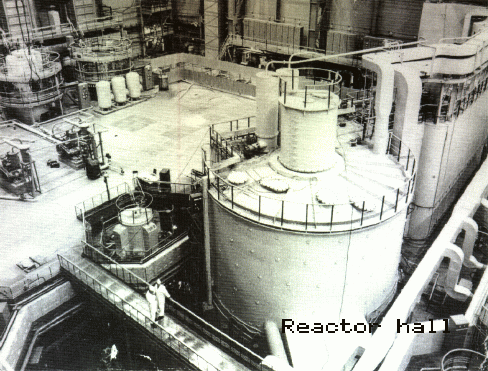
The history of nuclear power in Kazakhstan has many chapters: the arms race, the suffering of people due to test sites, the highest achievements in the name of science, and the service of the nuclear industry for the benefit of society are closely intertwined here. On the eve of the referendum on Kazakhstan's first atomic power plant, it is necessary to revisit these pages in history.   A dark past Construction of the Semipalatinsk nuclear test site began in the Kazakh Soviet Socialist Republic in 1947. The test site is located on the border of the Semipalatinsk (now Abay), Pavlodar, and Karaganda regions, 130 kilometers northwest of Semipalatinsk (now Semey), on the left bank of the Irtysh River. On its territory is the previously closed city of Kurchatov, renamed as such in honor of Soviet-era physicist, Igor Kurchatov. The first nuclear weapons test held in the Soviet Union was conducted at this site on August 29, 1949. The power of the bomb totaled 22 kilotons. From 1949 to 1989, at least 468 nuclear tests were conducted at the Semipalatinsk nuclear test site. The long-term operation of this site and its negative impact on residents' health and the surrounding environment help to explain the fear of nuclear energy in Kazakhstan. Two million people were affected across 300 square kilometers; with all agriculture banned, a vast swathe of land still remains off-limits. Pregnancies are still screened for possible termination, with 6% of babies born “polygon” (the name for the "closed zone".) [caption id="attachment_23475" align="aligncenter" width="1200"] Polygon baby, National Museum of Kazakhstan, Astana; image: TCA, Stephen M. Bland[/caption]   Shutdowns and shortages On August 29, 1991, Kazakhstan's first president, Nursultan Nazarbayev, closed the Semipalatinsk test site. Prior to this, citizens had held rallies protesting against nuclear testing and its development. By 1994, Kazakhstan had voluntarily relinquished its part of the USSR's nuclear arsenal. On May 15, 1992, the National Nuclear Center in the city of Kurchatov was established based on the complex of the former Semipalatinsk test site. The Center deals with eliminating the consequences of nuclear tests and also conducts active and multidisciplinary scientific activities on the remaining research reactors in Kurchatov. Scientific research occurs internationally and touches upon safety technologies, the space program, and more. In 1957, the Institute of Nuclear Physics of the Kazakh SSR Academy of Sciences was founded near Almaty (then Alma-Ata), where the VVR-K reactor, which is still operating today, was launched in 1967. The reactor was shut down in the late 1980s after the Chernobyl disaster and the earthquake in Spitak (Armenia); it was restarted in 1997, and the complex underwent safety and seismic reinforcement modernization. The Institute owns eight experimental facilities: the VVR-K research reactor, a "Критический стенд" lit. "critical stand," and six charged particle gas pedal complexes. In 1972, a unique fast neutron reactor BN-350 was launched in Aktau (then Shevchenko) at the Mangistau Atomic Energy Combine (MAEC). The reactor provided the Mangistau Peninsula with electricity and heat, and supported the operation of desalination plants...
Pakistan Joins Transport Corridor Between Indian Ocean and Eastern Europe

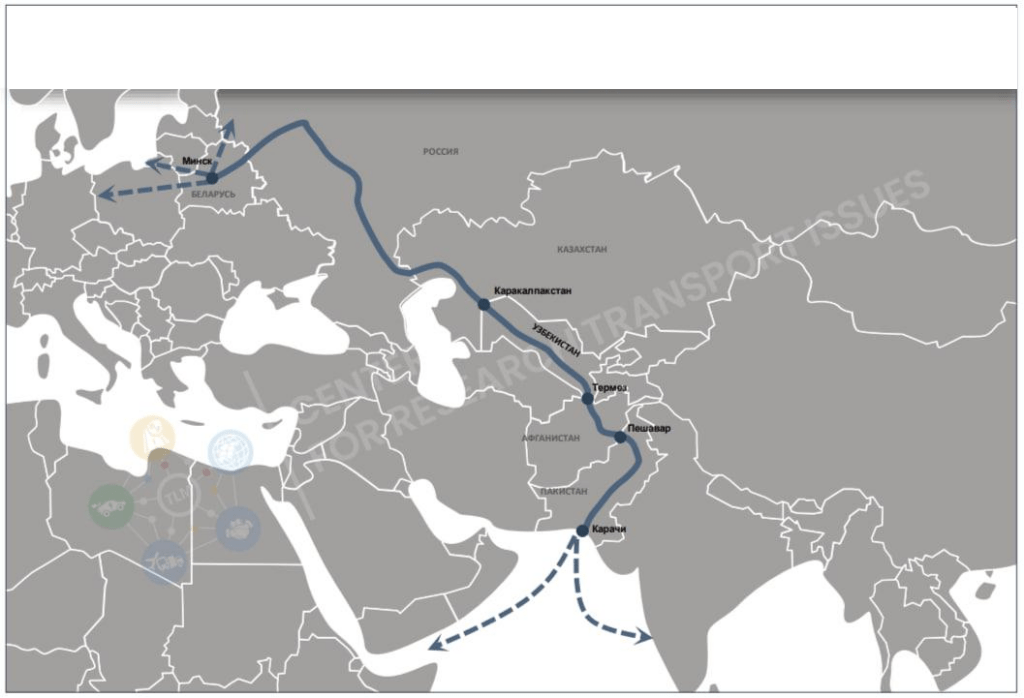
Uzbekistan’s Ministry of Transport has announced that Pakistan has officially joined the memorandum of understanding on establishing and developing the international transport corridor "Belarus–Russia–Kazakhstan–Uzbekistan–Afghanistan–Pakistan–Indian Ocean." The Pakistani Ministry of Communications signed this memorandum on September 18. The process of creating this multimodal transport corridor began in August 2022, at a meeting between the Uzbek government and the Eurasian Economic Commission – the governing body of the Russian-led Eurasian Economic Union that also includes Armenia, Belarus, Kazakhstan, and Kyrgyzstan. In November 2023, the transport ministries of Russia, Kazakhstan, and Uzbekistan signed a memorandum of understanding, launching the project's active phase of work. The group's first meeting on developing the proposed multimodal transport corridor was held in April 2024 in Termez, Uzbekistan. During that meeting, Belarus joined the memorandum, while Afghanistan and Pakistan announced the beginning of internal procedures for joining the project. At that meeting, a roadmap was signed, including specific plans for the development of cargo transportation, analysis of cargo flows, introduction of electronic digital documents, and optimization of customs procedures. The participating countries expect that the new corridor will become an important link in Eurasia's transport system, providing convenient and efficient routes for the transit of goods and strengthening economic cooperation.

Tokayev Gets Pundits Talking with “Invincible” Russia Remark

Carl von Clausewitz, the Prussian military theorist, described war as “the realm of uncertainty.” So, is Russia militarily invincible? Kazakh President Kassym-Jomart Tokayev´s emphatic statement earlier this week that Russia can’t be defeated on the battlefield had analysts, observers and history buffs musing about whether the proposition is actually true, and what if any politics were behind the widely reported remark. Tokayev made the point in a conversation with visiting German Chancellor Olaf Scholz as part of a general argument for peace more than two years after Russia’s full-scale invasion of Western-backed Ukraine. The official English-language translation of Tokayev’s comment didn’t include “invincible,” but basically said the same thing: “It is a fact that Russia cannot be defeated militarily.” For some people, the remark was a blunt assessment of a grinding conflict that, according to a report this week in The Wall Street Journal, has killed and injured about one million Russians and Ukrainians. For others, it amounted to a kind of pro-Russian defeatism, even though Kazakhstan and other Central Asian countries have angled for neutrality, not endorsing the invasion but maintaining traditional ties with Moscow. Roland Kater, an analyst and former commander in the Germany military, said he agreed – with caveats - with Tokayev’s assessment that Russia was militarily invincible. “With regard to the war in Ukraine, I would say yes at the moment, under the given conditions,” Kater said on Germany’s Welt news channel. He noted that NATO, which supports Ukraine won’t enter the war “as an institution.” “The result is that Ukraine cannot actually win this war at the moment and that the Russians there are, I don’t want to say unbeatable, but they are in the lead,” Kater said. Russia earned a reputation for resilience in past wars, after initial setbacks on its own territory and at great cost. It prevailed over Charles XII at the Battle of Poltava in 1709 after the Swedish king’s invasion of Russia; prevailed over Napoleon during the disastrous 1812 invasion in which the French emperor seized Moscow but was forced to retreat as disease, harsh weather and other problems took a toll; and prevailed over Adolf Hitler when the German invasion of the Soviet Union in 1941 eventually faltered with massive casualties on both sides. Still, the Washington-based Central Asia Consulting group, a critic of Russia, said there was no basis for Tokayev’s comment about Russia’s military invincibility and made some unflattering historical references. “Russia has faced defeats in the past wars (Crimean War, Russo-Japanese War, WWI, Winter War, Afghanistan, First Chechen War, Tajikistan War),” the group said on X. In his remarks, Tokayev also said “further escalation of the war will lead to irreversible consequences” for humanity, in what appeared to be a message for the West since he was in the company of Scholz when he said it. Scholz agreed that peace was the best option but that Russia could end the war anytime by stopping its aggression. Ukrainian President Volodymyr Zelenskyy, meanwhile, is expected to present what...

Redefining Diplomacy: Kazakhstan’s Strategic Shift in Relations With Afghanistan

On September 9, 2024, President Kassym-Jomart Tokayev signed a decree dismissing Alimkhan Yesengeldiyev from the position of Kazakhstan's Ambassador to Afghanistan. Yesengeldiyev has been at the post since April 2018. Local media have not yet reported on the appointment of a new ambassador. Previously, Astana has made bold diplomatic steps towards normalizing relations with Afghanistan under Taliban rule. For instance, Kazakhstan accredited Taliban diplomats in April 2023, and removed the Taliban from its list of banned organizations in December 2023. On August 21 of this year, Kazakhstan accredited the head of the Afghan diplomatic mission as charge d'affaires in the country. Astana continues to increase trade, economic, and humanitarian cooperation with the de facto authorities, and has actively engaged in various international platforms for initiatives in Afghanistan. Moreover, President Tokayev outlined Kazakhstan's position on the situation in Afghanistan just a month after the Taliban seized Kabul, when the world was still in shock. “Kazakhstan sees the future Afghanistan as a truly independent and united state living in peace with itself and its neighbors," he stated. "At this crucial historical moment, the multinational people of Afghanistan should not be left alone in the face of unprecedented difficulties.” By changing the head of its diplomatic mission in Kabul, it appears that the authorities in Kazakhstan intend to qualitatively improve the state of their relations with the Taliban. The eventual appointment of a new head of the Kazakh embassy will symbolize a new page in relations. In all likelihood, according to recognized international practice, a diplomat will be presented to the Taliban not in the rank of Ambassador Extraordinary and Plenipotentiary but as the Charge d'Affaires of Kazakhstan. This will preserve the principle of parity and be understandable given international disputes surrounding recognition of the Taliban. Overall, Kazakhstan's foreign policy steps have always been characterized by consistency and an unwavering focus on international law. It seems that the world as a whole is now acclimatizing to the idea of pragmatic dialog with the authorities in Kabul, with whom it is necessary to maintain constant bilateral and multilateral diplomatic contacts. On September 27, at the official request of the British government, the embassy of the former Islamic Republic of Afghanistan in London will officially cease operations. The embassy building will not be handed over to the Taliban or any other political representation. The embassy in Oslo representing the former government in Afghanistan has also ceased functions since September 12 at the request of the authorities there. Neither the British nor the Norwegian authorities are currently commenting on the situation. A few days ago, Deutsche Welle reported that the German Foreign Ministry has accepted the Taliban's application to recognize their consulate general in Munich as the sole center for providing consular services in Germany. In July, the Taliban Foreign Ministry declared that documents issued by 14 Afghan missions abroad are illegitimate. They were located in Britain, Berlin and Bonn in Germany, Belgium, Switzerland, Austria, France, Italy, Greece, Poland, Australia, Sweden, Canada, and Norway. Currently, the...

Kazakhstan Chairs International Fund for Saving the Aral Sea

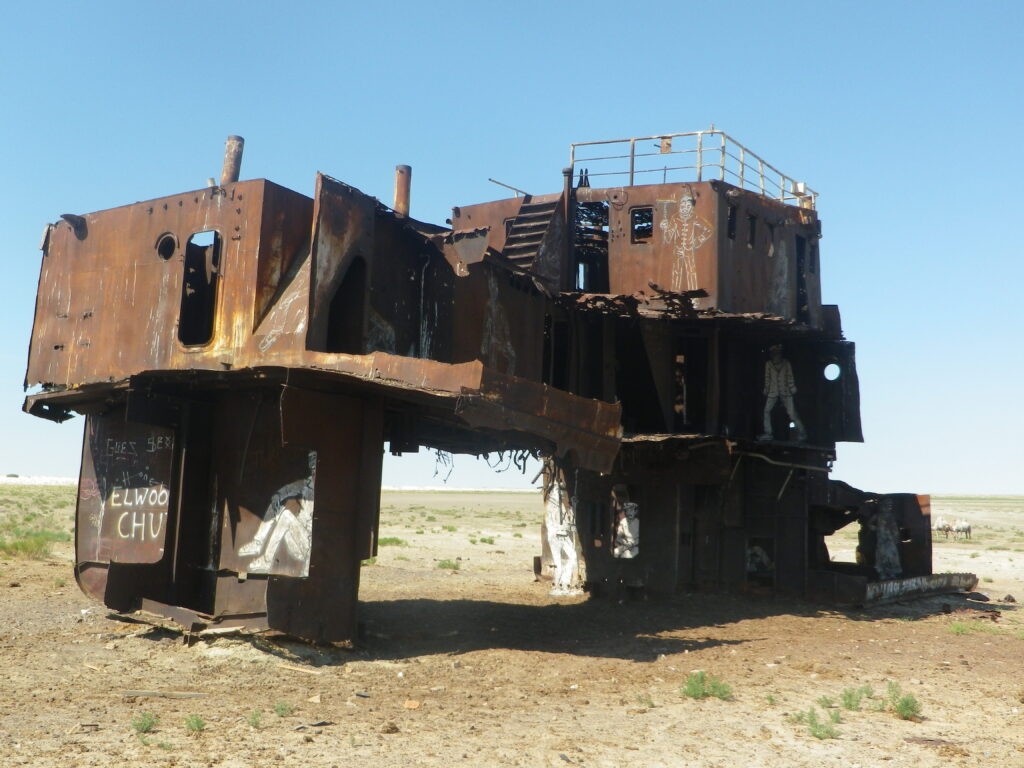
Since the beginning of 2024, 1.9 billion cubic meters of water have been sent to the North Aral Sea, raising its volume to 22 billion cubic meters. This announcement was made by Kazakhstan’s Minister of Water Resources and Irrigation Nurzhan Nurzhigitov  at the first meeting of the Board of the International Fund for Saving the Aral Sea (IFAS) on September 18, attended by delegations from  Kazakhstan, Tajikistan, Turkmenistan, Uzbekistan, and Kyrgyzstan ( as an observer country). The IFAS was established in 1993 to unite efforts by participating countries to mitigate the negative impact of the Aral Sea's desertification on the natural environment and the region's population. Discussions focused on progress on two large-scale projects: a program to assist the Aral Sea basin countries, and the Regional Environmental Protection Program for Sustainable Development in Central Asia, which aims to develop the principles of green economy and adaptation to climate change. The meeting commended Kazakhstan's commitment to working in close cooperation with other Central Asian states on preserving the Aral Sea and approved plans for work to be undertaken by the IFAS under President Kassym-Jomart Tokayev chairmanship from 2024-'26. "At the height of this year's irrigation period, up to 80 cubic meters of water per second flowed into the sea along the Syr Darya River, compared to only six cubic meters per second last year. In recent years, the volume of water in the North Aral Sea has been decreasing, but since the beginning of 2024, it has increased again and reached 22 billion cubic meters," stated Nurzhigitov. " To ensure a further increase -  we are strengthening water diplomacy and developing the second phase of the North Aral Sea conservation project." The North Aral Sea, the portion of the former Aral Sea fed by the Syr Darya River, split from the South Aral Sea in 1987–'88 when water levels dropped due to water diversion for agricultural use. According to the Kazakh Ministry of Water Resources, 75% of the flow of the Syr Darya River comes from Kyrgyzstan, 20% from Uzbekistan, and 5% from Kazakhstan.

Agreement by Kazakhstan and Turkey on Air Transit

The Government of Kazakhstan has signed an agreement with Turkey on the transit of military equipment and personnel through the airspace of both countries. The resolution, adopted on September 11, establishes a procedure for using air corridors regulated and authorized by the Ministry of Defense, responsible for the transit of military equipment and personnel; the Ministry of Foreign Affairs, responsible for issuing annual and one-time diplomatic permits (DCNs); and the Turkish Ministry of National Defense. Each party has committed to submitting a formal request through diplomatic channels by December 1 of a given year to obtain an annual diplomatic authorization number (DCN) which will be valid for transit operations  from January 1 to December 31 of the following year. Enabling the transit of official delegations, military equipment and personnel, humanitarian aid, and diplomatic cargo, the decree comes into force from the day of its signing. The draft agreement between the governments of Kazakhstan and Turkey on the transit of military property and personnel through the airspace of both countries was published on the portal “Open NPA” on August 13 and was under discussion until August 27.  The move which illustrates the strengthening relationship between the two countries, follows Kazakhstan's president's attendance  at Recep Tayyip Erdogan's inauguration as president in Ankara in June 2023,  Erdogans visit to Astana in November of the same year, and his return in July 2024, for the SCO Summit.