• KGS/USD = 0.01144 0%
  • KZT/USD = 0.00212 0%
  • TJS/USD = 0.10456 0.19%
  • UZS/USD = 0.00008 0%
  • TMT/USD = 0.28490 0%
  • KGS/USD = 0.01144 0%
  • KZT/USD = 0.00212 0%
  • TJS/USD = 0.10456 0.19%
  • UZS/USD = 0.00008 0%
  • TMT/USD = 0.28490 0%
  • KGS/USD = 0.01144 0%
  • KZT/USD = 0.00212 0%
  • TJS/USD = 0.10456 0.19%
  • UZS/USD = 0.00008 0%
  • TMT/USD = 0.28490 0%
  • KGS/USD = 0.01144 0%
  • KZT/USD = 0.00212 0%
  • TJS/USD = 0.10456 0.19%
  • UZS/USD = 0.00008 0%
  • TMT/USD = 0.28490 0%
  • KGS/USD = 0.01144 0%
  • KZT/USD = 0.00212 0%
  • TJS/USD = 0.10456 0.19%
  • UZS/USD = 0.00008 0%
  • TMT/USD = 0.28490 0%
  • KGS/USD = 0.01144 0%
  • KZT/USD = 0.00212 0%
  • TJS/USD = 0.10456 0.19%
  • UZS/USD = 0.00008 0%
  • TMT/USD = 0.28490 0%
  • KGS/USD = 0.01144 0%
  • KZT/USD = 0.00212 0%
  • TJS/USD = 0.10456 0.19%
  • UZS/USD = 0.00008 0%
  • TMT/USD = 0.28490 0%
  • KGS/USD = 0.01144 0%
  • KZT/USD = 0.00212 0%
  • TJS/USD = 0.10456 0.19%
  • UZS/USD = 0.00008 0%
  • TMT/USD = 0.28490 0%

Viewing results 1783 - 1788 of 4651

Kazakhstan Expands Invataxi Services with Taxi Aggregator Partnership

Kazakhstan is expanding its efforts to provide accessible transportation for people with disabilities through the Invataxi project, which offers specially adapted minivans for travelers with mobility challenges. In a significant step forward, the Ministry of Labor and Social Protection of the Population has partnered with a taxi aggregator to enhance and streamline the service, making it more accessible and efficient. As part of a pilot project launched in 2024, people with disabilities in Astana and Almaty used Invataxi services via the Yandex Go mobile application more than 207,000 times. This marks a dramatic increase compared to 2023 when the service was used 53,900 times. The pilot project introduced the use of passenger cars alongside the adapted minivans, significantly broadening the availability of transportation options. Previously, users had to book Invataxi rides by phone at least a day in advance. Now, thanks to Yandex's integration, users can request rides instantly via the mobile app, making the process faster and more convenient. A critical aspect of the pilot was that Yandex waived any commission on payments for these rides, ensuring affordability for passengers. The Yandex Go application includes a special feature that allows passengers with disabilities to notify drivers of any specific requests for the trip. Additionally, drivers have been trained to assist passengers with disabilities in entering and exiting the vehicle, further enhancing the service's accessibility. The pilot project initially operated in Astana and Almaty but will now be expanded to other regions across the country in 2025, as part of the government’s plan to replicate its success nationwide. In parallel with the Invataxi project, Kazakhstan is also investing in other accessible transportation initiatives, including the expansion of its fleet of Invacarriages specially adapted train carriages designed to accommodate people with disabilities. These efforts underscore the country’s commitment to improving mobility and inclusivity for all its citizens.

New U.S. Anti-Russian Sanctions Could Spell Trouble for Central Asian Economies

On January 10, 2025, the U.S. Treasury Department announced a new package of sanctions targeting Russia’s energy sector. The measures, which affect a wide range of organizations and individuals, are set to take effect on February 27. While ostensibly aimed at undermining Russia’s economic interests amid the ongoing conflict in Ukraine, the sanctions are likely to have significant repercussions for Central Asian countries given their close economic ties with Russian energy giants. The sanctions package, viewed by some analysts as a final move by the outgoing Biden administration, could become a potent tool for the incoming administration to exert influence over Russian interests in Central Asia. Sanctions on Gazpromneft Subsidiaries The new sanctions include restrictions on Gazpromneft's subsidiaries operating in Central Asia. Affected entities include Gazpromneft Tajikistan, Gazpromneft Kazakhstan, Gazpromneft Asia (Kyrgyzstan), and Munai Myrza (Kyrgyzstan). According to the U.S. Treasury Department, Gazpromneft and its regional subsidiaries are considered critical sources of revenue that support Russia’s military efforts in Ukraine. In response, Gazpromneft characterized the sanctions as "unfounded, illegitimate and contrary to the principles of free competition." The impact of these sanctions, however, could prove severe for the economies of Central Asia, where Gazpromneft plays a key role in the energy sector. Gazpromneft Asia, for example, is a major supplier of petroleum products in Kyrgyzstan, making it a critical player in the domestic market. Sanctions on the company could disrupt fuel supplies and drive up energy prices in the country. Gazpromneft Kazakhstan LLP, based in Almaty, operates a network of Gazpromneft-branded gas stations in Kazakhstan. While disruptions to fuel supplies in this network might not critically affect Kazakhstan’s economy - the largest in Central Asia - the sanctions carry broader implications. Threats to Joint Projects Beyond direct sanctions on companies, several executives of Russian oil firms actively operating in Kazakhstan have been added to the U.S. sanctions list. Key figures include Vadim Vorobyev, President of Lukoil PJSC and a member of Kazakhstan’s Foreign Investors Council. Lukoil is a strategic partner of KazMunaiGas (KMG) in production and exploration projects; Nail Maganov, CEO of Tatneft, which collaborates with KMG on projects such as Karaton Podsolovaya, Butadiene, and the Saran Tire Plant; Alexander Dyukov, the Chairman of Gazpromneft, and Sergei Kudryashov, CEO of Zarubezhneft, which has signed letters of intent for joint projects with KMG. These sanctions could complicate existing partnerships and delay key projects, undermining Kazakhstan’s energy sector and its broader economic growth. Sanctions on Rosatom and Nuclear Energy Another significant element of the sanctions package is the inclusion of Rosatom executives on the U.S. sanctions list. This development poses challenges to Kazakhstan’s plans to establish an international consortium - including representatives from France, South Korea, China, and Russia - to build a nuclear power plant. With Rosatom facing restrictions, the consortium is now likely to exclude Russia, potentially straining relations between Astana and Moscow. A global leader in nuclear energy, Rosatom was expected to play a central role in the project. Kazakhstan may now explore alternative arrangements, balancing its energy ambitions with the...

Kazakhstan Increases Water Levels in North Aral Sea by 42%

Kazakhstan’s efforts to restore the North Aral Sea have yielded significant results, with the water volume increasing by 42% to 27 billion cubic meters. The salinity of the sea has decreased nearly fourfold, and annual fish catches have risen to 8,000 tons. These achievements were highlighted by Minister of Water Resources and Irrigation Nurzhan Nurzhigitov during a meeting with residents of the Aral district in the Kyzylorda region on January 13. The North Aral Sea restoration project, initiated in response to the catastrophic shrinkage of the Aral Sea, focuses on the portion of the sea fed by the Syr Darya River. The North Aral Sea separated from the South Aral Sea in 1987-1988 due to declining water levels caused by extensive water diversion for agriculture. During the meeting, Nurzhigitov discussed plans for the second phase of the project, which aims to: Further increase water levels in the North Aral Sea; Improve water accumulation and management; Expand fisheries and promote ecotourism; Enhance the region’s overall ecological health. In 2024, Kazakhstan directed approximately 2.6 billion cubic meters of water into the Aral Sea, a dramatic increase compared to 816 million cubic meters in 2022. Nurzhigitov attributed the project’s success to the efficient distribution of water from the transboundary Syr Darya River, achieved through close cooperation with upstream countries. "These figures are the result of systematic work over the past two years. We [Kazakhstan] have reached a mutual understanding with neighboring countries on the conservation and fair distribution of water resources in transboundary rivers,” Nurzhigitov said. The minister emphasized that the project’s ultimate goal is to improve the region’s ecology, boost fisheries and tourism, and enhance the quality of life for local communities. The restoration of the North Aral Sea has become a symbol of Kazakhstan’s commitment to addressing ecological challenges while fostering sustainable development. By prioritizing cooperation with regional partners and implementing systematic water management strategies, the initiative offers hope for reversing decades of environmental degradation and improving economic opportunities for communities in the region.

Two Dead, One Injured in Hostage Situation in Kazakhstan

A hostage situation in the Kazakh city of Aktobe on January 13 has left two people dead and a young woman seriously injured. The events unfolded around 8pm when police received a report of a man breaking into a private residence and taking a young woman hostage. Emergency services promptly arrived at the scene, cordoning off the area. According to the press service of the Aktobe Region Police Department, both the department chief and the city prosecutor were present and personally led negotiations with the suspect. Authorities revealed that the suspect was previously acquainted with the hostage. However, the man made no demands during the standoff. After three hours of failed negotiations, law enforcement decided to storm the house. The operation resulted in the successful arrest of the suspect and the rescue of the hostage. Tragically, the woman’s elderly parents were discovered in the cellar during the inspection of the house. Both had sustained stab wounds. The 67-year-old mother succumbed to her injuries while en route to the hospital, and the 75-year-old stepfather died during emergency surgery. The rescued hostage also sustained serious injuries, including slash wounds to her head and hands. She remains hospitalized in critical condition and is receiving both medical and psychological care. A criminal case has been opened in connection with the incident. The suspect is currently being held in a temporary detention center as investigations continue. Authorities have not disclosed further details about the attacker’s motives, leaving the community in shock as they mourn the loss of two lives and hope for the recovery of the injured woman.

Kazakhstan Named Most Promising Destination for Chinese Travelers

Kazakhstan has affirmed its credentials as a tourist destination for Chinese travelers, receiving the award for “Most Promising New Destination of 2025” from Tongcheng Travel, China's largest online travel agency. Demand for travel to Kazakhstan surged by 300% year-on-year in 2024, according to Tongcheng. This growth trend is expected to continue in 2025, fueled in part by the Year of Kazakhstan Tourism in China. During this campaign, the number of tourists from China increased by 78%, reaching 655,000 visitors. Kazakhstan’s natural diversity, historical landmarks, and rich cultural heritage have proven to be major draws for Chinese travelers. “We have recorded a two-fold increase in the number of tourists from China and intend to maintain this positive dynamic. Our cooperation with leading Chinese platforms will expand,” said Kairat Sadvakasov, Chairman of Kazakh Tourism. Kazakhstan’s appeal as a tourist destination extends beyond China. Western travel journalists have also acknowledged the country’s potential. The British publication Lonely Planet included Kazakhstan in its list of the best travel destinations for 2024, whilst CNN Travel named Almaty as one of the top tourist destinations for 2025. These accolades reflect Kazakhstan’s efforts to establish itself as a major global tourism hub, leveraging its unique natural beauty and cultural heritage to attract visitors from around the world. Kazakhstan’s recognition by Tongcheng Travel underscores its growing reputation in the Chinese market, which has immense potential given the scale of outbound tourism from China. By fostering partnerships with major Chinese platforms and continuing to promote its diverse offerings, Kazakhstan is poised to solidify its position as a leading destination for travelers in the region.

NASA Discovers ‘Ghost’ Island in the Caspian Sea

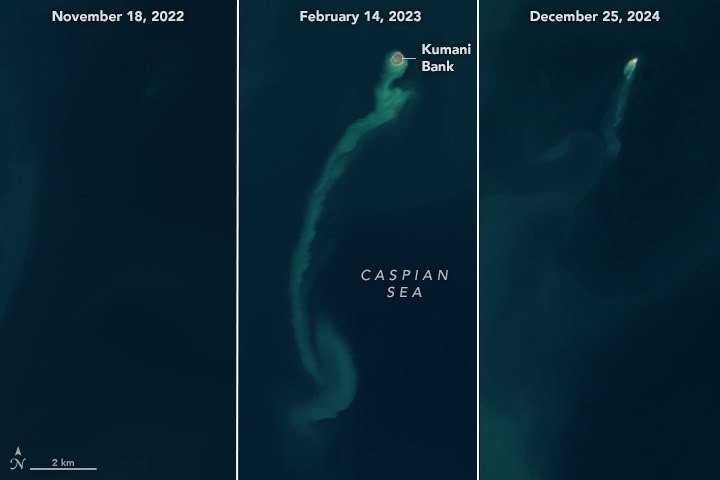
NASA satellites have detected a fascinating phenomenon in the Caspian Sea: the temporary formation of an island following the eruption of the Kumani mud volcano. According to data from NASA's Earth Observatory, the island emerged in early 2023 but had almost completely disappeared by the end of 2024, earning it the nickname “ghost island.” The island was first observed using Landsat 8 and 9 satellite imagery in January 2023, shortly after the volcano erupted. It measured up to 400 meters wide and was accompanied by a visible sedimentary plume extending from its surface. However, by late 2024, the island had diminished significantly, leaving only faint traces of its existence. The Kumani mud volcano, located 25 kilometers off the eastern coast of Azerbaijan, is no stranger to such occurrences. Since its first recorded eruption in 1861, the volcano has periodically created temporary islands, which vanish after short periods. Mud volcanoes like Kumani are common in regions with active tectonic activity. They eject high-pressure mixtures of water, gas, and sediment, forming landmasses that are often unstable and short-lived. The Caspian region is notable for its high concentration of mud volcanoes, with more than 300 such formations in Azerbaijan and on the Caspian Sea shelf. Many of these volcanoes emit combustible gases, particularly methane, which has drawn the interest of scientists and geologists. The connection between these mud volcanoes and the hydrocarbon systems of the South Caspian Basin makes them critical subjects for research. The emergence and disappearance of this “ghost” island in the Caspian Sea highlight how much remains to be understood about mud volcanoes. These transient landforms demonstrate the dynamic forces of nature and underscore the need for further exploration of geological processes occurring on the seafloor.