
• KGS/USD = 0.01143 0%
  • KZT/USD = 0.00216 0%
  • TJS/USD = 0.10684 -0.28%
  • UZS/USD = 0.00008 0%
  • TMT/USD = 0.28571 0%
  • KGS/USD = 0.01143 0%
  • KZT/USD = 0.00216 0%
  • TJS/USD = 0.10684 -0.28%
  • UZS/USD = 0.00008 0%
  • TMT/USD = 0.28571 0%
  • KGS/USD = 0.01143 0%
  • KZT/USD = 0.00216 0%
  • TJS/USD = 0.10684 -0.28%
  • UZS/USD = 0.00008 0%
  • TMT/USD = 0.28571 0%
  • KGS/USD = 0.01143 0%
  • KZT/USD = 0.00216 0%
  • TJS/USD = 0.10684 -0.28%
  • UZS/USD = 0.00008 0%
  • TMT/USD = 0.28571 0%
  • KGS/USD = 0.01143 0%
  • KZT/USD = 0.00216 0%
  • TJS/USD = 0.10684 -0.28%
  • UZS/USD = 0.00008 0%
  • TMT/USD = 0.28571 0%
  • KGS/USD = 0.01143 0%
  • KZT/USD = 0.00216 0%
  • TJS/USD = 0.10684 -0.28%
  • UZS/USD = 0.00008 0%
  • TMT/USD = 0.28571 0%
  • KGS/USD = 0.01143 0%
  • KZT/USD = 0.00216 0%
  • TJS/USD = 0.10684 -0.28%
  • UZS/USD = 0.00008 0%
  • TMT/USD = 0.28571 0%
  • KGS/USD = 0.01143 0%
  • KZT/USD = 0.00216 0%
  • TJS/USD = 0.10684 -0.28%
  • UZS/USD = 0.00008 0%
  • TMT/USD = 0.28571 0%

Viewing results 199 - 204 of 988

In Kyrgyzstan, 13,000 Low-Income Families Receive Funds to Launch Businesses

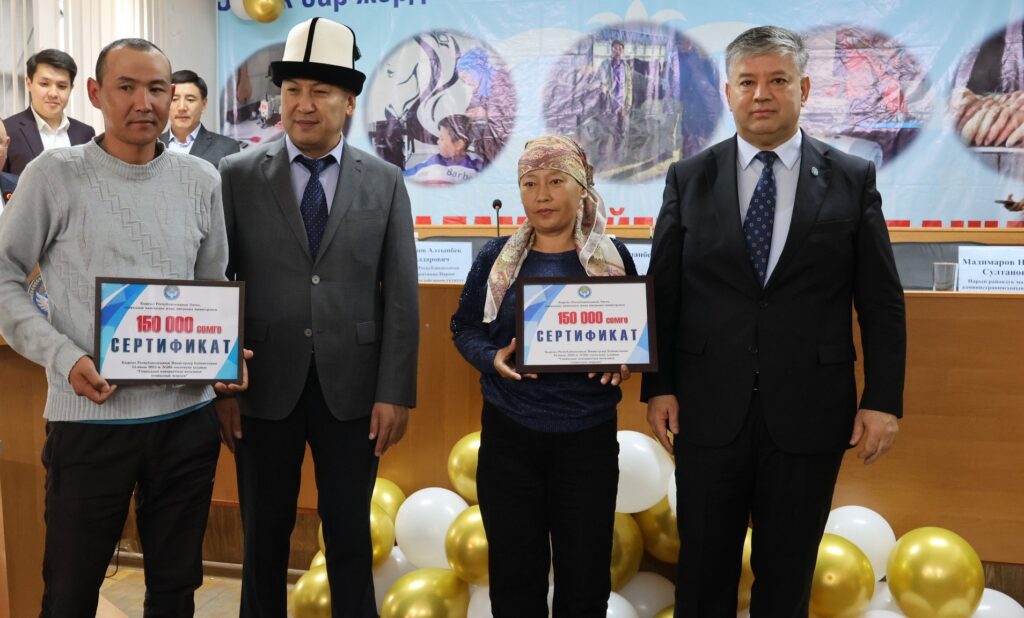
Over the past two years, 13,333 families in Kyrgyzstan living below the subsistence level have signed social contracts with the state. Through this initiative, each family received an interest-free loan of $1,700 to start a small business. According to the Ministry of Labor, the social contract program is designed to help families break the cycle of poverty by providing both start-up capital and practical support. Recipients use the funds to establish businesses, engage in subsistence farming, or purchase tools and equipment. In addition to financial assistance, the program offers training and consulting in sustainable agriculture and income-generating practices. How the Program Works Participants can use the funds to acquire equipment, materials, and other business essentials. The initiative has supported the creation of sewing workshops, food production facilities, apiaries, and small-scale poultry farms. Many recipients now produce honey, natural juices, felt goods, and meat products. The program is open to both new ventures and the expansion of existing microbusinesses. Specially trained consultants guide participants through the process of launching and managing their businesses, helping to increase long-term viability. Results and Regional Reach Although the social contract program was launched five years ago, its most significant impact has been seen in the past two years. More than 13,000 families have become self-sufficient and no longer require government aid. The majority of successful projects have emerged in Kyrgyzstan’s southern provinces, particularly Jalal-Abad and Osh, where rural entrepreneurship has rapidly expanded. Government data indicates that over 280 different products have been developed through the program. While most are sold domestically, a small number are now being exported abroad. This social contract initiative is a cornerstone of the government’s strategy to combat poverty and promote self-employment. Authorities emphasize its role in stimulating economic activity in rural areas and encouraging entrepreneurship among vulnerable populations.

Modernization of Kyrgyzstan’s Largest Hydropower Plant Nears Completion

Kyrgyzstan is nearing a major milestone in its energy sector with the impending completion of modernization work at the Toktogul Hydropower Plant (HPP), the country’s largest energy facility, which generates approximately 40% of its electricity. According to the Ministry of Energy, the country consumed 10 billion kilowatt-hours (kWh) of electricity in the first half of 2025, of which 2.05 billion kWh were imported. Domestic production during this period included 6.616 billion kWh from large hydroelectric plants, 1.132 billion kWh from thermal power plants, 219.7 million kWh from small HPPs, and 0.141 million kWh from the nation’s only solar power plant. To reduce dependence on imports and address recurring power shortages, the government is prioritizing both the construction of new and the modernization of existing hydropower facilities. On July 15, a major milestone was reached at Toktogul HPP with the installation of a new rotor for hydroelectric unit No. 3, the last of the plant’s four turbines to undergo a full overhaul under a multi-year modernization project. The rotor, weighing 768 tons, is the heaviest component of the unit and was installed using two 400-ton cranes. A similar operation was last carried out nearly five decades ago, during the plant’s initial construction. Three of the four turbines have already been upgraded. Upon completion of work on unit No. 3 in November 2025, Toktogul’s total installed capacity will rise by 240 megawatts (MW), reaching 1,440 MW. This upgrade will enable the plant to generate an additional 525.3 million kWh of electricity annually. Alongside the Toktogul modernization, Kyrgyzstan is also advancing its small-scale hydropower capacity. By the end of 2025, 18 small hydropower plants with a combined capacity of 78.57 MW are expected to be completed. Two plants, with a total capacity of 10.29 MW, are already in test operation. Although the country’s only solar power plant currently produces 1.43 MW, this is set to change. Kyrgyzstan has launched construction of two major renewable energy projects in 2025: a 300 MW solar power plant and a 100 MW wind farm, marking a significant step toward diversifying the national energy mix and enhancing long-term energy security.

Kyrgyzstan Pushes for Flour Self-Sufficiency

Kyrgyzstan’s Minister of Water Resources, Agriculture, and Processing Industry, Bakyt Torobaev, has called on domestic millers to produce at least 200,000 tons of wheat annually in a bid to reduce the country’s reliance on flour imports. His remarks came during a groundbreaking ceremony for a new flour mill in the northern Chui region. Torobaev emphasized the need to boost local wheat production to cover at least four to five months of national flour demand each year. He also urged producers to work toward gradually lowering retail prices. “If flour producers work closely with farmers, understand and address their challenges, the situation will improve. The Ministry of Agriculture is ready to support the sector from seed selection and soil analysis to mechanization,” he stated. With coordinated efforts, the minister believes that the cost of domestically milled flour could become competitive with imports from Kazakhstan and Russia. Tackling Price Volatility and Import Dependence Due to limited domestic production, Kyrgyz flour is currently more expensive than imported alternatives. This price gap has left the country vulnerable: any disruption in imports has previously led to sharp increases in bread prices. Nevertheless, the local milling industry has shown robust growth in 2025. According to the Ministry of Agriculture, 215,000 tons of grain were processed in the first five months of the year. Once the new plant in Chui becomes operational, total national milling capacity is expected to exceed 300,000 tons annually. Expanding Capacity and Mechanization To support expanded production, 1,500 units of harvesting equipment have been deployed across Kyrgyzstan’s wheat-growing regions. The government has also relocated machinery from the Issyk-Kul and Naryn regions to high-output areas such as the south, Talas, and Chui. Harvesting operations are ongoing without interruption. Official statistics show that agriculture is becoming a major engine of economic growth. In the first half of 2025, GDP grew by 11.7%, surpassing 700 billion KGS ($8 billion). The food processing industry alone contributed 50 billion KGS ($500 million) to this growth.

Central Asia Faces Growing Energy Deficit

Central Asia is heading toward a serious energy crunch. According to the Logistan.info portal, regional demand for imported natural gas is expected to reach 25 billion cubic meters annually by 2030. This looming shortfall is driven by rapid population growth, around one million people per year, industrial expansion, declining domestic production, and the deteriorating state of aging infrastructure. Recent accidents in Bishkek, Tashkent, Dushanbe, and Ekibastuz illustrate the scale and urgency of the problem. Kazakhstan: Rising Output, Falling Exports Kazakhstan produced 59.2 billion cubic meters of gas in 2024, representing a 6.4% increase from the previous year. However, nearly half of this was reinjected into oil reservoirs to sustain production. Only 29 billion cubic meters were available for domestic consumption. Soaring internal demand has already led to a sharp decline in exports to China, which fell 40% to 8.7 billion cubic meters. Uzbekistan: From Exporter to Importer Uzbekistan's situation is even more precarious. In 2024, the country produced 44.6 billion cubic meters of gas and 713,400 tons of oil, figures that are in decline, dropping 4.5% and 8.5% respectively. To cover the shortfall, Tashkent has turned to Russia and Turkmenistan, purchasing $1.7 billion worth of gas. Uzbekneftegaz expects to produce just 26.5 billion cubic meters of commercial gas in 2025, far short of projected domestic needs. Kyrgyzstan, Tajikistan, and Turkmenistan Kyrgyzstan and Tajikistan produce virtually no hydrocarbons and rely entirely on imports of these resources. Meanwhile, demand continues to grow in tandem with their populations, and domestic energy generation falls short of even basic consumption needs. Turkmenistan remains the region’s top gas exporter, sending 41.3 billion cubic meters abroad in 2024. However, Ashgabat’s ability to increase exports is limited by its own growing domestic consumption, binding long-term contracts with China, and a lack of large-scale infrastructure development. Investment, Delays, and Structural Challenges While Central Asian governments have announced plans for new hydroelectric plants, combined heat and power stations, and nuclear power facilities, tangible progress remains slow. Kazakhstan, Kyrgyzstan, and Uzbekistan have yet to break ground on any of their proposed nuclear power projects. Key obstacles include a shortage of qualified personnel, water scarcity, environmental concerns, and, above all, insufficient funding. Without substantial foreign investment, modernization efforts are likely to stall. To ease financial pressures, countries in the region have begun raising gas and electricity tariffs. These price hikes aim to offset upgrade costs but have provoked public backlash and fueled inflation. In Uzbekistan, for instance, inflation accelerated to 15% in May 2025, with energy prices cited as the primary driver. The Russian Option Forecasts for regional gas imports remain imprecise, but analysts estimate the need could rise to 20-25 billion cubic meters annually by 2030. Russia appears poised to become the main supplier, though details of supply agreements, including pricing, volumes, and terms, have not been disclosed. Central Asian governments are attempting to keep cooperation with Moscow strictly within the economic sphere, wary of entangling political dependencies. As a result, the region faces a dual challenge: securing energy stability through...

Kyrgyzstan Enacts Code to Boost Financing for Female Entrepreneurs

Kyrgyzstan has officially enacted the Code on Financing Women Entrepreneurs, a regulatory framework aimed at expanding women’s access to financial products from banks and microfinance institutions. The National Bank of the Kyrgyz Republic (NBKR) will oversee the implementation of the Code, which it regards as a milestone in institutional support for women’s entrepreneurship. Speaking at the launch ceremony, NBKR Chairman Melis Turgunbaev emphasized the crucial role of women in the country’s economy, particularly within the small and medium-sized business sector. “The launch of the Code, backed by the recent legislative recognition of the concept of ‘women’s entrepreneurship,’ creates a solid institutional foundation for mobilizing financial sector resources and directing them toward the development of this strategically important segment of the economy,” Turgunbaev said. The legal definition of women’s entrepreneurship was introduced into Kyrgyz legislation only last year. Lawmakers noted that female entrepreneurs often face structural challenges, such as balancing business activities with domestic responsibilities and limited access to property assets that can serve as loan collateral. According to the Ministry of Economy and Commerce, the typical Kyrgyz female entrepreneur is between 40 and 50 years old, has a secondary education, runs a small or medium-sized enterprise, often individually and began her business career before turning 30. The new Code modifies financial regulations to simplify access to credit for women. Key provisions include expanded opportunities for unsecured lending and the removal of a previous requirement for financial institutions to set aside 1% of the loan amount for potential losses when lending to women. The NBKR believes these changes will make financing for women both strategically and commercially attractive across the banking sector. “Our actions are not just advocacy, they are about building sustainable market mechanisms,” said Turgunbaev. “The National Bank is establishing economically sound conditions that incentivize the entire financial sector to support women entrepreneurs.” According to the NBKR, the Code applies specifically to enterprises in which women own at least 51% of the capital and make up at least 51% of the workforce. Financial institutions are encouraged to offer more accessible, long-term loans to qualifying women-led businesses on preferential terms. However, The Times of Central Asia has learned that the Code currently lacks a dedicated mechanism to support women facing loan repayment difficulties. Nonetheless, the regulator clarified that this does not restrict banks from granting relief measures. “The NBKR will not prevent commercial banks from offering concessions to women entrepreneurs with overdue loans under programs focused on financing women-led businesses,” a spokesperson said. The National Bank plans to coordinate the Code’s rollout and ongoing refinement, emphasizing that support for women entrepreneurs is viewed as a long-term institutional priority.

Kyrgyzstan Launches New Agro-Industrial Zone with $24 Million Investment

Kyrgyzstan has begun construction of a new agro-industrial zone in the Chui region as part of a broader effort to modernize agriculture, boost food production, and attract foreign investment. The facility is being developed by Kyrgyz Agroholding JSC in the village of Nurmanbet, just east of the capital Bishkek. Speaking at the capsule-laying ceremony on July 12, Deputy Prime Minister and Minister of Agriculture Bakyt Torobaev described the initiative as a critical step toward enhancing the country’s agricultural resilience and food sovereignty. “This is a large-scale initiative that will strengthen our agricultural sector, create jobs, and help ensure food security,” Torobaev said. The event also marked the signing of two major investment agreements totaling $24 million: A $12 million deal with South Korea’s DOD Company to support joint projects in meat livestock farming, logistics, and modern agricultural technologies. A separate $12 million agreement with Asyl Teri LLC to construct a tannery capable of processing up to 24 tons of animal hides per day. The Chui agro-industrial zone is expected to significantly increase the value of Kyrgyz agricultural products while drawing additional investment into a sector that already contributes nearly 18% of the nation’s GDP and employs almost half of its workforce. Government officials emphasize that the new zone will offer improved infrastructure, greater market access, and cutting-edge technologies to farmers and agribusinesses, enhancing Kyrgyzstan’s competitiveness in regional food production.
