
• KGS/USD = 0.01144 0%
  • KZT/USD = 0.00217 0%
  • TJS/USD = 0.10456 0%
  • UZS/USD = 0.00008 0%
  • TMT/USD = 0.28571 0%
  • KGS/USD = 0.01144 0%
  • KZT/USD = 0.00217 0%
  • TJS/USD = 0.10456 0%
  • UZS/USD = 0.00008 0%
  • TMT/USD = 0.28571 0%
  • KGS/USD = 0.01144 0%
  • KZT/USD = 0.00217 0%
  • TJS/USD = 0.10456 0%
  • UZS/USD = 0.00008 0%
  • TMT/USD = 0.28571 0%
  • KGS/USD = 0.01144 0%
  • KZT/USD = 0.00217 0%
  • TJS/USD = 0.10456 0%
  • UZS/USD = 0.00008 0%
  • TMT/USD = 0.28571 0%
  • KGS/USD = 0.01144 0%
  • KZT/USD = 0.00217 0%
  • TJS/USD = 0.10456 0%
  • UZS/USD = 0.00008 0%
  • TMT/USD = 0.28571 0%
  • KGS/USD = 0.01144 0%
  • KZT/USD = 0.00217 0%
  • TJS/USD = 0.10456 0%
  • UZS/USD = 0.00008 0%
  • TMT/USD = 0.28571 0%
  • KGS/USD = 0.01144 0%
  • KZT/USD = 0.00217 0%
  • TJS/USD = 0.10456 0%
  • UZS/USD = 0.00008 0%
  • TMT/USD = 0.28571 0%
  • KGS/USD = 0.01144 0%
  • KZT/USD = 0.00217 0%
  • TJS/USD = 0.10456 0%
  • UZS/USD = 0.00008 0%
  • TMT/USD = 0.28571 0%

Viewing results 151 - 156 of 1504

Icy Relations Between Pakistan and Afghanistan Threaten Central Asian Trade Plans

On November 25, the Afghan authorities accused Pakistan of a new round of airstrikes in eastern Afghanistan. The bombing killed nine children and a woman, injuring several others. The attacks are the latest escalation in rapidly worsening tensions between Islamabad and the Taliban-led government in Kabul, with key border crossings currently closed, and Afghan refugees being expelled from Pakistan. At the heart of the crisis is Pakistan’s claim that Kabul is providing support to the Tehrik-e-Taliban Pakistan (Pakistani Taliban, or TPP), a militant group seeking to topple Pakistan’s government and impose its strict interpretation of Islamic law. The fallout may ripple beyond bilateral relations, with significant consequences for Central Asian trade, particularly the Pakistan-Afghanistan-Uzbekistan plan for a Trans-Afghan railway. The planned 647-kilometer line is set to connect the northern Afghan city of Mazar-e-Sharif with Peshawar in Pakistan. When combined with existing infrastructure, this will mean that trains can travel from southern Uzbekistan all the way to the Pakistani ports of Gwadar and Karachi, granting landlocked Uzbekistan and Afghanistan a long-sought gateway to the Indian Ocean. But mounting instability, along with Islamabad’s willingness to shut borders as leverage, may now place the project in serious jeopardy. “The moment a state weaponizes geography, every financier in Tashkent, Moscow, or Beijing prices in risk, delays commitments, and quietly explores alternative alignments,” Anant Mishra, Marie Skłodowska-Curie Research Fellow at the International Centre for Policing and Security at the University of South Wales, told The Times of Central Asia. So, what are the prospects for salvaging the Trans-Afghan railway? How can Pakistan and Afghanistan de-escalate? And what does this turmoil mean for Central Asia’s wider economic ambitions? A sudden frost On July 17, Uzbekistan’s Transport Minister Ilkhom Makhkamov, Pakistan’s Railway Minister Muhammad Hanif Abbasi, and Afghanistan’s acting Public Works Minister Mohammad Esa Thani signed an agreement to conduct a feasibility study for the proposed railway. Many hoped the railway would presage a new era of fraternal relations between Central and South Asia. “Civil society, the intelligentsia, media, and business community of Pakistan have been loudly calling for intimate trade relations with the Central Asian Republics,” Khadim Hussain, Research Director at the Centre for Regional Policy and Dialogue (CRPD), Islamabad, told TCA. For Uzbekistan, which has aggressively pursued diversification of trade routes to reduce reliance on transit through Iran and Kazakhstan, the project promised a cheaper, faster corridor to global markets. According to Nargiza Umarova, Head of the Center for Strategic Connectivity at the Institute for Advanced International Studies, University of World Economy and Diplomacy in Tashkent, the trans-Afghan is one of two high-priority transport projects, along with the China-Kyrgyzstan-Uzbekistan railway – work on which began in April 2025. But the ink had barely dried on the July accord when tensions between Afghanistan’s Taliban government and Islamabad began escalating, throwing the ambitious railway into doubt. [caption id="attachment_40211" align="aligncenter" width="1600"] Uzbek passenger and freight trains parked in Andijan; image: TCA, Joe Luc Barnes[/caption] In early October, Pakistan launched an airstrike in Kabul targeting the leader of the...
China Demands That Tajikistan Protect Chinese Citizens After Attack

China is urging Tajikistan to “take all necessary measures” to protect Chinese citizens and businesses in Tajikistan’s border area, where several Chinese workers were killed in a drone attack that was carried out from neighboring Afghanistan last week. Tajik President Emomali Rahmon, meanwhile, met senior security officials in his government on Monday to discuss ways to strengthen security on the southern border with Afghanistan, whose ruling Taliban movement has expressed sorrow and promised to help find the attackers. “According to reports from officials, during the past week two incidents of gunfire occurred across the border into Tajikistan, resulting in five deaths and five injuries,” Tajikistan’s presidential office said. It said Rahmon “strongly condemned the illegal and provocative actions of Afghan citizens” and ordered security officials “to resolve the issue and prevent the recurrence of such unfortunate incidents.” The statement did not provide details on the five people who were killed. The government previously said a drone attack from Afghanistan targeted a camp housing company employees in Tajikistan’s southwestern Khatlon region last week, killing three Chinese workers. The government meeting on Monday came a day after Chinese ambassador Guo Zhijun called Tajik Foreign Minister Sirojiddin Muhriddin as well as a senior Tajik security official to discuss the border situation. “Guo demanded that Tajikistan take all necessary measures to ensure the safety of Chinese enterprises and citizens in Tajikistan,” the Chinese embassy in Dushanbe said on Monday. It noted that Tajikistan said it “will immediately upgrade its security measures to protect the safety of Chinese enterprises and citizens to the fullest extent of the law.” Chinese workers are involved in mining and construction projects in Tajikistan, which along with other countries in Central Asia is seeking to improve relations and develop trade with Afghanistan despite persistent security concerns. Tajikistan said that it used a drone to kill two suspected drug smugglers from Afghanistan in the border area last month. In August, Tajik guards and fighters from the Afghan Taliban exchanged fire. Afghanistan’s Ministry of Foreign Affairs has condemned the killings of the three Chinese workers last week and blamed that attack on “those seeking to create disorder, instability, & mistrust among the countries of the region.” It said it “stands ready for information-sharing, technical collaboration, & joint assessments in order to identify those responsible for the incident.” Separately, Afghanistan’s border to the east and south with Pakistan has been the focus of recent clashes between the two countries that killed dozens of people and disrupted trade. Pakistan accuses Afghanistan of providing sanctuary to militants who carry out attacks against Pakistani security forces, an allegation that the Taliban in Afghanistan denies.    

UN Meeting on Wildlife Trade Rules on Saiga, Striped Hyena

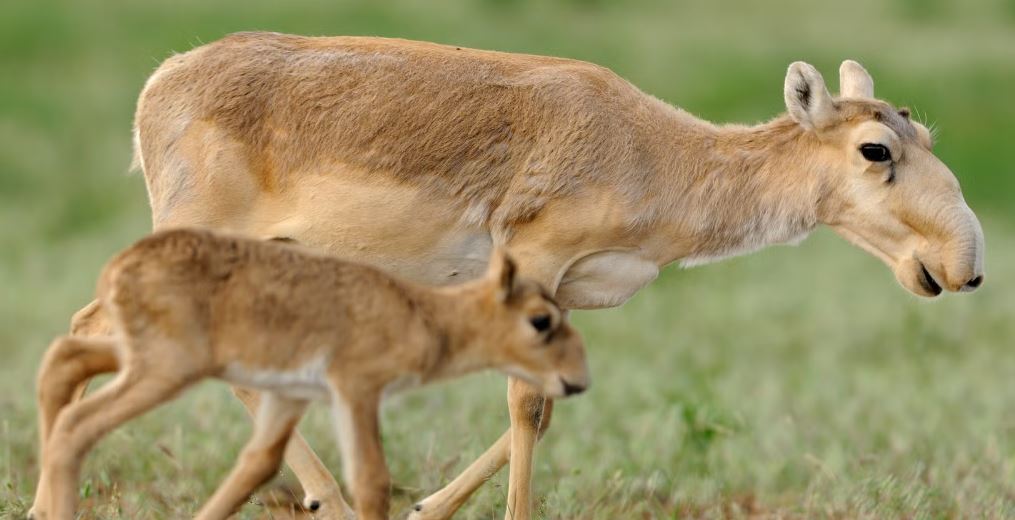
Delegates to a United Nations meeting on global wildlife commerce have approved a proposal by Kazakhstan to loosen trade restrictions on the saiga antelope, while rejecting a move by Tajikistan to tighten protections for the striped hyena. The decisions came in Samarkand, Uzbekistan, where several thousand representatives from around the world have gathered for a meeting of the Convention on International Trade in Endangered Species of Wild Fauna and Flora, or CITES. The conference, which runs from November 24 to December 5, was last held in Panama in 2022. The decision to relax trade in saigas, whose horns are used in traditional medicine, is a response to the spectacular recovery of the species after it was close to extinction. Kazakhstan presided over this conservation success story, and the CITES decision amends a “zero export quota” to exclude saigas only from populations Kazakhstan. A CITES committee adopted the proposal by a vote of 111 in favor, 7 against, and 14 abstentions, reported the Earth Negotiations Bulletin, which covers U.N. environment and development negotiations. A proposal needs a two-thirds majority vote to be approved. More saiga safeguards were added in an amendment backed by Britain, the European Union and the United States, and the situation will be reviewed at the next CITES meeting in a few years. Mongolia, which has a smaller, more vulnerable population of saigas, had opposed Kazakhstan’s initiative. Some groups, including the New York-based Wildlife Conservation Society, said the reopening of commercial trade in Kazakhstan’s saigas could increase consumer demand, promote poaching and put pressure on enforcement mechanisms. In the case of the striped hyena, Tajikistan unsuccessfully sought to persuade delegates to the wildlife trade meeting to place the species on Appendix I, a CITES designation that would effectively bar trade aside from with a few exemptions. The species, labeled “near threatened” by the global IUCN Red List of Threatened Species, is currently on the much less restrictive Appendix III. Algeria, Iran and Kazakhstan were among countries that backed Tajikistan’s proposal, while Britain, the European Union, Zambia and Tanzania said the proposal doesn’t meet Appendix I criteria, according to the Earth Negotiations Bulletin. A CITES committee rejected Tajikistan’s proposal in “a secret ballot of 75 for, 47 against and 13 abstentions,” the bulletin said, indicating that proponents did not pass the two-thirds threshold. The striped hyena has a vast range that includes Africa, the Middle East, and Central Asia, but there is difficulty in obtaining data on the solitary, noctural species. Additionally, while habitat degradation and human-wildlife conflict are factors in the population’s decline, uncertainty over how much the illegal trade in the striped hyena is affecting its numbers may have raised questions about whether Tajikistan’s proposal was justified.  

Number of Tajik Citizens on Russia’s “Controlled Persons” List Surpasses 150,000

The number of Tajik nationals included in Russia’s registry of “controlled persons” has risen sharply, according to new figures released by the Representative Office of Tajikistan’s Ministry of Labor, Migration and Employment in Russia. Citing the latest update, Asia-Plus reports that more than 150,000 Tajik citizens were listed as of November, an increase of approximately 30,000 since the last official count. The previous figures, published in October 2024, placed the number at over 120,000. Since then, the Tajik authorities have repeatedly urged migrants in Russia to legalize their status and take steps to be removed from the so-called “blacklist.” However, no updated statistics had been released until now. Russia’s controlled persons registry, which came into force on February 5, 2025, encompasses individuals accused of various administrative violations. These range from minor offenses such as unpaid utility bills and traffic infractions to failure to appear at state agencies despite repeated summonses. Russian authorities gave migrants until September 10 to regularize their documents and avoid inclusion in the system. In September, Russia’s Interior Ministry announced that around 770,000 people were registered nationwide, one-third of them women and children. Foreign nationals on the list face wide-ranging restrictions, including bans on changing their place of residence without permission, leaving their region, operating vehicles, purchasing property, or conducting specific financial transactions. Since the registry’s introduction, numerous migrants have reported being added to the list in error. Many only discovered their status after receiving bank notifications about frozen accounts or blocked transactions. Tajikistan’s migration office in Russia continues to advise citizens to verify their status through the Russian Interior Ministry’s online platform. Migrants whose names appear on the list are encouraged to contact local migration offices for assistance. Those unable to resolve their situation are urged to leave Russia within the legally mandated timeframe. Earlier this year, The Times of Central Asia reported that the Tajik authorities had called on labor migrants in Russia to renew their documents before the deadline when Russia's updated migration regulations came into effect. The Tajik Interior Ministry has reminded citizens that maintaining legal residency is essential for continued employment in the country.

Tajikistan to Repay Over $500 Million to Foreign Creditors in 2026

Tajikistan plans to allocate $548 million to repay its principal external debt in 2026, according to the country’s draft state budget. This would be one of the largest annual external debt payments in recent years for the republic. Most of the repayment will be covered directly from the national budget. A portion will also come from state-owned companies and enterprises that previously received sub-loans backed by government guarantees. These entities are now participating in the repayment process. In addition to external debt, Tajikistan’s domestic obligations in 2026 are projected at more than $51 million. Of that amount, $16 million will be serviced from the budget, while the remaining $34.5 million will be financed through the Ministry of Finance’s deposits at the National Bank of Tajikistan, as well as revenue from the sale and lease of assets belonging to the now-liquidated Agroinvestbank and Tajiksodirotbank, both of which have been transferred to state ownership. Despite these substantial repayments, Dushanbe plans to continue attracting foreign financing for development purposes. More than $678 million is earmarked for state investment projects in 2026, with funding to be directed toward the energy, infrastructure, and social sectors. According to the Ministry of Finance, as of October 1, Tajikistan’s total external debt stood at $3.037 billion, down $151 million, or 4.7%, from the beginning of the year. The figures indicate a gradual reduction in the country’s debt burden. The vast majority of the debt, 95.5%, or nearly $2.9 billion, is classified as direct government debt. Debt secured by state guarantees amounts to slightly over $138 million. China remains Tajikistan’s largest creditor, with over $700 million in outstanding loans. Other major lenders include the World Bank, the Asian Development Bank, the Islamic Development Bank, and the European Bank for Reconstruction and Development.

Tajikistan: Three Chinese Workers Killed in Drone Attack from Afghanistan

Three Chinese workers in Tajikistan were killed in a drone attack that was carried out from across the border in Afghanistan, Tajikistan's government said on Thursday. The attack targeted a camp housing company employees in Tajikistan’s southwestern Khatlon region on Wednesday night, according to the Ministry of Foreign Affairs. “This attack was carried out using an unmanned aerial vehicle” carrying explosives, the ministry said. “Despite the constant efforts by Tajikistan to maintain security and create an atmosphere of peace and stability in the border areas between Tajikistan and Afghanistan, the disruptive actions by criminal groups located in the territory of Afghanistan still continue,” it said. The ministry condemned “these acts of terrorist groups” and urged Afghan authorities to stabilize and secure their side of the border. Chinese workers are involved in mining and construction projects in Tajikistan. Trouble along the border with Afghanistan has flared from time to time. Tajikistan said that it used a drone to kill two suspected drug smugglers from Afghanistan in the area a week ago. In August, Tajik guards and fighters from Afghanistan’s ruling Taliban movement exchanged fire. The drone attack that killed the Chinese workers came ahead of a meeting on Thursday of the Collective Security Treaty Organization, a regional bloc. Leaders from the member countries of Russia, Belarus, Kazakhstan, Kyrgyzstan and Tajikistan gathered for the summit in Bishkek, Kyrgyzstan. Tajikistan has periodically asked the group for more help in securing its long frontier with Afghanistan.