• KZT/USD = 0.00218
  • TJS/USD = 0.10820
  • UZS/USD = 0.00009
  • TMT/USD = 0.29760
  • KZT/USD = 0.00218
  • TJS/USD = 0.10820
  • UZS/USD = 0.00009
  • TMT/USD = 0.29760
  • KZT/USD = 0.00218
  • TJS/USD = 0.10820
  • UZS/USD = 0.00009
  • TMT/USD = 0.29760
  • KZT/USD = 0.00218
  • TJS/USD = 0.10820
  • UZS/USD = 0.00009
  • TMT/USD = 0.29760
  • KZT/USD = 0.00218
  • TJS/USD = 0.10820
  • UZS/USD = 0.00009
  • TMT/USD = 0.29760
  • KZT/USD = 0.00218
  • TJS/USD = 0.10820
  • UZS/USD = 0.00009
  • TMT/USD = 0.29760
  • KZT/USD = 0.00218
  • TJS/USD = 0.10820
  • UZS/USD = 0.00009
  • TMT/USD = 0.29760
  • KZT/USD = 0.00218
  • TJS/USD = 0.10820
  • UZS/USD = 0.00009
  • TMT/USD = 0.29760
24 August 2026

Viewing results 13 - 18 of 1154

Internet Restrictions in Central Asia: How the Five Countries Differ

There is no single Central Asian internet. Crossing a border can turn a freely accessible website into one that is blocked or reachable only through a virtual private network (VPN). The contrast is starkest in Turkmenistan, where years of censorship have created a black market for access to the open internet. Freedom House’s 2025 Freedom on the Net assessment covers three of the five Central Asian countries. Kyrgyzstan scored 47 out of 100 and retained its Partly Free status. Kazakhstan scored 37, while Uzbekistan scored 29; both were classified as Not Free. Turkmenistan has the most restrictive system in the region. The largest measurement study of its internet censorship to date tested 15.5 million domains and found that more than 122,000 were blocked. Researchers also identified filtering rules that inadvertently made more than 5.4 million additional domains inaccessible. Bypassing these restrictions has developed into a market of its own. In July 2025, VPN keys were being sold for around $50 a month, while access through a connection exempt from government filters cost up to $2,000. Turkmen officials were also alleged to have been involved in selling such access. Such claims are difficult to verify independently inside one of the world’s most closed countries. Even so, the market illustrates the effect of years of blocking: for some residents, a working VPN can provide access to large parts of the internet that would otherwise remain unavailable. The situation in Kazakhstan is different. The internet is far more accessible than in Turkmenistan, although the authorities also use technical controls. A study published by the Open Observatory of Network Interference (OONI) found evidence that at least 17 news websites and 73 sites for circumvention tools were blocked between June 1, 2023, and June 1, 2024. The affected sites included independent media and major VPN services. Researchers also found evidence of Transport Layer Security (TLS) man-in-the-middle attacks, in which a third party intercepts an encrypted connection between a user and a website. This can allow the third party to read or alter the data passing through the connection. Similar technology prompted an international dispute in 2019, when internet service providers in Kazakhstan instructed users to install a government-issued security certificate capable of intercepting encrypted web traffic. Major browser developers responded by blocking the certificate or preventing their software from trusting it. Kazakhstan does not, however, operate a closed network. OONI found that some circumvention tools remained accessible, unlike in Turkmenistan, where stable access to the open internet can itself be difficult. Kyrgyzstan’s online environment has traditionally been more open than those of its Central Asian neighbors, though restrictions have increased in recent years.  Freedom House kept the country in the Partly Free category in 2025, lowering its score from 48 to 47. It cited the detention of journalists and activists, as well as pressure on online media. Government control has also extended to internet infrastructure. In July 2025, President Sadyr Japarov signed a decree giving state-owned operator ElCat a temporary monopoly on international internet traffic. The decree set the one-year trial...

What Do Former Presidents Do? From Akayev to Nazarbayev, the Fates of Central Asia’s Ex-Leaders

Central Asia has produced remarkably few former presidents who simply retired from public life. In Kyrgyzstan, former leaders have been driven from office, prosecuted, imprisoned, or forced into exile. Kazakhstan’s Nursultan Nazarbayev has followed a different path, largely withdrawing from public view after losing much of his political influence. Elsewhere, some of the region’s founding presidents died in office, leaving no post-presidential career to examine. The Times of Central Asia has previously examined how political succession has developed across the region. The fate of leaders after they leave office reveals another side of that political tradition. The architect of Kyrgyzstan’s early post-Soviet political model was its first president, Askar Akayev, who remained in office until 2005. Akayev introduced democratic institutions in Kyrgyzstan, but gradually tightened the pressure on his opponents as his presidency progressed. His rule was badly shaken by the Aksy shootings in 2002, which followed the prosecution of opposition lawmaker Azimbek Beknazarov and a territorial dispute with China. Akayev’s government had agreed to transfer disputed border territory to China, a decision fiercely criticized by the opposition. In March 2002, demonstrators in southern Kyrgyzstan demanded Akayev’s impeachment. Security forces opened fire during the unrest, killing several people. The shootings became one of the defining political crises of his presidency. In a 2003 referendum, Akayev significantly strengthened presidential powers at parliament’s expense. Economic hardship, unemployment, widespread corruption, and allegations of fraud in the 2005 parliamentary elections eventually helped trigger the Tulip Revolution in March of that year. Akayev had to flee, with rumors at the time claiming that he was smuggled out in the trunk of an official car, wrapped in a carpet. Criminal cases involving corruption were opened against him and members of his family in Kyrgyzstan. The authorities repeatedly sought his extradition from Russia, but were unsuccessful. After leaving Kyrgyzstan, Akayev lived in Moscow and taught at Moscow State University. In 2006, he became a foreign member of the Russian Academy of Sciences. In August 2021, Akayev reappeared in Bishkek. He unexpectedly flew into the country and was immediately questioned as part of the criminal investigation into corruption surrounding the Kumtor gold mine. Afterward, he said he had come to Bishkek for a week and was prepared to assist investigators. “I came to speak honestly and sincerely about how we built Kumtor, why we built it, and what mistakes may have been made. The investigation will continue,” he said. In 2023, Kyrgyzstan’s Prosecutor General’s Office announced that the criminal prosecution of Akayev had been terminated because the statute of limitations had expired. Tajikistan’s former president Rahmon Nabiyev was also forced from power. The former Soviet politician lost power amid the country’s civil war in 1992. He died at his home in Khujand the following year, at the age of 62, reportedly from a heart attack. According to his wife, Nabiyev spent his final months in Khujand in conditions resembling house arrest and received a pension of just five rubles. While Tajikistan did not repeat the experiment of violently...

Central Asian Music Takes the Stage in Berlin

Young Central Asian musicians have featured at the ongoing Young Euro Classic festival in Berlin. Since its beginnings in 2000, the festival has brought youth orchestras from around the world to the German capital, while the later addition of the Future Now series as a “festival within the festival” opened it to smaller experimental ensembles. It was not the first time that orchestras and smaller groups from Central Asia had performed at Young Euro Classic. Kazakh musicians had appeared before, including at the 2024 festival. Turkmen musicians also performed in Berlin later that year as part of the separate FUTURE NOW – Central Asia festival. However, this year’s performances introduced two new groups to Young Euro Classic audiences. On August 1, Mohiron from Dushanbe opened the Future Now series. The six Tajik musicians played traditional Tajik melodies, their own compositions, and arrangements of Western music at their sold-out concert. Their interpretations of Vivaldi’s “Escala Palladio” and Zequinha de Abreu’s “Tico-Tico” drew particularly enthusiastic responses from the audience. On August 9, the Youth Symphony Orchestra of Turkmenistan made its Young Euro Classic debut in Berlin. The orchestra traces its roots to a chamber ensemble founded by conductor Rasul Klychev in 2007, which had previously performed elsewhere in Germany. Klychev and his musicians introduced the audience to Turkmen orchestral classics alongside contemporary works by American composer Aidan Gold and French composer Pierre Thilloy, both receiving German premieres. Highlights included the demanding piano concerto by Turkmen composer Chary Nurymov, performed by the young pianist Shaislam Komildjanov, and the final “Danzón No. 2” by Mexican composer Arturo Márquez. The audience gave the performance a standing ovation. As much of Central Asia remains relatively unfamiliar to many German audiences, the concerts offered a chance to introduce the region and its musical traditions. The appearances may also create further opportunities for the musicians to represent their countries elsewhere in Germany and Europe.

Why Central Asia Growth Forecasts Differ So Sharply

How fast can Central Asia continue to grow? The Eurasian Development Bank (EDB) and the International Monetary Fund (IMF) give markedly different answers. The contrast is sharpest in Kyrgyzstan, where the EDB expects another year of double-digit growth, while the IMF sees a much more pronounced slowdown. Both institutions are looking at the same countries and have access to broadly the same set of macroeconomic data. Their forecasts, however, reflect different assessments of how much of Central Asia’s recent momentum can be sustained. The EDB expects strong investment to keep growth high, while the IMF is more cautious about how long the recent pace of expansion can continue. The EDB is itself a regional development institution. It was established by Russia and Kazakhstan in 2006, with Armenia, Belarus, Kyrgyzstan, and Tajikistan later becoming shareholders. Uzbekistan joined the bank in 2025. The EDB is headquartered in Almaty. The comparison covers the four Central Asian states that are EDB members; Turkmenistan is not included. Its latest forecast for Central Asia is optimistic. In 2026, the EDB expects growth of 10.2% in Kyrgyzstan, 8.3% in Tajikistan, 7.9% in Uzbekistan, and 5.5% in Kazakhstan. The region’s economy as a whole is expected to grow by more than 6.5%, with its combined GDP exceeding $600 billion for the first time. The IMF gives lower figures. Its latest available country projections put 2026 growth at 4.6% for Kazakhstan, 6.8% for Uzbekistan, 6.1% for Kyrgyzstan, and 6.0% for Tajikistan. These projections were published at different times rather than as a single set of four country forecasts. The largest gap is in Kyrgyzstan, where the forecasts differ by 4.1 percentage points, but there are nevertheless modest percentage point gaps between the forecasts for Tajikistan (2.3), Uzbekistan (1.1), and Kazakhstan (0.9). These differences are large enough to raise the question: why the difference in expectations? Part of the answer lies in how the institutions assess the effect of a more uncertain global economy. The IMF expects the world economy to grow by 3% in 2026 and 3.4% in 2027. Its July update said the conflict in the Middle East was weighing particularly heavily on energy importers and warned that renewed conflict or financial-market disruption could weaken the outlook. For the four countries, this means different things. Kazakhstan exports oil and benefits from high prices, although it also depends on the condition of export routes and external demand. Kyrgyzstan and Tajikistan import a significant share of their fuel, while their economies are closely linked to migrant remittances. Uzbekistan has a larger domestic market and its own resource base. Kazakhstan illustrates the logic of the IMF forecast particularly well. Its GDP grew by 6.5% in 2025, one of its strongest performances in recent years. The Fund does not expect that surge to be repeated. Oil production is expected to stabilize after last year’s increase, with growth slowing to 4.6% in 2026, according to the IMF forecast. This does not mean that the Fund attributes everything to oil. Domestic demand remains strong,...

Central Asia and Azerbaijan Extend Cooperation Across the Caspian

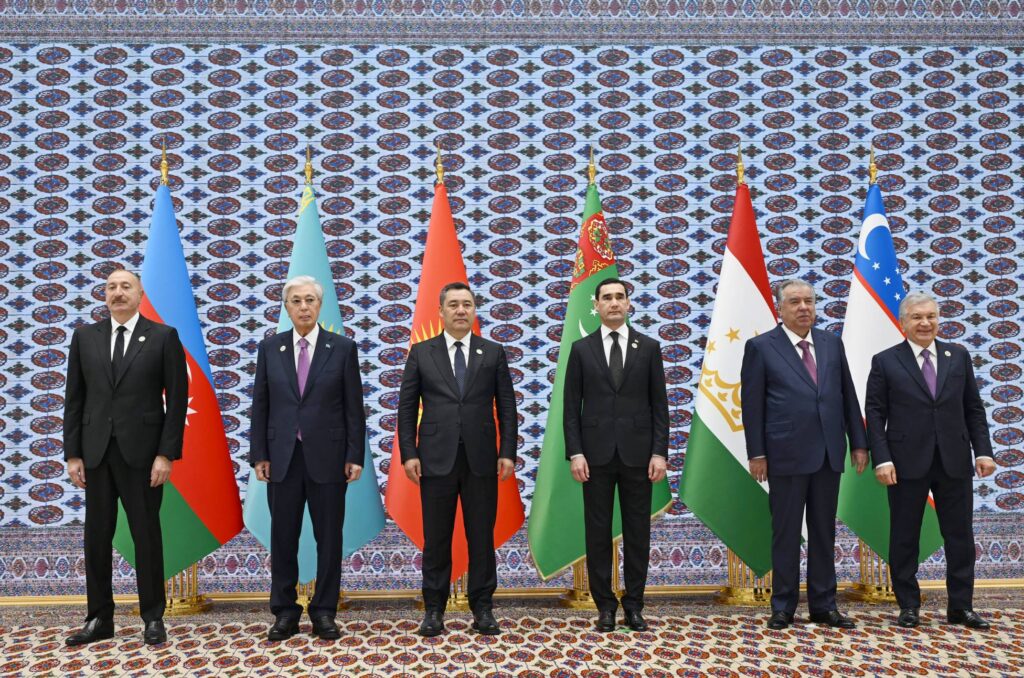
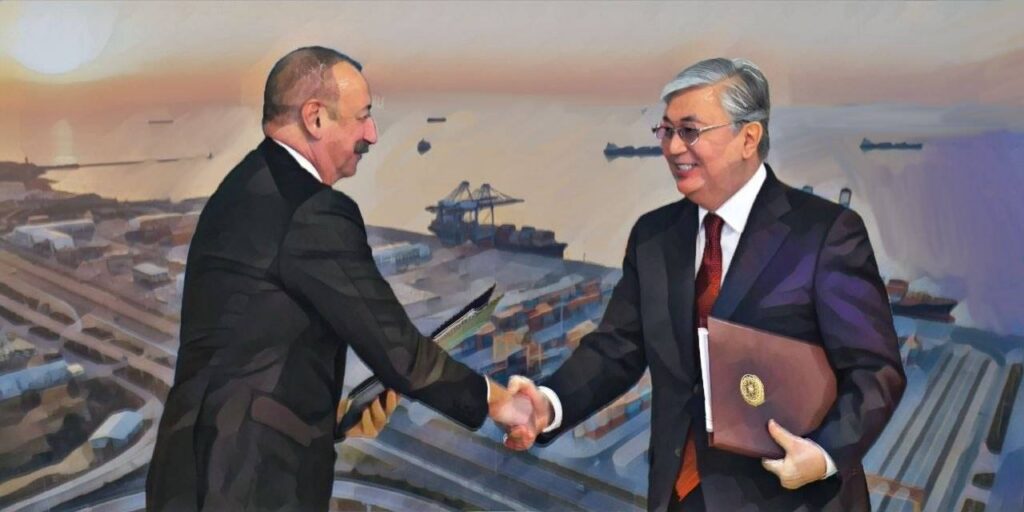
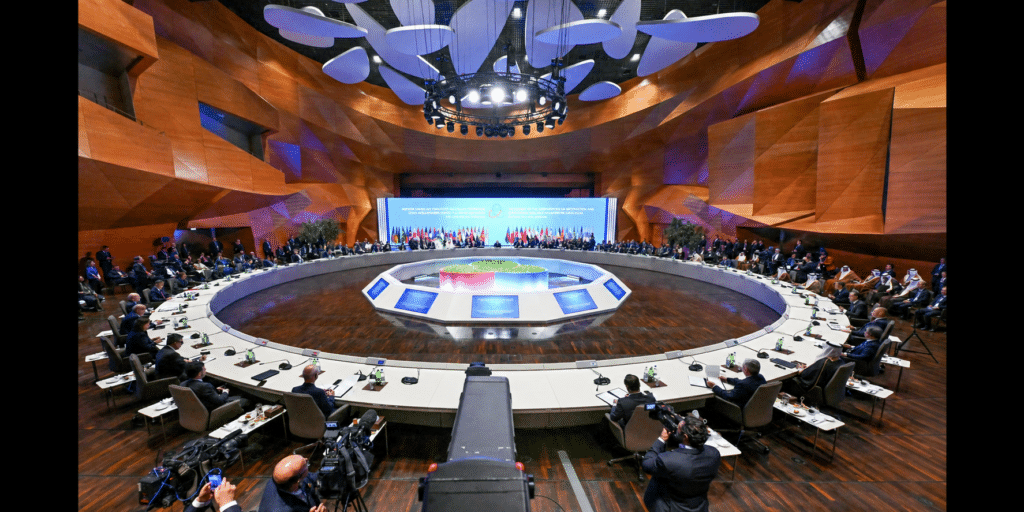
Central Asia’s presidential forum now spans both shores of the Caspian. Kazakhstan and Azerbaijan anchor the principal Caspian crossing at the center of the Middle Corridor, the rail-and-sea network linking Central Asia to European markets through Azerbaijan, Georgia, and Türkiye. Azerbaijan’s full participation brings the corridor’s eastern and western Caspian gateways into the same regular political setting. The six governments can use it to coordinate the transport, energy, digital, and investment links already developing across the Caspian, even though Georgia and Türkiye remain essential to the route’s westward operation. On July 31, 2026, the presidents of Kazakhstan, Kyrgyzstan, Tajikistan, Turkmenistan, Uzbekistan, and Azerbaijan signed the Cholpon-Ata Declaration at an informal Consultative Meeting of the Heads of State of Central Asia and Azerbaijan in Kyrgyzstan. The Declaration gave formal political expression to cooperation that had already been developing. Official accounts said the leaders emphasized expanded regional cooperation, including trade, transport and logistics, and energy. The full text has not been released, so those priorities come from official accounts rather than the declaration itself. Proposed by Uzbekistani President Shavkat Mirziyoyev in 2017 and first convened in Astana in March 2018, the Consultative Meetings brought together the five Central Asian states in an informal presidential format. They expanded in November 2025 with Azerbaijan’s admission as a full-fledged participant, while retaining their consultative character. Azerbaijan attended in 2023 and 2024 as a guest; Cholpon-Ata was its first informal meeting in the new capacity. Official documents continue to call the format “Central Asia and Azerbaijan.” C6 is analytical shorthand for the enlargement, not the name of a new bloc or formal organization. Azerbaijan’s admission follows several years of practical cooperation. At a ministerial meeting in Aktau on November 25, 2022, Kazakhstan, Azerbaijan, Georgia, and Türkiye signed a 2022–2027 roadmap for the simultaneous elimination of bottlenecks and development of the Middle Corridor. At its 2023 Baku summit, the UN Special Programme for the Economies of Central Asia (SPECA) adopted a digitalization roadmap and established a multi-partner trust fund, followed by work on digital data exchange and port-to-port cooperation. The transport roadmap includes Georgia and Türkiye, while SPECA also includes Afghanistan; neither is institutionally identical to C6. The enlarged format gives the six governments a regular political setting in which to coordinate existing transport, digital, and investment mechanisms. The Trans-Caspian International Transport Route Association reports that freight through the seaports of Kazakhstan and Azerbaijan reached 3.3 million tons in 2024, 20% above the 2023 level, while container traffic within the same scope rose 176% to 56,500 twenty-foot equivalent units (TEU). Freight remains the principal basis of integration. Oil transit, prospective electricity links, and joint investment instruments are extending cooperation into adjacent sectors. Kazakhstan's use of the route for oil exports is also rising: according to KazMunayGas reports, Kazakhstani oil shipments from Aktau through the Baku–Tbilisi–Ceyhan route increased by 34% to 1.4 million tons in 2024. At COP29 in Baku on November 13, 2024, Azerbaijan, Kazakhstan, and Uzbekistan signed a strategic-partnership agreement on producing and transmitting green energy,...

Uzbekistan Forms Commission After Nizhnekamsk Drone Strike as Russia Puts Uzbek Death Toll at Eight

Uzbekistan has formed a special commission after its citizens were killed in a drone attack on several locations in the Russian city of Nizhnekamsk on Monday. Russian authorities now say eight Uzbek citizens were among the 13 people killed, one more than Uzbekistan’s consulate in the Russian city of Kazan initially reported. A Tajik citizen was also reported among the dead. Moscow blamed Ukraine for the attack, the latest in a campaign of long-range strikes by the Ukrainian military in the long-running war with Russia. Ukraine has often targeted oil facilities in an attempt to undermine a key source of revenue for Russia, though there were conflicting accounts of what was hit in the Nizhnekamsk attack. Ukraine’s General Staff said it hit an oil refinery and caused a fire, while local Russian officials said residential areas as well as industrial facilities were hit, and a child was among those killed. Uzbekistan’s consulate in Kazan did not name the Uzbek nationals who died in the attack on Monday and did not provide any further personal information. The consulate initially put the Uzbek death toll at seven. Azattyq Asia subsequently reported that Russian authorities put the number at eight. Tajikistan’s Foreign Ministry said one Tajik citizen was also killed. “Necessary contacts have been established with local responsible authorities, agencies, and investigative bodies to clarify the details of the incident,” the consulate said. “We would like to inform you that the necessary arrangements are being made to repatriate the bodies of the deceased citizens to their homeland after the completion of forensic examinations and the necessary official procedures.” The consulate quoted law enforcement agencies in Tatarstan, the region of Russia where Nizhnekamsk is located, as saying that 13 people were killed and 39 people were injured in the drone strikes. Nizhnekamsk is a major industrial center that lies about 900 kilometers east of Moscow.