• KGS/USD = 0.01144 0%
  • KZT/USD = 0.00211 0%
  • TJS/USD = 0.10537 0%
  • UZS/USD = 0.00008 0%
  • TMT/USD = 0.28530 0%
  • KGS/USD = 0.01144 0%
  • KZT/USD = 0.00211 0%
  • TJS/USD = 0.10537 0%
  • UZS/USD = 0.00008 0%
  • TMT/USD = 0.28530 0%
  • KGS/USD = 0.01144 0%
  • KZT/USD = 0.00211 0%
  • TJS/USD = 0.10537 0%
  • UZS/USD = 0.00008 0%
  • TMT/USD = 0.28530 0%
  • KGS/USD = 0.01144 0%
  • KZT/USD = 0.00211 0%
  • TJS/USD = 0.10537 0%
  • UZS/USD = 0.00008 0%
  • TMT/USD = 0.28530 0%
  • KGS/USD = 0.01144 0%
  • KZT/USD = 0.00211 0%
  • TJS/USD = 0.10537 0%
  • UZS/USD = 0.00008 0%
  • TMT/USD = 0.28530 0%
  • KGS/USD = 0.01144 0%
  • KZT/USD = 0.00211 0%
  • TJS/USD = 0.10537 0%
  • UZS/USD = 0.00008 0%
  • TMT/USD = 0.28530 0%
  • KGS/USD = 0.01144 0%
  • KZT/USD = 0.00211 0%
  • TJS/USD = 0.10537 0%
  • UZS/USD = 0.00008 0%
  • TMT/USD = 0.28530 0%
  • KGS/USD = 0.01144 0%
  • KZT/USD = 0.00211 0%
  • TJS/USD = 0.10537 0%
  • UZS/USD = 0.00008 0%
  • TMT/USD = 0.28530 0%

Viewing results 115 - 120 of 1174

2025: The Year Central Asia Stepped Onto the Global Stage

For much of the post-Soviet era, Central Asia occupied a peripheral place in global affairs. It mattered to its immediate neighbors, but rarely shaped wider debates. In 2025, that changed in visible ways. The region became harder to ignore, largely not because of ideology or alignments, but because of assets that the world increasingly needs: energy, minerals, transit routes, and political access across Eurasia. One of the clearest signs came in April, when the European Union and the leaders of Kazakhstan, Kyrgyzstan, Tajikistan, Turkmenistan, and Uzbekistan met in Samarkand for their first summit at the head-of-state level. The meeting concluded with a joint declaration upgrading relations to a strategic partnership, with a focus on transport connectivity, energy security, and critical raw materials. The document marked a shift in how Brussels views Central Asia, moving beyond development assistance toward geopolitical cooperation, as outlined in the official EU–Central Asia summit joint declaration. European interest is rooted in necessity. Russia’s war in Ukraine has forced EU governments to rethink energy imports, supply chains, and overland trade routes. Central Asia sits astride the most viable alternatives that bypass Russian territory. It also holds resources essential to Europe’s green transition, including uranium and a range of industrial metals. The region’s leaders spent much of the year framing their diplomacy around these tangible advantages, rather than abstract political alignments. The United States followed a similar track. Through the C5+1 format, Washington deepened engagement with all five Central Asian states, with particular emphasis on economic cooperation and supply-chain resilience. A key element has been the Critical Minerals Dialogue, launched to connect Central Asian producers with Western markets. This initiative formed part of a broader U.S. effort to diversify access to strategic materials and reduce dependence on Russia and China. Russia remained a central but changing presence in Central Asia throughout 2025. Economic ties, labor migration, and shared infrastructure ensured that Moscow continued to matter across the region. At the same time, however, Russia’s war in Ukraine constrained its ability to act as the dominant external power it once was. Central Asian governments maintained pragmatic relations with Moscow, but they increasingly treated Russia as one partner among several rather than the default reference point. Trade continued, security cooperation persisted, and political dialogue remained active, yet the balance shifted toward hedging rather than dependence. Uranium sits at the center of this shift, with the United States having banned imports of certain Russian uranium products under federal law, with waivers set to expire no earlier than January 1, 2028. As Washington restructures its nuclear fuel supply chain, Central Asia’s role has grown sharply. According to the U.S. Energy Information Administration’s 2024 Uranium Marketing Annual Report, Kazakhstan supplied 24% of uranium delivered to U.S. reactor operators, while Uzbekistan accounted for about 9%. Canada and Australia remain major suppliers, but the Central Asian share is now strategic rather than marginal. That economic weight translated into political visibility. In December, U.S. President Donald Trump said he would invite Kazakhstan and Uzbekistan to attend...
Can the New Multimodal Route Become a Sustainable Corridor for Central Asia?

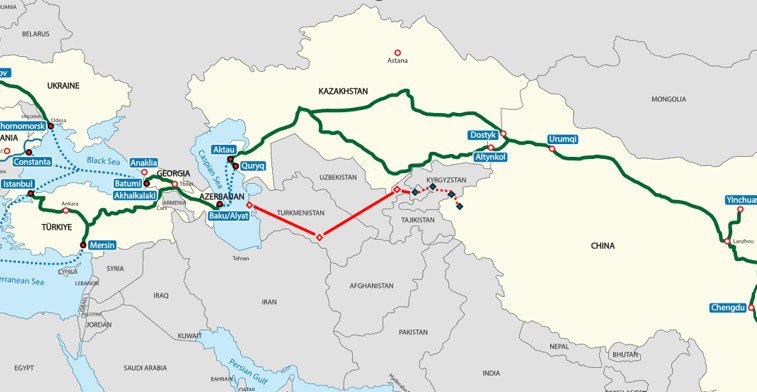
The launch of the China-Kyrgyzstan-Uzbekistan-Turkmenistan-Caspian multimodal corridor has generated significant interest as another attempt to expand Eurasian transport connectivity. A pilot shipment in the fall of 2025 demonstrated the technical feasibility of the new route: cargo transported from Kashgar, China, passed through Kyrgyzstan and Uzbekistan, reached Turkmenistan, and was then delivered to Azerbaijan via the Caspian Sea, continuing along the Baku-Tbilisi-Kars railway toward Europe. Despite its evident geopolitical appeal, questions remain over the route’s long-term sustainability and commercial viability. The central question is whether this demonstration project can evolve into a regularly functioning transport corridor. A Third Alternative Between the Northern and Middle Corridors This multimodal route can be seen as a potential alternative to the two existing pathways: the northern route, China-Kazakhstan-Russia-Europe; and the Trans-Caspian International Transport Route (TITR), or Middle Corridor, which passes through Kazakhstan, the Caspian Sea, the South Caucasus, and Turkey. The growing geopolitical risks along the northern route since 2022, combined with capacity limitations on the Caspian segment of the TITR, have spurred interest in a third option, a so-called “southern belt” traversing Kyrgyzstan, Uzbekistan, and Turkmenistan. Each country along this route has its own strategic calculus. Uzbekistan is seeking to overcome its “double continental isolation” and elevate its role as Central Asia’s transit hub. Kyrgyzstan is aiming to monetize its geographic position between China and the Ferghana Valley. Turkmenistan is developing the port of Turkmenbashi as an alternative to the increasingly congested hubs of Aktau and Alat. China, meanwhile, continues to diversify its westward overland trade routes. The Uzbek Factor: Geoeconomics vs. Logistics From Tashkent's perspective, this corridor aligns with its long-term transport strategy. Analysts frequently cite Uzbekistan’s ambition to transition from a landlocked to a “land-linked” state with direct access to China, the Caspian Sea, and southern routes to the Indian Ocean. The new route offers Uzbekistan three strategic advantages: alternative access to China via Kyrgyzstan, enhanced status as a regional transit hub, and deeper transport cooperation with Turkmenistan, including potential joint development of the Turkmenbashi port. However, when shifting from geopolitical ambition to logistical execution, serious limitations emerge, many outside Uzbekistan’s control. Kyrgyzstan: A Bottleneck in the Chain Documents from the Central Asia Regional Economic Cooperation (CAREC) program highlight the continued challenges facing multimodal transport in the region, namely slow transit, poor modal integration, border delays, and outdated logistics technologies. Within this corridor, Kyrgyzstan remains the primary bottleneck. Approximately 82% of its foreign trade by weight is transported by road, making the route through this mountainous country highly seasonal, expensive, and unpredictable. According to the International Road Transport Union, Kyrgyzstan’s transport system faces severe constraints from alpine terrain, avalanches, and impassable mountain passes that render winter transport nearly impossible in many areas. It is therefore unsurprising that, following the pilot shipment, no major logistics operators committed to shifting regular cargo to this route. The Caspian Sea: Structural Constraints The Caspian Sea leg, anchored by Turkmenbashi port, presents another critical challenge. The limitations here are systemic rather than national. Key issues include insufficient...

Japan and Central Asia Enter a New Era of Strategic Partnership

On December 20, the first summit of Central Asian and Japanese leaders (CA+JAD) was held in Tokyo. The Tokyo Declaration, an ambitious roadmap for future cooperation, was adopted during the summit. It aims to transform relations between Japan and the five Central Asian countries into a deep and multifaceted strategic partnership.  New Paths for the Region Japan intends to invest about $20 billion in business projects across Central Asia over the next five years. Priority areas for cooperation include environmental initiatives, and the transition to carbon neutrality in the energy sector. Additional areas include developing supply chains for key minerals, disaster risk reduction, and earthquake preparedness. Projects in agriculture and logistics, particularly improvements along the Trans-Caspian International Transport Route, were also discussed. Other topics covered included launching direct flights between Japan and Central Asia, advancing cooperation in digital technologies and artificial intelligence, and expanding scholarships and training programs.  Attendees included Japanese Prime Minister Sanae Takaichi; Kazakh President Kassym-Jomart Tokayev; Kyrgyz President Sadyr Japarov; Tajik President Emomali Rahmon; Turkmen President Serdar Berdimuhamedov; and Uzbek President Shavkat Mirziyoyev. The second Central Asia-Japan summit is scheduled to take place in Kazakhstan, in line with the agreed English alphabetical rotation. Turkmenistan: Petrochemical Cooperation President Serdar Berdymuhamedov met with representatives of major Japanese corporations, including Sumitomo, Toyo Engineering, Muroosystems, Itochu, Argonavt, Mitsubishi, Kawasaki Heavy Industries, and Tokyo Boeki Eurasia.  He cited several successful Japanese-led projects in Turkmenistan, such as waste processing plants, a wastewater treatment initiative for industrial reuse, PET plastic recycling, and e-waste processing to reduce hazardous materials. New memorandums were signed between Turkmen and Japanese entities. Key among them: an agreement involving the state-owned concern Turkmenhimiya, Mitsubishi Heavy Industries, Mitsubishi Corporation, and Gap Inşaat on building a urea plant in the Balkan region with a capacity of 1.155 million tons per year. Turkmenhimiya also signed an agreement with Kawasaki Heavy Industries to extend maintenance for the Akhal gas-to-gasoline plant. In addition, a cooperation deal was reached with Toyo Engineering and Turkey’s Rönesans Endüstri for the second phase of the Kiyanly polymer plant. Other memoranda included partnerships between the Ministry of Automobile Transport of Turkmenistan and Sumitomo Corporation, TurkmenGas and Sumitomo Europe, and the Ministry of Communications and Mitsubishi Corporation Machinery, focusing on artificial intelligence and digital technologies. Agreements were also signed with media outlets, banks, and universities. Diplomatic ties between Japan and Turkmenistan were established in 1992. The Japanese Embassy opened in Ashgabat in 2005, and the Turkmen Embassy in Tokyo followed in 2013. Japan also plays a vital role in Turkmenistan’s export of polypropylene. Japanese firms Kawasaki and Sojits helped construct a fertilizer complex in the town of Mary, while Itochu and Day Nippon were involved in modernizing the national railway’s IT systems. Kyrgyzstan: Energy and Education Ties President Sadyr Japarov oversaw the signing of bilateral agreements spanning exports, energy, healthcare, education, tourism, agribusiness, and digital development.  Agreements included a roadmap between Kyrgyzstan’s Ministry of Energy and MurooSystems for a small hydropower plant on the Chon-Kemin River and various education-related memorandums with...

From the Central Asian Steppe to Manhattan: A Turkmen Bard in New York

A halal Chinese Muslim restaurant in New York City is an unlikely setting for a concert by a highly acclaimed bard of the Turkmen tradition. Yet on a Saturday afternoon in Manhattan’s Kips Bay neighborhood, before an audience of attentive listeners and curious onlookers peering through the window, the multi-award-winning Mohammad Geldi Geldi Nejad filled Beef Up Noodle with sustained melodic phrases and guttural embellishments. At times, his dexterous strumming of the dutar, a two-stringed long-necked lute, deliberately mimicked the rhythm of galloping horse hooves central to the Turkmen bardic style. Mohammad was raised in the Turkmen community of Gonbad-e Kavus in northeastern Iran. At age ten, he became only the second musician ever to receive the honorary title Oghlan Bakhshi, meaning Child Bard. His musical education in Turkmen bardic traditions began in early childhood, before more formal training in Turkmenistan’s capital, Ashgabat. Turkmen culture, shaped by a nomadic heritage, extends across Turkmenistan, Iran, Afghanistan, Uzbekistan, and Kazakhstan, with smaller populations in Turkey, Iraq, and the North Caucasus. It draws on nomadic traditions where performance serves as a primary vehicle of cultural expression. Central Asian music and culture, carried by diasporic communities from these regions, has found a growing audience in the United States. Turkmen traditions, however, given the minuscule size of the Turkmen population in the U.S., remain largely unfamiliar to most audiences. [video width="848" height="478" mp4="https://timesca.com/wp-content/uploads/2025/12/WhatsApp-Video-2025-12-17-at-18.16.28.mp4"][/video] Even so, Mohammad has brought his music to audiences beyond Turkmenistan and Iran, performing in parts of Europe and the U.S., including recent concerts at the Lowell Folk Festival in Massachusetts and at Roulette in Brooklyn. At the latter, he offered Western listeners rare access to a musical lineage sustained within a family across generations. Performing under his honorific alias Oghlan Bakhshi, he appeared alongside his father, the gyjak, or spike fiddle, master Abdolghaffar Geldinejad, and his wife and regular musical collaborator, Zyyada Jumayeva, a dutar player who represents the female bardic tradition of Turkmenistan. His album Journey Across the Steppes is the first international release of Turkmen folk music in 30 years. His work has also been documented in a book series, The Music of Central Asia. At Beef Up Noodle, Mohammad’s performance, titled Songs of the Bakhshi: Turkmen Bardic Heritage, formed part of a broader curatorial landscape shaped by ethnomusicologist Mu Qian, whose work spans scholarship, publishing, and community-based music making. From Zayton to New York is the concert series he curates, exploring how music travels through histories of migration and exchange. Mohammad’s appearance opened a Central Asian trilogy within the series, to be followed by programs devoted to Kyrgyz and Kazakh musical traditions in early 2026. This trilogy represents one strand of Mu Qian’s wider mission, developed through the See & Sea Cultural Foundation, to support minority musicians and bring underrepresented musical cultures from across Asia into conversation with audiences beyond their places of origin. [caption id="attachment_41154" align="aligncenter" width="1283"] Mu Qian with Mohammad Geldi Geldi Nejad; image: Paul Adams[/caption] British expat Margaret Murray, an audience member whose chance meeting...

Japan Opens First Leaders-Level Summit With Central Asia

Japan hosted its first leaders-level summit with the five Central Asian republics on Friday, marking a diplomatic advance in a relationship that has existed for more than two decades but has rarely drawn wide attention. Prime Minister Sanae Takaichi opened the “Central Asia + Japan” summit in Tokyo, with discussions set to continue through December 20. The summit elevates a dialogue that until now has been conducted mainly at foreign ministers’ or senior diplomatic levels. Japan launched the original “Central Asia + Japan” initiative in 2004 to build cooperation with the Central Asian states through economic, educational, and political channels. In a bilateral meeting linked to the summit, Japanese Foreign Minister Toshimitsu Motegi met with his Tajik counterpart Sirojiddin Muhriddin, with the two sides agreeing on a cooperation program covering 2026–2028 and an investment treaty. These agreements represent the most concrete, publicly documented outcomes from the summit’s opening day and highlight Japan’s focus on strengthening bilateral ties alongside the broader multilateral dialogue. In parallel with the leaders’ meeting, Japan is hosting a “Central Asia + Japan” business forum organized by the Ministry of Economy, Trade and Industry to promote trade and private-sector cooperation. The leaders’ summit follows high-level bilateral diplomacy earlier in the week. On December 18, Prime Minister Takaichi met Kazakh President Kassym-Jomart Tokayev in Tokyo, where the two leaders signed a strategic partnership statement focused on energy, critical minerals, and expanded cooperation. Central Asia’s geopolitical significance has increased in recent years as its governments pursue multi-vector foreign policies aimed at broadening their external partnerships beyond traditional ties with Russia and China. Japan’s decision to elevate its dialogue with the region reflects this shift and Tokyo’s effort to remain an active partner amid growing engagement from the European Union, the United States, South Korea, and others. For Friday, the summit’s significance lies less in headline announcements than in its symbolism and early bilateral outcomes. The opening confirmed Japan’s intent to engage Central Asia at the highest political level, with broader commitments expected once the leaders conclude their talks and release a joint statement or action plan.

Japan Steps Out of the Shadows With First Central Asia Leaders’ Summit

On December 19-20, Tokyo will host a landmark summit poised to reshape Eurasian cooperation. For the first time in the 20-year history of the “Central Asia + Japan” format, the dialogue is being elevated to the level of heads of state. For Japan, this represents more than a diplomatic gesture; it signals a shift from what analysts often describe as cautious “silk diplomacy” to a more substantive political and economic partnership with a region increasingly central to global competition over resources and trade routes. The summit will be chaired by Japanese Prime Minister Sanae Takaichi. The leaders of all five Central Asian states, Kazakhstan, Kyrgyzstan, Tajikistan, Turkmenistan, and Uzbekistan, have confirmed their participation. Alongside the plenary session, bilateral meetings and a parallel business forum are scheduled to take place. Why Now? Established in 2004, the “Central Asia + Japan” format has largely functioned as a platform for foreign ministers and technical cooperation. According to Esbul Sartayev, assistant professor at the Center for Global Risks at Nagasaki University, raising the dialogue to the head-of-state level marks a deliberate step by Japan to abandon its traditionally “secondary” role in a region historically dominated by Russia and China. This shift comes amid a changing geopolitical context: disrupted global supply chains, intensifying competition for critical and rare earth resources, and a growing U.S. and EU presence in Central Asia. In this environment, Tokyo is promoting a coordinated approach to global order “based on the rule of law”, a neutral-sounding phrase with clear geopolitical resonance. Unlike other external actors in Central Asia, Japan has historically emphasized long-term development financing, technology transfer, and institutional capacity-building rather than security alliances or resource extraction. Japanese engagement has focused on infrastructure quality, human capital, and governance standards, allowing Tokyo to position itself as a complementary partner rather than a rival power in the region. Economy, Logistics, and AI The summit agenda encompasses a range of priorities: sustainable development, trade and investment expansion, infrastructure and logistics, and digital technology. Notably, the summit is expected to include a new framework for artificial intelligence cooperation aimed at strengthening economic security and supply chain development. It is also likely to reference expanded infrastructure cooperation, including transport routes linking Central Asia to Europe. As a resource-dependent country, Japan sees Central Asia as part of its evolving “resource and technological realism” strategy. For the Central Asian states, this presents a chance to integrate into new global value chains without being relegated to the role of raw material suppliers. Kazakhstan: Deals Worth Billions The summit coincides with Kazakh President Kassym-Jomart Tokayev’s official visit to Japan from December 18-20. During the visit, more than 40 agreements totaling over $3.7 billion are expected to be signed. These span energy, renewables, digitalization, mining, and transport. Participants include Samruk-Kazyna, KEGOC, Kazatomprom, KTZ, and major Japanese corporations such as Marubeni, Mitsubishi Heavy Industries, Toshiba, and JOGMEC. Japan’s ambassador to Kazakhstan, Yasumasa Iijima, has referred to Kazakhstan as a future Eurasian transport and logistics hub, highlighting its strategic role in developing the Trans-Caspian...