• KZT/USD = 0.00219
  • TJS/USD = 0.10820
  • UZS/USD = 0.00009
  • TMT/USD = 0.29760
  • KZT/USD = 0.00219
  • TJS/USD = 0.10820
  • UZS/USD = 0.00009
  • TMT/USD = 0.29760
  • KZT/USD = 0.00219
  • TJS/USD = 0.10820
  • UZS/USD = 0.00009
  • TMT/USD = 0.29760
  • KZT/USD = 0.00219
  • TJS/USD = 0.10820
  • UZS/USD = 0.00009
  • TMT/USD = 0.29760
  • KZT/USD = 0.00219
  • TJS/USD = 0.10820
  • UZS/USD = 0.00009
  • TMT/USD = 0.29760
  • KZT/USD = 0.00219
  • TJS/USD = 0.10820
  • UZS/USD = 0.00009
  • TMT/USD = 0.29760
  • KZT/USD = 0.00219
  • TJS/USD = 0.10820
  • UZS/USD = 0.00009
  • TMT/USD = 0.29760
  • KZT/USD = 0.00219
  • TJS/USD = 0.10820
  • UZS/USD = 0.00009
  • TMT/USD = 0.29760
24 August 2026

Viewing results 13 - 18 of 94

Tajikistan and UN to Host Water Crisis Conference in Dushanbe

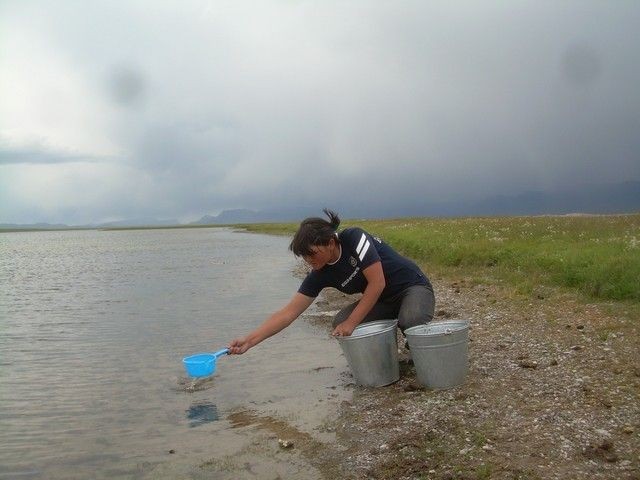
Tajikistan and the United Nations will co-host the 4th High-Level International Conference on the International Decade for Action "Water for Sustainable Development " 2018-2028 next week, as Central Asia and other regions face increasing water scarcity because of climate change, higher consumption, and other factors. Delegates to the May 25-28 water conference in Dushanbe include government officials, scientists, executives from financial institutions and civil society members from around the world. The goal of creating “sustainable” water resources is especially critical in Central Asia, where there is growing concern that shortages could threaten public health and stir tension between upstream and downstream countries. Kyrgyzstan and Tajikistan, for example, are in mountainous regions and have relatively significant water resources that they share with neighboring countries. However, the resources are under strain. Kazakhstan, Uzbekistan and Turkmenistan, in turn, rely on the cross-border water supply that flows downstream. Central Asian governments have begun joint projects on water infrastructure to avoid the kind of tensions that emerged in the past. The Dushanbe conference is another step in that process, even though the event is global in perspective. Tajik diplomats have held briefings in Azerbaijan, Saudi Arabia and other countries to promote the conference, describing Tajikistan as a leader in “water diplomacy” as the world faces a water crisis that is increasingly evident in floods, droughts, pollution and melting glaciers. Dushanbe has already hosted several international conferences on water. Saidjon Shafizoda, spokesman for Tajikistan’s Ministry of Foreign Affairs, said at a briefing in the Tajik capital on Wednesday that the conference can help accelerate innovation and mobilize funding for the “sustainable and inclusive” management of water, the state Khovar news agency reported. Organizers say more than 2,500 people are expected to participate.

Central Asian Countries Rank Among World’s Highest Water Consumers

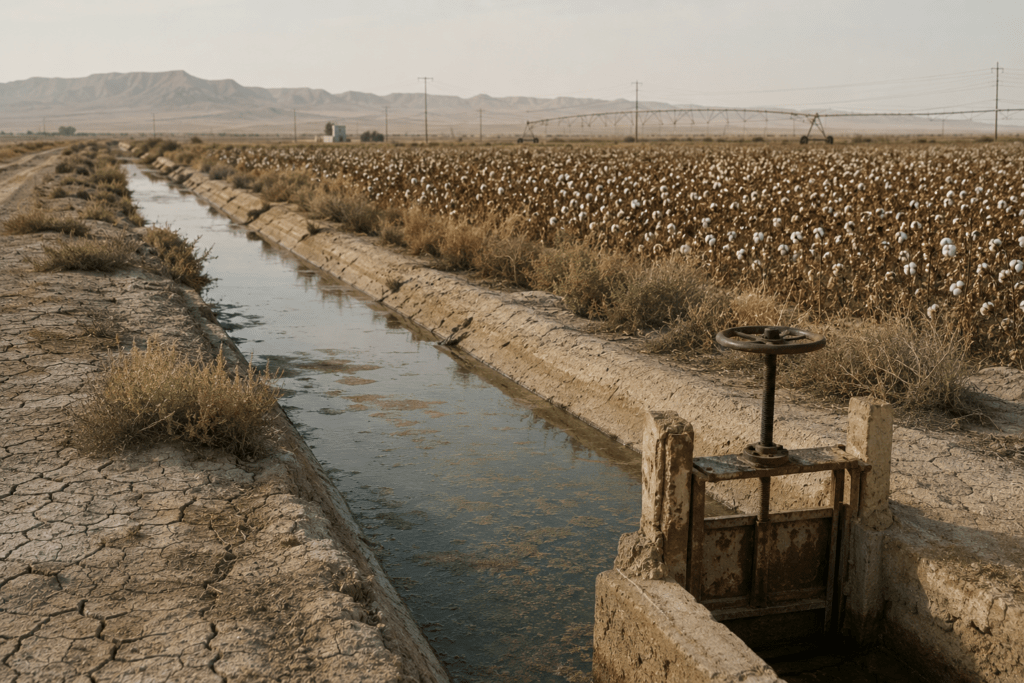
Several Central Asian countries rank among the world’s highest consumers of water per person, according to data compiled by the Worldometer portal. The figures, based on statistics from UN agencies including UNESCO and the UN Food and Agriculture Organization (FAO), place Turkmenistan first globally, with Uzbekistan, Tajikistan, and Kyrgyzstan also in the top ten. The figures highlight a long-standing regional challenge: heavy dependence on water-intensive agriculture combined with aging irrigation systems that lose substantial amounts of water before it reaches fields. Turkmenistan leads the global ranking with daily water consumption of 15,445 liters per person. Uzbekistan ranks fourth worldwide at 4,778 liters per capita per day, followed by Tajikistan with 4,460 liters and Kyrgyzstan with 4,153 liters. Kazakhstan recorded the lowest level among Central Asian states, at 3,397 liters per person daily, though that still places it among relatively high-consuming countries internationally. In terms of total annual water use, Uzbekistan consumes the largest volume in the region at 54.56 billion cubic meters a year. It is followed by Turkmenistan with 27.9 billion cubic meters, Kazakhstan with 22.77 billion, Tajikistan with 11.49 billion, and Kyrgyzstan with around 8 billion cubic meters. Experts say agriculture explains much of the region’s high consumption. Globally, farming accounts for about 70% of freshwater use, compared with 20% for industry and 10% for households. In Central Asia, agriculture represents more than 80% of water consumption, while up to 40% of water is estimated to be lost through deteriorating irrigation infrastructure. The problem has become increasingly significant as freshwater demand rises worldwide. According to UN estimates, freshwater withdrawals have tripled over the past 50 years, while global demand continues to grow by around 64 billion cubic meters annually because of population growth, changing consumption patterns, energy production, and biofuel development. Several Central Asian governments have begun introducing reforms aimed at reducing water losses. In Uzbekistan, authorities joined the World Bank’s Water Forward initiative and announced plans to expand water-saving technologies across 4.1 million hectares of irrigated farmland while reducing irrigation losses by 25%. Kazakhstan has also faced recurring shortages. Seasonal water restrictions are regularly introduced in southern regions, and this year the government approved consumption limits because of expected shortages during the agricultural season. The issue is closely linked to energy production in upstream countries. Studies by the Organization for Economic Co-operation and Development (OECD) indicate that more than 80% of electricity generation in Kyrgyzstan and Tajikistan comes from hydropower, creating a close link between irrigation needs and energy supply. Limited coordination over water releases and electricity generation has contributed to summer shortages in some years. The figures show the scale of the challenge for Central Asian governments seeking to reduce water losses and manage shared rivers more effectively.

UNEP Interview: From Space, Central Asia’s Methane Challenge Comes Into Focus

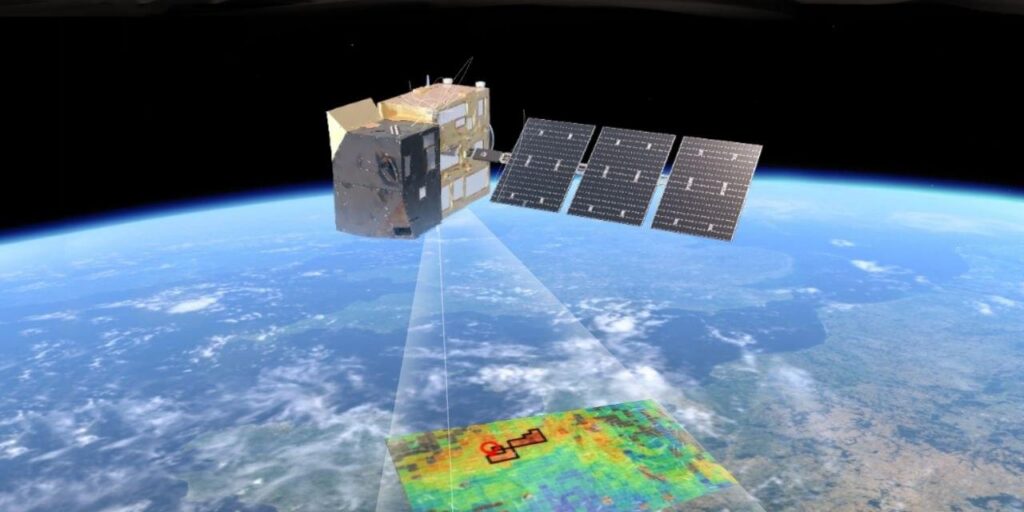
Satellites are changing the way the world sees methane. What was once an invisible leak from a well, flare, pipeline, landfill, or coal mine can now be detected from space, traced to a specific site, and sent to governments and companies for action. A new analysis by the United Nations Environment Programme’s International Methane Emissions Observatory puts that system to the test. Its Methane Alert and Response System, known as MARS, uses 35 satellite instruments to identify major human-caused methane “super-emitters” and notify those responsible. UNEP says the system has already enabled 41 mitigation cases in 11 countries, covering sources estimated to have released 1.2 million tonnes of methane. For Central Asia, the findings are especially relevant. UNEP’s new data includes a rolling list of the world’s 50 largest satellite-detected methane sources, covering oil and gas, coal, and waste, and shows where rapid action may be possible. Several of those sources are linked to Turkmenistan’s oil and gas sector, placing the region firmly inside a global debate over methane transparency, climate responsibility, and whether satellite alerts can lead to action on the ground. Of the 50 sources featured in the latest UNEP/IMEO snapshot, China has the largest number, while Turkmenistan stands out sharply for Central Asia, with the second-largest individual source and four of the top ten. Methane is shorter-lived than carbon dioxide, but far more powerful in the near term. That makes cutting large leaks one of the fastest ways to slow global warming. The harder question, as UNEP’s latest data makes clear, is no longer only where the leaks are, but who responds when they are found. On April 30, UNEP/IMEO presented the new MARS findings, highlighting the growing role of satellite-based monitoring in identifying major methane sources and pressing governments and companies to act. The Times of Central Asia spoke with Meghan Demeter, MARS Programme Manager, International Methane Emissions Observatory, UNEP. TCA: What does the new MARS data reveal about Central Asia specifically that may surprise readers? Demeter: The latest MARS data products depict the region as one with growing engagement and significant mitigation potential. Responses to MARS notifications are increasing, supported in particular by designated national focal points who play a key role in coordinating follow-up with operators. Based on the published 2025 data alone, the response rate across Central Asia currently stands at 22%. Managing a high volume of alerts requires more effort to achieve very high response rates compared to countries that receive only a handful of notifications. Encouragingly, the region has already recorded nearly 20 mitigation cases, underscoring the strong potential for emissions reductions when large methane sources are identified and addressed. TCA: Why does Central Asia matter in the global methane debate, even if it is not the world’s largest methane-emitting region? Demeter: Across Central Asia, looking at the 2025 data alone, UNEP’s International Methane Emissions Observatory, through the Methane Alert and Response System (MARS), detected and notified 298 emission sources from the oil and gas sector. While satellites detect only a fraction of global methane emissions, satellites are highly effective at identifying so-called “super-emitters,” methane emission events so large they can be detected from space. These represent opportunities where action can deliver the greatest and fastest climate wins, while also catalyzing broader change. Regarding the “top 50” list of emission events, 11 of these sources are located in Central Asia, all from...

Opinion: The Regional Ecological Summit and the Making of a Central Asian Voice

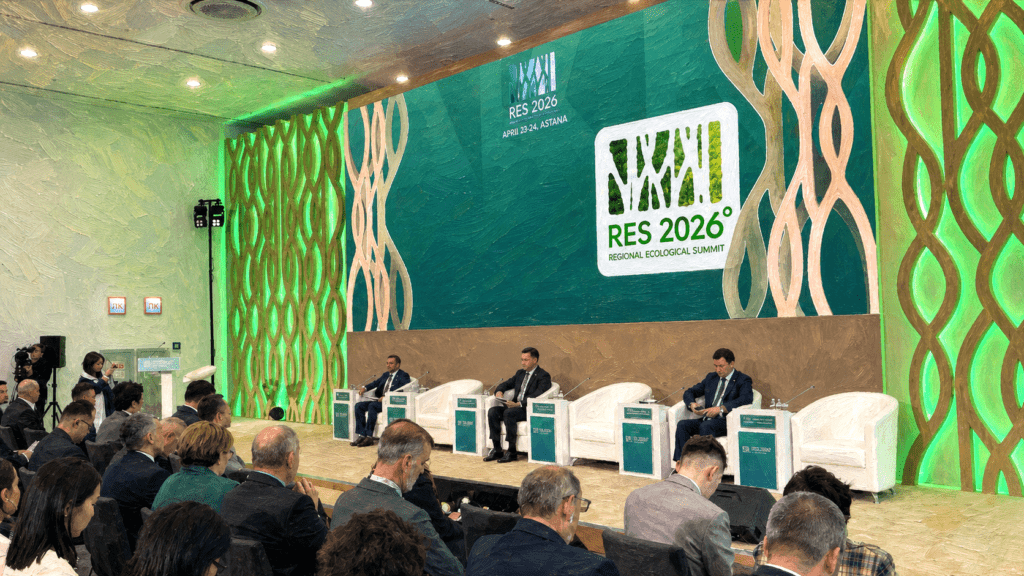
On 22–24 April, Astana hosted the Regional Ecological Summit—a gathering of governments, international organizations, financial institutions, and civil society that marked a new level of ambition in Central Asia’s environmental diplomacy. Fifty-eight sessions were held across three days at a moment when Central Asia’s ecological agenda is becoming inseparable from its political and economic future. The opening ceremony was attended by the presidents of all five Central Asian states. The summit adopted the Astana Declaration on Ecological Solidarity in Central Asia and brought renewed attention to the need to reform the International Fund for Saving the Aral Sea (IFAS). Taken together, these developments signal more than procedural diplomacy. They point to growing political momentum. The region has never lacked shared history or channels of communication. Russian remains a practical language of intergovernmental exchange, and borders, economies, rivers, energy systems, and labor markets have tied these countries together long before contemporary climate diplomacy gave this interdependence a new vocabulary. For decades, much external analysis of Central Asia expected this interdependence to produce confrontation, particularly around water and energy. Those risks remain real. Yet the Astana summit showed a more complex trajectory. Climate change, biodiversity loss, water insecurity, land degradation, and food security are not separate national problems neatly contained within borders. Addressing them is becoming one of the fields through which regional coherence is being built. The significance of the Summit lies less in ceremonial language than in the consolidation of multiple ecological agendas into a visible diplomatic architecture. Through its panels and high-level discussions, the Summit placed Central Asia’s natural heritage not at the margins of development but at its center. Ecosystems, rivers, glaciers, mountains, and landscapes are not only environmental assets. They are conditions for prosperity, stability, and resilience. Kazakhstan’s chairmanship of IFAS reopened the question of whether the Fund, long criticized for its limitations, can be reworked rather than left as a symbol of failed regional environmental governance. Kazakhstan’s proposal for an International Water Organization should be read in the same frame: it is not merely a technical proposal about water governance but an attempt to move a Central Asian concern into the language of global institutional reform. Kyrgyzstan’s mountain agenda and Tajikistan’s glacier diplomacy also belong to this broader pattern. They are not just isolated national branding exercises. Together with Uzbekistan’s increasingly active regional posture, they form a wider mosaic: each country brings a distinct ecological priority, but these priorities are becoming legible as parts of one regional perspective, and its voice carries more weight when presented as such. This is particularly important in the current geopolitical moment. As larger powers turn inward, compete over corridors, or speak about Central Asia through the old grammar of influence, the region is attempting to define itself not as terrain for another “Great Game" but as a pole of its own. This does not mean distance from external partners. On the contrary, the United Nations was a strategic partner of the Summit, and many formats involved major international organizations, European...

Central Asian Countries to Jointly Address Cryosphere Threats

As part of the Regional Ecological Summit (RES 2026) in Astana, the UNESCO Regional Office in Almaty organised a session titled “The Cryosphere of Central Asia: From Scientific Assessment to Joint Climate Adaptation Action,” in cooperation with Kazakhstan’s Ministry of Ecology and Natural Resources and Ministry of Science and Higher Education. The event was held under the GEF-UNDP-UNESCO Cryosphere project and in collaboration with Central Asian countries. The session focused on discussing the Joint Subregional Action Programme (JSAP) on the cryosphere, a framework document developed by Central Asian countries with UNESCO’s support. The programme is aimed at strengthening regional cooperation in monitoring and research on glaciers, snow cover, and permafrost, as well as aligning approaches to climate change adaptation, according to Kazakhstan’s Ministry of Ecology and Natural Resources. Central Asia is experiencing accelerated glacier melt. Under a high-emissions scenario, the region could lose up to 85% of its glacier volume by 2100 compared to 2020 levels. This would increase pressure on water resources, infrastructure, and communities, while also heightening the risk of natural hazards, including glacial lake outburst floods. As these processes are regional in nature, they require coordinated responses across Central Asian countries. “UNESCO has been actively supporting Central Asian countries in strengthening the scientific basis and advancing regional cooperation on the cryosphere. Today, the key priority is to move from scientific assessment to concrete action. The Joint Subregional Action Programme provides a practical framework for this transition and enhances coordination of adaptation efforts across the region,” said Amir Piric, Director of the UNESCO Regional Office in Almaty. As a key outcome of the session, heads of relevant government authorities from Kazakhstan, Tajikistan, Turkmenistan, and Uzbekistan responsible for environmental protection issued a joint statement supporting JSAP implementation, reaffirming their commitment to strengthened regional cooperation. “Today it is clear that no country can effectively address climate change challenges alone. Regional cooperation is therefore essential. The Joint Statement reflects the readiness of Central Asian countries to join efforts and develop coordinated approaches to climate change adaptation,” said Nurlan Kurmalayev, Deputy Minister of Ecology and Natural Resources of Kazakhstan. The JSAP provides a foundation for coordinated action among countries and partners, defines cooperation priorities, and supports the advancement of climate adaptation measures in the region. The joint statement also opens opportunities to mobilise funding from various sources, including donors, international financial institutions, and the private sector.

Regional Ecological Summit in Astana Produces Ecology Declaration and Broader Regional Agenda

Central Asian leaders have adopted the Astana declaration on ecology and sustainable development, giving the Regional Ecological Summit in Astana a formal political outcome while a wider package of biodiversity, climate, and pollution initiatives takes shape around it. Kazakhstan’s environment ministry says the five heads of state adopted the document, titled “Ecological Solidarity of Central Asia,” during the April 22 to 24 Summit. The declaration sets out a common regional position on several of Central Asia’s biggest environmental pressures. According to the ministry summary, the text calls for closer coordination in climate negotiations, glacier preservation, the mountain agenda, biodiversity, chemical and waste management, plastic pollution, air quality, land degradation, and desertification. It also presents the declaration as a contribution to ecological sustainability, inclusive economic growth, and a sustainable future for the region. Water runs through the document, but the language is careful. The declaration welcomes work on an interstate program to conserve the Caspian Sea and expresses concern about declining water levels and the shallowing of lakes in Central Asia. It also notes Kazakhstan’s proposal for a possible International Water Organization within the United Nations system, but stops short of endorsing its creation. The summit’s outcome does not rest on a single document. On April 24, the United Nations Environment Programme said the Astana meeting had launched new regional partnerships on circular economy and glaciers, while countries established common approaches on biodiversity, climate action, and air pollution. UNEP also said a regional climate and ecology investment portfolio was set up to widen access to international finance for environmental projects. A separate biodiversity track had already produced its own result earlier in the week. On April 22, UNDP in Kazakhstan said Central Asian countries had signed a regional declaration on biodiversity conservation during a high-level plenary session in Astana. According to UNDP, the document envisages an umbrella programme and action plan, as well as a regional resource mobilization plan to be presented at COP17 in Armenia. Outside confirmation of the main declaration has also become clearer. EFE reported on April 22 that the five Central Asian republics had approved the Astana Declaration of Ecological Solidarity, linking it to Tokayev’s focus on water security, the Aral Sea, and the Caspian. Put together, the Astana summit now looks like a broader regional attempt to turn shared ecological pressure into a workable political agenda. The summit’s next test will be whether these declarations and partnerships are followed by funding, coordination, and cross-border implementation.