

• KGS/USD = 0.01144 0%
  • KZT/USD = 0.00214 0%
  • TJS/USD = 0.10508 0.48%
  • UZS/USD = 0.00008 0%
  • TMT/USD = 0.28571 0%
  • KGS/USD = 0.01144 0%
  • KZT/USD = 0.00214 0%
  • TJS/USD = 0.10508 0.48%
  • UZS/USD = 0.00008 0%
  • TMT/USD = 0.28571 0%
  • KGS/USD = 0.01144 0%
  • KZT/USD = 0.00214 0%
  • TJS/USD = 0.10508 0.48%
  • UZS/USD = 0.00008 0%
  • TMT/USD = 0.28571 0%
  • KGS/USD = 0.01144 0%
  • KZT/USD = 0.00214 0%
  • TJS/USD = 0.10508 0.48%
  • UZS/USD = 0.00008 0%
  • TMT/USD = 0.28571 0%
  • KGS/USD = 0.01144 0%
  • KZT/USD = 0.00214 0%
  • TJS/USD = 0.10508 0.48%
  • UZS/USD = 0.00008 0%
  • TMT/USD = 0.28571 0%
  • KGS/USD = 0.01144 0%
  • KZT/USD = 0.00214 0%
  • TJS/USD = 0.10508 0.48%
  • UZS/USD = 0.00008 0%
  • TMT/USD = 0.28571 0%
  • KGS/USD = 0.01144 0%
  • KZT/USD = 0.00214 0%
  • TJS/USD = 0.10508 0.48%
  • UZS/USD = 0.00008 0%
  • TMT/USD = 0.28571 0%
  • KGS/USD = 0.01144 0%
  • KZT/USD = 0.00214 0%
  • TJS/USD = 0.10508 0.48%
  • UZS/USD = 0.00008 0%
  • TMT/USD = 0.28571 0%

Viewing results 235 - 240 of 1151

Attack on Uzbek Migrants in Vladivostok Prompts Diplomatic Response

An attack on Uzbek migrants in the Russian city of Vladivostok has drawn an official response from Uzbekistan’s diplomatic mission, following reports of violence and online footage showing the assault. On September 13, a group of local youths reportedly attacked several migrants from Uzbekistan on the city's Khabarovskaya street, according to Russian media outlet Vladivostok1. Eyewitnesses said the altercation began when the group began throwing stones at cars carrying the migrants. When the drivers got out to confront them, they were physically assaulted. Several people sustained injuries in the incident. Videos circulated online show the assailants laughing, shouting, and encouraging each other to “hit” the migrants. In one clip, a driver attempts to defend himself with a scooter while demanding that one of the attackers drop a knife. Another migrant was pursued into a store and struck in the face. The individual recording the video acknowledged the presence of surveillance cameras but continued filming. According to Vladivostok1, local police have launched an investigation. While no victims or witnesses initially came forward to file complaints, authorities believe the majority of the attackers were minors. Uzbekistan’s Consul General in Vladivostok, Yusuf Qobiljonov, confirmed that the consulate had promptly contacted the injured citizens and provided legal support. Uzbek nationals have since submitted an official complaint to the Vladivostok Interior Department. Diplomatic notes have also been sent to the Russian Foreign Ministry’s regional office and the Prosecutor’s Office of Primorsky Krai, requesting appropriate legal action. Qobiljonov stated that the case remains under the direct oversight of both Uzbekistan’s consulate and Russian law enforcement agencies. He urged media outlets to rely solely on official information from the Foreign Ministry and diplomatic representatives to prevent misinformation. The incident follows a similar controversy earlier this year, when a video circulated showing a Russian citizen calling an Uzbek immigrant a “slave of the Russians.” That case also prompted Uzbekistan to issue a diplomatic note to the Russian government.
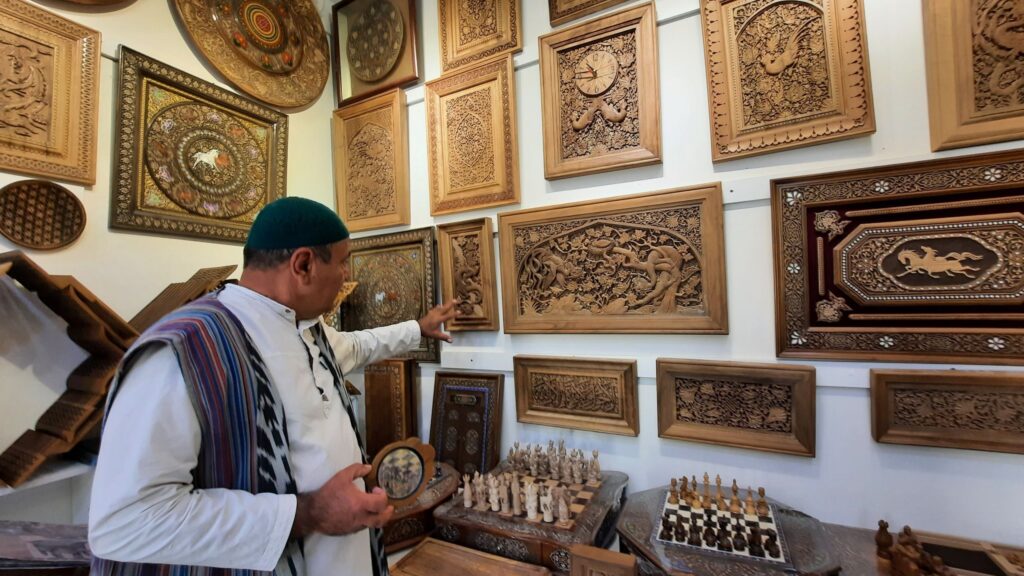
Bukhara Craftsman Keeps Ancient Woodcarving Traditions Alive

In the heart of Bukhara, one of Uzbekistan’s most historic cities, the sound of chisels meeting wood still resonates through the workshop of Shavkat Ashurov. At 57, he has dedicated more than two decades to the art of woodcarving, a tradition that has endured through centuries of upheaval and modernization in Central Asia. Ashurov’s workshop feels like a living museum. The patterns he carves are not modern inventions but trace their lineage back to the fifth and sixth centuries, long before the spread of Islam in the region. “There is only one similar piece left in Shahrisabz," Ashurov explains, "on the museum door connected to Amir Temur, and another in Turkistan. What we do here is to keep these traditions alive.” [caption id="attachment_36145" align="aligncenter" width="2560"] Ashurov's workshop. @Sadokat Jalolova[/caption] For Ashurov, woodcarving is more than a profession, it is a family legacy. “We are the fourth generation,” he said. “I only try to pass on what I know. I don’t add more than I can. What I learned from my forefathers, I hand over to my students.” He began carving more than 35 years ago, but for the past two decades has devoted himself almost entirely to the craft. Over the years, he has trained nearly 100 apprentices, though today he works with just four. The reason, he admits, is the patience the art requires. “This work takes time and patience, and not everyone can manage that,” he said. “Some of my students chose other professions. But with the ones I have, I continue.” The work itself is painstaking. A simple carved bowl may take about 40 minutes if the wood is well-prepared, but larger projects can span months. “One of our biggest works took nine months to complete,” he recalled. “It depends on inspiration too. Sometimes you work every day; sometimes you pause, waiting for the right moment to continue.” [caption id="attachment_36146" align="aligncenter" width="1280"] Chess pieces from an 83-year-old apprentice working with his teacher Ashurov. @Sadokat Jalolova[/caption] Ashurov’s designs are rich with symbolism. Many incorporate chessboard-like patterns, interlocking stars, or subtle references to family and genealogy. Over centuries, foreign influences have entered Uzbek woodcarving, but artisans like Ashurov have absorbed them into a distinctly local tradition. “Miniature lacquer work came from Europe and Russia, and we placed it into our art,” he said. “The use of mother-of-pearl came through Iran and Turkey. But we reworked them into our own tradition.” Equally important to him is honesty. “I tell customers about product defects before selling them, and I teach my students to be honest too. Honesty is as important as the design itself.” Woodcarving is both an art and a livelihood. His workshop supports not only his own household but four other families. Income is unpredictable from modest sums to as much as 100 million soums (around $8,000) depending on commissions. “It is 50 percent local buyers, 50 percent foreigners,” he said. “Our people also value this work, but foreigners are often very interested.” Social media has become an unexpected...

Learning Across Borders: Education at the Heart of Central Asia–Japan Relations

For more than three decades, Japan has cultivated a distinctive partnership with the countries of Central Asia, one rooted not in geopolitics or grand strategy alone, but in human connection. Education has emerged as one of the strongest pillars of this relationship, as young people from Uzbekistan, Kyrgyzstan, Kazakhstan, Tajikistan, and beyond increasingly look to Japan for academic training, language study, and professional development. Tokyo’s support for scholarships, university exchanges, and Japanese language programs reflects a long-term vision: to invest in people-to-people ties that strengthen mutual understanding and prepare a new generation of leaders across the region. The Times of Central Asia spoke with Central Asian students at the International University of Japan to gauge their experiences. Ilyos from Uzbekistan: "As an international student, I found Japan to be a country of fascinating contrasts - deeply rooted in tradition, yet highly modern. I was struck by the coexistence of fast-paced, bustling cities and quiet, remote towns, each offering a very different atmosphere and way of life. "I chose Japan because I’d previously studied in South Korea at the undergraduate level. That experience made me curious about Japan, as I expected certain similarities but also wanted to explore the differences. I thought that if Japan were similar to Korea, the adjustment would be smooth, and if it offered something new, it would be an even greater opportunity to broaden my perspective and prepare for my career. "I’ve been truly impressed by how consistently Japanese people follow rules, respect social order, and demonstrate a high level of etiquette in everyday interactions. This has left a strong impression on me and has shaped the way I think about discipline, respect, and community values." Farrukh from Tajikistan: "I first visited Japan back in 2019. At that time, it was a business trip, and I spent a month here. I’d been thinking about studying in Japan for a long time, but I finally had the opportunity last year when the JICE JDS Scholarship in my home country was announced. "In the time I’ve been here, I’ve never felt I was treated differently from other people, even locals. There have been minor instances when Japanese people acted very strictly, but I guess that’s how they usually are. In terms of cultural differences, one thing I noticed was how hard they work; there is a lack of work-life balance." Azmat from Uzbekistan: "Most of my colleagues from work got their Master’s degrees in Japan, and we have some agreements between the Japanese government and our organization about studying here. My ex-director, my current deputy director, and the head of division are graduates of Japanese universities. So, listening to their stories, I ended up studying in Japan. "I find the people of Japan to be very polite and patient. The way they treat us as foreigners is really good. Of course, there are some difficulties - Japan is a country of rules - but they’re minor." As Central Asia deepens its educational links with Japan, the stories of...

Central Asians in Putin’s War: Fighting for Ukraine, Forced for Russia

As the war in Ukraine continues to drag on, fighters from across Central Asia have found themselves on both sides of the frontlines. In Kyiv, Kazakh national Zhasulan Duysembin has traded his past life as a sales agent for a rifle, sporting a tattoo of Kazakhstan’s flag on his back as he battles to defend his adopted home. He now fights, he says, to protect his children and believes that “Russia will not stop in Ukraine, it will go further. We must make every effort to ensure that our Kazakhstan does not suffer.” Alan Zhangozha, an ethnic Kazakh who grew up in Kyiv and now serves as a public relations officer in the Ukrainian Army, echoes this sentiment. “Ukraine’s victory will also be a victory for my Motherland,” he told The Diplomat. But as the war drags on, in Kazakhstan, families mourn men like 22-year-old Kiril Nysanbaev - a labor migrant in Russia coerced into signing up for the war who only came home in a coffin. His sister recalls how her brother told her that Russian officers beat and forced him to enlist while he was detained on dubious charges in Chelyabinsk. Nysanbaev was killed in Ukraine’s Donetsk region in March 2024, news that only reached his family three months later. Citizens of all five Central Asian countries have been pulled into the conflict since Russia’s invasion in 2022. Some have volunteered to fight for Ukraine, driven by personal ties or ideals, while others, mostly labor migrants, have been recruited, enticed, or pressured into fighting for Russia. These parallel currents reflect the complex impact of the war on a region that remains officially neutral but was historically deeply entwined with Moscow. While a handful of Central Asians now wear the blue-and-yellow insignia in Ukraine’s defense, far more have ended up in Russia's ranks, often as expendable foot soldiers. From Bishkek to Bucha In November 2022, a Kyrgyz former labor migrant, Almaz Kudabek uulu, announced the creation of the Turan Battalion, a volunteer unit of Turkic-speaking fighters formed to assist Ukraine. “Kyrgyzstan is my homeland; I will always love it. But Ukraine is my home now; I am fighting for Ukraine,” he told reporters. The battalion, joined by volunteers from Kyrgyzstan, Kazakhstan, Azerbaijan, and elsewhere, operates as a semi-autonomous unit supported by private donations and allied Ukrainian brigades. Back in Kyrgyzstan, however, the authorities opened a criminal case against Kudabek, punishable by up to eight years in prison, and local media that covered his story faced pressure. Others have supported Ukraine in tangible, humanitarian ways. Early in the war, members of Ukraine’s Kazakh diaspora erected traditional yurts in cities like Bucha and Kyiv as heated shelters dubbed “Yurts of Invincibility.” These spaces provided food, tea, and electricity during blackouts, a gesture of solidarity that irritated Moscow but drew only a muted response from Kazakhstan’s government. Moscow’s Migrant Recruits: Coercion and Casualties Far greater numbers of Central Asians have ended up fighting for Russia, which hosts millions of migrant workers from...

Uzbekistan’s Garden Blossoms at the Osaka Expo

At Osaka Expo 2025, Uzbekistan is stepping onto the global stage with a pavilion that embodies the country’s theme: culture as the foundation of future societies. Created by the Uzbekistan Art and Culture Development Foundation (ACDF), the space celebrates heritage as both a legacy and a launchpad to connect communities, bridge generations, and spark global conversations. ACDF is no stranger to ambitious cultural projects. In Tashkent, it has staged the World Conference on Creative Economy, created the first Aral Culture Summit in Nukus, and is behind the renovation of the Centre for Contemporary Art. The Foundation is also working with star architect Tadao Ando on the design of a new National Museum and restoring the storied Palace of the Grand Duke of Romanov. Its research project, Tashkent Modernism XX/XXI, has already caught international attention with publications from Rizzoli New York and Lars Müller Publishers. [video width="1280" height="720" mp4="https://timesca.com/wp-content/uploads/2025/09/IMG_6020-online-video-cutter.com_.mp4"][/video] Recently, ACDF has been igniting fresh cultural currents. In Bukhara, the UNESCO-listed jewel of the Silk Road, the debut of the first-ever Biennial, Recipes for Broken Hearts, has transformed the ancient city into a vibrant stage for contemporary creativity. As we approached the pavilion, the queue was already packed and closed off to latecomers still straggling in. Before entry, a guide explained in Japanese the concepts in motion. Designed by internationally acclaimed ATELIER BRUCKNER, the installation unfolds under the theme Garden of Knowledge: A Laboratory for a Future Society, inspired by Uzbekistan’s fertile soil and fragrant gardens where wisdom and originality take root. Built with materials sourced in Japan, the structure features 10,000 hand-glazed bricks crafted by a master artisan from Uzbekistan. Its design has already earned international acclaim, winning the prestigious Red Dot: Best of the Best, and taking home gold at the German Design Award. Inspired by Khiva and the Khorezm region’s rich architectural and intellectual legacy, it’s a two-storey 750 square meter space that blends the ancient with forward-thinking design, mirroring the life cycle of a garden. Khiva, a UNESCO World Heritage city, has long been a crossroads of learning where scholars, artisans, and merchants exchanged ideas within its madrasahs and courtyards. It reimagines this heritage as a contemporary space for gathering and exchange. [caption id="attachment_36099" align="aligncenter" width="2560"] Exhibit: transport of the future; image: TCA, Stephen M. Bland[/caption] Brick and clay symbolize earth and ancestry, while cypress wood cultivated near Osaka underscores environmental responsibility. The triangular plot draws from the tumar, a traditional Central Asian amulet of protection, while a floor-level garden evokes Uzbekistan’s landscapes. Visitors follow a symbolic journey from planting seeds of knowledge to harvesting ideas, exploring zones aligned with UNESCO’s goals, including quality education, clean energy, resilient infrastructure, and innovation. [caption id="attachment_36097" align="aligncenter" width="2560"] Exhibit blending the ancient and the modern; image: TCA, Stephen M. Bland[/caption] The experience begins in the soil, a ground-floor gallery that highlights Uzbekistan’s shift toward a green economy through renewable energy, eco-friendly transport, and energy-efficient housing, along with landmark projects such as the revitalization of the Aral Sea Basin. From there,...

Opinion: A Railway to the Future – Uzbekistan’s Bold Path to Connectivity and Carbon Cuts

I still remember the thrill of boarding the sleek high-speed train from Tashkent to Bukhara. What could have been an ordinary journey turned into something unforgettable - the kind of experience that stays alive in the memory long after the trip ends. The speed, the comfort, and above all, the hospitality of Uzbekistan Railways revealed more than just modern engineering; it was a glimpse into the vision of a country determined to connect its people and its future to the wider world. The resonance of this project is deep. The Silk Road was once the artery of global exchange, moving not just goods but ideas, cultures, and entire civilizations between East and West. From Xi’an to Samarkand, Bukhara, and Tashkent, caravans carried silk, porcelain, and paper eastward, while wool, stones, fruits, and glassware travelled west. The CKU Railway is not simply another infrastructure project; it is the revival of this legacy, adapted for the 21st century. By shortening transport routes by nearly 900 kilometers and halving transit times, it promises to transform Uzbekistan’s geographic disadvantage into a strategic strength. For a landlocked country, this is more than steel on tracks - it is a lifeline to global markets. That is where railways carry an underappreciated advantage. Beyond the economics, rail is also a climate solution. The International Energy Agency (IEA) has found that rail freight is three to four times more energy-efficient than trucks. Trains use 65–80% less fuel per kilogram of cargo. The European Environment Agency calculates that a ton of freight moved by train emits 14–20 grams of CO₂ per kilometer, while the same tonnage on trucks produces 60–120 grams. That is a four- to fivefold difference. If the 20th century belonged to highways, the 21st must belong to railways. To grasp what this means for Central Asia, consider the region’s emissions profile. According to the EDGAR 2023 dataset, annual greenhouse gas emissions (excluding LULUCF, 2022) stand at roughly 320 MtCO₂e for Kazakhstan, 214 MtCO₂e for Uzbekistan, 99 MtCO₂e for Turkmenistan, 22 MtCO₂e for Kyrgyzstan, and 21 MtCO₂e for Tajikistan. Transport is responsible for around a tenth of that, and road freight dominates. The opportunity for reductions through a modal shift is therefore enormous. Take Uzbekistan as a case in point. The country moves about 90 billion ton-km of freight annually, within a regional total of some 350 billion. At present, 70% of this moves by road and 30% by rail. Imagine that by 2035, half of current road freight shifts to electrified rail - around 32 billion ton-km. On trucks, that freight would generate 2.9 MtCO₂e per year. On electrified trains, it would produce only 0.54 MtCO₂e. The savings: 2.4 MtCO₂e annually, or more than 1% of Uzbekistan’s entire national emissions. For a single infrastructure project, that is an extraordinary return in climate terms. The regional potential is just as striking. If similar shifts occurred across Central Asia, annual savings would reach 7–9 MtCO₂e by 2035 - the equivalent of removing two million cars from the road....
