• KGS/USD = 0.01144 0%
  • KZT/USD = 0.00209 0%
  • TJS/USD = 0.10438 0%
  • UZS/USD = 0.00008 0%
  • TMT/USD = 0.28490 0%
  • KGS/USD = 0.01144 0%
  • KZT/USD = 0.00209 0%
  • TJS/USD = 0.10438 0%
  • UZS/USD = 0.00008 0%
  • TMT/USD = 0.28490 0%
  • KGS/USD = 0.01144 0%
  • KZT/USD = 0.00209 0%
  • TJS/USD = 0.10438 0%
  • UZS/USD = 0.00008 0%
  • TMT/USD = 0.28490 0%
  • KGS/USD = 0.01144 0%
  • KZT/USD = 0.00209 0%
  • TJS/USD = 0.10438 0%
  • UZS/USD = 0.00008 0%
  • TMT/USD = 0.28490 0%
  • KGS/USD = 0.01144 0%
  • KZT/USD = 0.00209 0%
  • TJS/USD = 0.10438 0%
  • UZS/USD = 0.00008 0%
  • TMT/USD = 0.28490 0%
  • KGS/USD = 0.01144 0%
  • KZT/USD = 0.00209 0%
  • TJS/USD = 0.10438 0%
  • UZS/USD = 0.00008 0%
  • TMT/USD = 0.28490 0%
  • KGS/USD = 0.01144 0%
  • KZT/USD = 0.00209 0%
  • TJS/USD = 0.10438 0%
  • UZS/USD = 0.00008 0%
  • TMT/USD = 0.28490 0%
  • KGS/USD = 0.01144 0%
  • KZT/USD = 0.00209 0%
  • TJS/USD = 0.10438 0%
  • UZS/USD = 0.00008 0%
  • TMT/USD = 0.28490 0%

Viewing results 139 - 144 of 1136

Gor and Landau Tour Central Asia Amid Rising Stakes

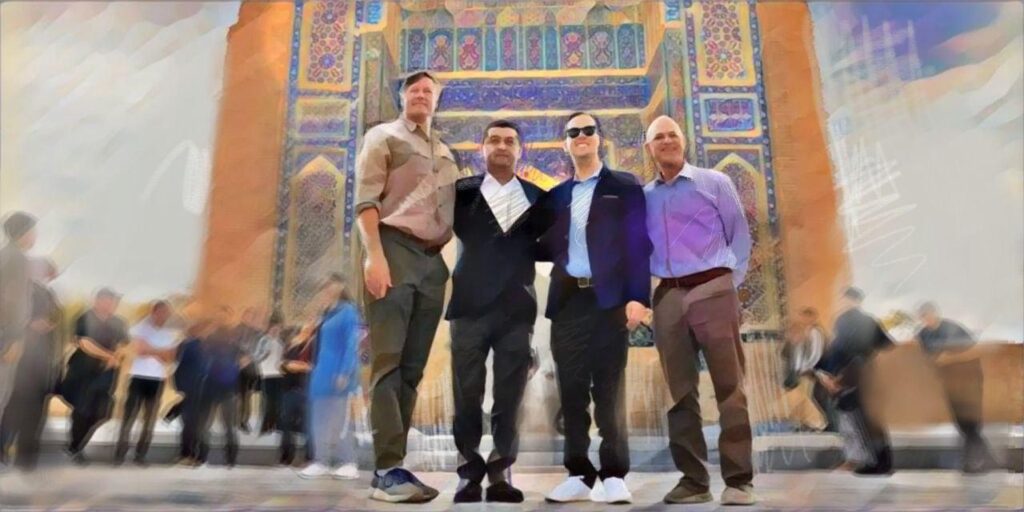
On October 25, U.S. Special Representative for South and Central Asia Sergio Gor and Deputy Secretary of State Christopher Landau arrived in Tashkent on an official visit. The visit to Central Asia was not publicly scheduled in advance, with news of the trip only emerging a few days beforehand. In Uzbekistan, the high-ranking visitors were received with full state honors. A motorcycle escort and blocked roads in the capital are typically reserved for visits by heads of state. Although the American delegation’s visit to Uzbekistan ended by Monday evening, local media coverage remained scant. Apart from posts on the U.S. Embassy in Uzbekistan’s Telegram channel, almost no media outlets covered the event. On the evening of October 25, Gor and Landau held productive talks with representatives of U.S. companies about numerous opportunities to strengthen mutual prosperity. Afterwards, they traveled to Samarkand, where they toured the city often referred to as the pearl of Central Asia. On October 26, the visitors held fruitful talks with Foreign Minister Saidov, thanking him for his leadership and hospitality throughout the visit. His efforts, they noted, are elevating the strategic partnership between the U.S. and Uzbekistan to a new level. The delegation also held “productive” talks with Ministers Bobir Islamov and Laziz Kudratov on expanding trade and investment ties. By Monday evening, Gor and Landau had arrived in Almaty, Kazakhstan. As the largest city in the country, Almaty is also one of Central Asia’s key business hubs. According to sources, the agenda in Kazakhstan includes meetings with business leaders and a cultural program. As in Uzbekistan, there was no official information about the visit released on Monday. This may, however, be because Monday was a national holiday - Republic Day – an event which President Donald Trump extended his congratulations to mark, stating that ““The United States values ​​our close economic and security ties with Kazakhstan and looks forward to further strengthening our expanded strategic partnership in the coming year.” Secretary of State Marco Rubio also sent his “congratulations to the people of Kazakhstan.” By all indications, the lightning-fast visit by the senior U.S. delegation is linked to the recently announced C5+1 summit in Washington on November 6. Beyond cultural sightseeing, the talks reportedly covered cooperation in rare earth mineral processing and other sensitive areas. Recently, U.S. interest in the countries of the region has expanded significantly. While China and, traditionally, Russia are considered the main players in the region, Europe and the U.S. are increasingly seeking a firmer foothold in Central Asia’s strategic landscape. Recent global conflicts have exposed major powers’ dependence on raw materials and logistics routes. The search for new corridors and suppliers now seems both logical and urgent. Sanctions on Russia have also had a direct impact on regional economies, requiring swift responses. The C5+1 format presents an ideal framework for launching coordinated political and business cooperation. Yet, it’s essential to recognize the significant disparities among Central Asian countries. Kazakhstan is the region’s financial heavyweight. According to the IMF, Kazakhstan’s GDP per capita...
Uzbekistan and EU Sign Landmark Enhanced Partnership Agreement in Brussels

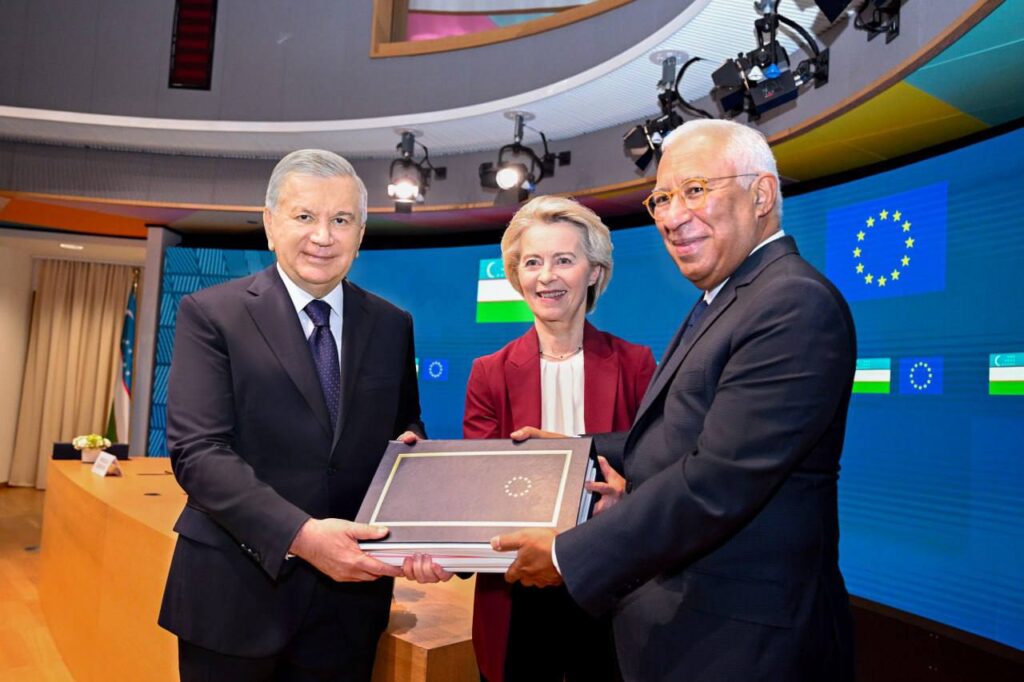
President Shavkat Mirziyoyev of Uzbekistan paid an official visit to Brussels on October 23-24 at the invitation of European Council President Antonio Costa and European Commission President Ursula von der Leyen, where a landmark agreement was signed to deepen Uzbekistan-EU cooperation across multiple sectors. During the visit, Mirziyoyev attended the signing ceremony of the Enhanced Partnership and Cooperation Agreement (EPCA), which replaces the 1996 Partnership and Cooperation Agreement. The new accord significantly broadens the scope of bilateral ties, covering areas such as trade, investment, digital technologies, environmental protection, and climate resilience. Negotiations began in February 2019 and concluded in July 2022. The EPCA includes nine sections, 356 articles, and 14 annexes, forming a comprehensive legal framework for political dialogue and long-term economic collaboration. It aims to bolster cooperation in trade, innovation, sustainable development, education, and cultural exchange between Uzbekistan and EU member states. In Brussels, Mirziyoyev also participated in a roundtable with executives from leading European companies and financial institutions, including Vandewiele, Linde, Lasselsberger Group, Meridiam, SUEZ, the European Investment Bank, Commerzbank, and KfW. The parties agreed to pursue new joint projects worth over €10 billion in sectors such as energy, chemicals, critical minerals, logistics, textiles, and pharmaceuticals. These initiatives build on an existing portfolio of EU-led projects in Uzbekistan, currently valued at more than €40 billion. Over the past seven years, trade between Uzbekistan and the European Union has doubled, while the number of joint ventures with European investment has surpassed one thousand. Mirziyoyev highlighted that the partnership is grounded in mutual trust and shared priorities, particularly in human capital development, renewable energy, digital transformation, and sustainable infrastructure. The President outlined four priority areas for expanding cooperation: joint production of high-value goods through deeper processing of strategic raw materials; collaboration in the green economy; development of logistics and transport corridors linking Europe and Asia; and partnerships in digital technologies, including artificial intelligence and cybersecurity. On the sidelines of the visit, Mirziyoyev met with King Philippe of Belgium at Laeken Palace. The two leaders discussed trade, investment, and cultural ties, with the King congratulating Uzbekistan on the signing of the historic EPCA. Relations between Uzbekistan and Belgium continue to grow, with rising trade volumes and expanding business cooperation. Belgian firms are active in Uzbekistan’s textile, logistics, and service sectors, while cultural ties have also deepened. Notable milestones include the unveiling of a bust of Ibn Sina in Kortrijk and sister-city partnerships such as Tashkent-Kortrijk and Samarkand-Liège. Mirziyoyev extended an official invitation to King Philippe to visit Uzbekistan, underscoring a shared commitment to strengthening bilateral ties in the years ahead.

Uzbek Militants Become Mediators in Syria Stand-Off

Brandishing assault rifles, the Uzbek fighters in Syria arrived ready to fight. They ended up helping to mediate an end to a confrontation between another group of militants and government security forces.  Fighting broke out early last week when Syrian forces raided a stronghold of the Islamic militant group Fiqrat al-Ghuraba, whose leader, identified as Omar Diaby, is a French national of Senegalese origin. Authorities accused the group of kidnapping and other crimes, though some analysts say the government is under international pressure to rein in foreign fighters who helped oust former leader Bashar al-Assad last year but have resisted integration into the military of Syria’s new, relatively moderate leadership. The confrontation erupted in the city of Harem in Idlib province in northern Syria. Ethnic Uzbek fighters deployed to the area, saying they were prepared to reinforce the so-called French jihadis. Uzbek combatants play a prominent role in two groups of foreign fighters in Syria that are known by the acronyms KIB and KTJ and retain ties to al-Qaida and the Taliban, according to a recent West Point analysis. But the Syrian Observatory for Human Rights, which tracked the country’s long civil war, said an agreement to end the fighting was reached with the mediation of Uzbek fighters and members of the Turkistan Islamic Party, a mostly Uyghur extremist movement. As part of the deal, heavy weapons were to be withdrawn from the region and the mediators were “entrusted to track the fate” of Omar Diaby, according to the observatory.  While the agreement resolved the local stand-off, it didn’t address the broader question of how the Syrian government will deal with the many foreign militants who joined the fight against al-Assad and remain, with their weapons, in the country. At least in the short term, the deal seemed to benefit the extremists who demonstrated leverage in their talks with authorities. Foreign fighter groups had shared the same goal as Hayat Tahrir al-Sham, a group with al-Qaida roots that led the rebel push to overthrow al-Assad and whose leader, Ahmed al-Sharaa, is now trying to project an inclusive image as Syria’s president.  The French-led extremists have accused Syrian authorities of collaborating with France to detain them and turn them over to French authorities. China, which is concerned about Uyghur militants, has also urged Syria’s transitional government to crack down on designated terror groups.

Trump to Host U.S.-Central Asia Summit on November 6

Kazakhstan’s presidency says a Central Asia–United States summit will be held in Washington on November 6. President Kassym-Jomart Tokayev sent a letter to U.S. President Donald Trump to thank him for the invitation to participate in the summit on that date in the U.S. capital, Tokayev’s press office said on Sunday. President Tokayev regarded the initiative of the American leader as both timely and important, the office said. “The Head of State also noted that he shares the key principles of President Trump’s domestic and foreign policy, in particular the advocacy of traditional values based on common sense, as well as dedication to safeguarding peace and security.” The summit would mark the tenth anniversary of the C5+1 diplomatic forum, which includes the United States and the five Central Asian countries of Kazakhstan, Kyrgyzstan, Tajikistan, Turkmenistan, and Uzbekistan. Citing unidentified sources in Uzbekistan’s presidential administration, Gazeta, a media outlet in Uzbekistan, confirmed the summit plan, saying Uzbek President Shavkat Mirziyoyev was among the Central Asian leaders who had received invitations from Trump to attend the November 6 meeting in Washington. Kyrgyz media have also reported that President Sadyr Japarov will attend the C5+1. According to Azattyq, the invitation was extended to all five Central Asia leaders. The announcement of the summit coincides with a visit to Kazakhstan and Uzbekistan by Sergio Gor, U.S. Special Envoy for South and Central Asia, and Deputy Secretary of State Christopher Landau. Trump met Tokayev and Uzbek President Shavkat Mirziyoyev on the sidelines of the U.N. General Assembly last month. Multi-billion-dollar business deals were announced in connection with those meetings. The U.S. president is currently on an Asia tour during which he is expected to meet Chinese President Xi Jinping to discuss trade tensions. A summit with Central Asian leaders could potentially help the U.S. counter the influence of Russia and China in that region. In an Oct. 20 letter, a U.S. congressional foreign affairs panel urged Trump to host a summit with Central Asian leaders before the end of the year. It noted U.S. interests such as the development of critical minerals, including tungsten, antimony, lithium, and rare earth elements; the full repeal of the Jackson-Vanik amendment, a Cold War-era law that imposes some restrictions on trade with several countries in Central Asia; and counterterrorism efforts against the regional branch of the Islamic State group.

U.S. Special Envoy and Deputy Secretary of State to visit Central Asia

The U.S. Department of State has published a statement announcing that the Special Envoy for South and Central Asia, Sergio Gor, and Deputy Secretary of State Christopher Landau will travel to Kazakhstan and Uzbekistan from October 26 to October 30. According to the statement, "Special Envoy Gor and Deputy Secretary Landau will meet with Kazakh and Uzbekistani government counterparts to discuss a wide range of economic and security issues. The United States will continue to work with our Central Asian counterparts to strengthen relations and expand commercial ties. We look forward to enhancing bilateral cooperation between our countries and also recognizing ten years of U.S.-Central Asian partnership through the C5+1 diplomatic platform." No further details were provided in the announcement. Gor was born as Sergio Gorokhovsky on November 30, 1986, in Tashkent, Uzbekistan, which was part of the Soviet Union at the time. Gor's lawyer, Robert Garson, confirmed by email that his client was born in Tashkent. The previously unannounced visit is a continuation of recent talks held by the leaders of Astana and Tashkent with President Trump, and comes in the wake of new sanctions imposed on Russia last week, which directly affect countries in the region. In addition, last week, the U.S. Congressional Foreign Affairs Panel asked U.S. President Donald Trump to host a meeting in Washington, D.C. with leaders from Central Asia by the end of 2025.

Syrian Government Raid on Foreign Fighters Draws in Uzbek Militants

A Syrian government raid on a compound controlled by French foreign fighters in northern Syria threatened to evolve into a wider conflict after Uzbek Islamist militants arrived to reinforce the French group.  The fighting that started on Monday reflects the challenges that Syria’s transitional government faces as it tries to restore stability to the country after the 2024 ouster of former leader Bashar al-Assad and the end of more than a decade of civil war. Outbreaks of sectarian violence have disrupted progress. An additional problem is how to handle foreign fighters who originally arrived in Syria to fight al-Assad’s forces, but have turned down an invitation to join the new government’s military.  “The Syrian transitional government appears to be pursuing a low-level effort to target foreign fighters in Syria who have not integrated into the Ministry of Defense,” the Institute for the Study of War, a U.S.-based research group, said in a report on Wednesday.  The institute said that Syrian forces targeted a compound run by a group of French militants called Fiqrat al-Ghuraba as well as fighters from the Caucasus in Harem, a city in Idlib province near the border with Türkiye. Fighting broke out and a group of Uzbek foreign fighters deployed to the compound to reinforce the militants, according to the institute.  Syrian security forces “previously arrested two prominent Uzbek foreign fighters in August 2025, which has led to increased discontent among Central Asian foreign fighter groups,” it said.  Videos purportedly showing ethnic Uzbek fighters arriving in Harem are circulating on social media.  An Arabic-language news platform, nabd.com, reported that an Uzbek fighter in one video clip said: “We have gathered in Idlib to support our French brothers." The Syrian Observatory for Human Rights, a Britain-based group that tracks events in Syria, said security forces tried to storm the jihadi camp with “light and medium weapons” and that fighting “left several casualties among French migrants and security forces, amid confirmed arrests of French jihadists.” Syrian authorities said they took action this week after the militants in Idlib had kidnapped a girl and committed other “grave violations” against civilians, the state-run Syrian Arab News Agency reported.  Uzbek militants previously collaborated with Hayat Tahrir al-Sham, a group that led the rebel push to overthrow al-Assad. Hayat Tahrir al-Sham, or HTS, had al-Qaida roots but later split off and moved to project a more moderate image under leader Ahmed al-Sharaa, now Syria’s president. On Tuesday, Britain removed HTS from its list of terrorist organizations as it seeks to engage the new Syrian government. The United States took a similar step in July.  Two mainly ethnic Uzbek groups of foreign fighters in Syria, known by the acronyms KIB and KTJ, retain ties to al-Qaida and the Taliban in Afghanistan, according to an analysis by Kathleen Collins that was published last month by the Combating Terrorism Center at West Point, the U.S. military academy.  The two groups “constitute a resilient force of battle-hardened fighters, demonstrating remarkable staying power in Syria,” Collins wrote.