
• KGS/USD = 0.01144 0%
  • KZT/USD = 0.00205 0%
  • TJS/USD = 0.10441 0.1%
  • UZS/USD = 0.00008 0%
  • TMT/USD = 0.28571 0%
  • KGS/USD = 0.01144 0%
  • KZT/USD = 0.00205 0%
  • TJS/USD = 0.10441 0.1%
  • UZS/USD = 0.00008 0%
  • TMT/USD = 0.28571 0%
  • KGS/USD = 0.01144 0%
  • KZT/USD = 0.00205 0%
  • TJS/USD = 0.10441 0.1%
  • UZS/USD = 0.00008 0%
  • TMT/USD = 0.28571 0%
  • KGS/USD = 0.01144 0%
  • KZT/USD = 0.00205 0%
  • TJS/USD = 0.10441 0.1%
  • UZS/USD = 0.00008 0%
  • TMT/USD = 0.28571 0%
  • KGS/USD = 0.01144 0%
  • KZT/USD = 0.00205 0%
  • TJS/USD = 0.10441 0.1%
  • UZS/USD = 0.00008 0%
  • TMT/USD = 0.28571 0%
  • KGS/USD = 0.01144 0%
  • KZT/USD = 0.00205 0%
  • TJS/USD = 0.10441 0.1%
  • UZS/USD = 0.00008 0%
  • TMT/USD = 0.28571 0%
  • KGS/USD = 0.01144 0%
  • KZT/USD = 0.00205 0%
  • TJS/USD = 0.10441 0.1%
  • UZS/USD = 0.00008 0%
  • TMT/USD = 0.28571 0%
  • KGS/USD = 0.01144 0%
  • KZT/USD = 0.00205 0%
  • TJS/USD = 0.10441 0.1%
  • UZS/USD = 0.00008 0%
  • TMT/USD = 0.28571 0%

Our People > Bruce Pannier

Bruce Pannier's Avatar

Bruce Pannier

Bruce Pannier is a Central Asia Fellow in the Eurasia Program at the Foreign Policy Research Institute, the advisory board at the Caspian Policy Center, and a longtime journalist and correspondent covering Central Asia. For a decade, he appeared regularly on the Majlis podcast for RFE/RL, and now broadcasts his Spotlight on Central Asia podcast in partnership with The Times of Central Asia.

Articles

Heads of Kyrgyz, Tajik, and Uzbek Governments Meet… Finally

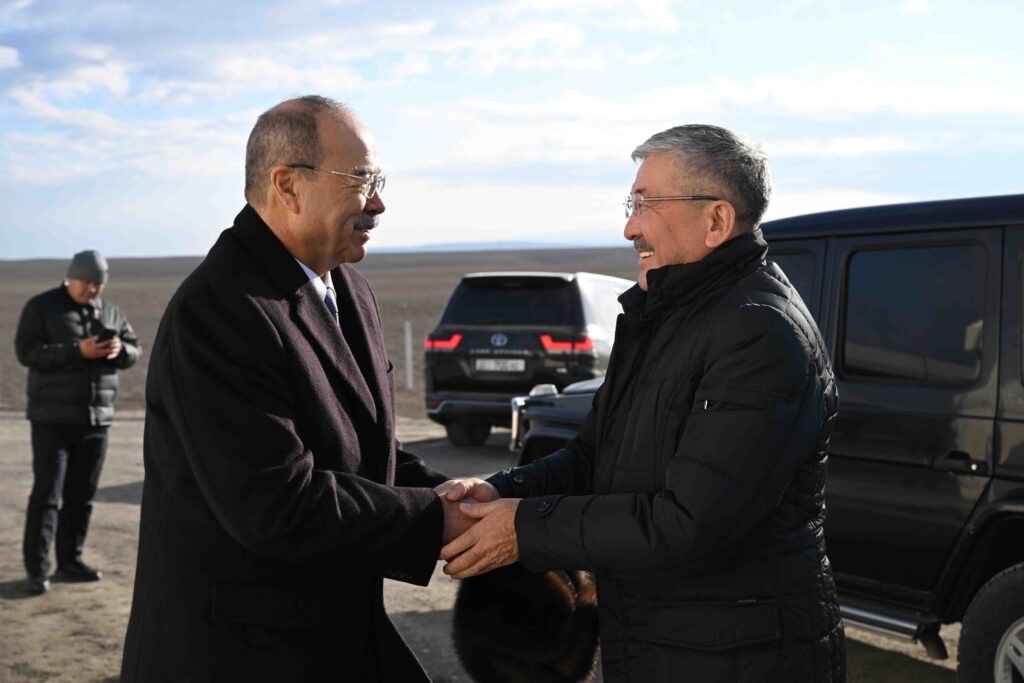
It took more than 30 years, but the prime ministers of the three Central Asian countries that share the Ferghana Valley finally met to discuss a range of important issues that concern all three states. Tajik Prime Minister Kohir Rasulzoda, Uzbek Prime Minister Abdulla Aripov, and Chairman of Kyrgyzstan’s Cabinet of Ministers (Kyrgyzstan does not have a post of prime minister) Adylbek Kasymaliyev met on January 8 at a desolate area where the borders of the three countries meet. [caption id="attachment_27412" align="aligncenter" width="8256"] Image: gov.kg[/caption] The group touted agreements on the completion of the delimitation process along the Uzbek-Kyrgyz border and the early December 2024 agreement on the Kyrgyz-Tajik border. Since 1991, unmarked areas of the borders in the Ferghana Valley were often the scenes of conflicts between communities on either side of the frontier. Border guards sometimes fired on trespassers and dozens of people were killed or wounded, sometimes simply because they inadvertently strayed over unmarked territory into the neighboring country. The Ferghana Valley is the most densely populated region in Central Asia. This is due to the rich agricultural land which makes the region to this day the breadbasket of Central Asia. Soviet mapmakers drew lines to create Soviet republics in the region, though these borders mattered little since they were internal administrative boundaries inside one country. [caption id="attachment_27413" align="aligncenter" width="8256"] Image: gov.kg[/caption] After the USSR collapsed, these often-arbitrary, zigzagging borders took on meaning, and disputes quickly broke out about what land historically belonged to which nation and who had rights to water use. These issues were greatly complicated by the existence of enclaves created during the Soviet period such as Uzbekistan’s Soh and Shahimardon and Tajikistan’s Vorukh, all three of which are surrounded by Kyrgyzstan.   Looking Ahead The three prime ministers discussed hydropower plants (HPP), an important topic for all three countries, especially as key HPPs are located in the mountains ringing the Ferghana Valley and more are currently under construction. Central Asia is one the regions most affected by climate change, so HPPs and water use in general are crucial issues, especially given that agriculture in the Ferghana Valley is vital to all three countries. All three countries face electricity shortages and hydropower is seen as a means of alleviating or even totally resolving this dilemma, but at the same time waters flowing from the mountains of Kyrgyzstan are important for agriculture in every Central Asian state. Uzbek media noted Uzbek Energy Minister Jurabek Mirzamahmudov was part of the delegation attending the January 8 talks. Reports did not mention if energy ministers from Kyrgyzstan and Tajikistan were also present. [caption id="attachment_27414" align="aligncenter" width="8256"] Image: gov.kg[/caption] Central Asia is also taking on a new importance as a trade corridor between Europe and China, and from Europe and China into Afghanistan and on further to Pakistan. Reports noted logistics were high on the agenda at the meeting of the three prime ministers. Trade between the three countries, specifically in the Ferghana Valley, was also discussed not only...

1 year ago

Old Projects Now Part of Kyrgyzstan’s Near Future

Two projects that successive governments in Kyrgyzstan over the course of more than three decades have promoted as key to the country’s long-term success appear to finally be making progress. The idea for the China-Kyrgyzstan-Uzbekistan (CKU) railway dates back to the early days of Kyrgyzstan’s independence, and plans for construction of the massive Kambar-Ata-1 hydropower plant (HPP) go back even further, to the Soviet-era. After all these years, these aspirations that have almost faded into dreams are set to be realized.   All Aboard On December 27, Kyrgyz President Sadyr Japarov took part in a ceremony near the southern city of Jalal-Abad to launch construction of Kyrgyzstan’s section of the CKU railway. The idea of a trans-Asian railway that would run from China into Kyrgyzstan and on to points further west goes back to the first meeting on Central Asian presidents in December 1991 in Ashgabat, Turkmenistan. It was a lofty ambition from five leaders whose countries had been independent for barely three months, but then-Kyrgyz President Askar Akayev followed up on the proposal, discussing the railway project with Chinese leaders when he visited Beijing in May 1992. That was more than one year before the first road border crossing opened between the two countries. By the end of the 1990s, the scope of the project had narrowed to a railway connecting China, Kyrgyzstan, and Uzbekistan, though it was often vaguely mentioned the line could be part of a longer railway connecting China to Europe through Central Asia. The topic of the CKU railway was always part of the agenda for every Kyrgyz president whenever they met with Chinese leaders. In June 2001, then-Kyrgyz transport and communications minister Kubanychbek Jumaliyev announced his country would sign an inter-governmental agreement with China and Uzbekistan on construction of the railway. At that time, Jumaliyev said some 250 kilometers of the line would pass through Kyrgyzstan and the cost of construction of the whole line would be about $2.3 billion. According to the latest plans for the route, CKU railway will be 486 kilometers, from Kashgar in China’s western Xinjiang Uyghur Autonomous Region to Torugart on the Kyrgyz-China border, then through the Kyrgyz cities of Makmal and Jalal-Abad to Andijon in Uzbekistan. The distance is not great, but the mountainous landscape of Kyrgyzstan through which the route will pass presents some formidable challenges. The 312 kilometers that will run through Kyrgyzstan requires construction of 81 bridges and 41 tunnels that will account for some 120 kilometers of the 312-kilometer Kyrgyz section of the railway. According to some sources, including Akylbek Japarov, who until December 16 was chairman of Kyrgyzstan’s Cabinet of Ministers, the estimated cost of building the entire railway is now put at some $8 billion. Cash-strapped Kyrgyzstan is expected to pay some $4.7 billion of that, and has already agreed to accept a Chinese loan of some $2.35 billion. The advantages for Kyrgyzstan will not come quickly, but they should come eventually. Simply being better connected to markets in Europe and China...

1 year ago

Fear Returns to Tajikistan’s Konibodom Area

A series of murders in spring had residents in the area around Tajikistan’s northern city of Konibodom on edge for weeks. Thirteen people were killed between late March and late May, apparently by someone who broke into their homes at night. The victims ages ranged from young children to elderly people; they were ethnic Tajiks and Kyrgyz (Konibodom is located near the border with Kyrgyzstan), and the crimes happened in different areas around the city. The murders stopped, and later the Tajik authorities said they had captured the suspects, but on December 9, the nightmare started again with six people being killed, and on December 16, four more people were found dead in their homes.   The Killing Starts Again On December 9, the bodies of six people were found in the Shurkurgon neighborhood of Konibodom. All six were members of the Nematov family. Thirty-seven-year-old Naimjon was found hanged on a tree in the courtyard of the family’s home. His body showed signs of a struggle. His 33-year-old wife and four children, the youngest only two years old, were all strangled inside the family’s home. Local authorities and police have not commented on the killings. On December 16, reports said the bodies of 35-year-old Gaibullo Majidov and his 28-year-old wife Zarnigor were found in their home in Konibodom’s Hisorak neighborhood. Their three children were reportedly unharmed. On the same day in the same neighborhood, the bodies of 70-year-old Oyisha Shokirova and her 44-year-old son Javlon were found. Reports said all appeared to have died violent deaths, but the exact cause was not given. Police have also not commented on these murders. Prior to these latest killings, it appeared the police had caught at least some of the people responsible for a wave of murders in the spring that had local residents talking about “men in black” who prowled the streets in the middle of the night.   The Authorities’ Version On July 31, Konibodom Mayor Abdusalom Tukhtasunzoda said a suspect had been caught for the May 28-29 killings of six people in the village of Sanjidzor, on the outskirts of Konibodom. Tukhtasunzoda did not give any details about the suspect or the motive, except to say the person had been detained the week before. The Konibodom mayor said the murders in May were not connected to the earlier killings of five members of the Sharipov family in March, or to Muzaffar Urmonov and his wife Inoyat Urmanova in April. Tukhtasunzoda also dismissed the tales being told of men dressed in black clothing and masks being responsible for any of the murders. “There were no people ‘in black’ in the city of Konibodom,” Tukhtasunzoda said, “The video, which is distributed on social networks, was not filmed in Konibodom. Such footage is being circulated to frighten people.” On August 8, First Deputy Interior Minister Abdurahmon Alamshozoda told a press conference the was “nothing sensational” about the murders in Konibodom the previous spring. Alamshozoda said the incidents in March and April were the...

1 year ago

Turkmenistan to Boost Gas Exports to Neighbor Uzbekistan

Uzbekistan has agreed to purchase more natural gas from Turkmenistan, though the amount of additional gas and the price remain unclear. Uzbek President Shavkat Mirziyoyev spoke by phone with the chairman of Turkmenistan’s Halk Maslahaty (People’s Council) and leader of the country Gurbanguly Berdimuhamedov on December 5 to discuss the deal. According to Turkmen state news, Berdimuhamedov “agreed to the increase” of Turkmen gas to Uzbekistan, and it would not be surprising if Berdimuhamedov was quietly dancing in celebration on the other end of the line.   Anxious to Sell Turkmenistan has the fourth largest gas reserves in the world, some 17.5 trillion cubic meters, at least. To put that in perspective, the 27 countries of the European Union, combined, used 350 billion cubic meters of gas in 2022, meaning Turkmenistan has enough gas to meet all the EU’s gas needs, at current levels, for 50 years. Unfortunately, more than 33 years after becoming independent, Turkmenistan still does not have many customers for its gas. There is China, which buys the most Turkmen gas, some 35 billion cubic meters (bcm), Uzbekistan, which in recent years has been purchasing 1.5-2 bcm annually from Turkmenistan, and Azerbaijan, which gets 1-1.5 bcm of Turkmen gas via a swap arrangement involving Iran. Turkmenistan’s only successful recent export deal is with Iraq for 10 bcm, which involves a swap arrangement with Iran that will require maintenance work and repairs on Turkmenistan’s and Iran’s pipelines. Turkmenistan just lost Russia as a customer after the contract for Russia to purchase up to 5.5 bcm of Turkmen gas expired at the end of June 2024. The expiration of the agreement with Russia meant Turkmenistan lost its second biggest buyer, but that might now turn out to be good news for Uzbekistan.   Anxious to Buy The jump in the number of people and accompanying expansion of service infrastructure have combined with Uzbekistan’s gross failure to increase domestic gas output to make Uzbekistan a net gas importer. In late January 2023, Uzbek media reported the country produced some 51.7 bcm of gas in 2022 and said plans called for increasing that to 56.3 bcm in 2023. Instead, gas production fell to 46.7 bcm in 2023, and it is set to decrease further in 2024. Uzbekistan signed its first contract for Turkmen gas in December 2022. That deal was for 1.5 bcm annually, but in August 2023, the two countries agreed to boost that to 2 bcm. However, that was not enough to fill Uzbekistan’s growing gas consumption needs. In June 2023, Uzbekistan signed a two-year agreement to import up to 2.8 bcm of gas from Russia, but by March 2024, reports showed Uzbekistan looking to increase Russian gas imports to 11 bcm starting in 2026. It looks like some of the 5.5 bcm Turkmenistan was until recently selling to Russia will instead be sent to Uzbekistan, so for Turkmenistan, the gas deal with Uzbekistan only recovers some of the revenue lost with the expiration of the contract with Russia....

1 year ago

A Final Deal Along Central Asia’s Deadliest Border

It took some 33 years, but on December 4, Kyrgyz and Tajik officials reached a final agreement on delimitation of the last sections of their 972-kilometer border. It is a relief for the entire Central Asian region. In those 33 years the five Central Asian countries (including Kazakhstan, Turkmenistan, and Uzbekistan) have been independent, the only open conflicts between the armed forces of two Central Asian countries happened between Kyrgyzstan and Tajikistan. In the southern Kyrgyz city of Batken on December 4, Kyrgyz security chief Kamchybek Tashiyev and Tajik counterpart Saimumin Yatimov announced an agreement that Tajik state news agency Khovar said “fully completed the delimitation of the remaining sections of the Tajik-Kyrgyz state border.” Most of the Kyrgyz-Tajik border runs through the Pamir Mountains. The eastern part, approximately two-thirds of the common frontier, passes through remote and sparsely inhabited areas. Agreement on where the dividing line between the two countries was easy to reach in this section. The remaining one-third of the border in the west proved far more difficult to find compromises. [caption id="attachment_26293" align="aligncenter" width="2256"] Road near the Kyrgyz village of Ak-Sai. On one side of the road is Tajikistan, the other side, Kyrgyzstan; image: Bruce Pannier[/caption] Kyrgyz and Tajiks are two of the oldest peoples in Central Asia. Their ancestors lived in what is now the border area many hundreds of years before there were any borders. The Soviet Union changed that when it created the Kyrgyz and Tajik Soviet Socialist Republics, not only drawing lines on a map, which were redrawn more than once, but also including enclaves on either side of the border. Roads in the area zigzagged back and forth, one minute through Kyrgyzstan, and few minutes later through Tajikistan, over and over again. As border tensions began to appear toward the end of the 2000-2010 period, both countries started building roads to avoid crossing into the neighboring state, but the terrain is rugged, limiting possibilities for alternate routes. Also, new road construction is expensive and Kyrgyzstan and Tajikistan are both poor countries. [caption id="attachment_26294" align="aligncenter" width="2256"] The entrance to Tajikistan's Vorukh enclave; image: Bruce Pannier[/caption] The lone road leading from Batken to the Kyrgyz village of Ak-Sai and the Tajik enclave of Vorukh weaves through both countries several times and in some places, the road is the border. Visible from any village in this area are the snow-capped mountains, but down in the valleys, water has always been a problem. Like the roads, small rivers and canals meander across both sides of the border, and unsurprisingly, water use is a major source of tensions and has been a significant obstacle in deciding where the border should be. The first hints of trouble came after 2000 and involved petty vandalism, usually children throwing rocks at passing vehicles with license plates from the neighboring country. This escalated and after 2010, when incidents of physical altercations between members of border communities started, followed by vandalism targeting homes and businesses in border villages. Since much of...

1 year ago