• KGS/USD = 0.01144 0%
  • KZT/USD = 0.00207 0%
  • TJS/USD = 0.10409 -0.86%
  • UZS/USD = 0.00008 0%
  • TMT/USD = 0.28571 0%
  • KGS/USD = 0.01144 0%
  • KZT/USD = 0.00207 0%
  • TJS/USD = 0.10409 -0.86%
  • UZS/USD = 0.00008 0%
  • TMT/USD = 0.28571 0%
  • KGS/USD = 0.01144 0%
  • KZT/USD = 0.00207 0%
  • TJS/USD = 0.10409 -0.86%
  • UZS/USD = 0.00008 0%
  • TMT/USD = 0.28571 0%
  • KGS/USD = 0.01144 0%
  • KZT/USD = 0.00207 0%
  • TJS/USD = 0.10409 -0.86%
  • UZS/USD = 0.00008 0%
  • TMT/USD = 0.28571 0%
  • KGS/USD = 0.01144 0%
  • KZT/USD = 0.00207 0%
  • TJS/USD = 0.10409 -0.86%
  • UZS/USD = 0.00008 0%
  • TMT/USD = 0.28571 0%
  • KGS/USD = 0.01144 0%
  • KZT/USD = 0.00207 0%
  • TJS/USD = 0.10409 -0.86%
  • UZS/USD = 0.00008 0%
  • TMT/USD = 0.28571 0%
  • KGS/USD = 0.01144 0%
  • KZT/USD = 0.00207 0%
  • TJS/USD = 0.10409 -0.86%
  • UZS/USD = 0.00008 0%
  • TMT/USD = 0.28571 0%
  • KGS/USD = 0.01144 0%
  • KZT/USD = 0.00207 0%
  • TJS/USD = 0.10409 -0.86%
  • UZS/USD = 0.00008 0%
  • TMT/USD = 0.28571 0%

Viewing results 1 - 6 of 21

Kyrgyzstan Ready to Act as a ‘Gateway’ for Tajik Goods to EAEU and EU Markets

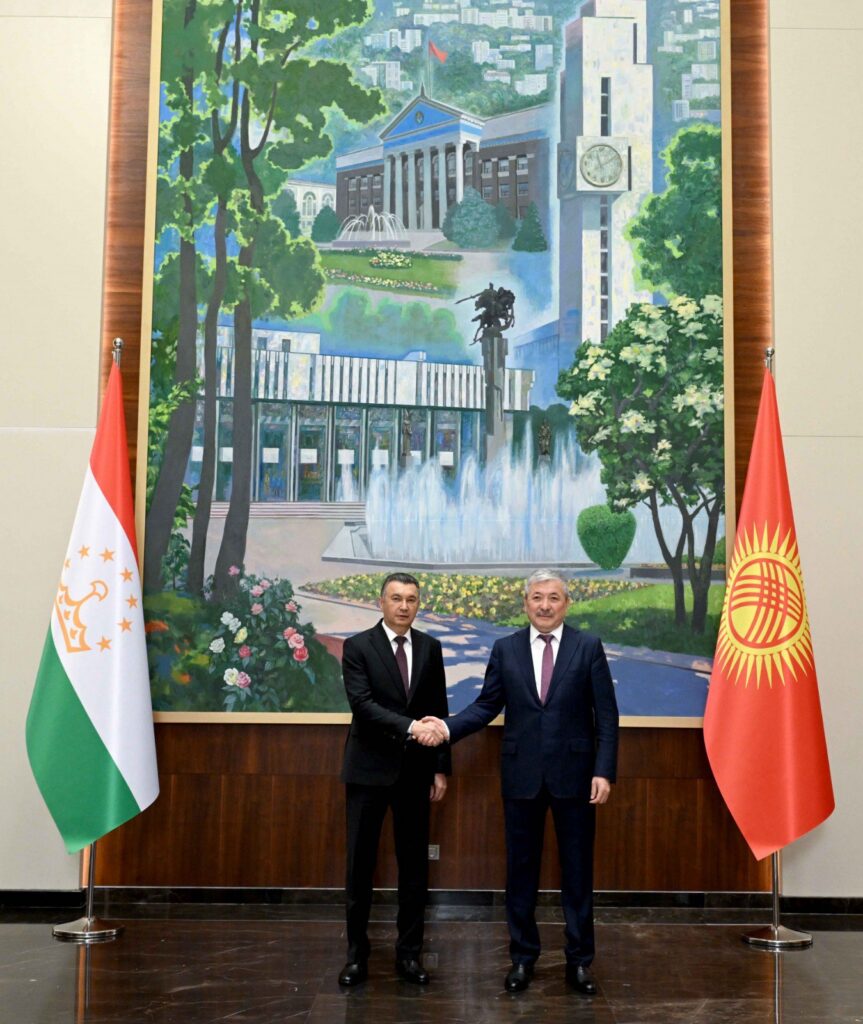
On February 13 in Bishkek, Chairman of the Cabinet of Ministers of Kyrgyzstan Adylbek Kasymaliev and Prime Minister of Tajikistan Kokhir Rasulzoda held the first meeting of the Kyrgyz-Tajik Intergovernmental Council. Opening the session, Kasymaliev said that 2025 marked a historic milestone in bilateral relations, citing the completion of the delimitation process of the Kyrgyz-Tajik border. He described the agreement as “a decisive factor in strengthening security and stability not only in our countries but also in the entire region.” Addressing trade and economic cooperation, Kasymaliev stated that Kyrgyzstan is ready to expand supplies of meat and dairy products, clothing and textiles, coal, glass, and sugar to Tajikistan. According to official figures, bilateral trade turnover reached $36 million in 2025, representing a nearly 24-fold increase compared to 2024. Both sides have set a target of increasing annual trade to $500 million. In the field of transport and logistics, Kasymaliev emphasized the need to improve border infrastructure and enhance the efficiency of checkpoints. Proposed measures include modernizing existing border crossings, expanding capacity, developing logistics and cargo terminals, and introducing digital solutions in customs and border administration. “Kyrgyzstan is ready to act as a trade gateway for Tajik goods to the markets of the Eurasian Economic Union (EAEU), as well as the European Union through the Generalised Scheme of Preferences Plus (GSP+),” Kasymaliev said. He also highlighted the strategic China-Kyrgyzstan-Uzbekistan railway project, which he said would significantly increase Kyrgyzstan’s transit potential and strengthen its role as a logistics hub in Eurasia. According to the Kyrgyz prime minister, the new transport corridor will create additional opportunities for Tajikistan. Kasymaliev further noted positive dynamics in tourism cooperation. In 2025, 86,000 tourists from Tajikistan visited Kyrgyzstan, a 12-fold increase compared to 2024. Kyrgyzstan reaffirmed its interest in developing joint tourism initiatives, including the possible introduction of a unified visa for third-country nationals traveling across Central Asia. Rasulzoda stated that Tajikistan places particular importance on good-neighborly relations and mutually beneficial cooperation with Kyrgyzstan, confirming readiness to further strengthen the partnership. As part of his visit to Bishkek, Rasulzoda toured a recently opened waste-to-energy plant constructed by a Chinese company. He described the facility as a promising example of modern waste recycling and expressed Tajikistan’s interest in implementing similar projects.

Japarov Credits Mirziyoyev’s in Resolving Kyrgyzstan-Tajikistan Border Dispute

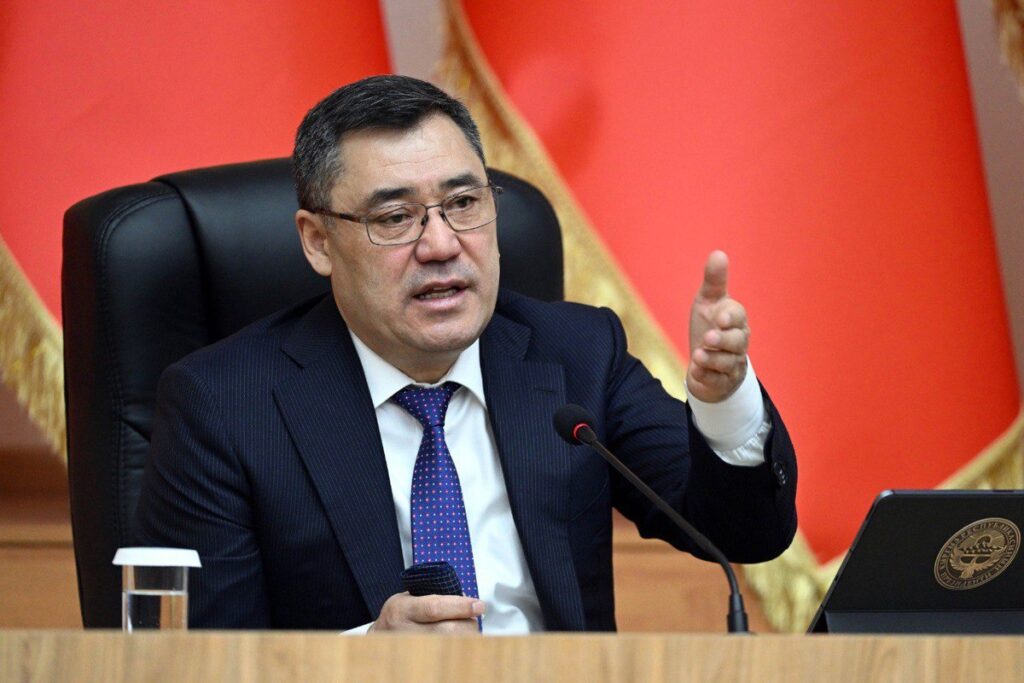
Kyrgyz President Sadyr Japarov has detailed how the long-standing border conflict with Tajikistan was resolved, citing direct diplomacy, enhanced military capabilities, and crucial regional mediation. His remarks came during the second part of the documentary President, aired on Kyrgyzstan’s Region TV. Japarov recounted that after the deadly clashes along the Kyrgyz, Tajik border in April 2021, he opted to visit Dushanbe for direct talks with Tajik President Emomali Rahmon, despite opposition from some members of his inner circle, including State Committee for National Security Chairman Kamchybek Tashiyev. The negotiations, which lasted ten hours, ended without immediate results. “We talked for many hours, but at that time we could not reach an agreement,” Japarov recalled in the film. The 2021 conflict, triggered by disputes over infrastructure near the Kyrgyz village of Kok-Tash, exposed significant weaknesses in Kyrgyzstan’s defense capacity. The two-day confrontation involved heavy weaponry, including mortars, armored vehicles, and helicopter gunships. Official figures reported 54 fatalities, hundreds of injuries, and mass civilian displacement. Japarov said the violence spurred a modernization of the Kyrgyz military. The country began acquiring advanced equipment, including Turkish-made Bayraktar Akıncı and Aksungur drones. By the time renewed clashes broke out in September 2022, the president claimed that the balance of power had shifted. “By then, the forces were already equal, and we had begun to gain air superiority,” he said. Despite these developments, Japarov stressed that diplomacy ultimately brought resolution, and credited Uzbek President Shavkat Mirziyoyev with playing a pivotal role. “At summits, I told Rahmon, ‘Let’s sit down and talk.’ At first he refused. The second time, he agreed,” Japarov stated. “I must say that the role of Uzbekistan’s President Shavkat Mirziyoyev was very significant. He persuaded us not to miss the moment and to reach an agreement. That’s how we sat down and resolved the border issue.” Kyrgyz Foreign Minister Jeenbek Kulubaev supported this view, describing Mirziyoyev as a regional leader who consistently urged neighbors to resolve disputes peacefully. He noted that Mirziyoyev had warned unresolved conflicts risk deterring both investors and tourists, who often see Central Asia as a single, interconnected region. Kyrgyzstan and Tajikistan officially signed a border delimitation agreement on March 13 of last year, following a preliminary signing on March 31 in Khujand during a trilateral meeting involving the leaders of Kyrgyzstan, Tajikistan, and Uzbekistan.

Kyrgyz Authorities Upgrade Energy Infrastructure in Conflict-Affected Batken Region

Authorities in Kyrgyzstan have modernized more than 600 kilometers of high-voltage power lines in the Batken region and launched construction of a new power substation near the Tajik border, an area impacted by armed clashes in 2022. According to the National Electric Grid of Kyrgyzstan (NEGK), stable and uninterrupted power supply has been ensured across all settlements in the region during the first half of 2025. Major repairs extended to remote mountainous areas prone to natural hazards, where energy workers replaced over 2,500 outdated porcelain insulators, enhancing grid reliability. Much of the infrastructure was located in landslide-prone and difficult-to-access terrain. “To prevent natural disasters, particularly floods, and ensure the safety of electrical equipment, we reinforced overhead power lines using gabions, stone materials, wire ties, and specialized equipment,” the NEGK reported. The Batken region experienced prolonged blackouts following the 2022 Kyrgyz-Tajik border conflict, which left 32 settlements without electricity. Although power was restored within a year, much of the infrastructure had not been updated for decades. Local officials now say outages should become rare. Construction has also begun on a new substation valued at $800,000 near the Tajik border, with completion expected by October 2025. The facility will supply electricity to an 800-hectare area, including the newly built village of Zhan Dostuk. The village is designated for residents displaced from areas transferred to Tajikistan under an intergovernmental agreement. Power will also extend to the planned city of Batken City, newly constructed state-owned mortgage housing, a large Russian-language school, and a stadium with a capacity of 10,000 spectators. Additionally, the region remains a key hub for the CASA-1000 project, which aims to export electricity from Kyrgyzstan and Tajikistan to Pakistan via Afghanistan, an initiative that officials say will strengthen energy infrastructure across Central Asia.

Kyrgyz President Visits Tajikistan, Opening New Era of Friendship

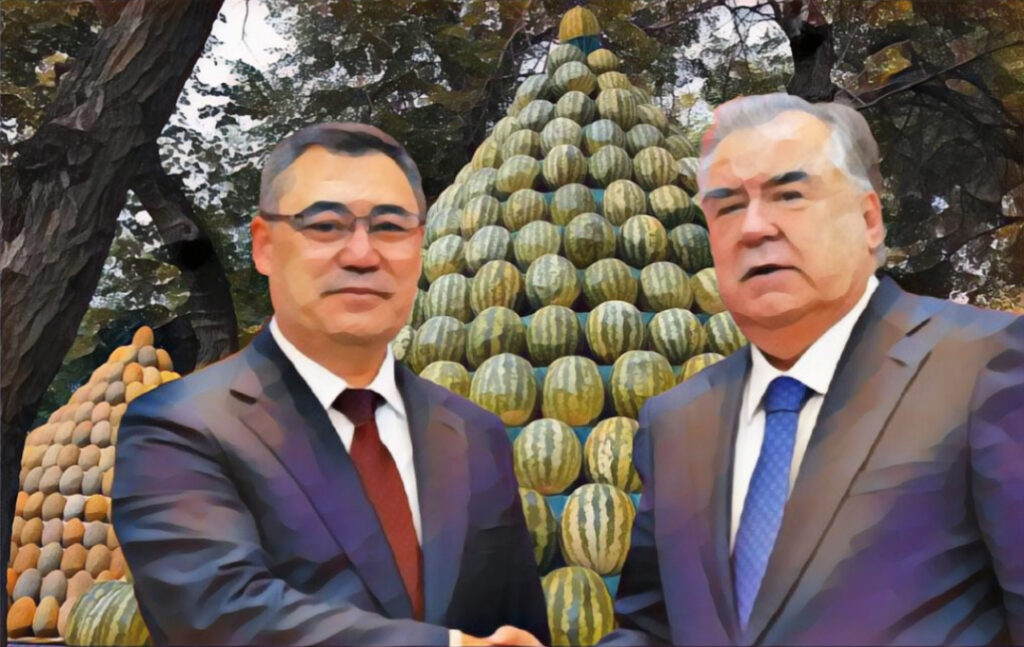
Kyrgyzstan’s President Sadyr Japarov just concluded a two-day visit to Tajikistan. Rarely has the visit of one Central Asian leader to another Central Asian country been as welcome as Japarov’s trip to Tajikistan was. The two countries engaged in brief, but intense and devastating conflicts in late April 2021 and mid-September 2022, the only clashes between the militaries of the two Central Asian countries since the five Central Asian states became independent in late 1991. Judging by Japarov’s warm reception in the Tajik capital Dushanbe, the worst of times have passed in Kyrgyz-Tajik relations. A Year of Firsts Japarov, who has been in power in Kyrgyzstan since late 2020, was making his first state visit to Tajikistan on July 8-9. Japarov traveled to Tajikistan in June 2021, nearly two months after the first outbreak of hostilities along the Kyrgyz-Tajik border, to speak with Tajik President Emomali Rahmon about easing tensions along their common frontier. That June, a meeting was hastily arranged as an exercise in damage control, not a state visit, and in any case, the talks between the two presidents failed to head off even worse fighting in September of the next year. This first state visit by Japarov followed President Rahmon’s visit to the Kyrgyz capital in March 2025, the first state visit by Rahmon to Kyrgyzstan in nearly 12 years. During Rahmon’s meeting in March, Kyrgyzstan and Tajikistan signed the agreement delimiting the final disputed sections of their border, which both sides hope will end more than a decade of violence and destruction in the border area. That agreement led to the first-ever summit of the presidents of the three Central Asian countries that share the Ferghana Valley. Uzbek President Shavkat Mirziyoyev joined Japarov and Rahmon on March 31 in the northern Tajik city of Khujand to celebrate the agreement on all three countries’ borders and talk about future cooperation. Pomp and Ceremony Rahmon was at the Dushanbe airport to meet Japarov when the latter arrived on July 8. Tajikistan’s Honor Guard played the national anthems of both countries, followed by a 21-gun salute for Japarov, before the two presidents made their way to the Tajik capital to hold talks. The two leaders also visited a Kyrgyz-Tajik trade exhibit and attended a concert featuring performers from both countries dedicated to “Eternal Friendship.” Moving Forward Ahead of the Japarov-Rahmon meeting, The Times of Central Asia reported that trade between the two nations is starting to increase again. The figure for January-May trade between the two countries this year was a modest $6.35 million, but that is 15 times more than the meager $405,100 of bilateral trade during the first five months of 2024. Less than a decade ago, there were years when Kyrgyz-Tajik bilateral trade topped $50 million. Following the border agreement in March, two border crossings were reopened along the western sections of the Kyrgyz-Tajik frontier. During the meeting between the two presidents, it was announced that a third crossing had opened, the Tajvaron-Karamyk post connecting Kyrgyzstan’s...

Kyrgyzstan Begins Construction of Border Fence with Tajikistan

Kyrgyzstan has launched construction of a border fence along its frontier with Tajikistan in the Batken region, according to a report by 24.kg. The project commenced near the village of Koshmolo in the Tort-Gul area, a strategically significant location where the borders of Kyrgyzstan, Tajikistan, and Uzbekistan converge. An official ceremony marking the start of the project was held at a nearby border marker. Kyrgyz Deputy Prime Minister and head of the State Committee for National Security, Kamchybek Tashiev, addressed the event via video link. Other senior officials in attendance included Director of the Border Guard Service Major General Abdikarim Alimbaev and Aybek Shamenov, the presidential representative in Batken. To facilitate the project, a field operations camp has been established, and specialized construction equipment has been deployed. Authorities report that all necessary logistical conditions have been prepared for personnel working on site. “Today we are witnessing a significant event of great importance for the citizens of Kyrgyzstan and Tajikistan. The Border Service will make every effort to complete the development work within the established timeframe. Our goal is to create a zone of security and tranquility on the shared border,” said Alimbaev. 420 Kilometers of Fencing Planned in First Stage In its initial phase, the project aims to install barbed wire fencing along 420 kilometers of the border. The entire border fortification is expected to be completed by the end of 2025. The initiative follows a pivotal agreement between Kyrgyzstan and Tajikistan signed on March 13 in Bishkek. During a bilateral summit, the presidents of both countries reached a historic deal to fully delimit and demarcate the 1,006-kilometer border after years of disputes and sporadic clashes.

Historic Khujand Summit Paves Way for Peace in the Ferghana Valley

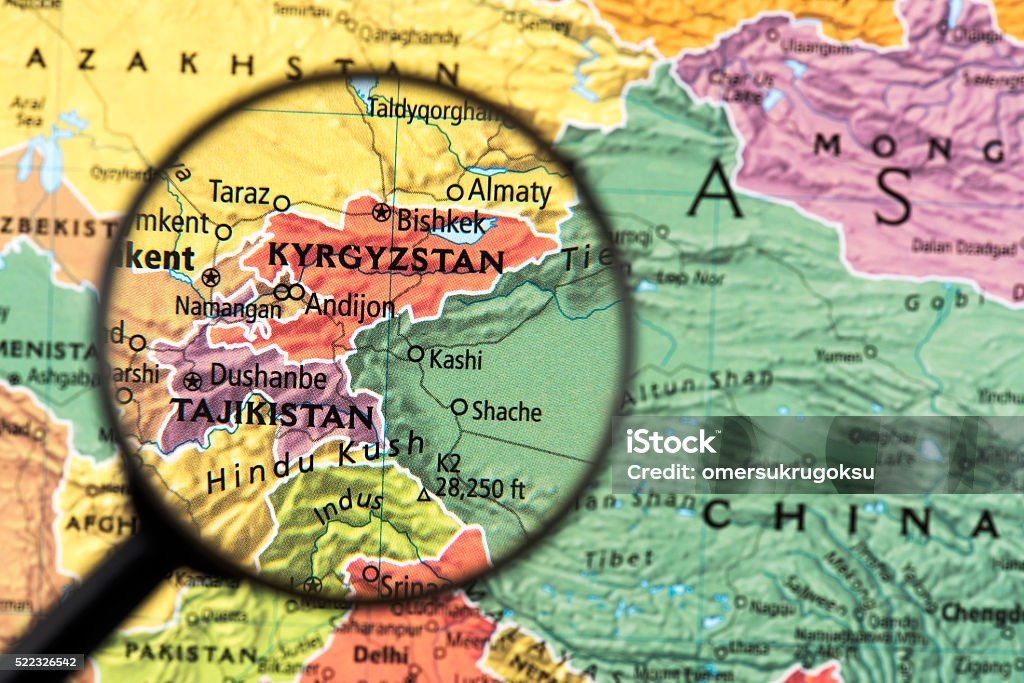
The presidents of Kyrgyzstan, Tajikistan, and Uzbekistan gathered in the northern Tajik city of Khujand on March 31 for a meeting that is decades overdue. Among the agreements the three signed were one fixing the border where their three countries meet. Prior to Uzbek President Shavkat Mirziyoyev’s arrival, Kyrgyzstan’s President Sadyr Japarov and Tajikistan’s President Emomali Rahmon exchanged ratified documents of the border agreement between the two countries. Rahmon and Japarov, via video link, also launched the Datka-Sughd power transmission line, a major step in the CASA-1000 project that aims for both their countries to supply electricity to Afghanistan and Pakistan. These agreements might not seem monumental, but they represent a major departure from the troubled past the three governments have had in their border areas. Trouble in Paradise The three countries share the Ferghana Valley, an area roughly the size of Costa Rica that is home to more than 20% of Central Asia’s population. Since the Central Asian states became independent in late 1991, the Ferghana Valley has also been the region’s hotbed of tension. The Ferghana Valley is the cradle of ancient Central Asian civilization. Some living there today say it was the location of the Garden of Eden, and it is not difficult to see why. The Valley is abundant in fruits and vegetables and has extensive arable and grazing land. It is surrounded by mountains to the north, east, and south, and the rivers that flow from these mountains supply ample water. Since independence, the Ferghana Valley has been the most dangerous place in all of Central Asia. The arbitrary borders Soviet mapmakers drew to divide Kyrgyzstan, Tajikistan, and Uzbekistan left many problems for the three after they became independent states. Agreement on where Kyrgyz-Uzbek border is came only in late 2022, and Kyrgyzstan and Tajikistan just signed the agreement on delimitation of their border on March 12. The Islamic Movement of Uzbekistan The roots of Islam lie deep in the Ferghana Valley. There were already calls for Shari’a law in Uzbekistan’s section of the valley just months after Uzbekistan declared its independence. The most serious security threat to Central Asia to date originated in the Ferghana Valley in 1999 and 2000. In early August 1999, a group of some 20 armed militants from the Islamic Movement of Uzbekistan (IMU) appeared in southern Kyrgyzstan, captured a village, and took the villagers and subsequent government negotiators hostage. The IMU leaders were from the eastern Uzbek city of Namangan. They were connected to the protests in Uzbekistan in late 1991 and later joined the Islamic opposition in neighboring Tajikistan’s 1992-1997 civil war. The peace accord that ended the civil war called for opposition fighters to either join the Tajik armed forces or disarm. There was no longer any need for the opposition’s foreign fighters, and the final phase of disarmament was underway by the summer of 1999. In mid-August, the Kyrgyz government paid a ransom for the hostages’ release and the departure of the IMU militants, but this...